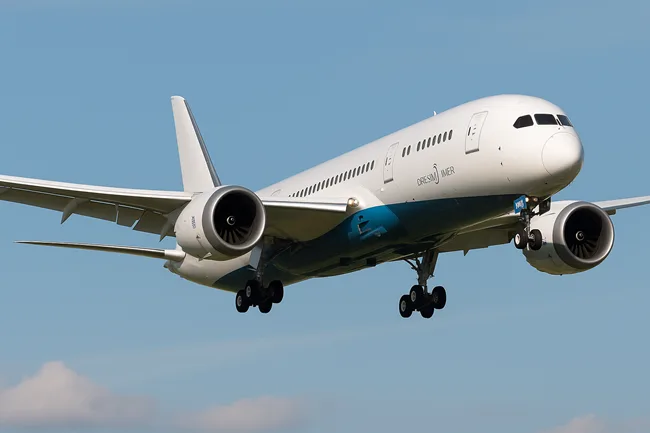
The Boeing Company (NYSE: BA) is preparing a change at the top of its commercial sales organization, with Senior Vice President of Global Sales and Marketing Brad McMullen due to retire in December and North American sales leader Ryan Weir set to succeed him. The transition was disclosed in a company memo and places Weir in charge of airline and leasing relationships at a time when Boeing Commercial Airplanes carries a record backlog valued at approximately $597 billion. Orders are only one part of the task because the company still has to convert that backlog into aircraft deliveries, cash generation and stronger margins while completing important certification programmes. Boeing’s leadership change therefore comes at a point where commercial credibility increasingly depends on reliable execution after the sale rather than simply expanding the order book.
Why is Boeing changing commercial sales leadership when its aircraft backlog is already at a record?
McMullen’s retirement follows a period in which Boeing rebuilt commercial momentum after severe operational disruption and greater scrutiny of its manufacturing system. Reuters reported that he played an important role in rebuilding airline relationships and that Boeing surpassed Airbus in the 2025 order race for the first time in seven years. His departure therefore removes an executive closely associated with the customer-facing portion of Boeing’s commercial recovery.
Weir brings experience across several parts of Boeing’s sales organization rather than entering from outside the company. He has led North American sales and previously held responsibilities covering India, South Asia and global aircraft leasing companies, giving him exposure to airlines with substantially different fleet requirements and capital structures. Those relationships matter because major aircraft purchases often involve years of negotiation covering pricing, delivery slots, financing, fleet planning and aftermarket support.
The succession is also occurring when Boeing’s principal commercial constraint is not a shortage of theoretical demand. Commercial Airplanes ended the second quarter with more than 6,200 aircraft in backlog valued at $596.7 billion, while total company backlog reached a record $715.3 billion. Weir’s challenge is therefore to protect customer confidence while production and certification determine how quickly those orders can be monetized.
What do Boeing’s latest financial results reveal about the scale of the commercial execution challenge?
Boeing reported second-quarter revenue of $24.56 billion, up 8% from the prior-year period, as higher aircraft deliveries supported improved operating performance. The company generated $1.36 billion of operating cash flow and approximately $631 million of free cash flow, but still recorded a $428 million net loss. Cash and marketable securities stood at $20 billion at quarter-end while consolidated debt was $45.9 billion, down from $47.2 billion three months earlier.
Commercial Airplanes produced $11.75 billion of quarterly revenue, an 8% increase, as deliveries rose 14% to 171 aircraft. The segment’s operating loss narrowed to $322 million from $557 million, improving operating margin to negative 2.7% from negative 5.1%. Boeing also booked 246 net commercial orders during the quarter, including business from Korean Air, Delta Air Lines and SMBC Capital.
Those numbers clarify why sales leadership and operational recovery are now tightly connected. Boeing can continue signing airline agreements, but the economic value of each sale depends on production stability, delivery timing and the cost incurred to build the aircraft. A large backlog supports long-term revenue visibility, yet it does not automatically produce attractive margins or immediate cash.
How will the 737 MAX 10 and 787 programmes shape Ryan Weir’s early priorities?
The 737 family remains central to Boeing’s competitive position in single-aisle aircraft, where airline customers make fleet decisions over long time horizons and availability of specific variants can influence order allocation. Boeing said in July that certification flight testing had been completed for both the 737-7 and 737-10, while management continued to anticipate certification during 2026 and first deliveries in 2027. Those dates remain company expectations rather than completed milestones.
The 737-10 is commercially important because Airbus has built a strong position with the larger A321neo family in the long-range and high-capacity narrowbody market. Boeing needs a certified 737-10 not simply to add another product but to give sales teams a broader response when airlines compare future fleet structures. Further delays could make those negotiations more difficult even when existing Boeing customers prefer commonality with their installed fleets.
The 787 provides a different opportunity. Demand for long-haul capacity has supported recent widebody orders, and Boeing’s Charleston investment is intended to expand 787 production capacity over time. Weir will therefore inherit a sales portfolio in which narrowbody competitiveness, widebody growth and actual delivery-slot availability need to be managed together rather than as separate commercial problems.
Why does Boeing’s balance sheet make sales execution more important than headline order wins?
Boeing’s $45.9 billion of consolidated debt remains much larger than its $20 billion of cash and marketable securities, even after debt declined during the second quarter. That makes cash conversion from commercial deliveries strategically important because stronger operating cash flow gives management more flexibility to reduce leverage while continuing to invest in production and certification. A customer order does not achieve that objective until Boeing progresses sufficiently through manufacturing and delivery to recognize the associated economics.
The company has made measurable progress. Second-quarter free cash flow turned positive at $631 million, and higher deliveries helped Commercial Airplanes narrow its operating loss. Boeing also had $10 billion of undrawn credit facilities at quarter-end, providing additional liquidity if required.
Ryan Weir’s role sits indirectly inside that financial recovery because customer relationships influence order quality, delivery schedules and commercial terms. Sales leadership will need to avoid chasing volume at economics that undermine margin recovery while maintaining enough flexibility to keep major airlines committed through production constraints. That makes disciplined commercial execution more relevant than an isolated annual order ranking.
What does Boeing’s latest share-price performance say about investor expectations?
Boeing shares closed at $190.21 on October 16, up 0.8% for the session. The stock was almost unchanged from its October 9 close of $190.37, showing that the sales leadership transition did not materially alter the market’s wider assessment of Boeing during the week. Shares remained about 25% below their 52-week high of $254.35, leaving significant distance between the current valuation and the year’s strongest levels.
That performance is consistent with an investment debate focused more heavily on production and cash recovery than on one executive succession. Boeing’s backlog already demonstrates that airlines want substantial quantities of its aircraft. Greater confidence would require evidence that the company can raise output without compromising quality, complete certification programmes and move Commercial Airplanes toward sustainable positive margins.
Weir therefore inherits a commercially powerful but operationally demanding position. If Boeing converts its record backlog into higher deliveries, improved customer satisfaction and stronger cash flow, the sales organization will become one component of a broader recovery. If production or certification delays persist, even a strong order book will offer only partial insulation from airline frustration and financial pressure.
What are the key takeaways from Boeing’s Ryan Weir appointment and commercial sales transition?
- Brad McMullen plans to retire as Boeing’s global commercial sales leader in December 2026.
- Ryan Weir, currently responsible for North American sales, is expected to succeed him.
- Weir has also worked with customers in India, South Asia and the global aircraft leasing market.
- Boeing Commercial Airplanes carried a record $596.7 billion backlog at the end of the second quarter.
- Total Boeing backlog reached $715.3 billion, including more than 6,200 commercial aircraft.
- Second-quarter commercial deliveries increased 14% to 171 aircraft.
- Commercial Airplanes narrowed its quarterly operating loss to $322 million.
- Boeing expects 737-7 and 737-10 certification during 2026, with first deliveries targeted for 2027.
- Converting orders into deliveries, margin and cash will be more important than headline order volumes alone.
Discover more from Business-News-Today.com
Subscribe to get the latest posts sent to your email.