

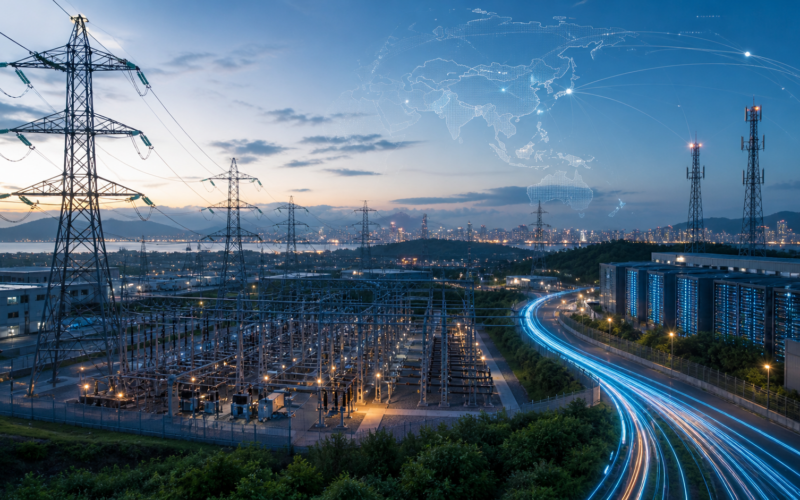
Asian Development Bank has unveiled a $70 billion infrastructure programme to expand Asia-Pacific power grids and digital networks by 2035, placing cross-border electricity trade and broadband access at the centre of the region’s next development cycle. The plan includes $50 billion for the Pan-Asia Power Grid Initiative and $20 billion for the Asia-Pacific Digital Highway, giving the multilateral lender a more explicit role in regional energy and digital integration. The immediate significance is not just the size of the commitment, but the attempt to bind power transmission, renewable energy, data infrastructure and artificial intelligence readiness into one long-term investment framework. For governments, utilities, telecom operators, renewable energy developers and infrastructure financiers, the message is clear: the next phase of Asia-Pacific growth will depend less on isolated national buildouts and more on connected regional systems.
Why is Asian Development Bank putting $70 billion behind Asia-Pacific power grids and digital infrastructure now?
The Asian Development Bank’s $70 billion plan lands at a moment when Asia-Pacific economies are facing two uncomfortable infrastructure realities at once. Electricity demand is rising because of industrial growth, urbanisation, cooling needs, electric mobility and data centre expansion, while digital access remains uneven across remote, island, landlocked and lower-income markets. Treating those two issues separately would have been the old development-bank playbook. The new approach links them because a region that wants renewable energy, artificial intelligence adoption and higher-value manufacturing cannot afford unreliable grids or weak connectivity.

The strategic intent is also defensive. Asia-Pacific governments are under pressure to secure energy supply without locking themselves into higher fossil fuel dependence, especially as climate commitments, fuel-price volatility and geopolitics complicate traditional energy planning. Cross-border grid integration offers a way to move renewable power from resource-rich locations to demand centres, but it also requires regulatory alignment, political trust, financing depth and technical standards that many bilateral projects have historically struggled to achieve. In plain English, the power line is the easy part. Getting everyone to agree on what flows through it, at what price, and under which rules is where the fun begins.
The Asian Development Bank is also responding to the economics of digital infrastructure. Broadband networks, fibre corridors, subsea cables, satellite links and regional data centres are no longer social development add-ons. They are now productivity infrastructure, especially as artificial intelligence workloads, cloud services, digital payments and online public services become embedded in national competitiveness. By joining energy and digital connectivity in a single platform, the Asian Development Bank is effectively arguing that the next infrastructure gap is not only about access, but about whether economies can participate in AI-enabled growth on reasonable terms.
How could the Pan-Asia Power Grid Initiative change cross-border electricity trade in Asia-Pacific?
The $50 billion Pan-Asia Power Grid Initiative is the larger part of the programme and the more politically complex one. The initiative aims to mobilise capital for cross-border transmission, substations, storage, grid digitalisation and generation projects tied to electricity trade. Its targets include integrating about 20 gigawatts of renewable energy across borders, connecting 22,000 circuit-kilometres of transmission lines, improving electricity access for 200 million people and cutting regional power-sector emissions by around 15 percent by 2035.
The most important shift is from national energy planning to regional balancing. Many Asia-Pacific countries have renewable energy potential that does not neatly match their domestic demand centres. Hydropower, solar, wind and hybrid generation-storage projects can produce surplus power in one market while neighbouring economies face shortages, high tariffs or fossil fuel exposure. A better-connected grid could reduce curtailment, improve reliability and make renewable projects more bankable by giving developers access to wider demand pools.
The competitive implication is significant for utilities, independent power producers, transmission companies and equipment suppliers. Grid-scale investment could create long-cycle demand for high-voltage transmission equipment, grid software, energy storage, transformers, substations and digital control systems. It could also reshape renewable energy project economics, particularly for export-oriented solar, wind and hydropower projects. However, the risk is equally large. Cross-border electricity trade can be slowed by tariff disputes, currency risks, land acquisition, environmental permitting, state utility finances and the old favourite of infrastructure bankers everywhere, political timing.
Why does the Asia-Pacific Digital Highway matter for broadband access, data centres and AI readiness?
The $20 billion Asia-Pacific Digital Highway is the quieter but potentially more disruptive half of the plan. The programme is designed to finance fibre networks, subsea cables, satellite links, regional data centres and policy support for cybersecurity, digital skills and artificial intelligence readiness. Its targets include first-time broadband access for 200 million people, improved connectivity for another 450 million people, connectivity-cost reductions of about 40 percent in remote and landlocked areas, and up to 4 million jobs by 2035.
This is not just a telecom coverage story. Digital infrastructure now sits inside industrial policy, financial inclusion, education delivery, healthcare access, government services and small-business productivity. Countries that lack affordable broadband and resilient data infrastructure may find themselves excluded from cloud-based enterprise systems, AI-enabled services and digital trade. That exclusion becomes more expensive over time because late adopters must not only build networks, but also catch up on skills, cybersecurity, regulation and local digital ecosystems.
The Asia-Pacific Digital Highway also gives the Asian Development Bank a role in shaping the region’s AI infrastructure conversation before it becomes dominated entirely by hyperscalers, telecom incumbents and national security agencies. Regional data centres and connectivity corridors could help smaller economies gain access to digital capacity without relying only on costly national buildouts. Still, the economics need careful handling. Data centres require power, water, land, cooling and regulatory certainty. If digital infrastructure expands faster than clean and reliable electricity supply, the programme could accidentally expose the very grid weaknesses it is trying to solve.
What does the $70 billion plan signal for private capital, public finance and infrastructure risk?
The financing structure matters because the Asian Development Bank is not positioning itself as the only source of capital. For the Pan-Asia Power Grid Initiative, the institution expects to finance roughly half of the $50 billion from its own resources and attract the rest through co-financing, including private investment. For the digital initiative, the Asian Development Bank expects to finance $15 billion of the $20 billion programme, leaving $5 billion to be mobilised from other sources.
That split reveals the core investment thesis. The Asian Development Bank can reduce early-stage risk, fund technical assistance, create project pipelines and help governments align standards, but the programme will only reach scale if private capital sees predictable returns. For transmission and digital infrastructure investors, that means bankable contracts, stable regulation, credible counterparties and protection from sudden policy shifts. Development finance can open the door, but private capital will not walk through it just because a summit speech sounded nice.
The capital-allocation challenge is that many of the highest-impact projects may also be the hardest to monetise. Remote broadband, rural electrification, cross-border transmission and landlocked connectivity often produce broad economic benefits but narrow direct cash flows. That creates a familiar development-finance tension between social value and investor return. The Asian Development Bank will need to blend concessional finance, sovereign lending, guarantees, technical assistance and private co-financing carefully, or the plan risks becoming a collection of admirable pilots rather than a durable regional infrastructure platform.
How could regional politics and regulation shape the success of the Asian Development Bank plan?
The largest execution risk is not technology. Asia-Pacific already has access to the transmission, storage, fibre, satellite and data-centre technologies needed to build much of this infrastructure. The bigger challenge is coordination across borders, especially in a region where energy policy, digital sovereignty, cybersecurity, data localisation and strategic competition are increasingly sensitive. Cross-border grids and digital corridors create efficiency, but they also create interdependence. That is exactly why they matter, and exactly why they can become difficult.
For power markets, governments will need to align grid codes, wheeling charges, dispatch rules, tariff-setting methods and dispute mechanisms. National utilities may resist reforms that reduce their control or expose domestic systems to external competition. Countries with surplus renewable energy may want export revenue, while importing countries may worry about supply security and foreign dependency. If the Asian Development Bank can help standardise rules and reduce trust deficits, the Pan-Asia Power Grid Initiative could move from aspiration to infrastructure reality.
For digital networks, cybersecurity and data governance will be central. Fibre corridors, subsea cables, satellite links and data centres are now strategic assets. The Asia-Pacific Digital Highway can support inclusion and productivity, but it will also force governments to confront questions around data flows, digital sovereignty, cloud governance and AI safety. A development bank can convene, finance and advise, but it cannot eliminate geopolitical suspicion. The programme’s success will depend on whether participating economies view connectivity as shared economic infrastructure rather than another arena for strategic leverage.
What does this mean for utilities, telecom operators, renewable developers and technology providers?
For utilities and grid operators, the Asian Development Bank plan could accelerate the shift from single-country capacity planning toward regional flexibility. That could create new revenue streams from transmission services, balancing services, storage integration and cross-border power purchase arrangements. It could also pressure weaker utilities to modernise faster, because regional grid participation requires operational discipline, data transparency and technical reliability. No one wants a regional electricity market where the weakest node becomes everyone’s headache.
For renewable energy developers, the Pan-Asia Power Grid Initiative could improve the bankability of export-oriented clean energy projects. Projects that previously looked stranded because of limited domestic demand could become more attractive if transmission access and cross-border offtake improve. However, developers will still need to manage permitting, land, community relations, currency exposure and counterparty risk. The plan may widen the opportunity set, but it does not magically turn every renewable project into an investable asset.
For telecom operators, data-centre developers, satellite providers and fibre infrastructure players, the Asia-Pacific Digital Highway could create long-term demand in underserved markets. The opportunity is especially relevant in remote, island and landlocked economies where commercial returns have historically been too thin for private investment alone. The strategic upside is that digital connectivity can create demand for cloud services, cybersecurity, fintech, edtech and government digitisation. The risk is that infrastructure arrives before affordability, skills and local enterprise adoption are ready to absorb it.
What happens next if the Asian Development Bank’s $70 billion connectivity strategy succeeds or stalls?
If the plan succeeds, Asia-Pacific could move closer to a regional infrastructure model where clean electricity, data flows and digital services become shared growth enablers rather than fragmented national bottlenecks. Lower-cost connectivity could support manufacturing diversification, AI adoption, financial inclusion, digital public services and renewable energy integration. The region would also gain more resilience against fuel-price shocks and infrastructure gaps that have repeatedly constrained growth in emerging and frontier markets.
If the plan stalls, the consequences would be less dramatic but more corrosive. Asia-Pacific economies could continue building parallel, underconnected systems, with renewable power stranded in some markets, high electricity costs persisting in others, and digital divides widening between urban centres and remote communities. The result would be uneven productivity gains, slower AI adoption and more pressure on national budgets to finance infrastructure alone.
The Asian Development Bank’s announcement should therefore be read less as a single funding headline and more as a test of regional execution capacity. The bank has put a large number on the table, but the true story will be written in power-purchase agreements, transmission permits, cybersecurity frameworks, tariff reforms, co-financing deals and whether private capital believes the rules will hold long enough to earn a return. Infrastructure stories often begin with big numbers. The winners are usually decided by the boring documents that follow.
Key takeaways on what Asian Development Bank’s $70 billion plan means for Asia-Pacific infrastructure
- The Asian Development Bank’s $70 billion plan signals that regional energy and digital connectivity is becoming a core economic competitiveness issue for Asia-Pacific, not just a development priority.
- The $50 billion Pan-Asia Power Grid Initiative could improve renewable energy economics by allowing clean power to move across borders instead of being trapped inside national grids.
- The $20 billion Asia-Pacific Digital Highway positions broadband, data centres, fibre, satellite links and AI readiness as strategic infrastructure for long-term productivity growth.
- Private capital will be essential, but investors will need predictable regulation, credible counterparties and stronger project preparation before large-scale participation becomes realistic.
- Utilities and transmission companies could benefit from long-cycle grid investment, although weaker national systems may face pressure to modernise operational and regulatory practices.
- Renewable energy developers may gain new export opportunities, but cross-border offtake risk, currency exposure and permitting challenges will remain central investment hurdles.
- Telecom operators, fibre players, satellite providers and data-centre developers could find new growth corridors in remote, island and landlocked markets.
- Regional politics may be the biggest execution risk, because power grids and digital networks create interdependence in sectors increasingly tied to sovereignty and security.
- The plan could help Asia-Pacific reduce emissions and connectivity costs, but only if technical standards, tariff rules and cybersecurity frameworks advance alongside physical infrastructure.
- The real test will be whether the Asian Development Bank can turn a $70 billion ambition into bankable projects that governments, utilities and private investors can execute at scale.
Discover more from Business-News-Today.com
Subscribe to get the latest posts sent to your email.