




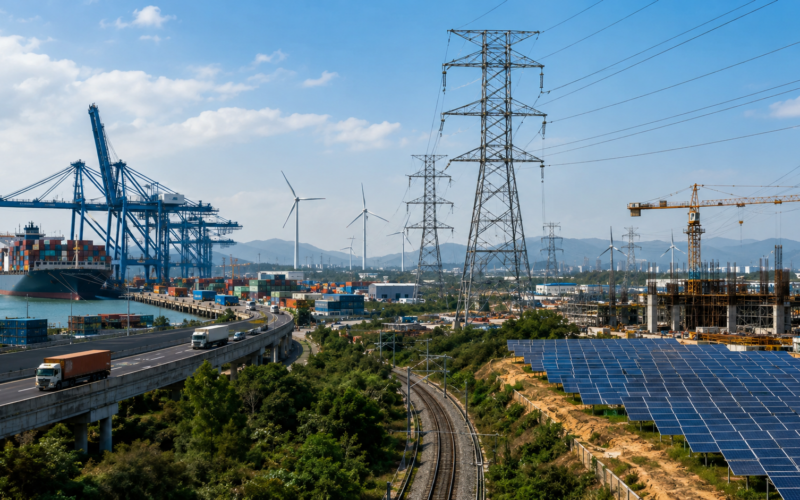
Adani Portfolio companies reported record capital expenditure of ₹1,52,967 crore in FY26, or about $16.1 billion, alongside all-time high EBITDA of ₹94,834 crore, placing India’s largest private infrastructure platform back at the centre of the market’s growth-versus-leverage debate. The group said its gross asset base expanded to ₹7,85,098 crore, with nearly 80 percent of investment directed toward energy, utilities, transport and logistics. Core infrastructure businesses contributed 87 percent of FY26 earnings, reinforcing the group’s argument that cash flows are now anchored more heavily in regulated, contracted and operating infrastructure assets. For investors tracking Adani Enterprises Limited (NSE: ADANIENT, BSE: 512599), Adani Ports and Special Economic Zone Limited (NSE: ADANIPORTS, BSE: 532921) and Adani Green Energy Limited (NSE: ADANIGREEN, BSE: 541450), the update raises a clear question: can Adani Group convert one of India’s largest capex cycles into stable cash flow without reigniting concerns over debt intensity?
Why does Adani Portfolio’s record FY26 capex matter for India’s infrastructure cycle?
Adani Portfolio’s ₹1.53 lakh crore FY26 capex matters because it signals that the group is moving into a more aggressive execution phase across infrastructure platforms that sit close to India’s long-term growth priorities. The spending was not spread randomly across unrelated businesses. Nearly 80 percent went into energy, utilities, transport and logistics, which are sectors where capacity creation can compound over long periods if projects are commissioned on time and operate with predictable demand.
The scale is important because infrastructure growth in India is no longer driven only by public spending. Private capital is becoming more visible in ports, airports, transmission, renewables, data-linked power demand, industrial logistics and city-linked infrastructure. Adani Group’s investment cycle therefore acts as a proxy for how far large corporate balance sheets are willing to lean into India’s infrastructure demand curve. When a single portfolio deploys more than ₹1.5 lakh crore in one year, the signal is not subtle.
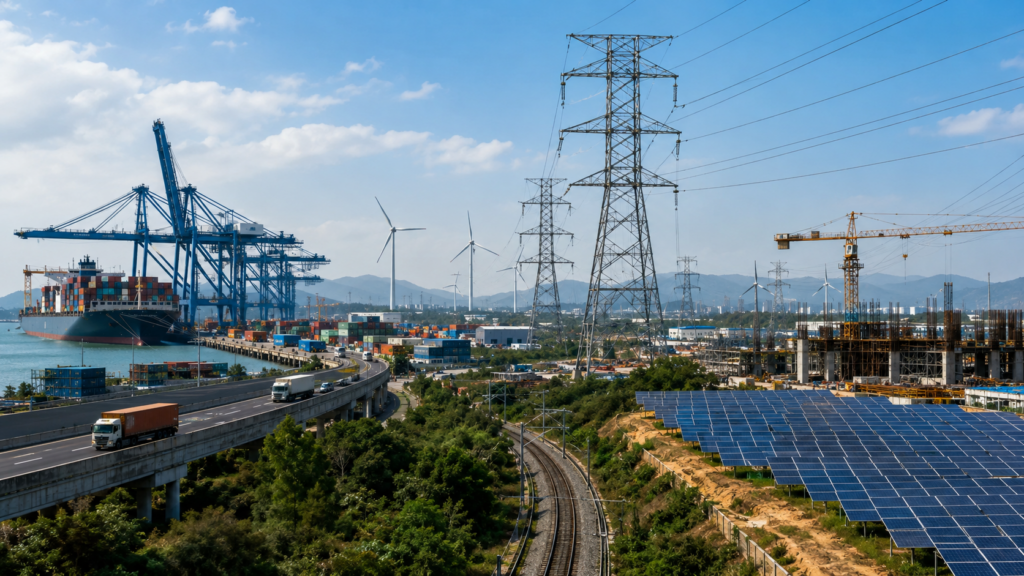
The risk is that infrastructure capex is always front-loaded while returns arrive gradually. Projects take time to build, regulatory approvals can move unevenly, and cash flows depend on commissioning schedules, tariffs, utilisation and demand. Adani Portfolio’s FY26 update shows ambition and operating scale, but investors will judge the cycle on conversion. Asset creation is the first chapter. Cash generation is the chapter everyone actually bookmarks.
How should investors read Adani Group’s ₹94,834 crore FY26 EBITDA?
Adani Group’s FY26 EBITDA of ₹94,834 crore gives the capex story more credibility because it shows that operating earnings are rising alongside asset growth. EBITDA rose 5.6 percent year on year, while core infrastructure contributed 87 percent of earnings. That mix is relevant because investors tend to place higher confidence in cash flows from utilities, ports, logistics, transmission and operating infrastructure than from more volatile or early-stage ventures.
The earnings base also matters for leverage. A large capex cycle funded without adequate operating earnings can quickly become uncomfortable. Adani Portfolio’s argument is that its asset base is expanding while earnings remain sufficiently deep to support growth and debt servicing. The group’s net debt to EBITDA stood around 3.3 times, below its stated ceiling of 3.5 times. That gives the portfolio room to argue that growth is being pursued within a defined leverage framework rather than through unchecked expansion.
The more nuanced question is whether EBITDA quality remains consistent as newer assets enter the base. Investors will want to see how much of future earnings comes from mature, cash-generating assets versus projects that still require ramp-up. A portfolio can look stronger as asset value rises, but equity markets often care more about return on capital than gross asset scale. The market will therefore ask whether the record EBITDA is the beginning of a sharper compounding phase or simply the support beam under an even larger investment load.
What does the FY26 update reveal about Adani Group’s balance-sheet discipline?
The FY26 update is clearly designed to address the balance-sheet question that has followed Adani Group for years. A record capex cycle can excite growth investors, but it can also make creditors and equity holders check leverage metrics twice. By highlighting net debt to EBITDA below the stated 3.5 times target, Adani Portfolio is trying to frame the investment programme as controlled acceleration rather than balance-sheet stretch.
That distinction matters because infrastructure companies often trade on trust in capital allocation. Investors are willing to tolerate debt when assets have regulated returns, contracted revenues or high utilisation visibility. They become less forgiving when debt funds speculative expansion, unproven demand or opaque structures. Adani Group is effectively telling the market that its FY26 spending is concentrated in core platforms with clearer cash-flow characteristics.
Still, leverage discipline will need to be proved over time. Large projects can face cost escalation, delays or slower utilisation. Interest rates, refinancing conditions, currency exposure and credit-market sentiment can all influence the group’s funding cost. The stated leverage ratio is encouraging, but investors will still watch free cash flow, debt maturity profiles, pledged-share concerns, project-level leverage and related-party complexity. Balance-sheet confidence is not rebuilt through one annual update. It is rebuilt quarter by quarter, covenant by covenant, cash flow by cash flow.
Why are energy, utilities, transport and logistics central to Adani Portfolio’s strategy?
Energy, utilities, transport and logistics are central to Adani Portfolio because they form the backbone of a vertically connected infrastructure model. Ports move cargo. Logistics networks connect industrial corridors. Power generation and transmission support manufacturing and urban demand. Renewable energy and utilities position the group within India’s decarbonisation and electricity-demand story. Each business can stand alone, but the portfolio logic becomes stronger when they reinforce one another.
This strategy gives Adani Group both scale and complexity. Scale allows the group to participate in national infrastructure priorities, bid for large projects, build integrated corridors and negotiate with suppliers and financiers from a stronger position. Complexity, however, means investors must understand multiple regulated and cyclical sectors at once. A ports business does not behave like a renewables business. A transmission asset does not carry the same risk as an airport or incubating infrastructure project.
The FY26 capex mix suggests that Adani Group is deliberately concentrating capital where India’s infrastructure deficit and policy priorities remain strongest. That is strategically sensible. The execution test is whether management can allocate capital across these businesses without weakening returns. A large portfolio can create synergies, but it can also hide underperforming assets if disclosure is not clear. Investors will want segment-level visibility as the asset base moves toward the ₹8 lakh crore mark.
How are Adani Enterprises, Adani Ports and Adani Green shares reacting to the infrastructure growth story?
Adani Enterprises Limited traded around ₹2,902 on NSE on June 2, 2026, below its recent 52-week high of ₹3,027.50 and far above its 52-week low of ₹1,753.00. That price position shows that investors have substantially rerated the flagship incubator from its lows, but the stock is still being tested near the upper end of its yearly range. For Adani Enterprises Limited, the market focus remains on whether incubating infrastructure businesses can mature into cash-generating platforms without requiring excessive capital support.
Adani Ports and Special Economic Zone Limited traded around ₹1,813 on NSE, close to its 52-week high of ₹1,842.80 and well above its 52-week low of ₹1,290.50. The stock’s position near its high reflects stronger investor comfort with ports and logistics as a relatively mature cash-flow engine within the broader group. Adani Ports and Special Economic Zone Limited is likely to remain one of the cleaner listed read-throughs for investors who want exposure to Adani Group’s transport and logistics infrastructure without taking the full incubation risk of the flagship company.
Adani Green Energy Limited closed around ₹1,449.40 on June 2, 2026, below its 52-week high of ₹1,532.50 and sharply above its 52-week low of ₹765.00. That rebound reflects improved sentiment toward renewable infrastructure, but the stock still carries higher sensitivity to execution, project commissioning, financing costs and valuation expectations. Taken together, the three listed names show a market that is constructive on Adani Group’s infrastructure buildout but still differentiating between mature cash flow, incubation risk and renewables growth.
What are the biggest execution risks behind Adani Portfolio’s record capex cycle?
The first execution risk is project delivery. Large infrastructure portfolios face land acquisition issues, environmental approvals, supply-chain constraints, contractor performance problems, grid connectivity delays and regulatory changes. The larger the capex pipeline, the more important execution governance becomes. Even a small percentage of delayed projects can tie up substantial capital when the absolute investment base is this large.
The second risk is return discipline. Infrastructure companies can grow assets quickly if they are willing to accept lower returns, but equity value is created only when projects earn above their cost of capital. Adani Portfolio’s record capex will be judged by whether new assets generate returns consistent with investor expectations. A ₹1.53 lakh crore capex number sounds impressive, but capital markets will eventually ask the boring and brutal question: what did each rupee earn?
The third risk is funding perception. Adani Group has worked to highlight leverage discipline and core infrastructure earnings, but large-scale expansion will always keep funding scrutiny alive. Credit rating actions, bond-market appetite, bank exposure, refinancing rates and global investor sentiment can influence valuation across the portfolio. The group does not need only project execution. It needs confidence execution.
How does Adani Group’s FY26 performance fit into India’s private infrastructure investment story?
Adani Group’s FY26 performance fits into a broader shift in India’s infrastructure model, where private corporate platforms are expected to support public capital formation. The Indian government continues to invest heavily in roads, railways, power, ports and logistics, but the size of the country’s infrastructure need requires private participation at scale. Adani Portfolio’s investment programme is one of the clearest examples of that model.
The concentration in energy, utilities, transport and logistics also aligns with India’s industrial policy priorities. Manufacturing growth, energy security, renewable integration, export competitiveness and urbanisation all require infrastructure depth. If Adani Group’s assets are commissioned efficiently, the benefits may extend beyond the group’s earnings. Better ports, power and logistics can reduce friction for manufacturers and exporters.
The concern is concentration risk. When one corporate group becomes deeply embedded across multiple infrastructure layers, policymakers and investors both need transparency, governance and financial resilience. Large platforms can accelerate national development, but they also become systemically visible. Adani Group’s FY26 update strengthens the growth narrative, but it also reinforces why disclosure quality and leverage discipline will remain central to market confidence.
Can Adani Portfolio convert record capex into durable investor confidence?
Adani Portfolio can convert record capex into durable investor confidence if it proves that FY26 was not merely a spending milestone but the beginning of a cash-flow compounding phase. The ingredients are present: a large asset base, strong core infrastructure contribution, growing EBITDA, stated leverage discipline and exposure to sectors with long-term demand visibility. The market is already showing confidence in several listed entities trading close to 52-week highs.
The next phase will be more demanding. Investors will want segment-level execution evidence, stable leverage, visible free cash flow and clear project commissioning updates. They will also watch whether Adani Enterprises Limited can keep incubating new assets without diluting returns, whether Adani Ports and Special Economic Zone Limited can keep compounding through logistics integration, and whether Adani Green Energy Limited can scale renewables profitably.
The FY26 update is a strong strategic signal, but not the final verdict. Adani Group has shown that it can deploy capital at extraordinary scale. The market’s next question is sharper: can it keep that capital productive, financed and trusted? In infrastructure, concrete is impressive. Cash flow is persuasive.
Key takeaways on what Adani Portfolio’s FY26 capex and EBITDA mean for investors and India’s infrastructure sector
- Adani Portfolio reported record FY26 capex of ₹1,52,967 crore, or about $16.1 billion, marking one of India’s largest private corporate investment programmes.
- FY26 EBITDA reached ₹94,834 crore, up 5.6 percent year on year, giving the capex cycle a stronger operating earnings base.
- Nearly 80 percent of FY26 spending was directed toward energy, utilities, transport and logistics, reinforcing the group’s core infrastructure focus.
- Core infrastructure businesses contributed 87 percent of FY26 earnings, helping support the group’s argument that cash flows are increasingly anchored in operating assets.
- The group’s gross asset base rose to ₹7,85,098 crore, reflecting a faster buildout across infrastructure platforms.
- Net debt to EBITDA remained around 3.3 times, below the group’s stated 3.5 times ceiling, but investors will still monitor refinancing and project-level leverage.
- Adani Enterprises Limited, Adani Ports and Special Economic Zone Limited and Adani Green Energy Limited are all trading well above their 52-week lows, showing improved investor confidence.
- Adani Ports and Special Economic Zone Limited appears to offer the clearest mature cash-flow read-through, while Adani Enterprises Limited carries more incubation exposure and Adani Green Energy Limited remains more sensitive to renewables execution.
- The main risks include project delays, cost escalation, funding-market volatility, return dilution and governance scrutiny.
- The next valuation trigger will be whether record capex produces measurable cash-flow expansion rather than only a larger asset base.
Discover more from Business-News-Today.com
Subscribe to get the latest posts sent to your email.

