




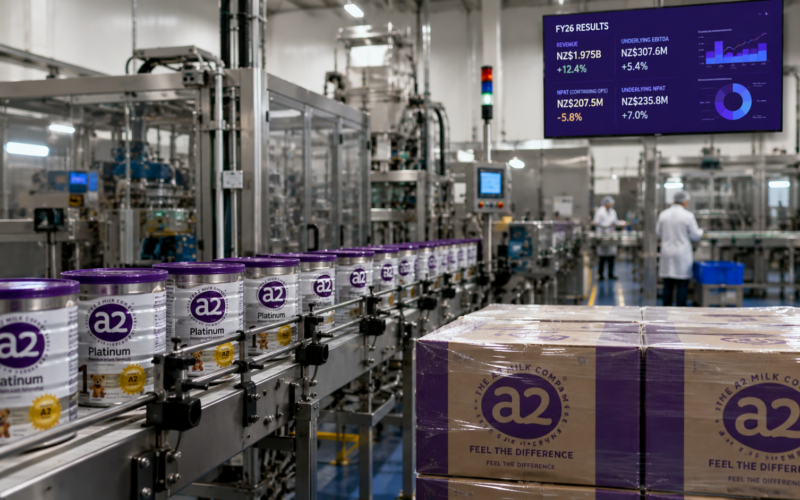
The a2 Milk Company Limited (ASX: A2M; NZX: ATM) increased FY26 revenue 12.4% to a record NZ$1.975 billion even as China-label infant milk formula revenue fell 14%, exposing an unusual split between strong portfolio diversification and serious disruption in one of its most strategically important products. Continuing-operations NPAT declined 5.8% to NZ$207.5 million, while underlying NPAT increased 7% to NZ$235.8 million and underlying EBITDA rose 5.4% to NZ$307.6 million. Management now expects FY27 revenue growth to slow to the mid-single digits, with first-half revenue broadly flat and earnings materially weighted toward the second half as the company tries to win back China-label users who switched brands during fourth-quarter supply shortages. The central question is therefore no longer whether a2 Milk can grow outside its traditional China-label franchise, because FY26 demonstrated that it can, but whether that diversification can protect earnings while the company repairs China-label market share and ramps its newly acquired a2 Pōkeno manufacturing platform.
The market treated that outlook cautiously. The a2 Milk Company shares closed at A$6.53 on the Australian Securities Exchange on August 17, down 3.26%, after falling as low as A$6.10 during the session. The stock is about 6.2% below its A$6.96 July 17 close, approximately 34.5% beneath its A$9.97 52-week high and roughly 34% above its A$4.88 annual low. Using approximately 733 million shares outstanding, the closing price implies an indicative Australian-dollar equity value of around A$4.8 billion.
That valuation now rests on a more complicated earnings mix than it did a year ago. China & Other Asia still generated NZ$1.448 billion, or approximately 73% of group revenue, yet China-label formula itself represented only around 27.6% of total group sales after falling to NZ$544.3 million. English and other-label infant formula, liquid milk and other nutritionals all expanded strongly enough to offset the China-label decline and still produce double-digit group revenue growth.
How did a2 Milk grow group revenue 12.4% when China-label infant formula sales fell 14%?
The answer is increasingly important to understanding what The a2 Milk Company has become. China-label infant milk formula revenue fell from NZ$632.5 million to NZ$544.3 million, a reduction of approximately NZ$88 million. Yet English and other-label infant formula revenue increased from NZ$641.4 million to almost NZ$790 million, liquid milk increased from NZ$346.3 million to NZ$421.9 million and Other Nutritionals expanded from NZ$135.1 million to NZ$216.1 million.
The shift means a2 Milk is no longer relying on one China-label product stream to produce essentially all meaningful growth. English-label formula benefited from cross-border e-commerce and offline-to-online channels into China alongside expansion in other markets. Other Nutritionals grew particularly rapidly, with China & Other Asia revenue from that category increasing 71% to approximately NZ$188.6 million as fortified kids and seniors products, paediatric supplements and other innovations gained traction.
Management said recent innovation contributed more than half of FY26 revenue growth. Products contributing included a2 Genesis, a2 Gentle Gold, fortified milk powders for children and seniors, kids UHT products and liquid-milk extensions. That is a strategically important development because it reduces the proportion of incremental growth dependent on the birth rate and competitive dynamics of the traditional China infant-formula market.
The diversification should not be overstated. China & Other Asia still accounts for nearly three-quarters of total company revenue, so a2 Milk remains heavily exposed to Chinese consumer demand, channel behaviour and regulation. The change is more subtle: dependence on China remains high, but dependence on one individual China-label formula stream is falling.
That distinction may become increasingly important if China’s infant-formula volumes remain structurally pressured. The company noted that 2025 newborn numbers in China fell 17% to 7.9 million after cycling an unusually strong previous year. Premiumisation helped stabilise market value despite weaker volumes, but demographic pressure means companies increasingly need market-share gains, premium pricing and adjacent nutrition categories to grow faster than the underlying infant population.

Why did the fourth-quarter China supply disruption hurt FY27 guidance more than FY26 revenue?
The disruption arrived late enough in FY26 that its full commercial consequences are spilling into FY27. China-label revenue had been positive through the first three quarters before product shortages at distributors and retailers materially reduced availability in the fourth quarter. The company said many existing users switched to alternative brands as their household stocks ran out, particularly during June. China-label sales consequently fell 33% year on year during the second half even though the full-year decline was 14%.
Inventory availability has since improved substantially, but restocking shelves does not automatically restore lost customers. Infant formula is an unusually sensitive consumer category because parents who switch successfully to an alternative product may not immediately move back simply because their previous brand becomes available again.
That is why FY27 guidance assumes a gradual rather than immediate recovery. The a2 Milk Company expects infant milk formula sales overall to be broadly similar to FY26, China-label sales to recover progressively during the year and English-label offtake momentum to improve during the first half. Group revenue and EBITDA are expected to be materially weighted toward the second half.
Management expects FY27 revenue growth in the mid-single digits and an EBITDA margin of approximately 15%. First-half revenue is expected to be broadly in line with the previous corresponding period, while the first-half EBITDA margin is expected to be materially below the first half of FY26 because the company will increase marketing and other recovery investment before the sales benefit fully appears.
That sequencing explains much of the August 17 share-price weakness. Investors are being asked to accept weaker first-half economics in exchange for a recovery that management expects to become visible later. Reuters reported that Citi viewed the FY27 outlook as underwhelming relative to the valuation, particularly because the China-label recovery is expected to take longer than previously hoped.
How expensive could winning back China infant formula customers become for a2 Milk?
The company already spends heavily on customer recruitment and brand development. FY26 marketing investment reached NZ$325 million, equivalent to approximately 16.5% of group revenue. China represented the vast majority of that investment, with spending directed toward growth, innovation and new-user recruitment.
That percentage gives some perspective on the economics of the FY27 recovery. The a2 Milk Company is not attempting to rebuild lost users from a low marketing base. It is already committing roughly one dollar of marketing expenditure for every six dollars of group revenue, and management has indicated that marketing will increase particularly during the first half of FY27.
The commercial question is therefore not simply whether marketing spending increases. The more important measurement is whether that investment restores China-label offtake and market share without creating a permanent increase in customer-acquisition cost.
The company does have two new products that could help. Regulatory approvals have been secured for two additional China-label products manufactured at a2 Pōkeno, expanding the China-label portfolio from one product to three. The products are intended partly to extend the brand into lower-tier cities and the organic segment, giving a2 Milk additional routes to customer recruitment beyond merely trying to recover buyers of its existing formula.
This creates a potentially better recovery path than simply spending more money behind the same product. If new products expand the addressable customer pool while former users return, a2 Milk could rebuild China-label growth without depending exclusively on recovering lost fourth-quarter volume.
Can a2 Pōkeno turn a supply-chain problem into a long-term margin advantage?
The acquisition of the Pōkeno nutritional manufacturing facility is becoming central to the investment case because it is meant to solve both capacity and supply-chain control problems. The a2 Milk Company has already begun transferring production of English-label a2 Platinum from Synlait Milk Limited to a2 Pōkeno and has commenced production of the two new China-label products. Management expects this insourcing to generate vertical manufacturing margin benefits over time.
The transition is currently costing money. a2 Pōkeno recorded an FY26 EBITDA loss of NZ$23.2 million and an NPAT loss of NZ$28.3 million while production volumes remained temporarily low ahead of the a2 Platinum transition. The company is targeting profitability at a2 Pōkeno by FY28.
Capital investment has also been significant. Total FY26 capital expenditure reached NZ$86.4 million, of which NZ$51.6 million went into the a2 Pōkeno transformation program. That means Pōkeno absorbed almost 60% of group capital expenditure during the year. The broader multi-year investment program is approximately NZ$100 million.
Working capital has moved in the same direction. Inventory increased by NZ$151.5 million, partly because the company built raw materials and base powder ahead of bringing a2 Platinum production in-house, prepared for two new China-label products and normalised China-label inventory following earlier manufacturing difficulties.
These costs explain why Pōkeno should be judged over several years rather than one reporting period. If higher utilisation absorbs the fixed manufacturing base, China-label volumes recover and internal production replaces external manufacturing margin, the facility could improve both resilience and profitability. If volumes remain below expectations, however, a2 Milk will have increased its fixed-cost exposure to a category already facing demographic and competitive pressure.
Does NZ$784 million of net cash give a2 Milk enough room to fund the recovery?
The balance sheet remains one of the strongest parts of the story. The a2 Milk Company finished June with NZ$784.5 million of net cash despite completing the Pōkeno acquisition, investing heavily in manufacturing and carrying substantially more inventory. Operating cash conversion was 68%, broadly in line with guidance.
There is an important timing adjustment, however. The NZ$784.5 million balance was reported at June 30, while a NZ$300 million special dividend was paid on July 24. A simple subtraction would leave approximately NZ$484.5 million before allowing for any other cash movements after year-end. That is not a current reported cash balance, but it provides a more realistic indication of the scale of liquidity available after the special distribution.
The company also declared a 9.5-cent final ordinary dividend, taking FY26 ordinary dividends to 21 cents per share and approximately 74% of continuing-operations NPAT. The NZ$300 million special dividend equated to approximately 41.36 cents per share.
Capital returns therefore coexist with heavy investment rather than replacing it. Management expects approximately NZ$70 million of capital expenditure in FY27 while continuing to invest in marketing, product launches, Pōkeno and international expansion.
The balance sheet gives a2 Milk room to tolerate a slower China recovery without immediately forcing a financing decision. What investors now need to assess is whether capital that has already moved into Pōkeno, inventory and customer reacquisition starts producing stronger returns.
Could Other Nutritionals become large enough to reduce a2 Milk’s demographic dependence on infant formula?
The fastest-growing product category may also be the strategically most interesting. Other Nutritionals revenue increased 59.9% across the group to NZ$216.1 million, while the China & Other Asia component rose 71% to NZ$188.6 million.
At NZ$216 million, Other Nutritionals now represents almost 11% of group revenue. That is still far smaller than infant milk formula, but it is large enough that continued rapid growth could materially change the company’s product mix over several years.
The products also target different age groups. Fortified kids milk, seniors nutrition and paediatric supplements allow a2 Milk to participate in nutrition spending before, during and long after the traditional infant-formula period. That potentially increases customer lifetime value and reduces dependence on annual birth numbers.
This is particularly relevant in China, where falling births are a structural constraint on the infant-formula market. A business that can extend its brand across children, adults and seniors has more strategic flexibility than one whose addressable market resets every year with newborn numbers.
The company is also expanding outside China. It cited Vietnam and other emerging markets as growth opportunities while continuing to develop liquid milk in Australia, New Zealand and the United States. The United States business remains targeted for profitability in FY27.
What does the A$6.53 share price reveal about investor sentiment after the FY26 result?
The Australian-listed shares closed 3.26% lower at A$6.53 on August 17 after opening around A$6.18 and trading as low as A$6.10. Volume was materially higher than the stock’s recent average, indicating that the FY27 outlook triggered a significant reassessment rather than a quiet drift lower.
The stock is also approximately 6.2% below its July 17 close of A$6.96 and roughly one-third below its A$9.97 52-week high. That positioning suggests the market is already assigning a meaningful discount for the China recovery challenge, although the shares remain well above their A$4.88 annual low.
The valuation debate is therefore becoming less about FY26 revenue growth and more about the quality of FY27 earnings. Mid-single-digit revenue growth combined with an approximately 15% EBITDA margin could still generate higher full-year EBITDA than the reported FY26 result if guidance is achieved. As an illustration rather than company guidance, revenue growth in a 4% to 6% range combined with a 15% margin would imply EBITDA of roughly NZ$308 million to NZ$314 million, compared with NZ$284.4 million reported in FY26.
That would bring reported profitability closer to the NZ$307.6 million underlying EBITDA already achieved in FY26. The more difficult issue is timing because management expects the first half to be materially weaker before China-label recovery, new products and Pōkeno utilisation contribute more meaningfully later in FY27.
Key takeaways from a2 Milk’s FY26 results and FY27 China recovery outlook
- The a2 Milk Company increased FY26 revenue 12.4% to a record NZ$1.975 billion despite China-label infant formula revenue falling 14%.
- Continuing-operations NPAT declined 5.8% to NZ$207.5 million, while underlying NPAT increased 7% to NZ$235.8 million.
- Underlying EBITDA increased 5.4% to NZ$307.6 million, although reported EBITDA fell 2.5% to NZ$284.4 million.
- China & Other Asia generated approximately 73% of group revenue, but China-label formula accounted for only about 28%, showing growing product diversification.
- Other Nutritionals increased to NZ$216.1 million of revenue, while recent innovation contributed more than half of FY26 group revenue growth.
- FY27 revenue is expected to grow in the mid-single digits, with first-half revenue broadly flat and EBITDA materially weighted toward the second half.
- Management expects an approximately 15% FY27 EBITDA margin and plans higher first-half marketing as it tries to recover China-label users lost during supply shortages.
- a2 Pōkeno absorbed almost 60% of FY26 group capital expenditure and is targeted to reach profitability by FY28.
- The company finished June with NZ$784.5 million of net cash but subsequently paid a NZ$300 million special dividend in July.
- ASX-listed a2 Milk shares closed 3.26% lower at A$6.53 on August 17 and remain about one-third below their 52-week high.
Can a2 Milk turn its biggest FY26 operational failure into a stronger FY27 business?
The unusual feature of The a2 Milk Company’s FY26 result is that the company simultaneously demonstrated the strength and weakness of its current strategy. A late supply-chain failure caused customers to switch away from China-label formula and pushed second-half sales of that product sharply lower, yet the broader portfolio still generated record group revenue because English-label formula, liquid milk, new products and adjacent nutrition categories continued expanding.
That resilience matters. China-label formula remains commercially important, but it no longer determines the direction of every group revenue line. Other Nutritionals alone has become a more than NZ$200 million business, innovation produced more than half of annual growth and China-label formula now represents less than 30% of total revenue.
FY27 nevertheless requires a different kind of proof. Management has to regain customers while maintaining pricing discipline, launch two new China-label products, increase utilisation at a2 Pōkeno and absorb heavier first-half marketing without allowing the earnings recovery to slip materially beyond the second half.
The balance sheet provides time. Even after adjusting conceptually for the NZ$300 million special dividend paid after year-end, a2 Milk entered the new financial year with substantial liquidity and relatively few financial constraints. The company therefore has the capacity to invest through the recovery rather than being forced to optimise every quarter for short-term cash generation.
The real risk is commercial rather than financial. Consumers who changed formula because a2 Milk products were unavailable need to be persuaded to change again. If China-label momentum rebuilds while English-label formula and Other Nutritionals continue growing, FY26 may ultimately look like the year the company proved it could survive a serious problem in its largest traditional franchise.
If customer recovery remains slow, however, the same numbers will tell a different story. Marketing already represents approximately 16.5% of revenue, Pōkeno is still loss-making and first-half FY27 margins are expected to weaken before management anticipates improvement later in the year.
The November 19 annual meeting therefore becomes the next useful checkpoint, when The a2 Milk Company plans to update investors on its infant-formula recovery program. The key number will not simply be group revenue growth. It will be whether China-label customers are actually returning fast enough for the second-half-weighted FY27 guidance to remain credible.
Discover more from Business-News-Today.com
Subscribe to get the latest posts sent to your email.