


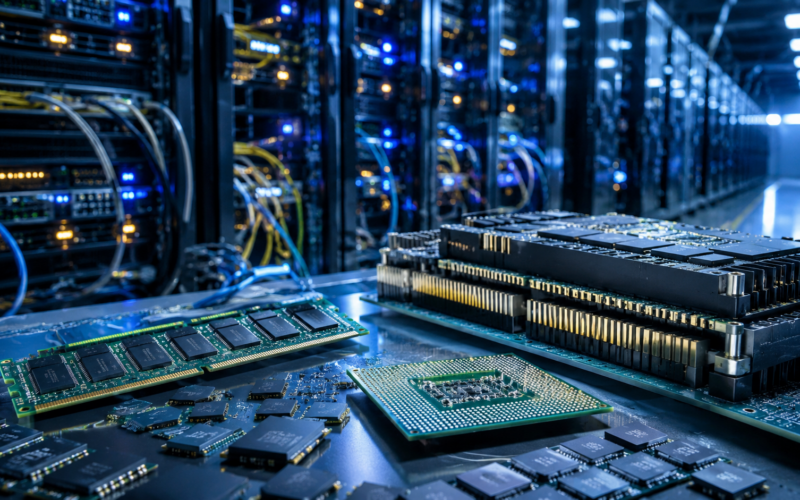
Micron Technology, Inc. (NASDAQ: MU), Western Digital Corporation (NASDAQ: WDC), and NVIDIA Corporation (NASDAQ: NVDA) are drawing renewed investor attention as artificial intelligence demand turns memory chips from a cyclical afterthought into a central infrastructure constraint. The Seeking Alpha page flagged the market debate around the best memory chip stock, with Micron Technology, Western Digital and NVIDIA-linked artificial intelligence demand sitting at the centre of the discussion. Micron Technology recently traded at $751.00, while Western Digital Corporation stood at $484.28 and NVIDIA Corporation traded at $215.33. The strategic issue is no longer whether artificial intelligence needs faster processors, but whether memory supply, storage bandwidth and high-bandwidth memory capacity can keep pace with the data centre buildout now driving the semiconductor market.
Why are memory chip stocks suddenly central to the artificial intelligence infrastructure trade?
Memory chip stocks are gaining investor attention because artificial intelligence workloads do not run on graphics processors alone. Training and inference require huge volumes of data to move quickly between processors, memory systems and storage layers. That makes high-bandwidth memory, DRAM, NAND flash and enterprise storage increasingly important to the artificial intelligence supply chain. NVIDIA Corporation may remain the market’s most visible artificial intelligence hardware winner, but memory suppliers are becoming the less glamorous, very profitable plumbing behind the same boom.
The old memory-cycle model was brutally cyclical. Producers added capacity during good times, prices collapsed when supply caught demand, and investors treated memory companies as boom-and-bust trades rather than durable compounders. The artificial intelligence cycle is challenging that framework because demand is being driven by hyperscale data centres, artificial intelligence accelerators, enterprise servers and storage-intensive workloads. If demand continues to outstrip supply, memory pricing could remain stronger for longer than in previous cycles.
That shift is visible globally. China’s Changxin Memory Technologies has projected a sharp revenue surge as memory chip demand rises, with Reuters reporting that the company expects first-half 2026 revenue between 110 billion yuan and 120 billion yuan, driven by artificial intelligence computing demand and higher DRAM prices. The report also noted that global DRAM demand has outpaced supply since the second half of 2025, supporting the idea that the memory market has entered a tighter phase.
For investors, the implication is clear but not risk-free. Memory stocks are no longer just proxies for personal computer and smartphone cycles. They are now tied to artificial intelligence server growth, data centre capacity planning and supply assurance. That raises the strategic value of Micron Technology and Western Digital Corporation, but it also raises expectations. When a cyclical industry becomes fashionable, valuation discipline becomes the first casualty if investors get too excited.
How does Micron Technology fit into the high-bandwidth memory and DRAM supercycle?
Micron Technology has become one of the most direct U.S.-listed ways to invest in the memory side of artificial intelligence infrastructure. The company’s exposure to DRAM and high-bandwidth memory gives it a clearer connection to artificial intelligence server demand than traditional storage-only narratives. High-bandwidth memory is especially important because advanced artificial intelligence accelerators require memory stacks capable of feeding processors at extremely high speeds. Without that memory bandwidth, expensive artificial intelligence chips cannot operate at their full potential.
Micron Technology recently traded at $751.00, with a market capitalization of about $857.64 billion and a price-to-earnings ratio near 35.46. That valuation shows how dramatically investor sentiment has changed around the company. Micron Technology is no longer being valued merely as a low-multiple cyclical chipmaker emerging from a downturn. The market is pricing it as a strategic beneficiary of a multi-year artificial intelligence memory upcycle.
The bullish argument is that high-bandwidth memory tightens overall DRAM supply because it consumes more wafer capacity than conventional memory. As suppliers shift capacity toward higher-margin artificial intelligence products, conventional DRAM supply can also tighten, supporting broader pricing. That creates a powerful operating leverage cycle for Micron Technology if demand remains strong and pricing continues improving. The company benefits not only from selling advanced memory into artificial intelligence systems, but also from a healthier commodity memory backdrop.
The risk is that memory remains a capital-intensive industry with a long history of oversupply. If Micron Technology and its peers add too much capacity, or if artificial intelligence server demand slows from current expectations, the cycle can turn quickly. The stock’s sharp rally means the market is already rewarding the company for a stronger and possibly longer upcycle. That makes future earnings, guidance and capital expenditure discipline crucial.
Why is Western Digital becoming a more important AI storage and NAND stock?
Western Digital Corporation is a different kind of artificial intelligence infrastructure play. While Micron Technology gives investors DRAM and high-bandwidth memory exposure, Western Digital Corporation is tied more closely to storage, NAND flash and data infrastructure. Artificial intelligence systems do not only need to process data quickly. They need to store, retrieve and manage enormous datasets across training clusters, enterprise environments and cloud architectures. That makes storage suppliers increasingly relevant to the artificial intelligence buildout.
Western Digital Corporation recently traded at $484.28, with a market capitalization of about $166.92 billion and a price-to-earnings ratio near 28.96. The stock has moved dramatically over the past year, with Yahoo Finance showing a 52-week range of $50.62 to $525.15. That range tells investors just how aggressively the market has repriced Western Digital Corporation as storage and memory conditions improved.
The broader flash memory market is also tightening. Barron’s reported that SanDisk’s chief executive officer said the flash memory market could remain undersupplied for an extended period because artificial intelligence is changing demand patterns, with customers increasingly focused on securing supply rather than negotiating only on price. The report also noted that SanDisk has shifted toward longer-term customer agreements that improve visibility in what has historically been a volatile market.
That matters for Western Digital Corporation because artificial intelligence may be improving the quality of storage demand. If customers move from short-term, price-driven procurement to supply-assurance agreements, the industry could become less violently cyclical. That does not eliminate downturn risk, but it can improve visibility. For investors, the question is whether Western Digital Corporation can translate stronger demand into durable margins and cash flow rather than merely riding a price spike.
How does NVIDIA’s AI dominance affect the investment case for memory chip companies?
NVIDIA Corporation remains the anchor customer signal for the artificial intelligence infrastructure cycle. When demand for NVIDIA Corporation graphics processors and accelerators rises, demand for high-bandwidth memory and supporting data infrastructure rises with it. That makes Micron Technology, SK Hynix, Samsung Electronics, Western Digital Corporation and storage suppliers indirect beneficiaries of NVIDIA Corporation’s platform dominance.
NVIDIA Corporation recently traded at $215.33, with a market capitalization of about $5.25 trillion and a price-to-earnings ratio near 32.77. The company’s scale shows how much artificial intelligence infrastructure value has concentrated around processors and accelerator platforms. But that concentration also creates a second-order opportunity: investors are looking for suppliers that benefit from the same demand without necessarily trading at NVIDIA Corporation’s level of visibility and crowding.
The memory supply chain is one of the most obvious places to look. Artificial intelligence accelerators require high-bandwidth memory, advanced packaging, networking, power systems and storage. If processor demand stays high, bottlenecks often shift to adjacent components. That is why memory has become more strategic. A shortage in high-bandwidth memory can constrain the deployment of expensive artificial intelligence chips, just as a shortage in power capacity can constrain data centre growth.
The risk for memory investors is customer concentration and bargaining power. Large artificial intelligence chip companies and hyperscalers are sophisticated buyers. They may accept higher prices when supply is tight, but they will also push for long-term capacity commitments, technical roadmaps and pricing discipline. Memory suppliers must balance near-term pricing power with the need to remain preferred partners in a supply chain dominated by giants.
Why could the memory supercycle last longer than past DRAM and NAND booms?
The argument for a longer memory upcycle rests on three structural changes. First, artificial intelligence workloads require more memory per system than traditional computing. Second, high-bandwidth memory production is more complex and capacity-consuming than standard DRAM. Third, customers are increasingly prioritizing supply security because artificial intelligence infrastructure rollouts can be delayed if memory and storage components are unavailable.
This is different from past cycles where personal computers and smartphones were the main demand drivers. Those markets were important, but they were more mature and easier to forecast. Artificial intelligence demand is being driven by hyperscalers, sovereign artificial intelligence projects, enterprise adoption, model training, inference growth and data-intensive applications. That gives the cycle more drivers, though not all of them are equally predictable.
The supply side also matters. Memory manufacturers became more disciplined after previous downturns, reducing the risk of immediate oversupply. If producers remain cautious while demand keeps expanding, pricing can stay stronger. However, the temptation to add capacity will rise as profits improve. Memory companies have historically found it hard to resist expansion during upcycles. That is why investors should watch capital expenditure guidance as closely as revenue growth.
The third factor is contract structure. The shift toward longer-term supply agreements, especially in flash and enterprise storage, may reduce some volatility. If customers are willing to pay for supply assurance, suppliers gain better visibility. That is a genuine improvement. But it does not make the industry immune to inventory corrections. Artificial intelligence may be changing the memory cycle, but it has not repealed the laws of semiconductor gravity.
Which memory stock looks better positioned for investors in the current cycle?
Micron Technology appears better positioned for investors seeking direct exposure to high-bandwidth memory and DRAM pricing tied to artificial intelligence accelerators. Its strategic upside is closely linked to the most capacity-constrained part of the memory market. If high-bandwidth memory demand remains strong and DRAM prices continue firming, Micron Technology could keep benefiting from pricing power, mix improvement and operating leverage.
Western Digital Corporation may appeal more to investors who want exposure to artificial intelligence storage, NAND recovery and enterprise data infrastructure. The stock has already rerated sharply, but the storage market could remain strong if artificial intelligence workloads continue pushing data retention, retrieval and flash demand higher. Western Digital Corporation’s investment case is less about feeding graphics processors directly and more about supporting the broader data layer around artificial intelligence.
The choice depends on risk appetite. Micron Technology offers a more direct artificial intelligence memory narrative, but expectations are very high after the stock’s explosive move. Western Digital Corporation offers a storage-led angle, but investors need to understand NAND pricing, flash supply conditions and the durability of customer commitments. Both stocks can benefit from artificial intelligence, but neither should be treated as a risk-free cousin of NVIDIA Corporation.
For institutional investors, the cleaner approach may be to separate “AI memory intensity” from “AI storage intensity.” Micron Technology sits closer to memory bandwidth. Western Digital Corporation sits closer to the storage layer. NVIDIA Corporation remains the processor platform leader. The strongest portfolio view may not be choosing one winner, but understanding where each company sits in the artificial intelligence infrastructure stack.
What risks could derail the bullish case for memory chip stocks?
The first risk is oversupply. Memory markets can turn quickly when producers add capacity at the same time demand normalizes. If high prices encourage aggressive expansion across DRAM, high-bandwidth memory and NAND, the same shortage narrative that lifts stocks today could become tomorrow’s margin problem. Investors should watch for signs of capacity additions that run ahead of committed demand.
The second risk is artificial intelligence spending fatigue. Hyperscalers and enterprises are spending heavily on artificial intelligence infrastructure, but capital expenditure cycles can slow if returns become unclear. If data centre spending pauses, memory and storage suppliers could feel the pressure faster than investors expect. Strong demand today does not guarantee linear growth tomorrow.
The third risk is geopolitics. Taiwan Semiconductor Manufacturing Company Limited, Samsung Electronics, SK Hynix, Micron Technology, Changxin Memory Technologies and other global suppliers operate inside a semiconductor landscape shaped by export controls, China-U.S. competition, subsidies and supply-chain localization. Memory chips are now strategically important enough to attract policy attention, and policy attention is rarely free.
The fourth risk is valuation. Micron Technology and Western Digital Corporation have already enjoyed powerful stock moves. When cyclical stocks begin trading like structural growth stories, downside risk rises if the cycle disappoints. The market is right to reassess memory’s role in artificial intelligence. It should not pretend that a historically cyclical sector has suddenly become a bond with better branding.
Key takeaways on what Micron, Western Digital and AI memory demand mean for investors
- Memory chip stocks are gaining importance because artificial intelligence workloads require faster memory, higher bandwidth and larger storage capacity.
- Micron Technology is one of the clearest U.S.-listed plays on high-bandwidth memory and DRAM pricing tied to artificial intelligence servers.
- Western Digital Corporation offers a storage-led artificial intelligence infrastructure angle through NAND flash and enterprise data demand.
- NVIDIA Corporation’s dominance supports memory demand because advanced accelerators require high-bandwidth memory and surrounding data infrastructure.
- Global DRAM demand has tightened as artificial intelligence computing increases pressure on supply.
- Flash memory suppliers are seeing stronger customer focus on supply assurance, which may improve visibility in a traditionally volatile market.
- The memory cycle could last longer than past booms if artificial intelligence demand stays strong and producers remain disciplined.
- Oversupply, artificial intelligence capital expenditure fatigue, geopolitics and valuation risk remain the main threats to the bullish case.
- Investors should distinguish between memory bandwidth exposure, storage exposure and processor exposure when comparing semiconductor stocks.
Discover more from Business-News-Today.com
Subscribe to get the latest posts sent to your email.