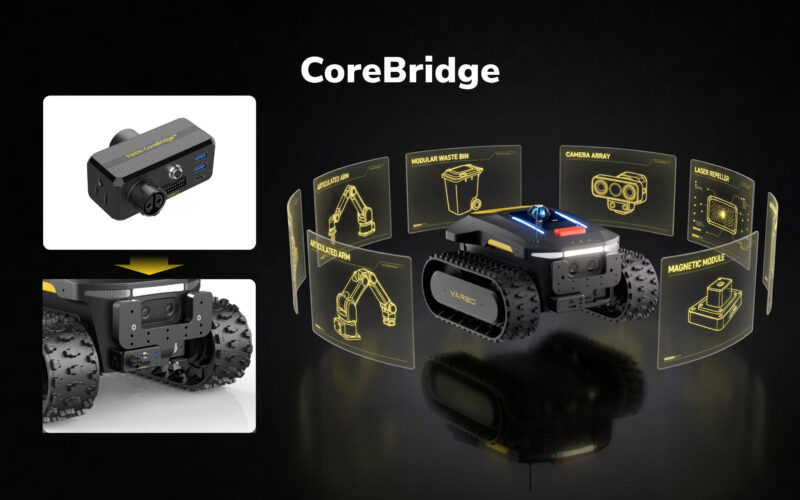
Yarbo said it plans to launch an open platform in early 2027 that would extend its modular yard robot system beyond fixed-function hardware into a broader software and developer ecosystem. The initiative, announced alongside the Smart Assist Module launch for the M Series on Kickstarter, is designed to add an Open API, software development kit, no-code automation tools, and a hardware expansion framework for future third-party modules. That matters because Yarbo is no longer positioning itself simply as a maker of robotic snow blowers or lawn devices, but as a company trying to define a category around programmable outdoor automation. The move also arrives as Yarbo tries to scale its addressable market through the lower-priced M Series, which the company previously said crossed $1 million in Kickstarter backing within two hours of launch.
What changed here is not just the addition of another attachment. Yarbo is attempting to shift the narrative from product versatility to platform extensibility. The distinction matters. A modular product can win buyers by doing multiple jobs, but a platform tries to win an ecosystem by letting other people build new jobs for it. That is the more ambitious, and far riskier, play.
The press announcement makes clear that the open platform is not available yet. Instead, Yarbo is outlining a roadmap built around three software layers: an Open API for outside integrations, an SDK for custom development, and a drag-and-drop Automation Editor aimed at non-technical users. The company also said the system is being designed for compatibility with Home Assistant, Google Home, and Amazon Alexa, which signals that Yarbo wants to plug into existing smart home habits rather than force users into a closed outdoor tech stack.
Why is Yarbo moving from modular yard robots to an open platform strategy now?
Timing is doing a lot of work in this announcement. Yarbo has already spent several years establishing the idea of a multi-purpose yard robot, with CES recognition for its 2024 model and a product pitch centered on year-round functions such as mowing, leaf blowing, and snow blowing. The M Series, revealed for a broader consumer audience this year, appears to be the company’s attempt to move from premium novelty toward a more scalable installed base.
That installed base is critical. Open platforms sound exciting, but they only matter if enough machines are in the field to attract developers, accessory makers, and tinkerers. In other words, Yarbo is trying to solve the classic platform chicken-and-egg problem by first widening adoption with the M Series and then promising a richer ecosystem behind it. The Smart Assist Module launch helps that narrative because it expands use cases beyond routine maintenance into follow-me and patrol functions, nudging Yarbo closer to the idea of an outdoor utility robot rather than a glorified lawn gadget.
There is also a strategic logic in going open while the category is still young. Robotic mowers already exist, but truly modular yard robotics remains a narrower space. If Yarbo can establish the interface standard before larger incumbents decide outdoor robotics deserves the full platform treatment, it could gain a first-mover advantage that is harder to dislodge than a simple hardware lead. Hardware can be copied. Ecosystem habits are messier.

How could Yarbo’s Open API, SDK, and CoreBridge change the yard robotics market?
The most interesting part of the announcement may be the hardware layer called CoreBridge, which Yarbo described as a standardized interface intended to expose mounting points, power, and data connections for future extensions. That suggests the company wants third parties to treat the robot like a base unit for new functions, not merely a proprietary appliance with approved accessories. Yarbo even floated an electromagnet-based module as an example, imagining tasks such as moving trash bins to the curb and back.
If that vision works, the commercial upside is obvious. Yarbo could diversify beyond selling finished attachments and start earning from a wider mix of software integrations, add-ons, community development, and possibly revenue-sharing around future modules. More importantly, it could expand use cases faster than an in-house product roadmap usually allows. Outdoor robotics is still an underbuilt category, and the range of repetitive property tasks is broader than mowing grass or clearing snow. Waste handling, patrolling, hauling, seasonal yard prep, and even property monitoring all sit within plausible adjacency.
This is where the smart home angle becomes strategically important. Indoor smart homes already run on triggers, routines, geofencing, and device interoperability. Outdoor automation has remained comparatively fragmented. Yarbo is effectively arguing that the yard should become another programmable zone of the connected home. That is a stronger thesis than “our mower also blows leaves,” and frankly a better story for investors and partners, even if Yarbo is private and not giving the market a stock chart to obsess over.
What execution risks could derail Yarbo’s smart yard ecosystem ambitions before 2027?
The easiest thing in robotics is to announce a roadmap diagram. The harder thing is to make it dependable when weather, terrain, safety, connectivity, and user improvisation all collide in the real world. Outdoor robotics has a much uglier operating environment than indoor automation. Rain, snow, mud, slopes, debris, pets, children, driveways, and inconsistent Wi-Fi all make open ecosystems more complicated than a glossy app screen suggests.
There is also the risk that openness creates quality-control headaches. Once a company invites third-party modules and integrations, it inherits the challenge of certification, support expectations, and blame assignment when something fails. If a homegrown attachment drains power, damages a mount, or causes erratic behavior, users rarely distinguish between “platform issue” and “developer issue.” They usually just decide the robot is annoying.
Another issue is consumer patience. Yarbo is announcing a platform for early 2027, not shipping it now. That gives the company time to build properly, but it also introduces roadmap risk. The farther out the promise, the more the market treats it as optional until proven. Robotics companies do not get infinite credit for future extensibility, particularly when adoption is still being built through crowdfunding and early enthusiast communities.
Then there is competitive response. Larger smart home and robotic lawn equipment players may not have the same modular story today, but they do have distribution, service networks, and brand familiarity. If Yarbo proves there is real consumer demand for programmable outdoor automation, it may end up validating the opportunity for better-capitalized rivals. That is the startup tax on category creation. Congratulations, you invented a market. Now defend it.
Why could Yarbo’s 2027 roadmap matter for the future of smart home and outdoor automation?
Even with those risks, Yarbo’s move is strategically sharper than a routine product launch. It signals that the next phase of consumer robotics may not be defined only by whether a machine can automate one chore well, but by whether it can become a reusable robotic base layer for many chores. That is a bigger idea, and one with more durable economics if it works.
The company’s prior CES recognition and ongoing product expansion show it has already built some narrative credibility around modularity. The M Series Kickstarter traction suggests there is at least early-market appetite for a more accessible version of that concept. The open platform now gives Yarbo a longer-term story about how outdoor robotics could evolve from appliance replacement into property workflow automation.
For the broader industry, this announcement is less about immediate revenue and more about strategic direction. Yarbo appears to be testing whether smart yard robotics can follow the same pattern that transformed other hardware categories: start with a useful device, build a user base, add software layers, open interfaces, and let third parties widen the product’s relevance. If that happens, the company may have a defensible niche in a category that still feels early enough to be shaped rather than merely entered.
For now, though, this is a vision story with encouraging but incomplete proof points. Yarbo has an interesting installed-base strategy, a clearer software thesis than many hardware startups, and a product narrative that reaches beyond seasonal yard work. But until the platform ships and developers actually build on it, this remains a well-framed bet, not a finished ecosystem. Yard work, it turns out, may be easier to automate than platform credibility.
What are the key strategic takeaways from Yarbo’s open platform push into outdoor robotics?
- Yarbo is trying to evolve from a modular hardware seller into a platform company with software, automation, and third-party expansion potential.
- The Open API, SDK, and Automation Editor suggest Yarbo wants to serve both mainstream users and technical developers.
- CoreBridge is the most strategically important element because it could turn Yarbo’s robot into a reusable hardware base for new categories of outdoor tasks.
- The M Series Kickstarter rollout appears to be the installed-base strategy that could make a future platform credible.
- Compatibility ambitions around Home Assistant, Google Home, and Amazon Alexa position Yarbo within existing smart home behavior rather than outside it.
- The announcement is a roadmap, not a live platform, so execution and delivery risk remain high until 2027 milestones become visible.
- If Yarbo succeeds, it could help define programmable outdoor automation as a category rather than remain a niche robotic mower story.
- If Yarbo fails to deliver a stable developer ecosystem, the platform narrative could collapse back into a narrower attachment-driven hardware business.
- The company’s real competitive challenge is not just product innovation but ecosystem trust, support quality, and long-term interoperability.
This development matters because it hints that the next battle in home robotics may move outdoors, where automation remains far less standardized than inside the home.
Discover more from Business-News-Today.com
Subscribe to get the latest posts sent to your email.