




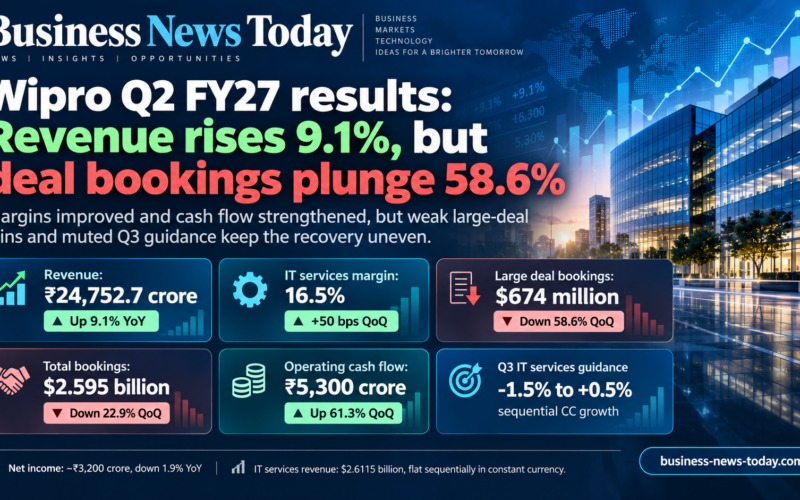
Wipro Limited (NSE: WIPRO, BSE: 507685, NYSE: WIT) reported a 9.1% year-over-year increase in consolidated revenue to ₹24,752.7 crore for the quarter ended September 30, 2026, but its underlying IT services business delivered only 0.6% growth in constant currency terms. The Bengaluru-headquartered technology services company also reported a 1.9% decline in net income to approximately ₹3,200 crore, even as its IT services operating margin improved sequentially to 16.5%. More concerning for its near-term growth outlook, large deal bookings fell 58.6% quarter over quarter to $674 million, while total bookings declined 22.9% to $2.595 billion. Management expects December-quarter IT services revenue to range between $2.571 billion and $2.625 billion, representing sequential constant currency growth of negative 1.5% to positive 0.5%. The October 15 results reveal a business improving profitability and cash generation while still struggling to establish sustained revenue momentum.
Why did Wipro’s consolidated revenue increase 9.1% while underlying IT services growth remained almost flat?
Wipro’s headline revenue performance presents a stronger impression than its core services growth metrics. Consolidated revenue increased from approximately ₹22,697 crore in the September 2025 quarter to ₹24,752.7 crore, adding roughly ₹2,055 crore over the year. Revenue also increased 1.1% sequentially from ₹24,480 crore in the June 2026 quarter. However, the company’s IT services division, which accounts for the overwhelming majority of its operations, generated $2.6115 billion in reported revenue, declining 0.1% sequentially and increasing only 0.3% from a year earlier.
On a constant currency basis, which removes the effects of exchange-rate movements on the comparison, IT services revenue was unchanged from the preceding quarter and increased 0.6% year over year. The difference between consolidated rupee revenue growth and constant currency services growth is important because it prevents the headline 9.1% increase from being interpreted as equivalent growth in underlying client demand. Exchange-rate translation and differences between reporting measures affect the comparison, while acquisitions and portfolio composition may also influence reported growth. The disclosed figures establish that organic operating momentum remains considerably weaker than the consolidated rupee growth rate might initially suggest, although the release does not provide a complete organic-growth bridge.
The September quarter nevertheless represented a sequential improvement from the first quarter’s 1.2% constant currency decline in IT services revenue. Wipro effectively stabilized its core business after the earlier contraction, even if the recovery was not strong enough to generate meaningful sequential expansion. The company also finished the quarter within its previously announced revenue guidance range of $2.574 billion to $2.627 billion. That performance suggests improved stability, but it does not yet demonstrate a sustained acceleration in technology spending among its customers.
Demand patterns remained uneven across geographies. European revenue increased approximately 5.1% year over year in constant currency terms, indicating stronger activity in a market representing more than one-quarter of Wipro’s business. This performance contrasts with the company’s modest overall services growth and suggests that regional demand and client investment priorities remain important drivers of its results. A broader recovery would require stronger contributions from other markets as well as continued European momentum.
Why did Wipro’s large deal bookings collapse 58.6% despite new AI transformation contracts?
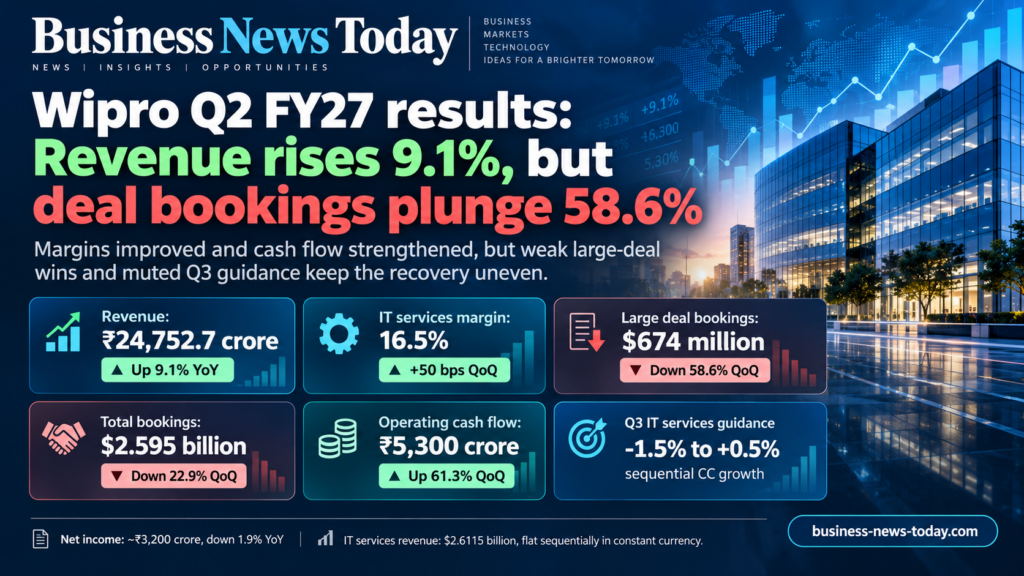
The sharp deterioration in large deal bookings is among the most consequential developments in Wipro’s September-quarter results. Total contract bookings declined from $3.370 billion in the June quarter to $2.595 billion, representing a sequential reduction of $775 million. Within that total, large deal bookings fell from $1.626 billion to $674 million, a decline of approximately $952 million or 58.6% in constant currency terms. The magnitude of the decrease raises questions about the timing and consistency of major outsourcing contract awards.
Large deals represented approximately 26% of total bookings in the September quarter, compared with about 48% in the preceding quarter. This suggests that the latest booking mix was considerably less dependent on contracts exceeding Wipro’s $30 million large-deal threshold. Such fluctuations can occur because major contracts often take several months to negotiate and are recognized in bookings when agreements are concluded. However, repeated periods of weaker large deal intake could eventually affect revenue visibility if new awards fail to replace completed or reduced customer engagements.
The year-over-year comparison also indicates weaker contracting momentum. Total bookings were approximately $4.7 billion in the September 2025 quarter, compared with $2.6 billion in the latest period. Although quarterly bookings can be volatile, a decline of this magnitude means investors will need stronger evidence that Wipro’s sales pipeline can convert into signed agreements. Bookings represent the total contract value of newly recorded orders, renewals and expansions, rather than revenue that will necessarily be recognized during the following quarter.
The company nevertheless disclosed strategic contract wins across banking, healthcare, technology, manufacturing, telecommunications and energy. These include a mortgage modernization programme for a major US bank, AI-enabled operations for a biotechnology company and an enterprise AI transformation engagement with an Asian Fortune 500 conglomerate. Wipro also secured a North American public services engagement involving AI agents, conversational AI and automated document processing. The announcements demonstrate continued customer activity, but the company has not published individual contract values for these examples, preventing an assessment of their contribution to future revenue.
How did Wipro improve its IT services operating margin to 16.5% despite slower revenue growth?
Wipro’s profitability performance was stronger at the IT services operating level than its revenue growth. Segment operating margin increased from 16.0% in the June quarter to 16.5% in September, an improvement of 50 basis points. Compared with the corresponding period of 2025, however, the margin remained 20 basis points lower. The improvement suggests that the company managed operating costs effectively during a quarter in which its core services revenue was essentially unchanged.
Chief Financial Officer Aparna Iyer attributed the margin performance to continued financial discipline while the company maintained investment in employees and strategic business priorities. Management has been emphasizing productivity improvements and the deployment of artificial intelligence across delivery operations. Such initiatives can potentially reduce the effort required for selected software development, testing and support activities. However, the financial disclosure does not isolate the contribution of AI automation to the quarterly margin improvement, making it inappropriate to assign the entire gain to those initiatives.
Consolidated net income presented a less favorable comparison. Profit declined 1.9% year over year to approximately ₹3,200 crore and fell 4.7% from the preceding quarter’s ₹3,360 crore. Earnings per share increased 4.2% year over year to ₹3.23, despite the decline in absolute net income. The contrasting movements reflect the importance of distinguishing aggregate profit from per-share performance, which also depends on the weighted-average share count.
The divergence between improving segment margins and declining consolidated profit limits the extent to which the quarter can be described as an earnings recovery. Better operating efficiency is valuable, particularly when demand remains uncertain, but sustainable profit expansion will ultimately require an appropriate combination of revenue growth, delivery productivity and cost control. A continuation of margin gains without stronger sales could support profitability but may not generate the earnings acceleration investors expect from a technology transformation cycle.
What does Wipro’s ₹5,300 crore operating cash flow reveal about the quality of its earnings?
Cash generation was one of the clearest positive developments in the quarterly results. Wipro reported operating cash flow of ₹5,300 crore, equivalent to approximately $553.6 million, representing an increase of 61.3% from the June quarter. Operating cash flow amounted to 165.8% of reported net income, substantially exceeding the conversion level of approximately 98% recorded in the preceding quarter. This indicates that the company generated considerably more operating cash than accounting profit during the reporting period.
Strong cash conversion provides financial flexibility when revenue growth is subdued. Wipro can use operating cash to support technology investments, acquisitions, employee training and shareholder distributions without relying exclusively on external financing. However, a single quarter of unusually strong conversion should not be treated as a permanent run rate because working capital movements, customer collections and payment timing can influence operating cash flow. The durability of the improvement will become clearer through subsequent reporting periods.
The company’s operating efficiency measures also need to be considered alongside workforce developments. Wipro ended September with approximately 236,328 employees, a sequential reduction of 6,716, after adding 888 employees during the June quarter. Voluntary attrition declined marginally from 13.9% to 13.8% on a trailing 12-month basis. The headcount reduction indicates a smaller workforce, but it does not independently establish that all departing employees were affected by layoffs or that artificial intelligence caused the decline.
For a technology services provider, workforce productivity has direct implications for profitability and delivery capacity. Automation can allow some activities to be completed with fewer manual interventions, while changing customer demand can affect the number and composition of employees required. However, Wipro must retain sufficient expertise in consulting, engineering, cybersecurity and complex enterprise systems to support future growth. Maintaining margins through workforce efficiency is commercially useful only if it does not constrain the company’s ability to deliver newly secured contracts.
Can Wipro’s artificial intelligence strategy translate growing enterprise interest into stronger revenue?
Wipro is expanding its artificial intelligence proposition beyond conventional software development and infrastructure support towards the modernization of enterprise operating processes. Chief Executive Officer and Managing Director Srini Pallia indicated that investments in consulting-led transformation and AI offerings were beginning to contribute to new client relationships and broader customer engagements. The company has positioned Wipro Intelligence as an integrated suite of platforms and capabilities intended to support this strategy. Its AI-Native Business & Platform unit is also targeting engagements in which automation forms part of the customer’s core operating model.
Several contracts announced during the quarter illustrate the breadth of these applications. The US banking engagement uses the NetOxygen lending platform to modernize mortgage processing, while a global life sciences customer has selected Wipro to develop an AI-powered supply chain intelligence platform. That project will use WEGA to support decision-making across manufacturing, distribution and inventory management. Another contract involves automating procurement, supplier interactions, invoice processing and exception handling for a major Middle Eastern energy company.
These engagements differ from traditional application maintenance contracts because they aim to change how customers perform business activities. A procurement modernization project may require workflow redesign, systems integration, governance controls and continued operational support. This could generate demand for consulting and implementation services as well as recurring platform-related work. However, Wipro has not disclosed the proportion of quarterly revenue attributable specifically to AI offerings or the incremental margin associated with those contracts.
The commercial challenge is that customers increasingly expect AI adoption to produce measurable productivity improvements. That can create additional consulting opportunities while also reducing the effort required for existing labour-intensive services. For Wipro, successful adoption needs to generate sufficiently valuable new work to offset any reduction in conventional service delivery requirements. The company would provide stronger evidence of progress by disclosing how AI-related bookings, deployments and recurring revenue contribute to overall growth.
Why does Wipro’s December-quarter guidance point to another period of subdued IT services demand?
Wipro expects December-quarter IT services revenue of $2.571 billion to $2.625 billion, representing sequential constant currency growth between negative 1.5% and positive 0.5%. The midpoint of this guidance is approximately $2.598 billion, slightly below the September quarter’s reported IT services revenue of $2.6115 billion. While the comparison involves exchange-rate assumptions, the guidance indicates that management is not expecting a material near-term acceleration. It also closely resembles the range communicated for the September quarter.
This outlook suggests that customers remain selective about major technology spending commitments even as interest in artificial intelligence continues to grow. Enterprise clients may invest in specific automation projects while delaying broader discretionary transformations or extending contract negotiations. The decline in large deal bookings reinforces this uncertainty, although individual major contracts can shift between reporting periods. A stronger December-quarter performance would require improvements in project execution, customer spending or the conversion of new opportunities into revenue.
The competitive environment adds further pressure. HCL Technologies reported 2.3% sequential constant currency growth in its September-quarter revenue, offering a useful contrast with Wipro’s flat underlying performance. Differences in client mix, business portfolios and contract timing mean the figures are not perfectly comparable, but they show that some competitors are achieving stronger near-term growth. Wipro’s improvement in margins is encouraging, yet it must also demonstrate that its consulting-led AI strategy can deliver sustained growth rather than isolated contract wins.
How did Wipro shares perform before the Q2 FY27 results, and what will influence investor sentiment?
Wipro shares closed at approximately ₹173.70 on BSE Limited on October 15, advancing 1.58% before the quarterly results were announced. The gain occurred during a broadly positive market session in which the S&P BSE Sensex increased approximately 2.11%. Wipro therefore participated in the wider market recovery but underperformed the benchmark on the day. Because the earnings announcement followed the regular trading session, the closing-price movement cannot be interpreted as a reaction to the newly reported financial results.
Despite the advance, Wipro shares remained approximately 36.4% below their 52-week high of ₹273.15, recorded in December 2025. The stock had also recovered from its September 30 low near ₹156.60, indicating a rebound from recently depressed levels. These movements suggest that investor expectations remain sensitive to signs of a sustained recovery in IT services demand. The sharp contraction in large deal bookings could temper enthusiasm about improved margins and operating cash flow, particularly if management does not demonstrate stronger order intake in subsequent quarters.
The latest results create competing interpretations of Wipro’s operating position. A constructive assessment emphasizes stronger margins, substantial cash generation, stabilizing constant currency revenue and exposure to expanding AI transformation requirements. A more cautious assessment focuses on falling major contract bookings, weak sequential growth and another quarter of subdued revenue guidance. Neither interpretation establishes how the stock will perform following the announcement, but the balance between new bookings and realized revenue growth will be central to future valuation assessments.
Wipro has demonstrated that it can defend profitability during a period of modest underlying revenue growth. The company has also secured AI-oriented engagements that could support a more differentiated services portfolio, although their financial contribution remains insufficiently disclosed. The immediate challenge is to rebuild large deal momentum without surrendering the operating efficiency achieved during September. A combination of stronger bookings, positive constant currency revenue growth and sustained margins above 16% would provide more convincing evidence of a durable recovery.
What are the key takeaways from Wipro’s September 2026 quarterly earnings and December outlook?
- Wipro reported second-quarter FY27 consolidated revenue of ₹24,752.7 crore, increasing 9.1% year over year.
- IT services revenue reached $2.6115 billion, with constant currency growth of 0.6% year over year and flat sequential performance.
- Total bookings fell 22.9% sequentially to $2.595 billion, indicating weaker contract intake.
- Large deal bookings declined 58.6% quarter over quarter to $674 million, the most significant negative development in the results.
- IT services operating margin improved 50 basis points sequentially to 16.5%.
- Consolidated net income declined 1.9% year over year to approximately ₹3,200 crore, despite the sequential margin improvement.
- Operating cash flow increased 61.3% to ₹5,300 crore, representing 165.8% of quarterly net income.
- The employee base declined by 6,716 during the quarter to approximately 236,328.
- Wipro disclosed AI-oriented enterprise contracts across banking, healthcare, manufacturing, energy and other industries.
- December-quarter guidance of negative 1.5% to positive 0.5% sequential constant currency growth indicates continued uncertainty surrounding the near-term revenue recovery.
Discover more from Business-News-Today.com
Subscribe to get the latest posts sent to your email.

