



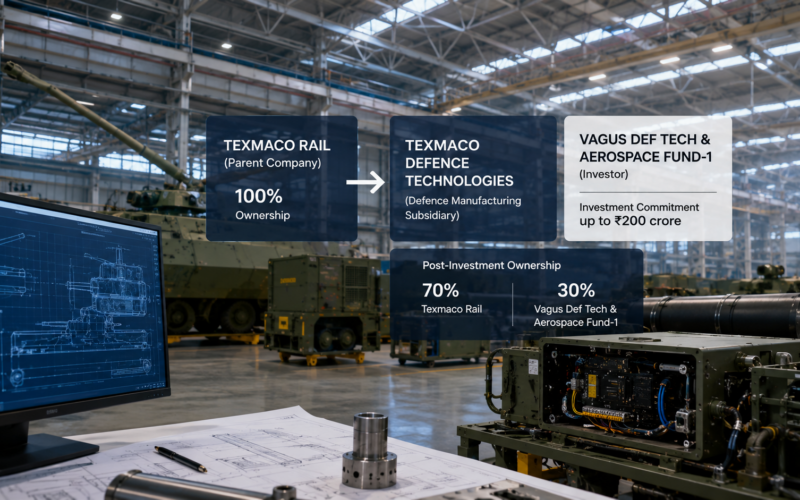
Texmaco Rail & Engineering Limited (NSE: TEXRAIL) is bringing an external institutional investor into its newly repositioned defence subsidiary, agreeing with Vagus Def Tech & Aerospace Fund-1, known as Calculus, on investment of up to ₹200 crore in Texmaco Defence Technologies Limited. The first ₹100 crore is structured as fresh equity, while the remaining ₹100 crore can be invested through equity, debt instruments or another mutually agreed form. Following completion, Calculus is expected to hold 30% of Texmaco Defence Technologies and Texmaco Rail will retain 70%, leaving the defence company as a controlled subsidiary but no longer a wholly owned one.
The transaction is notable because Texmaco Defence Technologies had reported no revenue and a net worth of only about ₹0.01 crore at March 31, 2026. Investors are therefore committing capital to a business platform before it has established a reported revenue base, effectively valuing the opportunity around Texmaco Rail’s industrial capabilities, future defence products and the policy environment supporting domestic defence manufacturing.
What does the ₹200 crore Calculus investment reveal about Texmaco Defence’s implied value?
The first ₹100 crore tranche will be subscribed through freshly issued shares, and Calculus is ultimately expected to own 30% of Texmaco Defence Technologies after the transaction. The exact implied valuation depends on the complete agreed capital structure and execution of both tranches, so simply dividing ₹200 crore by 30% would risk overstating the current equity valuation because the second ₹100 crore may include debt or another instrument.
That distinction is crucial. The headline says “up to ₹200 crore,” but only the initial ₹100 crore has a clearly disclosed fresh-equity structure. The balance can take different forms and therefore should not be treated automatically as equity purchase consideration for the same 30% stake.
The transaction was targeted for completion within approximately 90 days of the August 14 agreement, creating a near-term milestone for investors. Subsequent filings already show Texmaco Rail contributing ₹6.88 crore in equity while Vagus subscribed alongside it as the 30% investor.
The funding structure therefore appears designed to build the subsidiary’s balance sheet rather than simply pay Texmaco Rail for selling part of an existing mature business. That is economically important because fresh capital can be deployed into products, facilities and working capital inside the defence unit itself.
Why is Texmaco Rail willing to dilute its defence subsidiary before it generates revenue?
Texmaco Rail approved entry into the defence business earlier in 2026 and authorised investment of up to ₹200 crore over three to five years into Texmaco Defence Technologies. The company is seeking higher-margin specialised manufacturing opportunities under India’s defence-indigenisation programme rather than remaining overwhelmingly dependent on freight wagons and railway infrastructure.
Bringing in an external defence-focused fund can reduce how much capital Texmaco Rail itself must contribute while giving the subsidiary an investor whose return depends directly on building value in the new business. The dilution therefore trades 30% of future upside for additional capital and potentially greater financial flexibility today.
That approach can be attractive because defence manufacturing often requires investment well before revenue. Product development, testing, qualification, specialised machinery and security requirements can absorb capital for years before sizeable procurement orders arrive.
The risk is equally clear: Texmaco is giving up part of the subsidiary while commercial visibility remains limited. Whether the trade proves attractive will depend on the products developed, future contracts and the valuation at which subsequent capital enters.

How does defence fit Texmaco Rail’s strategy to reduce dependence on freight wagons?
Texmaco Rail remains a large railway-equipment manufacturer, with freight cars historically representing the majority of group revenue. FY26 consolidated gross revenue was approximately ₹4,377 crore, with freight cars accounting for roughly three-quarters and infrastructure-electrical contributing around 15%.
Management has been clear that it wants a broader earnings mix. The group has discussed defence, passenger mobility, mining, signalling and other adjacencies as a way to reduce dependence on cyclical government wagon procurement, with an ambition for newer businesses to become a much larger portion of revenue by the end of the decade.
Recent moves reinforce that diversification. Texmaco has signed a strategic collaboration with The Signalling Company NV around European Train Control System solutions and Kavach development, while it also secured a ₹77.76 crore order from IVC Logistics for ACT1 and BVCM wagons.
Defence adds another adjacent manufacturing vertical, but it is earlier in development than these railway businesses. The opportunity therefore carries greater uncertainty while potentially offering better margins if Texmaco establishes differentiated products.
Can Texmaco Rail’s ₹9,923 crore order book finance diversification without sacrificing its core business?
Texmaco entered the defence funding transaction with a consolidated order book of approximately ₹9,923 crore at June 30, after securing more than ₹5,200 crore of orders during Q1 FY27. That provides considerable visibility in the established railway and infrastructure businesses even while the company allocates management attention toward new verticals.
Q1 consolidated revenue nevertheless declined 16.9% year on year to ₹756.68 crore, illustrating that backlog conversion can be uneven. Net profit increased about 71% to ₹50.03 crore, helped by improved profitability even as wagon execution weakened.
The standalone EBITDA margin improved to about 10.8%, while financing costs also declined, suggesting the underlying core operation is becoming financially stronger as diversification accelerates.
The Calculus transaction can therefore be viewed as balance-sheet risk sharing. Instead of Texmaco Rail funding the full defence buildout internally, outside capital participates in the subsidiary while the parent preserves resources for its nearly ₹10,000 crore core order book.
Why could specialised defence products produce better economics than conventional wagon manufacturing?
Rail freight-car manufacturing can be volume intensive and competitive, with profitability influenced by steel prices, tendering and production utilisation. Defence electronics, specialised mechanical systems and indigenous subsystems can carry larger engineering content and higher qualification barriers, potentially allowing stronger margins once products reach serial production.
This explains why management has spoken about specialised defence product lines as part of a broader effort to improve group EBITDA.
However, higher theoretical margins do not guarantee high returns. Defence development cycles can be long, procurement schedules can change and companies may invest significant amounts in products that take years to secure meaningful orders.
The key missing information today is therefore product-level visibility. Investors know the capital structure and strategic ambition, but not yet the size of a recurring defence order book comparable with Texmaco’s established railway pipeline.
That information will become far more important than the initial investment announcement once the subsidiary begins bidding for and receiving contracts.
What does Texmaco Rail’s stock performance suggest about investor expectations for the defence pivot?
Texmaco Rail traded around ₹104-105 during August 20-21 after falling substantially from levels seen earlier in the year. The stock was down about 24% in 2026 by August 21 despite Q1 profit growth and a large group order book.
The subdued valuation response suggests investors are not yet treating the defence subsidiary as an established earnings contributor. That is reasonable given its nil reported revenue at the end of FY26 and the early stage of capital deployment.
The external investment nevertheless creates a clearer path toward testing the thesis. Texmaco Defence now has a defined capital partner, an agreed ownership structure and up to ₹200 crore of potential funding.
What remains unresolved is the most important part: which products turn that capital into contracts and whether those contracts deliver the higher-margin earnings profile that Texmaco Rail wants from its diversification strategy.
Discover more from Business-News-Today.com
Subscribe to get the latest posts sent to your email.


