Premier Energies Limited (NSE: PREMIERENE, BSE: 544238), the Hyderabad-based solar cell and module manufacturer, has formalised a strategic battery energy storage systems joint venture (JV) with Germany’s RCT Group as it expands beyond its established solar manufacturing operations. The October 15, 2026 agreement provides a framework for developing a proposed 12 gigawatt-hour manufacturing facility at Seetharampur in Telangana, with an initial 6 GWh phase targeted for establishment during FY2027-28. The agreement involves Premier Battery Technologies Private Limited, Premier Energies Storage Solutions Private Limited and RCT Nexor Energy Private Limited, formerly known as RCT Energy India Private Limited. The development advances Premier Energies’ diversification strategy, although manufacturing capacity remains planned rather than operational, and the new business has yet to establish a commercial revenue contribution.
The agreement follows a binding term sheet signed on September 10, 2026, moving the proposed partnership into a more detailed contractual framework. The venture aims to manufacture and assemble battery energy storage products for residential, commercial, industrial and utility-scale applications. While Premier Energies already operates a substantial solar manufacturing business, the proposed storage facility would introduce an additional product category whose economics will depend on manufacturing execution, customer orders, product competitiveness and capital deployment.
How does the RCT Group partnership change Premier Energies’ expansion into battery energy storage?
Premier Energies has been expanding its industrial footprint across the solar manufacturing value chain, including investments in cells, modules and upstream manufacturing capabilities. The proposed battery energy storage venture introduces a complementary activity that could allow the company to participate in projects requiring both renewable generation equipment and storage infrastructure. Although solar modules and battery systems serve different technical functions, developers increasingly evaluate them together when designing projects with firm or more flexible electricity delivery requirements.
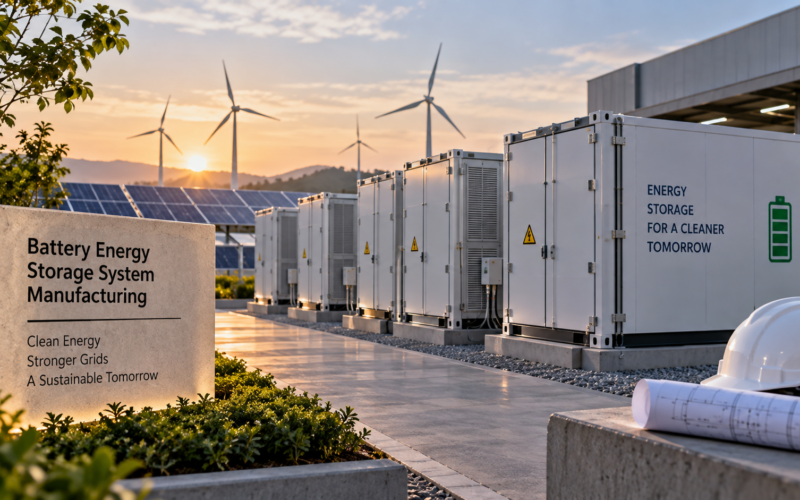
The proposed facility is intended to support production and assembly of battery energy storage products rather than necessarily establishing domestic manufacturing of every underlying battery cell or component. The disclosure refers to semi-automated or fully automated manufacturing facilities for BESS products, covering system applications across multiple customer segments. Consequently, the proposed 12 GWh capacity should be understood as planned battery energy storage system manufacturing capacity, not evidence that Premier Energies has already established battery cell production at that scale.
The initial 6 GWh phase is expected to be set up during FY2027-28, with the broader project targeting 12 GWh. The phased structure can allow manufacturing systems, supply chains and customer relationships to develop before the full planned capacity is deployed. However, the company has not established that all proposed capacity will enter commercial operation simultaneously, and production volumes will depend on commissioning, component availability, demand and plant utilisation.
RCT Group’s participation potentially provides access to technical expertise and experience in energy storage technologies, while Premier Energies contributes its existing industrial presence in India. The combination could reduce some of the organisational challenges associated with entering an unfamiliar product category, particularly where system integration and manufacturing processes require specialised capabilities. The agreement nevertheless does not guarantee commercial success, since technology transfer, manufacturing quality and customer acceptance will remain important determinants of the venture’s operating performance.
What do the joint venture ownership terms reveal about control and future equity participation?
The October 15 agreement establishes a milestone-linked ownership framework for Premier Energies Storage Solutions Private Limited. The venture company is currently wholly owned by Premier Battery Technologies Private Limited, which is itself a wholly owned subsidiary of Premier Energies Limited. RCT Nexor Energy Private Limited is expected to obtain equity participation progressively, rather than receiving its full potential stake immediately upon signing.
Under the agreement, RCT Nexor Energy Private Limited may receive equity shares aggregating to 15% of the venture’s issued and paid-up share capital across four milestone-linked tranches. The agreement also provides the German group’s Indian entity with a right, but not an obligation, to subscribe for an additional 5% equity interest for cash consideration at the end of Phase I, subject to agreed conditions. These provisions distinguish the potential future ownership structure from the company’s current shareholding position.
The joint venture’s board will comprise three directors, with Premier Battery Technologies entitled to nominate two and RCT Nexor Energy entitled to nominate one. This governance arrangement indicates that Premier Energies’ subsidiary will retain the larger representation on the venture’s board under the disclosed structure. However, the complete economics of the arrangement cannot be determined from board composition alone, particularly because operational responsibilities, commercial arrangements and future capital contributions may affect the parties’ respective interests.
The company explicitly disclosed that no immediate issue of shares was proposed under the agreement. It also stated that the transaction did not constitute a related-party arrangement and that there was no existing shareholding relationship between Premier Energies group entities and RCT Group entities. Therefore, the proposed equity participation should not be presented as an immediate sale of a completed 15% or 20% stake.
This milestone-linked structure may help align future ownership participation with progress in establishing the manufacturing venture. It could also give Premier Energies an opportunity to assess the partner’s contribution as the project advances, although the disclosure does not provide a detailed financial valuation for those contributions. Investors will need subsequent announcements to understand the capital expenditure, funding commitments and eventual economic interests associated with the manufacturing capacity.
Why is Premier Energies entering energy storage while expanding its solar manufacturing business?
India’s renewable energy sector is moving towards greater integration of generation assets, electricity storage and grid management capabilities. Solar and wind generation vary according to weather and time of day, creating demand for storage systems capable of shifting electricity delivery across different operating periods. Battery energy storage can address parts of this requirement by charging when electricity is available and discharging when system conditions or customer demand justify its use.
For Premier Energies, entering BESS manufacturing could broaden the range of products offered to renewable project developers and industrial energy customers. Its established relationships across solar equipment supply may provide opportunities to introduce adjacent products, particularly where customers require integrated procurement or technical coordination. However, the presence of existing solar customers does not automatically establish contracted storage demand, and the company has not disclosed a confirmed BESS order book associated with the new facility.
The broader expansion strategy includes significant investments across solar cells, modules, upstream ingot and wafer capabilities and adjacent electrical equipment categories. Premier Energies previously disclosed plans for capital expenditure exceeding ₹12,000 crore across multiple manufacturing initiatives, including roughly ₹6,000 crore for upstream ingot and wafer development over three years. The battery storage project therefore forms part of a wider industrial diversification programme rather than a standalone replacement for the company’s solar business.
That programme introduces both strategic opportunities and capital-allocation challenges. Manufacturing expansion requires expenditure before the associated capacity necessarily begins generating revenue, while specialised components and production equipment can influence initial working-capital requirements. Returns will depend on utilisation, product pricing, customer contracts and the ability to operate new production lines efficiently.
Premier Energies’ solar business provides a financial base for this expansion. In its first-quarter FY2027 results, the company reported consolidated total income of approximately ₹2,508 crore, EBITDA of ₹759 crore and profit after tax of approximately ₹472 crore. The figures represented year-on-year growth of about 34%, 27% and 53%, respectively, demonstrating the scale of the existing business while also providing context for the capital required to develop additional manufacturing capabilities.
Can the planned 12 GWh battery storage facility become a meaningful revenue source for Premier Energies?
The proposed capacity is substantial, but annual energy storage manufacturing capacity should not be confused with the power rating of a particular installation or the amount of electricity a completed project will deliver. Gigawatt-hours measure energy capacity, while megawatts measure power output, and the relationship between the two depends on system duration and operating specifications. Without details of the final product mix, manufacturing utilisation, selling prices and customer contracts, a defensible revenue estimate cannot yet be derived from the announced 12 GWh figure.
The project is expected to serve several customer categories, ranging from smaller installations to utility-scale storage projects. These markets have different technical requirements, commercial sales cycles and competitive environments. Utility-scale customers may place greater emphasis on lifecycle economics, warranties, system reliability and large-project delivery, while commercial and industrial buyers may evaluate storage alongside electricity tariffs, backup power needs and onsite renewable generation.
Domestic manufacturing could offer advantages where customers place value on local supply chains, installation support and after-sales service. However, competitiveness will also depend on the sourcing of battery cells, power conversion systems, thermal management equipment and other critical components. The announced partnership does not establish the proportion of components that will be manufactured domestically or imported.
The proposed first phase provides an identifiable development timetable, but the company has not disclosed enough information to independently estimate construction cost per GWh or the venture’s future operating margins. Subsequent announcements concerning equipment procurement, financing, plant commissioning and customer orders would provide stronger evidence of commercial readiness. Until those milestones are achieved, the investment should be viewed as an expanding strategic capability rather than an established earnings contributor.
What does the Premier Energies share price indicate about market expectations for the storage venture?
Premier Energies shares closed around ₹906.55 on the National Stock Exchange on October 16, down approximately 0.9% from the previous session. The share-price movement indicates that the announcement did not generate an immediate sustained positive reaction during the observed trading session. However, the price movement cannot be attributed exclusively to the storage agreement because broader market conditions, expectations and other company-related factors may also have influenced trading.
The relatively subdued reaction is understandable in the context of a long-dated industrial project. The agreement strengthens the formal structure of an expansion initiative that was already announced in September, but it does not immediately create operating capacity, customer revenue or a measurable increase in consolidated earnings. The eventual financial implications will become clearer as project expenditure, commissioning schedules, ownership participation and commercial orders are disclosed.
Premier Energies’ broader financial performance will continue to be driven primarily by its existing solar manufacturing operations until the new businesses make material contributions. Investors will therefore need to assess execution across several simultaneous projects, including the utilisation of expanded cell and module capacity and the planned entry into adjacent product categories. The capital intensity of these initiatives makes cash generation and disciplined deployment important alongside reported profit growth.
The immediate next milestones for the battery storage venture are the fulfilment of initial contractual milestones, further details of manufacturing investment and progress towards the first 6 GWh phase. Evidence of committed customer demand and a credible project commissioning timetable would strengthen the commercial case for the planned capacity. Conversely, cost escalation, delays or insufficient order conversion could reduce the returns generated by the expansion even if the project ultimately reaches its targeted manufacturing scale.
What are the key takeaways from Premier Energies’ 12 GWh BESS joint venture agreement?
- Premier Energies has formalised its BESS partnership with Germany’s RCT Group.
- The proposed manufacturing capacity totals 12 GWh.
- The first 6 GWh phase is expected to be set up during FY2027-28.
- The project is planned for Seetharampur in Telangana.
- RCT Nexor Energy may receive a milestone-linked 15% equity stake.
- The partner has an option to subscribe for another 5% after Phase I.
- No immediate share issuance was proposed under the agreement.
- The venture targets residential, commercial, industrial and utility-scale applications.
- Premier Energies is diversifying beyond its established solar manufacturing business.
- Project expenditure, commissioning and customer orders will determine the eventual financial contribution.
Discover more from Business-News-Today.com
Subscribe to get the latest posts sent to your email.