



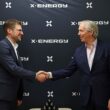

Hafnia Limited (NYSE: HAFN; Oslo Børs: HAFNI) has completed its planned CEO succession, with Søren Steenberg Jensen taking control on September 1 after Mikael Skov led the product-tanker company from its formation into one of the industry’s largest commercial platforms. Hafnia emphasised that the leadership change does not alter its strategy or operating model, while Skov is expected to remain closely connected with the company through a proposed board appointment subject to approval at a September 23 extraordinary general meeting.
Jensen begins his tenure immediately after one of Hafnia’s strongest quarters. Net profit surged to $277.8 million from $75.3 million a year earlier, while time-charter-equivalent earnings increased to $372.9 million from $231.2 million. Adjusted EBITDA more than doubled to $287.3 million from $134.2 million, driven by strong tanker markets and favourable shipping dynamics.
The board also approved $250 million of second-quarter dividends, equivalent to $0.5003 per share and a 90% payout ratio. That combination creates a very different CEO challenge from a turnaround situation. Jensen takes over a company producing exceptional cash returns, meaning his task is to preserve discipline during a strong freight market rather than simply chase additional fleet growth while earnings are elevated.
Why did Hafnia choose Søren Steenberg Jensen as Mikael Skov’s successor?
Jensen has been closely involved with Hafnia’s strategy and previously served as Executive Vice President and Head of Asset Management, giving him direct responsibility for one of the most important areas of a tanker company’s economics. Asset management determines how vessels are acquired, maintained, financed, deployed and eventually sold, making capital discipline central to the role.
Chairman Andreas Sohmen-Pao described Jensen as a natural successor because of his long involvement in Hafnia’s strategy and culture. Skov similarly said Jensen understands the business, employees and opportunities ahead, indicating that the board wanted continuity rather than a major strategic reset.
Jensen has already said the company’s strategy will not change on September 1. His priorities are disciplined commercial execution, operational excellence, digitalisation and maintaining the existing capital-allocation framework through what he expects could remain a volatile market.
That statement is important because tanker companies can destroy shareholder value by expanding aggressively near cyclical peaks. Hafnia’s board appears to believe an executive deeply familiar with asset economics is well positioned to avoid that temptation.
How extraordinary was Hafnia’s second quarter?
Hafnia’s $277.8 million second-quarter profit was nearly 3.7 times the $75.3 million earned a year earlier. Adjusted EBITDA increased approximately 114% to $287.3 million, while TCE earnings rose about 61% to $372.9 million.
Average TCE reached $44,093 per day. Tanker earnings can fluctuate sharply based on vessel supply, refinery output, trade routes, sanctions, geopolitical disruption and the distances products need to travel between suppliers and customers.
Those factors have been unusually supportive in 2026. Longer trade routes and disruption across global energy markets have increased tonne-mile demand, effectively requiring ships to spend more days carrying the same quantity of cargo.
That creates strong operating leverage for tanker owners because once vessel operating costs are covered, additional freight-rate revenue can translate quickly into profit.
Why is Hafnia returning 90% of quarterly profit to shareholders?
Hafnia’s dividend framework is designed to return a large portion of earnings when leverage and liquidity permit. For the second quarter, the company will distribute $250 million, equivalent to approximately 90% of reported net profit.
That capital discipline distinguishes tanker operators that prioritise cash returns from companies that reinvest every cyclical windfall into additional ships. Buying vessels when freight rates and asset prices are high can lead to poor returns if markets normalise before new capacity has earned back its cost.
Jensen has explicitly committed to Hafnia’s existing payout policy and investment strategy. That gives investors an early indication that the CEO transition is not intended to trigger an aggressive expansion programme.
The challenge is maintaining enough flexibility to invest when attractive opportunities arise without undermining dividend expectations that have become an important part of the stock’s appeal.
How much of Hafnia’s third-quarter earnings are already visible?
As of August 17, Hafnia had covered approximately 80% of its total third-quarter earning days at an average TCE of $30,716 per day. That rate is below the exceptional second-quarter average of $44,093 but still provides substantial visibility into near-term revenue.
The decline also illustrates the cyclicality Jensen must manage. Shipping investors cannot simply annualise one exceptional quarter because spot freight rates can change dramatically over short periods.
A CEO therefore needs to make capital decisions based on through-cycle economics rather than the strongest recent rate.
The fact that 80% of the quarter was already booked reduces near-term uncertainty while leaving enough spot exposure for Hafnia to benefit if tanker markets strengthen again.
Why does Mikael Skov’s proposed board move matter?
Skov has led Hafnia since its establishment in 2010 and played a defining role in building the company’s fleet, commercial platform and culture. Moving him toward a board position preserves access to that experience without leaving two executives simultaneously trying to operate the company.
The September 23 extraordinary general meeting will consider his board appointment. If approved, Jensen gains continuity at governance level while remaining clearly responsible for executive management.
That structure can work particularly well in shipping, where relationships with charterers, shipyards, financiers and partners are often developed over many years.
The key will be maintaining clear boundaries. Skov’s industry knowledge can support the new CEO, but Jensen needs sufficient independence to make asset and capital-allocation decisions as market conditions change.
What does Hafnia stock performance say about the handover?
Hafnia’s New York-listed shares closed at $8.44 on August 31. That compares with $8.13 on August 24, representing a roughly 3.8% five-session increase, while the July 31 close of $7.69 implies a one-month gain of approximately 9.8%.
The stock’s 52-week range is approximately $5.17 to $9.54. At $8.44, Hafnia was around 11.5% below the annual high but more than 63% above its 52-week low. Its market capitalisation stood around $4.22 billion.
Those numbers indicate that investors have already responded positively to stronger tanker economics. Jensen therefore inherits a valuation that reflects substantial optimism without sitting at an outright annual peak.
The dividend also remains a major attraction. At recent prices, Hafnia’s trailing indicated dividend yield is unusually high, although future distributions will naturally depend on earnings and board decisions rather than remaining fixed.
Why could digitalisation become increasingly important under Jensen?
Jensen has identified digitalisation as one of his operating priorities, which is significant for a shipping business managing vessels, chartering decisions, maintenance schedules, fuel consumption and regulatory compliance across a global network.
Digital tools can improve vessel routing, maintenance forecasting and fuel efficiency while helping commercial teams evaluate charter opportunities more quickly. Even small efficiency improvements can matter when applied across a large fleet over thousands of operating days.
Data also becomes increasingly valuable as carbon and emissions regulation tighten. Shipping companies need better information on fuel use, vessel efficiency and future compliance costs when deciding which ships to retain or replace.
The opportunity is therefore not technology for its own sake. It is using operational data to increase earnings per vessel and extend asset value.
What should investors watch during Søren Steenberg Jensen’s first year?
Freight rates remain the most immediate variable. The second quarter produced an average TCE of $44,093 per day, while 80% of third-quarter days were booked at $30,716, showing that earnings can move materially even over one quarter.
Capital allocation is the second test. Jensen has committed to the current payout framework, so investors will watch whether Hafnia continues returning a substantial proportion of cash during strong markets rather than overpaying for vessels.
Fleet investment also matters. Asset values can rise rapidly during tanker upcycles, increasing the risk of buying at the wrong point.
Finally, Jensen needs to demonstrate that the transition from a founder-era operating leader does not weaken commercial execution. Mikael Skov helped build Hafnia into a global platform over more than 15 years. Jensen inherits that platform at a moment when profits are exceptionally strong.
The handover therefore has a simple strategic tension. Hafnia does not need a new CEO to create a successful tanker company. It already has one. Søren Steenberg Jensen needs to prove he can protect the value created by his predecessor when shipping markets inevitably become less favourable than they are today.
Discover more from Business-News-Today.com
Subscribe to get the latest posts sent to your email.



