

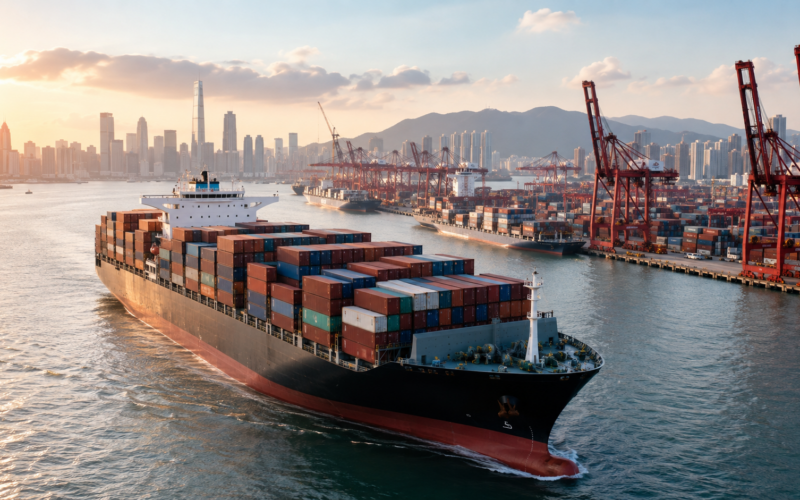
Seaspan Corporation Pte. Ltd. has entered China’s domestic Panda bond market with a RMB 1.5 billion private placement, becoming what the company describes as the first international ship owner and operator to use the funding channel. The three-year notes were issued on July 15, 2026 at an annual coupon of 2.50%, while investor orders reached 2.3 times the amount offered. For Seaspan, the significance extends beyond raising another tranche of debt because the transaction adds a large domestic Chinese investor market to an increasingly diversified financing platform. The central question is whether access to relatively low-cost renminbi funding becomes a repeatable part of Seaspan’s capital structure as its fleet and asset commitments expand.
The financing arrives at an important point in Seaspan’s evolution. As of June 30, 2026, the company reported a fleet of 247 vessels on a pro forma basis including undelivered newbuilds, representing approximately 2.5 million twenty-foot equivalent units of capacity on a fully delivered basis. The portfolio is also becoming more diverse, with Seaspan moving beyond its traditional containership focus through Pure Car and Truck Carriers, Very Large Ethane Carriers and Open Hatch Gantry Crane vessels.
That expansion increases the importance of financing flexibility. Shipping is an unusually capital-intensive business, and vessel acquisition programmes often involve large commitments stretching over several years. A ship owner capable of moving among bank loans, secured facilities, unsecured bonds and different geographic capital markets can potentially reduce dependence on any single funding source while matching financing structures more closely with individual investment programmes.
Seaspan’s Panda bond therefore matters less because RMB 1.5 billion alone changes the company’s scale and more because it establishes another route through which capital can potentially be raised in future.
Why does Seaspan’s RMB 1.5 billion Panda bond matter for its long-term funding strategy?
Panda bonds are renminbi-denominated debt securities issued in China by overseas entities. For an international maritime company such as Seaspan, admission to this market effectively expands the pool of investors that can participate in its unsecured debt financing.
The July transaction was structured as a three-year private placement note carrying a 2.50% annual coupon. The 2.3-times book coverage indicates demand exceeded the securities available, although oversubscription should not automatically be interpreted as evidence that every future Seaspan transaction would attract similar pricing or demand.
The strategic value is diversification.
Maritime companies historically rely heavily on secured bank lending because vessels themselves provide identifiable collateral. That model can be efficient, but excessive dependence on secured borrowing can gradually encumber more of a company’s asset base. Access to unsecured capital can provide additional flexibility because financing does not necessarily need to be attached to individual vessels.
For Seaspan, which has spent years building a larger pool of financing relationships and unsecured capital-market access, the Panda bond represents another step in that direction.
Management specifically linked the issuance to diversifying funding sources, broadening access to unsecured debt and supporting future investment in the fleet. The commercial test will be whether the Chinese market can be accessed repeatedly and at pricing that remains competitive after fees, currency management and other transaction costs are considered.
That distinction matters. Opening a capital market is valuable. Building a durable funding programme inside that market is considerably more valuable.

How does the 2.50% Panda bond coupon compare with Seaspan’s broader credit position?
The 2.50% headline coupon is likely to attract attention because it appears low compared with many international corporate bond coupons, particularly for issuers below investment grade. Direct comparisons, however, require caution because different currencies have different interest-rate environments, investor bases, maturities and hedging costs.
The more important signal is that Seaspan was able to place unsecured three-year renminbi debt with both Chinese onshore and international investor participation.
That development follows an improvement in Seaspan’s credit profile. Standard & Poor’s upgraded Seaspan’s issuer credit rating from BB- to BB in December 2025 and maintained a stable outlook. The ratings agency pointed to greater scale, improved profitability and earnings stability despite volatility in shipping markets.
BB nevertheless remains below investment-grade territory.
The Panda bond should therefore be viewed as evidence of improving financing optionality rather than proof that Seaspan has completed its credit transition. Continued progress will depend on leverage, cash generation, capital expenditure, charter coverage and management’s ability to fund growth without weakening the financial profile that helped support the rating upgrade.
There is also a currency dimension. Seaspan operates internationally and much of global shipping economics is conventionally denominated in United States dollars, while the Panda bond creates a renminbi liability. The company’s announcement did not provide detailed information on currency hedging arrangements for the issuance. Consequently, the economic cost cannot be assessed simply by looking at the 2.50% coupon.
If renminbi funding can be matched naturally against Chinese expenditure or efficiently hedged, however, access to the Panda bond market could become particularly useful.
Why is China strategically important to Seaspan beyond simply providing cheaper financing?
Seaspan’s relationship with China extends much further than this bond transaction.
China sits at the centre of global commercial shipbuilding and is increasingly important across maritime equipment, financing, logistics and vessel services. Seaspan said its existing relationships in the country cover chartering, shipbuilding, financing and maritime services.
That creates an unusually strong strategic logic for developing a local capital-market presence.
A ship owner ordering vessels from Chinese shipyards, working with Chinese maritime counterparties and potentially incurring renminbi-denominated expenditure can benefit from having another source of renminbi financing available. Even where funding is ultimately converted or hedged, deeper relationships with domestic financial institutions can broaden the company’s options when new projects emerge.
Seaspan’s recent portfolio expansion makes that increasingly relevant.
During 2026, the company moved into gas transportation with a five-vessel programme of 100,000-cubic-metre Very Large Ethane Carriers. It also expanded into specialised dry-bulk logistics through four 65,400-deadweight-tonne Open Hatch Gantry Crane newbuilds and began taking delivery of a six-vessel series of large dual-fuel liquefied natural gas Pure Car and Truck Carriers.
Seaspan has simultaneously been investing in the efficiency and emissions profile of its existing fleet, including conventional-to-methanol vessel conversions.
These initiatives widen the potential capital requirement beyond conventional containership acquisitions. A more diverse asset portfolio can create new revenue opportunities, but it also increases the importance of disciplined capital allocation because different vessel segments have different customers, charter structures, residual-value risks and operating characteristics.
The Panda bond gives Seaspan another financing instrument with which to manage that expansion.
It does not eliminate the need to prove that the investments themselves generate attractive returns.
Could Seaspan’s transaction encourage other international shipping companies to issue Panda bonds?
Seaspan’s claim to be the first international ship owner and operator to enter the Panda bond market gives the transaction wider industry relevance.
China has been progressively opening its domestic bond markets to overseas issuers. Panda bond issuance has developed from a relatively specialised financing route into a much larger market used by sovereign entities, international institutions, financial companies and multinational corporations.
Chinese authorities have also continued refining registration, disclosure and issuance mechanisms for foreign issuers. The People’s Bank of China said cumulative Panda bond issuance had surpassed RMB 1 trillion by August 2025, illustrating how rapidly the market has expanded.
Shipping could become a natural additional category.
International ship owners have unusually strong economic connections with China because the country is one of the world’s most important shipbuilding centres and a major source of maritime financing, manufacturing and cargo demand. For companies with sufficient scale and credit quality, domestic renminbi issuance could complement traditional European, Nordic, Asian and United States dollar funding markets.
Seaspan’s transaction provides an observable pricing and execution reference for competitors evaluating that possibility.
The 2.3-times coverage is particularly useful in that respect because it demonstrates that a substantial maritime issuer can attract a broader investor book. Whether that results in a meaningful wave of shipping Panda bonds will depend on pricing conditions, regulatory requirements and whether issuers have sufficient renminbi needs to justify entering the market.
Seaspan may have opened the door, but economics will determine how many others walk through it.
What does Seaspan’s expanding 247-vessel portfolio mean for future capital requirements?
Scale changes financing requirements.
Seaspan’s fleet has expanded materially in recent years, and Standard & Poor’s cited increasing fleet size and capacity as part of the rationale for its December 2025 rating upgrade. A larger portfolio can increase earnings visibility when vessels are secured on long-term charters, but it also creates sizeable refinancing, maintenance and fleet-renewal obligations.
Seaspan’s operating model reduces some of the volatility traditionally associated with shipping because it focuses heavily on long-term, fixed-rate leasing arrangements with major liner customers rather than relying entirely on short-term freight-market exposure.
That distinction is central to the credit story.
Predictable charter income can support long-duration financing because creditors have greater visibility into the underlying cash flows expected to service debt. Nevertheless, charter coverage does not make the business risk-free. Counterparty concentration, vessel values, interest rates, refinancing conditions and the cost of maintaining an increasingly technologically complex fleet remain important variables.
The company is also broadening its exposure beyond containerships. That creates a new analytical question for creditors: can Seaspan reproduce the economics and operating discipline of its container leasing platform across car carriers, gas transportation and specialised bulk vessels?
Funding availability is therefore only one side of the equation.
The other is whether new capital can be deployed into vessels carrying contracts and economics strong enough to preserve returns after financing costs.
Why could unsecured debt become increasingly valuable as Seaspan expands its maritime asset base?
One of the less visible advantages of unsecured borrowing is the optionality it can create around assets.
Secured vessel financing remains an essential part of shipping finance and can provide attractive borrowing terms. Yet every vessel pledged against a loan becomes part of a specific collateral package, potentially restricting how freely that asset can later be sold, refinanced or reorganised.
A larger unsecured funding pool can reduce that dependence.
This becomes particularly important for a company pursuing multiple vessel programmes simultaneously. Management may want the freedom to refinance one class of ships, sell selected assets, retrofit older vessels or move capital between segments without having every financing decision tied to individual hulls.
Seaspan has pursued broader unsecured capital-market access for several years. Its Panda bond extends that strategy geographically as well as structurally.
The transaction could also strengthen negotiating leverage across other funding channels. Companies with several credible sources of capital are generally less dependent on accepting the terms available from any one lender group or bond market.
That does not mean unsecured borrowing is inherently superior. Pricing, covenants, maturities and refinancing risk ultimately determine the relative attractiveness of each instrument.
The advantage lies in having choices.
What could prevent the Panda bond market from becoming a major funding source for Seaspan?
The first constraint is economics.
The 2.50% coupon is attractive at face value, but Seaspan must consider the full economic cost of renminbi financing, including foreign-exchange management, transaction expenses and any hedging required to align the debt with underlying cash flows.
The second constraint is market capacity.
A successful RMB 1.5 billion issue demonstrates investor demand for this particular transaction. It does not establish how much additional Seaspan debt Chinese investors would absorb at comparable pricing or how market conditions would change during periods of tighter domestic liquidity.
The third issue is maturity concentration.
A three-year instrument is useful for funding flexibility, but shipping assets have operating lives measured in decades. An effective capital structure requires a mixture of maturities so that large refinancing requirements do not cluster during unfavourable credit-market conditions.
Finally, capital availability can create its own discipline problem.
The easier it becomes to raise money, the more important it becomes to maintain stringent return thresholds for new investments. Seaspan’s diversification into different vessel categories increases its opportunity set, but each investment still needs to produce contracted returns capable of compensating for construction, technology, residual-value and counterparty risks.
The Panda bond therefore improves the financing toolkit. It does not by itself improve the economics of the assets financed with that toolkit.
Key takeaways from Seaspan’s RMB 1.5 billion Panda bond financing
- Seaspan Corporation Pte. Ltd. issued RMB 1.5 billion of three-year Panda bonds on July 15, 2026.
- The private-placement notes carry a 2.50% annual coupon.
- Investor orders produced book coverage of 2.3 times the amount issued.
- Seaspan says it is the first international ship owner and operator to access China’s Panda bond market.
- The transaction adds another unsecured funding channel as Seaspan expands its fleet and maritime asset portfolio.
- Seaspan reported 247 vessels on a pro forma basis as of June 30, 2026, representing approximately 2.5 million twenty-foot equivalent units on a fully delivered basis.
- The company is diversifying beyond containerships into car carriers, Very Large Ethane Carriers and specialised Open Hatch Gantry Crane vessels.
- Standard & Poor’s upgraded Seaspan to BB with a stable outlook in December 2025, although the rating remains below investment grade.
- The strategic value of the Panda bond will depend on whether Seaspan can access the market repeatedly at competitive all-in funding costs.
- Future credit progress will ultimately depend on disciplined capital deployment, leverage management and cash generation rather than funding availability alone.
What will show whether Seaspan’s Panda bond debut creates lasting strategic value?
Seaspan has achieved something more important than simply adding RMB 1.5 billion of debt to its balance sheet. It has established access to a deep domestic capital market located within one of the most important countries in its maritime ecosystem.
The immediate outcome looks favourable. Demand exceeded the amount issued, the coupon was 2.50%, and the financing expands Seaspan’s unsecured debt options at a time when its asset base is becoming larger and more diverse.
What remains unresolved is whether this becomes a recurring financing platform.
A second Panda bond, a larger programme or repeated issuance across different maturities would provide stronger evidence that China has become a permanent component of Seaspan’s capital structure. Equally important will be evidence that the vessels and projects funded by an increasingly diversified financing base generate sufficient contracted cash flow to preserve credit quality.
That is the real significance of the transaction. Seaspan has demonstrated that it can reach another pool of capital. The next measurable test is whether management can turn that additional financial flexibility into profitable fleet growth without allowing expansion to outrun balance-sheet discipline.
Discover more from Business-News-Today.com
Subscribe to get the latest posts sent to your email.