



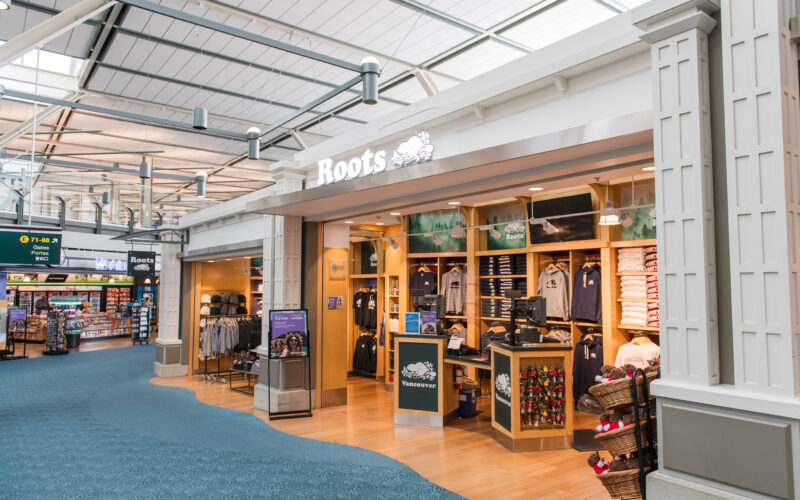
Roots Corporation (TSX: ROOT) has opened a store at Vancouver International Airport in partnership with Hudson, part of global travel retailer Avolta, as the Canadian apparel company expands its presence in airport retail. Located after security at Gate E88 in the United States Departures Terminal, the store gives Roots access to travellers at one of Canada’s busiest international gateways. The assortment combines the company’s established comfortwear with Vancouver-themed clothing, Canadian-made products and travel-friendly accessories. Strategically, the opening could help Roots reach customers outside its conventional mall, street and ecommerce channels, although the financial significance will depend on whether airport retail can deliver attractive sales productivity and be replicated across additional locations.
The July 23 opening is modest in physical scale, but it arrives during a consequential period for Roots Corporation. The company is completing a distribution centre transition, managing margin pressure and continuing a board-led review of strategic alternatives that could include a sale of the business. Against that backdrop, the Vancouver International Airport store is best understood as a test of brand portability: can Roots convert its Canadian identity into commercially productive retail space wherever tourists, business travellers and international consumers already gather?
Why is Vancouver International Airport a strategically useful test market for Roots travel retail?
Vancouver International Airport handled more than 26.9 million passengers during 2025, a record for the airport and a 2.7% increase from the previous year. Management at the airport has forecast approximately 27.1 million passengers for 2026, providing Roots with a large potential audience without requiring the company to build demand around a traditional neighbourhood catchment area.
Airport retail differs from an ordinary apparel store because the customer is already travelling, often has time available after clearing security and may be more receptive to compact purchases connected with place, identity or gifting. Roots appears to have designed its YVR range around those behaviours.
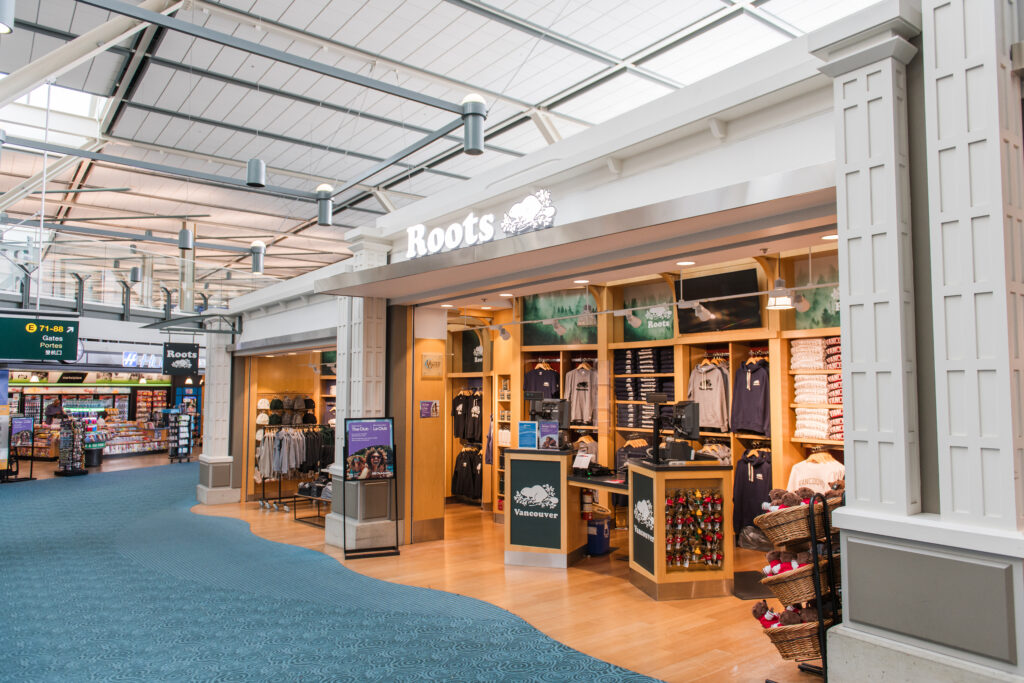
The store carries Original Sweats, Vancouver graphic fleece, T-shirts, Made in Canada collections and smaller accessories such as Cabin socks, keychains and beaver-themed products. Selected Vancouver graphic styles are exclusive to the airport location. That mix gives the store several ways to capture spending, ranging from higher-value apparel purchases to lower-cost souvenirs that can be bought quickly before departure.
Destination-exclusive merchandise is particularly important. A standard Roots assortment would give travellers another place to buy products available through the company’s wider store network or website. Exclusive Vancouver items create scarcity, strengthen the connection between the product and the journey, and reduce direct price comparison with other Roots channels.
The location nevertheless creates an important limitation. Because the store is situated after security in the United States Departures Terminal, it is not accessible to every passenger travelling through Vancouver International Airport. Its addressable traffic is concentrated among customers flying to the United States rather than the airport’s entire annual passenger base.
That distinction matters because transborder passenger traffic at Vancouver International Airport fell 7.1% during 2025, even as domestic traffic and Asia-Pacific travel increased. Roots is therefore entering a high-volume airport, but within a terminal segment that recently experienced softer traffic than the broader airport system.
The store’s success will depend less on headline airport passenger numbers and more on the volume, dwell time, nationality, spending behaviour and conversion rate of travellers passing Gate E88. A small number of highly productive square feet could still generate attractive economics, but Roots has not disclosed expected revenue, rent commitments, sales-density targets or the duration of its arrangement with Hudson.
How could the Hudson partnership change the economics of Roots’ airport expansion?
Roots is not operating the YVR store entirely on its own. The location is being run in partnership with Hudson, the North American travel retailer owned by Avolta. This potentially gives Roots access to airport retail expertise, operating infrastructure and landlord relationships that would be difficult to reproduce internally for every location.
Airports are specialised commercial environments. Retailers must manage security requirements, restricted delivery windows, irregular traffic patterns, compact storage space and demand that changes according to airline schedules. Hudson’s familiarity with those conditions could reduce execution complexity and allow Roots to focus on merchandise, brand presentation and product supply.
The partnership may also provide a more capital-efficient route into airport retail than building and staffing a conventional corporate store. However, the announcement did not disclose the commercial structure. It remains unclear whether Roots will record wholesale revenue from products sold to Hudson, licensing income, a share of store sales or another form of partner revenue.
That accounting distinction is important for investors. Wholesale or licensing arrangements may produce lower reported revenue than a directly operated store, but they can also involve lower occupancy, labour and operating costs. Direct retail can generate more revenue per sale while exposing the company to more fixed expenses and inventory risk.
Without the contract economics, the store should not automatically be described as either a high-margin licensing opportunity or a major direct-to-consumer expansion. The more defensible conclusion is that Hudson provides Roots with a potentially scalable operating partner while the commercial returns remain undisclosed.
Roots already has a travel retail presence at Taoyuan International Airport in Taiwan. The Vancouver opening therefore extends an existing strategy rather than creating an entirely new channel. Management has also indicated that it will examine additional travel retail opportunities across Canada.
The next phase will show whether Roots can use Hudson or other operators to assemble a network of airport locations without adding excessive fixed costs. A multi-airport programme could make travel retail strategically meaningful. A handful of isolated stores would be more valuable as brand exposure than as a material earnings driver.
Can destination-exclusive products turn airport footfall into higher-value Roots sales?
Roots has an advantage that many apparel retailers would struggle to reproduce: its brand is closely associated with Canada. That identity has potential commercial value in airports, tourism districts and other locations where shoppers are actively seeking products connected with their destination.
The Vancouver merchandise gives Roots a way to combine that national positioning with local relevance. Canadian-made collections may appeal to customers seeking authenticity, while Vancouver graphics allow the company to offer a location-specific product without repositioning the entire brand.
The airport environment also fits Roots’ emphasis on comfort. Sweatshirts, casual clothing, socks, bags and accessories can be presented as products suitable for long flights, changing temperatures and leisure travel. Management has described airports as a natural extension of the company’s retail strategy because the product range already emphasises comfort and versatility.
The strategic opportunity is not limited to immediate store sales. Airport locations can introduce Roots to international customers who may later purchase through ecommerce or partner-operated stores in Asia. That effect is difficult to measure, but it gives travel retail a potential customer-acquisition role alongside its direct commercial purpose.
Roots will still need to resist the temptation to treat every airport as an advertising venue. Airport space can be expensive, and a strong brand presence does not guarantee acceptable store-level profitability. Merchandise planning must account for luggage constraints, short shopping windows and customers who may be unfamiliar with Canadian apparel sizing or price points.
The most productive assortment may therefore differ from what works in a conventional Roots store. Smaller accessories, easily packed garments, destination graphics and recognisable core products may generate better conversion than a broad apparel presentation. Inventory depth will also need to be carefully managed because replenishment inside an airport can be more operationally demanding.
Why does the YVR opening matter during Roots Corporation’s strategic review?
Roots Corporation’s board began reviewing strategic alternatives in March 2026, including the possibility of selling the company. The process remained active when Roots reported its first-quarter results in June, although no transaction or preferred outcome had been announced.
The airport opening demonstrates that management is continuing to execute the operating plan while the board considers ownership alternatives. That is important because a strategic review can create uncertainty inside a business, particularly when management teams, suppliers and commercial partners are unsure whether the company will remain independent.
Expanding through Hudson suggests that Roots continues to negotiate partnerships and pursue channel development rather than placing the business into a holding pattern. For a potential buyer, travel retail could also represent an underdeveloped route for extending the brand without relying entirely on new corporate stores.
The strategic-review context nevertheless raises the threshold for what investors may consider material. A single airport store is unlikely to determine the company’s valuation or materially alter negotiations with prospective buyers. Its relevance lies in what it could reveal about the wider brand.
If Roots can demonstrate that its Canadian identity travels well across airports, tourism centres and international partner locations, a buyer may see more geographic and channel potential than is visible from the existing Canadian store base. If the store performs only as a niche souvenir outlet, its strategic contribution will be more limited.
The announcement therefore adds a potentially useful proof point, but not a completed growth thesis. Store productivity, repeat purchases, partner economics and the number of additional locations will matter more than the ceremonial opening itself.
What do Roots’ latest financial results reveal about its capacity to support expansion?
Roots entered the airport initiative with improving sales momentum but several competing operational priorities. First-quarter fiscal 2026 sales increased 6.5% to C$42.6 million, while direct-to-consumer sales rose 3.3% to C$35.8 million. Comparable direct-to-consumer sales grew 3.2%, marking the seventh consecutive quarter of comparable growth.
The Partners and Other segment, which includes wholesale, licensing and custom-product activities, grew 26.6% to C$6.8 million. That performance is relevant to the airport strategy because partner-led distribution is becoming an increasingly visible contributor to growth. The company said the increase reflected stronger domestic wholesale, custom-product and licensing activity as well as expansion in the customer base.
Profitability was less straightforward. Gross margin declined to 59.9% from 61.5%, partly because Roots increased final-sale activity ahead of its distribution centre transition and faced unfavourable foreign-exchange effects on United States dollar purchases. Adjusted EBITDA was negative C$7.4 million, compared with negative C$7.1 million a year earlier, while the quarterly net loss widened to C$10.1 million from C$7.9 million.
The first quarter is seasonally small for Roots, historically representing approximately 14% of annual sales. Even so, the results illustrate the company’s central financial challenge. Sales are growing, but temporary project costs, occupancy expenses, personnel spending and margin pressure can absorb that growth before it reaches earnings.
Roots is simultaneously moving its distribution operations to Metro Supply Chain. The company recorded C$1.8 million of incremental transition costs during the first quarter and expected the third-party distribution centre to become fully operational by the end of the second quarter. It also incurred C$0.6 million of consulting and legal costs connected with the strategic review.
Liquidity does not appear to prevent measured experimentation. Roots ended the quarter with C$53.7 million of total liquidity and reduced net debt by 20.7% year over year to C$23.4 million. However, inventory increased 11.1% to C$45 million, reinforcing the importance of disciplined purchasing as the company expands into new channels.
A partner-operated airport model could be attractive precisely because Roots has other capital and management priorities. The strongest travel retail strategy would add distribution and brand exposure without recreating the full cost structure of a corporate-store expansion programme.
What does recent Roots stock performance reveal about current investor expectations?
The latest reliably verified market close before the airport announcement placed Roots shares at C$3.45 on July 22. That represented an increase of approximately 3.9% from the July 16 close of C$3.32, but a decline of about 15.6% from C$4.09 on June 23. The stock remained within a 52-week range of C$2.81 to C$4.70 and traded approximately 26.6% below the upper end of that range.
Because the verified price predates the July 23 announcement, it would be inaccurate to attribute the recent movement to the airport store. The broader pattern suggests that enthusiasm surrounding Roots’ strategic review and improving operating performance has been moderated by uncertainty over margins, seasonal losses and the timing or outcome of any corporate transaction.
The YVR opening is unlikely to produce an immediate valuation change on its own. Small retail openings generally become financially relevant only when management discloses store economics, expands the concept or demonstrates that the channel is influencing comparable sales, partner revenue or margins.
Investor sentiment is therefore likely to remain anchored to larger catalysts. These include completion of the distribution centre transition, second-quarter operating performance, margin normalisation and any formal development arising from the strategic review.
Travel retail can support that investment narrative, but it cannot substitute for it.
What must Roots demonstrate before travel retail can influence its valuation?
The Vancouver International Airport store gives Roots a credible platform to test exclusive merchandise, travel-focused products and partner-operated retail in Canada. The airport’s record passenger volumes and the company’s recognisable national identity create a commercially logical starting point.
What remains unresolved is the store’s economic importance. Roots has not disclosed its investment, revenue-sharing structure, expected sales, margin profile or expansion timetable. Investors therefore have evidence of strategic intent but not yet evidence of financial contribution.
The next measurable proof point will be additional airport openings or management commentary showing that travel retail is contributing to partner revenue, customer acquisition or store productivity. A repeatable model with limited capital intensity would strengthen the case that Roots can grow beyond its conventional retail footprint.
The thesis would weaken if airport expansion requires high fixed commitments, generates weak conversion or merely shifts purchases away from nearby Roots stores and ecommerce. For now, YVR is a well-positioned experiment. Its strategic value will be determined by whether Roots can turn one gateway location into a commercially disciplined network.
Key takeaways: Can the Roots YVR store become a scalable Canadian travel retail model?
- Roots Corporation opened a store at Vancouver International Airport on July 23 through a partnership with Hudson, part of Avolta.
- The store is located after security at Gate E88 in the United States Departures Terminal.
- Vancouver International Airport handled a record 26.9 million passengers in 2025 and expects approximately 27.1 million in 2026.
- Location-exclusive Vancouver apparel and compact accessories are designed to capture souvenir, gifting and travel-related spending.
- The terminal location limits access to United States-bound passengers, a segment that experienced lower traffic during 2025.
- Hudson’s involvement could reduce airport operating complexity, although Roots has not disclosed the partnership’s financial structure.
- Roots’ Partners and Other revenue increased 26.6% during the first quarter, supporting the case for partner-led distribution.
- The airport expansion is occurring alongside a distribution centre transition and an ongoing strategic review that could include a company sale.
- Additional locations, disclosed store economics and evidence of repeatable profitability will determine whether travel retail becomes financially material.
Discover more from Business-News-Today.com
Subscribe to get the latest posts sent to your email.