

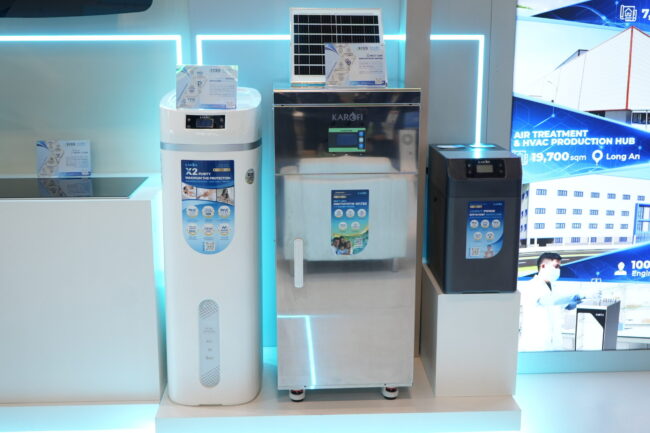
Karofi Group Joint Stock Company unveiled its latest generation of whole-house water purification systems at CES 2026 in Las Vegas, signaling a strategic shift from endpoint filtration toward source-based water treatment. With active operations across Southeast Asia, the United States, and more than 50 international markets, the Vietnam-based water tech manufacturer is positioning itself to redefine water protection as part of the modern smart home infrastructure stack.
Unlike traditional filters designed for drinking taps or showerheads, Karofi’s new systems are engineered to treat water at the point of entry. By protecting internal plumbing and improving water quality throughout the home, the company aims to respond to an escalating global challenge: inconsistent water safety, aging municipal systems, and rising consumer demand for integrated home wellness technologies.

Why is Karofi shifting to source-based water treatment instead of endpoint filtration in 2026?
The pivot to source-first filtration aligns with a broader market movement. Aging urban pipelines, industrial runoff, and mineral-heavy groundwater sources have made endpoint-only solutions insufficient. Many residential water systems deliver supply that exceeds taste or odor thresholds, but still present infrastructure or health-related challenges. Chlorine residues, high calcium or magnesium content, and microbial risks can degrade not only water quality, but also household appliances and the longevity of plumbing systems.
Karofi’s decision to engineer protection at the point of entry reframes water as a utility-grade infrastructure issue, not just a lifestyle preference. This model ensures that all water flowing through kitchens, showers, laundry systems, and dishwashers meets higher quality standards, even before point-of-use treatment. In an era where consumers are increasingly demanding healthier, more resilient homes, this approach positions Karofi to participate in the infrastructure modernization narrative rather than remain confined to the appliance category.
By controlling water conditions across all household touchpoints, Karofi also strengthens its case for being integrated by builders, architects, and real estate developers, especially in geographies where water reliability is a key concern for homebuyers.
What roles do the P01S and P02S systems play in Karofi’s segmentation strategy?
The P01S and P02S systems represent two distinct but complementary pillars in Karofi’s whole-house portfolio.
The P01S model has been optimized for apartments and smaller residences where space is a constraint. It features a multistage filtration sequence that includes polypropylene for sediment capture, activated carbon for chemical and odor reduction, and a cation exchange softening phase to limit scale formation. What makes it more compelling for urban households is its compact form factor. Designed to fit within a standard cabinet, the P01S includes an automatic control valve that enables self-cleaning cycles, reducing maintenance burdens and ensuring consistent performance.
The P02S, on the other hand, is Karofi’s answer to high-consumption households. With expanded flow capacity and extended filtration life, it is suitable for larger residences, multigenerational households, or villas with several bathrooms and higher water throughput. Its unique dual-outlet design allows residents to alternate between purified and fully softened water depending on the application. For instance, users might prefer softened water for laundry and bathing while opting for purified water for kitchen use and consumption.
Together, the systems enable Karofi to serve both the entry-level and high-performance segments without overlapping functionality. This vertical segmentation gives the company a more resilient commercial base and allows retailers and installers to cross-sell upgrades without risking brand fragmentation.
How does Karofi’s CDI platform create differentiation in a market dominated by salt-based softeners?
Karofi’s introduction of Capacitive Deionization (CDI) technology at the premium end of its product line is its most aggressive move toward category disruption. Unlike traditional softeners that use ion exchange resins and rely on salt regeneration, CDI systems use electrically charged electrodes to extract dissolved ions. This not only eliminates the environmental downsides of salt discharge but also provides users with greater control over water composition.
CDI-based systems offer adjustable total dissolved solids (TDS) reduction, which allows homeowners to customize mineral retention. This is particularly important in markets where over-purification through reverse osmosis has drawn criticism for stripping essential minerals from drinking water. In addition, CDI’s salt-free operation aligns with tightening regulations in water-stressed regions such as California, where sodium discharge is already restricted due to its impact on wastewater treatment infrastructure and agriculture.
Karofi’s CDI platform is also built for long operational life with reduced maintenance, giving it a favorable cost-of-ownership profile compared to conventional systems that require frequent resin replacement and salt replenishment. These features position Karofi to compete not just on upfront features but on lifecycle economics and sustainability metrics.
Can Karofi scale its smart water platform across markets with radically different water conditions?
One of Karofi’s most underappreciated strengths is its engineering approach to regional diversity. Water profiles vary widely across the globe, from high sediment content in South Asia to chlorine volatility in North America and microbial contamination risks in parts of Africa and Latin America. Karofi’s whole-house systems are designed to perform under varying pressure conditions, different TDS thresholds, and a range of contamination risks.
Rather than develop dozens of country-specific SKUs, Karofi has engineered its platforms to be modular and firmware-adaptable. This allows installers or distributors to reconfigure system performance based on regional water quality reports. Whether dealing with municipal-supplied water in Houston, well water in suburban Delhi, or desalinated supply in Dubai, Karofi’s systems can be tailored with minimal reengineering.
This adaptability is not just technical. It also strengthens Karofi’s channel economics. The company can standardize global manufacturing while enabling local configuration, reducing inventory complexity and easing installer training across emerging and developed markets alike.
What is Karofi’s long-term positioning in the smart home infrastructure value chain?
Karofi’s CES 2026 presentation was structured more like a platform showcase than a traditional appliance pitch. Its strategic framing signals a broader ambition: to become a smart infrastructure layer that sits alongside energy-efficient HVAC systems, smart lighting, and integrated security.
By treating water as a connected utility, Karofi opens the door to multiple future value propositions. These could include integration with home automation ecosystems, real-time water quality analytics via mobile apps, or predictive maintenance models driven by sensor data. Already, its P01S and P02S models include automation features such as self-cleaning valves, indicating a direction toward lower-friction ownership.
There are also signals that Karofi may seek to move horizontally. The company could plausibly extend into adjacent domains such as greywater reuse, ultraviolet sterilization, or in-appliance filtration partnerships with dishwasher and laundry machine OEMs. Each of these pathways would deepen its relevance to household infrastructure, moving it further from the transactional retail filter market and closer to a systems integration play.
For institutional partners and ESG-minded investors, Karofi’s commitment to salt-free systems, high water recovery efficiency, and durable component design positions the company well in regions facing pressure to balance urban growth with water security and environmental stewardship.
How does Karofi’s CES 2026 positioning affect competitive dynamics and market segmentation?
Karofi’s whole-house product strategy introduces new pressure points across several water technology verticals. For traditional under-sink filtration companies, it represents a threat of disintermediation. If source-based systems become mainstream, endpoint solutions may be viewed as redundant or insufficient. For salt-based softener providers, Karofi’s CDI move creates both regulatory and functional headwinds. And for appliance manufacturers, Karofi’s entry into whole-home systems may eventually evolve into a demand for embedded or bundled water protection.
The company’s expansion into infrastructure-grade solutions also raises new questions about who its real competitors are. Is it still competing with retail water brands, or is it increasingly a challenger to industrial softener firms and home services platforms like Pentair or Culligan? The answer may be both.
Karofi’s ability to scale, integrate, and differentiate will depend not just on product innovation, but also on how successfully it builds installer relationships, defends its patents, and navigates regulatory compliance across water-stressed regions. Its next strategic test will be proving that a Vietnam-headquartered brand can own the narrative and the margins in a sector where trust, reliability, and infrastructure-grade support are non-negotiable.
What are the key takeaways for investors, partners, and competitors from Karofi’s CES 2026 water purification reveal?
- Karofi’s whole-house systems mark a strategic pivot toward infrastructure-grade water treatment for urban and high-demand homes.
- The compact P01S and high-capacity P02S systems reflect a tiered approach targeting both space-constrained and multi-bathroom households.
- Capacitive Deionization (CDI) offers a salt-free alternative to conventional softeners, with regulatory, health, and sustainability advantages.
- Karofi’s modular engineering supports international scalability across diverse water conditions and infrastructure challenges.
- The company is positioning water purification as a home infrastructure layer, not just a consumer appliance or afterthought.
- Future platform extensions could include IoT integration, data analytics, and ESG-linked offerings in water health and compliance.
- Execution risks include service consistency across geographies and maintaining pricing competitiveness as premium features scale.
- Karofi’s CES 2026 showcase signals a category shift in how household water health is defined, marketed, and monetized globally.
Share this:
Discover more from Business-News-Today.com
Subscribe to get the latest posts sent to your email.