

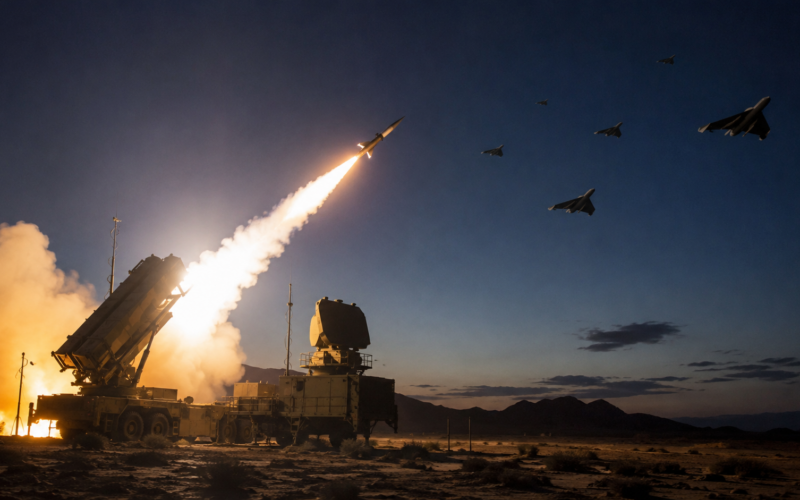
A single Terminal High Altitude Area Defense interceptor costs roughly 12.7 million dollars to build and fire. The Iranian Shahed-136 drone it might be tasked to destroy costs around 30,000 dollars. That ratio, better than 400 to one in the attacker’s favour, is the most important number in defense procurement right now, and it sat at the centre of the twelve-day June 2025 war between Israel and Iran, where United States forces expended close to a quarter of the entire national THAAD stockpile in under two weeks. The renewed United States-Israel campaign against Iran that began in late February 2026, designated Operation Epic Fury, has stress-tested the same math a second time. For the prime contractors building these systems, principally Lockheed Martin Corporation (NYSE: LMT) and RTX Corporation (NYSE: RTX), the cost-exchange problem is simultaneously the demand driver fuelling record munitions orders and the structural threat that could eventually erode the value of their highest-margin product lines. Understanding which of those forces wins is now the central question for the entire air and missile defense sector.
Why is the interceptor cost-exchange ratio considered the defining economic problem of modern air and missile defense?
The problem is deceptively simple to state and brutally difficult to solve. An attacker fielding cheap, mass-produced drones and rockets forces a defender to respond with interceptors that cost orders of magnitude more per unit, and in a sustained campaign the defender runs out of money and magazine depth long before the attacker runs out of cheap munitions. A roughly 3 million dollar Patriot interceptor is an absurd thing to fire at a 30,000 dollar Iranian drone, and the defender will exhaust its missiles before the attacker exhausts its drones. That asymmetry inverts the historical logic of warfare, where defense was usually cheaper than offense, and it is precisely the dynamic Iran has exploited deliberately. Part of the Iranian playbook has been to send waves of inexpensive drones first, drawing down interceptor inventories, before following with the ballistic missiles that pose the genuine threat.
The financial consequence is not abstract. During the June 2025 conflict, THAAD interceptors accounted for almost half of all interceptors the United States and Israel used to defend against Iranian medium-range ballistic missiles, with an estimated 92 interceptors fired from a supply of roughly 632. At approximately 12.7 million dollars per round, that single engagement consumed something on the order of a quarter of the inventory. The second-order problem is replenishment speed. Estimates suggest rebuilding the THAAD stockpile could take between three and eight years at the production rates that prevailed before the war. A defensive system that takes the better part of a decade to refill after a fortnight of combat is not a deterrent so much as a depleting asset, and that realisation is what has driven the entire 2026 procurement scramble.
How are Lockheed Martin and RTX positioned as the cost-exchange problem reshapes interceptor demand?
For the prime contractors, the cost-exchange crisis reads in the near term as pure demand, and the order book reflects it. Lockheed Martin Corporation has signed framework agreements with the United States Department of War to triple production of the PAC-3 Missile Segment Enhancement interceptor and to quadruple THAAD interceptor output from 96 to 400 units a year, and is committing more than nine billion dollars through 2030 to build and upgrade more than 20 facilities to support that ramp. RTX Corporation, which produces the Patriot family and the lower-tier Coyote interceptor, sits on the other side of the same demand wave. The competitive dynamic here is unusual because the segment is so supply-constrained that the two primes are not primarily fighting each other for scarce orders. The binding constraint is conversion, meaning who can turn framework agreements and appropriations into delivered hardware fastest.
The more interesting question for an investor is what the cost-exchange problem does to the long-term value of the premium interceptor franchise. The high-end rounds, THAAD at 12.7 million dollars and Patriot PAC-3 at a figure variously reported between 4 million and 13.5 million dollars depending on configuration, are the crown jewels of the missile defense portfolio. They are also, by definition, the wrong tool for the cheapest threats, and the entire policy apparatus is now explicitly trying to push those threats down to cheaper layers. That creates a subtle tension in the prime contractor thesis. The same companies that profit from selling 12.7 million dollar interceptors today are being asked to help build the 100,000 dollar and the two dollar alternatives that will, over time, absorb the lower end of the demand curve. Whether that migration expands the total addressable market or cannibalises the premium tier is the strategic uncertainty the sector has not yet resolved.
What cheaper kinetic interceptors are emerging to fix the drone cost-exchange problem and who builds them?
The first response to the cost-exchange problem is a tier of cheaper kinetic effectors designed to sit below the premium interceptors, and this is where the procurement money is now flowing fastest. RTX Corporation’s Coyote interceptor is the leading example, with a Block 2 unit cost reported at roughly 100,000 dollars, a fraction of a Patriot or THAAD round. The United States Army is pursuing a long-term supply arrangement for the Coyote, seeking fiscal year 2027 funding for both a framework agreement and a multi-year contract, in what would be the first such framework for a counter-drone intercept capability. The contracting approach has already culminated in an ordering vehicle worth roughly 5.04 billion dollars running into 2033 for Coyote effectors, launchers, and associated radars, signalling that the Army expects sustained rather than episodic demand.
The genuinely disruptive development within this tier is reusability. RTX has demonstrated a recoverable, non-kinetic Coyote Block 3 variant that defeated multiple drone swarms in an Army demonstration and was then recovered for reuse, shifting the economics from one-shot-one-kill toward sustained counter-swarm coverage. A recoverable interceptor that can loiter, engage, return and be serviced changes the per-engagement cost calculus fundamentally, because the dominant expense is no longer a consumed round. The competitive field is widening, too. Defense technology firm Anduril Industries has unveiled a jet-powered counter-drone interceptor called Roadrunner-M that is designed to be recovered and reused if it does not strike a target, and the entrance of well-funded non-traditional players into this tier is itself a signal that the cheap-effector market is now large enough to attract venture-scale capital. For the incumbents, this is the layer where their pricing power is weakest and their competition is broadest.
Can directed energy weapons like Iron Beam and HELIOS finally invert the cost-exchange ratio in the defender’s favour?
The endgame of the cost-exchange problem is directed energy, and in 2026 it stopped being theoretical. Israel’s Iron Beam, developed by Rafael Advanced Defense Systems, became the world’s first operational high-energy laser air defense system following its delivery to the Israel Defense Forces in late December 2025, and recorded the first confirmed combat interception by a high-energy laser on March 2, 2026. The economic significance is hard to overstate. Iron Beam engages targets at a marginal cost of roughly two dollars per intercept, essentially the price of the electricity and cooling, against threats that would otherwise demand a 50,000 dollar Tamir interceptor or far more. That advantage of a few dollars versus tens of thousands inverts the economic calculus that has always favoured the attacker, which is why it is being described as the single most transformative shift in modern air defense economics.
The United States is moving along a parallel track, and notably it is the same prime contractor at the centre of the kinetic story that is building the laser. The United States Navy has deployed the HELIOS directed-energy weapon, a 60-kilowatt-class system developed by Lockheed Martin Corporation, aboard an Arleigh Burke-class destroyer operating near Iran as part of Operation Epic Fury, after the system destroyed four drones in live-fire testing aboard the USS Preble in early February 2026. The United Kingdom’s DragonFire programme, led by MBDA with QinetiQ and Leonardo, has demonstrated intercepts at a reported cost of around ten pounds per shot and is scheduled for Royal Navy introduction around 2027. The forward-looking ambition is larger still, with the United States Navy’s SONGBOW programme aiming to combine multiple industrial laser units into a single 400-kilowatt shipboard beam.
The skeptical caveat matters as much as the promise. Directed energy systems remain range-limited, with Iron Beam effective to roughly seven to ten kilometres, and they are degraded by atmospheric conditions, cloud, dust and rain. They are also power-hungry in ways that constrain which platforms can host them. A laser solves the cost-per-shot problem only for the threats within its envelope, and it does nothing against the high-end ballistic missiles, hypersonic glide vehicles and long-range cruise missiles that remain the province of the expensive interceptors. The capital implication is that directed energy is additive to the architecture rather than a replacement for it, which is precisely why the same companies are investing in both.
Why does focusing only on interceptor unit cost misunderstand the strategic value of layered air defense?
The most important corrective to the cost-exchange narrative is that unit cost is the wrong frame for evaluating a deterrent, and the analytically serious version of this story has to engage with that argument rather than just reciting the dramatic ratios. As the Modern War Institute has argued, you do not buy air defense for the drone it intercepts today, you buy it for the aircraft it prevents from ever approaching, and that deterrent value operates continuously and silently, making it invisible to a simple cost-exchange calculation. The absence of an attack is the return on the investment, and it never shows up in a per-shot accounting. By that logic, the impulse to strip out expensive high-end interceptors purely on unit-cost grounds is strategically dangerous, because those rounds and their sensors are the foundation that the cheaper layers depend on for detection, tracking and engagement.
The correct conversation, on this view, is about architecture rather than price. The cheaper solutions, low-cost interceptors and directed-energy weapons, are needed to optimise the layered system, while the long-range interceptor and its sensors remain the irreplaceable foundation. This reframing carries real consequences for how the sector should be valued. If the future is a layered architecture in which lasers and cheap interceptors handle the low end while premium rounds are conserved for the threats only they can defeat, then the prime contractors are not facing the erosion of their high-end franchise so much as a rebalancing of the mix, with new revenue layers added beneath the existing one. The investment thesis that flows from the architecture argument is therefore considerably more constructive than the one that flows from the raw cost-exchange ratio, and the gap between those two readings is where much of the disagreement about defense valuations currently sits.
What does the cost-exchange problem signal about the long-term direction of defense procurement and industrial capacity?
The deepest signal in the cost-exchange story is about the structure of defense procurement itself, not about any single weapon. The crisis has exposed that the United States and its allies spent years buying premium interceptors in quantities suited to short, sharp conflicts rather than to the prolonged, missile-heavy attrition that modern adversaries can now impose. The policy response is visible in the budget. The 2026 Department of War spending plan directs funds to mass-produce lower-cost interceptors and directed-energy options, with line items including 250 million dollars for directed energy and additional funding to develop cheaper air and missile interceptors, alongside billions to scale unmanned platforms and industrial base capacity. The framework-agreement model that Lockheed Martin Corporation and RTX Corporation have signed is itself an attempt to fix the demand-signal problem, by giving suppliers the durable, multi-year commitment they need to justify investing in capacity rather than treating each appropriation as a one-off.
For the industry, this points toward a structurally larger but more stratified market. The total spend on air and missile defense is rising across every tier at once, which supports the bull case for the primes and for the newer entrants alike. The risk is concentrated in two places. The first is the durability of the demand signal, because the entire capacity build-out presumes sustained funding that has historically proven cyclical, and a return to constrained budgets once the immediate Iranian threat recedes would leave companies holding expensive purpose-built capacity. The second is the migration risk within the product mix, where the long-run shift of low-end demand toward 100,000 dollar interceptors and two dollar laser shots compresses the share of the market served by the highest-margin premium rounds. How the primes manage that migration, whether they capture the new layers or cede them to challengers like Anduril Industries, will determine whether the cost-exchange revolution expands their franchise or quietly hollows out its most profitable core.
Key takeaways on what the interceptor cost-exchange problem means for defense contractors and the air defense industry
- The cost-exchange ratio, exemplified by a 12.7 million dollar THAAD interceptor potentially engaging a 30,000 dollar drone, is the defining economic problem of modern air defense and the single most important variable shaping sector demand and valuation.
- The June 2025 war and Operation Epic Fury proved the problem is operational rather than theoretical, with the United States expending roughly a quarter of its THAAD stockpile in twelve days and replenishment estimated at three to eight years.
- For prime contractors Lockheed Martin Corporation and RTX Corporation, the crisis is simultaneously a record demand driver and a long-term threat to the premium interceptor franchise, a tension the sector has not yet resolved.
- The supply constraint is severe enough that the primes are competing on conversion speed, who can turn framework agreements into delivered hardware fastest, rather than directly for scarce orders.
- The mid-tier kinetic answer is led by RTX Corporation’s Coyote at roughly 100,000 dollars per unit, backed by an ordering vehicle worth about 5.04 billion dollars running to 2033, with reusable non-kinetic variants reshaping per-engagement economics.
- Non-traditional entrants such as Anduril Industries with the reusable Roadrunner-M are crowding the cheap-effector tier, the layer where incumbent pricing power is weakest and competition is broadest.
- Directed energy moved from concept to combat in 2026, with Rafael Advanced Defense Systems’ Iron Beam recording the first combat laser intercept in March and Lockheed Martin Corporation’s HELIOS deploying with the United States Navy near Iran.
- Lasers at two to ten dollars per shot invert the cost-exchange ratio but remain range and weather limited and useless against high-end ballistic and hypersonic threats, making them additive to the layered architecture rather than a replacement.
- The strongest counter-argument, that air defense value lies in deterrence invisible to per-shot accounting, reframes the sector thesis from franchise erosion toward a constructive rebalancing of the product mix with new revenue layers added beneath the premium tier.
- The two structural risks for investors are the durability of a historically cyclical demand signal underwriting the capacity build-out, and the long-run migration of low-end demand away from the highest-margin premium interceptors.
Discover more from Business-News-Today.com
Subscribe to get the latest posts sent to your email.