




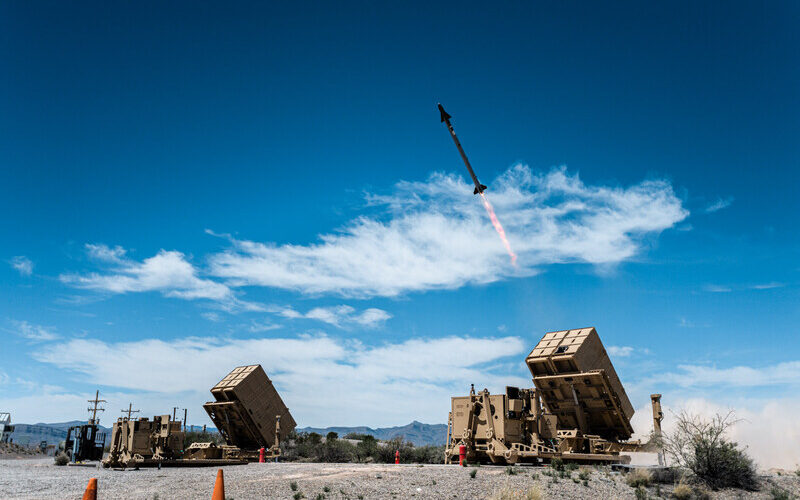
Leidos Holdings Inc. (NYSE: LDOS) has received a $617 million award from the U.S. Army to build and deliver additional launchers for the Indirect Fire Protection Capability Increment 2 system, deepening the company’s role in one of the Army’s most closely watched mobile air defense programs. The latest award takes Leidos’ IFPC Inc 2 production contracts to nearly $1.2 billion when combined with $356 million awarded in July and September 2025. The contract comes as the U.S. Army and the broader Pentagon procurement system are under pressure to expand layered defense against drones, cruise missiles, rockets, artillery and mortar threats. Leidos shares closed at $146.06 on April 24, 2026, leaving the stock materially below its 52-week high of $205.77 even as the company adds long-cycle defense production visibility.
Why does Leidos’ $617 million U.S. Army launcher award matter for mobile air defense procurement?
The immediate importance of the Leidos Holdings Inc. award is not simply that the U.S. Army has placed another large order. The more important signal is that the Indirect Fire Protection Capability Increment 2 system is moving deeper into the production and fielding phase at a time when battlefield air defense has stopped being a niche modernization category and has become a central readiness concern. The U.S. Army describes IFPC Inc 2 as a mobile, ground-based weapon system intended to protect fixed and semi-fixed sites from unmanned aerial systems, cruise missiles, and rocket, artillery and mortar attacks, making it a key layer between short-range tactical defense and higher-tier systems.
That matters because the threat mix has changed faster than many legacy procurement cycles were built to absorb. Low-cost drones, one-way attack systems, cruise missiles and saturation attacks have created a defensive economics problem: the side with the target must defend repeatedly, while the attacker can often impose cost and complexity with cheaper systems. IFPC Inc 2 is designed to sit inside that uncomfortable gap, where mobility, launcher availability, magazine depth and integration with command-and-control systems can matter as much as the interceptor itself.
For Leidos Holdings Inc., the contract strengthens a defense hardware position that is strategically different from its traditional profile as a technology, mission systems and government services contractor. Leidos is not becoming a pure-play missile prime, but the IFPC Inc 2 production ramp gives the company a more visible role in a weapons-system supply chain where manufacturing execution, systems integration and software-enabled architecture all converge. That makes the award financially useful, but also strategically useful, because it supports a higher-value defense identity at a time when investors are rewarding companies with credible exposure to air defense, autonomous threats and military modernization.

How does the IFPC Inc 2 launcher program fit into the U.S. Army’s layered air defense strategy?
The IFPC Inc 2 system is best understood as a plug-in layer in the Army’s broader air and missile defense architecture rather than as a standalone launcher purchase. Leidos has positioned the system as open architecture and compatible with current and future effectors, which is important because the interceptor landscape is still evolving. A launcher that can integrate multiple effectors over time gives the Army more flexibility than a closed system tied to a single missile family, especially when drone and cruise missile threats are changing quickly.
This open architecture point deserves attention because it is where procurement strategy and battlefield learning meet. The Army needs a system that can be fielded now, upgraded later and adapted as interceptors, sensors and battle management software improve. In that sense, the launcher is not just a piece of equipment. It is a platform decision that can shape future buying patterns, industrial partnerships and sustainment costs through the end of the decade.
The latest award also supports continued research, development and testing, with future orders potentially extending through 2029. That creates a dual-track opportunity for Leidos Holdings Inc.: near-term production revenue from committed launchers and longer-term upside if the Army expands IFPC Inc 2 procurement as part of a broader response to missile and drone threats. The risk is that scaling launchers is only one part of the equation. The Army also needs interceptor availability, resilient supply chains, trained operators, logistics support and integration with existing command-and-control systems.
What does the contract reveal about Leidos Holdings Inc.’s defense strategy and NorthStar 2030 priorities?
The $617 million award fits neatly into Leidos Holdings Inc.’s NorthStar 2030 strategic focus because it gives the company a concrete production anchor in air and missile defense. Leidos reported annual revenue of approximately $17.2 billion for fiscal 2025, up 3 percent year over year, with non-GAAP diluted earnings per share of $11.99 and operating cash flow of $1.8 billion. Against that revenue base, a nearly $1.2 billion IFPC Inc 2 production contract stack is not company-transforming by itself, but it is meaningful enough to sharpen investor attention around backlog durability and defense program mix.
The strategic attraction is that air defense production has a different quality from lower-visibility government services work. It can create multi-year revenue streams, reinforce customer intimacy with the U.S. Army, and support follow-on opportunities in sustainment, engineering services and future system upgrades. In a market where defense investors increasingly separate commodity contracting from mission-critical platforms, IFPC Inc 2 gives Leidos Holdings Inc. a stronger story around hardware-enabled mission systems.
There is also an execution test hidden inside the good news. Leidos has said it delivered the first IFPC Inc 2 Initial Operational Test and Evaluation launcher two months ahead of schedule, which supports the company’s argument that it can execute. However, early delivery of a test asset and scaled production across more than 100 committed launchers are different challenges. The next phase will test supplier capacity, manufacturing repeatability, quality control and the ability to keep cost growth from eroding the economics of a large defense production program.
Why is the timing important as drones, cruise missiles and base defense threats reshape Pentagon spending?
The timing of the Leidos Holdings Inc. award is important because air defense is being repriced across the defense market. The Russia-Ukraine war, Middle East drone and missile exchanges, Red Sea shipping disruptions and the growing focus on Indo-Pacific base vulnerability have all reinforced the same lesson: fixed military assets, logistics hubs, forward operating bases and critical infrastructure are no longer safe simply because they sit behind traditional defensive perimeters. That pushes defense ministries toward layered, distributed and mobile air defense networks.
The Pentagon’s spending priorities are increasingly reflecting that reality. Recent reporting has described the Leidos contract as part of broader U.S. military replenishment and readiness efforts, while the U.S. Army has already emphasized IFPC Inc 2 as a high-demand capability for defending critical infrastructure and forward sites. The market implication is straightforward: air defense is shifting from episodic procurement to an enduring capacity problem.
That is where Leidos Holdings Inc. may benefit from a broader structural cycle. If drone and cruise missile defense remains a persistent requirement, the Army will need more than a one-time batch of launchers. It will need upgrade pathways, spare parts, training systems, sustainment, interoperability improvements and integration with future interceptors. The opportunity is attractive, but it is not risk-free. Defense procurement priorities can shift, budgets can be contested, and production programs can face margin pressure if contract scope expands faster than supplier readiness.
How should investors read LDOS stock performance after the Army contract announcement?
The market has not treated the Leidos Holdings Inc. contract as an immediate valuation reset. LDOS closed at $146.06 on April 24, 2026, down 1.04 percent for the session and roughly 29 percent below its 52-week high of $205.77 reached on November 4, 2025. The stock also declined on April 23, the day of the contract announcement, closing at $147.60 after a 2.06 percent fall, suggesting the award did not offset broader pressure on the shares in the short term.
That divergence is important. A $617 million award improves backlog visibility and reinforces program credibility, but equity markets often look past individual contract wins when broader concerns involve growth rate, margin quality, valuation, cash conversion, or sector rotation. Leidos Holdings Inc. is trading with a market capitalization of about $18.7 billion and a price-to-earnings ratio near 13.7 based on current market data, which suggests investors are not pricing the company like a high-multiple defense technology story despite its exposure to high-priority defense modernization themes.
The more balanced interpretation is that the IFPC Inc 2 award supports the medium-term investment case, but does not remove the need for Leidos Holdings Inc. to show consistent execution across its portfolio. Investors will likely watch whether defense production awards translate into margin-accretive growth rather than simply larger backlog. In other words, the contract is strategically loud, but the income statement will decide how loud Wall Street allows it to be.
What risks could affect Leidos Holdings Inc. as IFPC Inc 2 moves toward larger-scale production?
The first risk is production scalability. More than 100 committed launchers create visibility, but they also require disciplined supplier coordination, manufacturing throughput and quality assurance. In defense procurement, a program can look attractive at award stage and become far more complicated once production schedules, testing feedback, parts availability and engineering changes collide. Leidos Holdings Inc. has a credibility boost from early launcher delivery, but the next investor question is whether that performance can be repeated across a larger fleet.
The second risk is system-level dependency. IFPC Inc 2 is part of a layered architecture, which means the launcher’s value depends on integration with sensors, command-and-control systems, interceptors and Army transport platforms. If any adjacent element faces delay or funding disruption, launcher deployment can become slower than contract headlines imply. That does not undermine the strategic value of the award, but it does mean investors should avoid treating the contract as a straight-line revenue story.
The third risk is procurement politics. U.S. defense budgets remain large, but individual programs still compete for priority inside a crowded modernization agenda that includes autonomous systems, shipbuilding, long-range fires, cyber, space, logistics resilience and munitions replenishment. IFPC Inc 2 has a strong threat-driven rationale, but future orders through 2029 will still depend on budget execution, Army priorities and demonstrated operational performance. The good news for Leidos Holdings Inc. is that drone and cruise missile defense are unlikely to drift out of relevance. The harder question is how quickly the Army can fund, field and sustain capacity at the scale commanders may want.
What are the key takeaways from Leidos Holdings Inc.’s $617 million U.S. Army IFPC Inc 2 launcher contract?
- The $617 million award strengthens Leidos Holdings Inc.’s position in mobile ground-based air defense at a time when drone and cruise missile threats are reshaping Army procurement priorities.
- The nearly $1.2 billion IFPC Inc 2 production contract base gives Leidos Holdings Inc. stronger multi-year visibility, but investors will still need evidence that the program can support attractive margins.
- The award is strategically more important than a routine defense order because it places Leidos Holdings Inc. inside a high-priority layered air and missile defense architecture.
- The IFPC Inc 2 system’s open architecture could become a long-term advantage if the Army integrates additional effectors and upgrades over time.
- The contract supports the NorthStar 2030 strategy by giving Leidos Holdings Inc. a more visible role in mission-critical defense production rather than only services-led government contracting.
- The key execution challenge is whether Leidos Holdings Inc. can move from early launcher delivery to repeatable scaled manufacturing across more than 100 committed launchers.
- LDOS stock has not yet reflected a major rerating from the award, suggesting investors are waiting for broader earnings and margin confirmation rather than reacting to contract value alone.
- The U.S. Army’s demand for IFPC Inc 2 reflects a wider procurement shift toward defending bases, infrastructure and forward sites from lower-cost aerial threats.
- Competitors across defense systems, interceptors, sensors and command-and-control software will watch IFPC Inc 2 closely because launcher architecture can influence future ecosystem winners.
- For Leidos Holdings Inc., the opportunity is clear: convert a strategically important Army contract into durable revenue, credible production performance and a stronger defense technology valuation story.
Discover more from Business-News-Today.com
Subscribe to get the latest posts sent to your email.