The Brihanmumbai Municipal Corporation has approved a ₹702.44 crore underground pedestrian connection linking the Nehru Science Centre station on Mumbai Metro Line 3 with the Worli promenade and proposed landscaped public space along the Coastal Road. The Standing Committee cleared the proposal on August 20, with Mumbai Metro Rail Corporation Limited expected to build the passage while BMC funds the project.
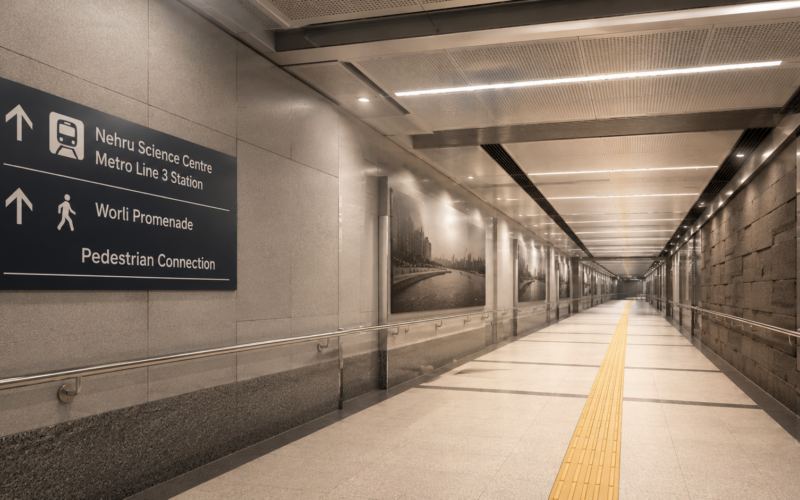
Post-approval information from PTI describes the core passage as approximately one kilometre long and 7.5 metres wide, running from the Metro station through the Mahalaxmi Racecourse precinct, underneath Lala Lajpatrai Road and onward to the Worli promenade. The route will include a travelator to support pedestrian movement across a connection considerably longer than a conventional station subway.
The ₹702.44 crore figure is notable because this is not a new Metro rail line or highway structure but a pedestrian-integration project designed to connect several expensive pieces of urban infrastructure already developed around Mahalaxmi and Worli. The commercial and planning question is therefore whether improved access can generate enough public utility and transit-oriented development value to justify the unusually high capital cost.

What does Mumbai’s ₹702.44 crore Nehru Science Centre-Worli pedestrian link include?
The approved core alignment will provide an underground walking connection from the Nehru Science Centre Metro station on the Aqua Line toward the Mahalaxmi Racecourse area and across Lala Lajpatrai Road to the Worli promenade and proposed landscape garden. A travelator is planned to reduce the effort involved in traversing the longer underground route.
The project is intended to solve an increasingly visible last-mile problem. Metro Line 3 provides rapid underground transit through central Mumbai, while the Coastal Road has created new waterfront infrastructure and a large public promenade, but direct pedestrian movement between the two systems remains difficult because major arterial roads and the Racecourse precinct separate them.
By placing the connection underground, planners can avoid forcing large pedestrian volumes across heavily trafficked surface roads. That could make the Metro a more practical access mode for visitors to the promenade and future landscaped areas rather than leaving the new waterfront substantially dependent on private cars and road-based transport.
The project also integrates with the proposed redevelopment of public open space around Mahalaxmi Racecourse. In effect, the underpass is being designed as connecting infrastructure between a Metro station, a major urban park precinct and the Coastal Road waterfront rather than as a conventional station entrance.
Why do Mumbai project reports describe the Mahalaxmi underground network as both 1 km and up to 4 km?
There is a material difference between reports published before and after Standing Committee approval. PTI’s post-approval account describes the approved pedestrian passage as approximately one kilometre long and 7.5 metres wide. Earlier planning reports, however, described a broader underground connectivity concept ranging from about three kilometres to as much as 3.5-4 kilometres around the Metro station, Racecourse and Coastal Road precinct.
The earlier Indian Express report described a roughly three-kilometre proposal that also contemplated underground parking and indoor recreational space, while ETInfra reported a 3.5-4 kilometre subterranean network. Those reports were published while the proposal was still being considered rather than after the committee’s approval.
The prudent interpretation is therefore that the approximately one-kilometre figure describes the core approved pedestrian passage reported after the vote, while longer figures appear to relate to the wider planning network or associated underground connections considered during development. Until BMC or MMRCL publishes final execution drawings and package lengths, presenting 3.5-4 kilometres as the confirmed length of the approved ₹702.44 crore passage would overstate what the latest authoritative report establishes.
That discrepancy matters because cost-per-kilometre comparisons would change dramatically depending on which length is used. It is consequently more useful at this stage to focus on the confirmed project cost, alignment and implementation arrangement rather than derive misleading unit-cost calculations from inconsistent route-length descriptions.
Why is BMC funding a project that Mumbai Metro Rail Corporation will build?
The institutional structure reflects the different roles of the two agencies. BMC is responsible for the city’s civic infrastructure and is financing the pedestrian-connection objective, while Mumbai Metro Rail Corporation has the specialised underground-construction expertise developed through Metro Line 3. The proposal therefore assigns implementation to MMRCL rather than requiring BMC to procure and manage a major subterranean project independently.
Earlier project documents envisaged BMC transferring funds in stages tied to execution. Indian Express reported that 25% would be released after execution of a memorandum of understanding between the agencies, with additional instalments linked to permissions and construction milestones.
Using an experienced underground rail agency could reduce interface risk because the passage begins at a Metro Line 3 station and must be coordinated with existing subterranean infrastructure. The arrangement nevertheless raises governance questions over cost control and procurement because BMC is providing the money while a separate entity performs the work.
Those concerns were already part of the political debate before approval, with opposition representatives questioning why the entire burden should sit with the civic body while it is simultaneously funding other large infrastructure programmes. The Standing Committee’s approval means the project can move forward, but scrutiny is likely to shift toward implementation costs and how BMC recovers the expenditure.
Can transit-oriented development premium recover Mumbai’s ₹702.44 crore pedestrian-link cost?
BMC intends to use Transit-Oriented Development premium under the Development Control and Promotion Regulations 2034 as a mechanism to recover the expenditure. Reporting on the civic proposal indicates that ₹107.47 crore has been earmarked for the project during FY27, equivalent to about 15% of the total ₹702.44 crore estimate, with subsequent spending extending beyond the current financial year.
Transit-oriented development policy generally allows greater development intensity or other planning benefits around mass-transit corridors in exchange for premiums, creating a way to capture part of the land-value uplift associated with improved accessibility. In theory, that allows some of the cost of transport-linked infrastructure to be recovered from development beneficiaries rather than entirely from general municipal revenues.
The unresolved issue is timing. Construction expenditure must be financed as the project proceeds, while TOD premiums depend on future development activity and payments by property owners or developers. If premium collections develop more slowly than expected, the civic body still carries the interim financing burden.
That makes the recovery structure as important as the project’s engineering. A ₹702 crore pedestrian connection could be easier to defend fiscally if it unlocks substantial development value and increases Metro usage, but the economics become less attractive if BMC has to absorb most of the cost without corresponding premium receipts.
How could the underground link change access to Metro Line 3, Mahalaxmi and the Coastal Road?
Mumbai has invested heavily in major transport infrastructure around the corridor, but infrastructure produces its highest utility when different modes connect conveniently. Metro Line 3 can move passengers rapidly across the city, while the Coastal Road primarily improves road movement and creates substantial new waterfront public space. The pedestrian passage is intended to connect those investments at human scale.
For Metro passengers, direct underground access could reduce the need for taxis, private vehicles or difficult surface crossings to reach the Worli promenade. For BMC, that could help make new coastal public spaces accessible to residents who do not arrive by car.
The travelator is significant in this context because a kilometre-scale walking tunnel can otherwise become impractical for elderly visitors, children and passengers carrying bags. The design must still address ventilation, emergency evacuation, security, drainage, accessibility and maintenance if the passage is to function as a comfortable public route rather than simply an engineering connection.
The project consequently represents a different phase of Mumbai infrastructure spending. The city has already built the Metro and Coastal Road; the ₹702.44 crore question is whether expensive last-mile integration can make those assets materially more useful together than they are separately. That is the measure by which the Mahalaxmi-Worli pedestrian connection will ultimately have to justify its cost.
Discover more from Business-News-Today.com
Subscribe to get the latest posts sent to your email.