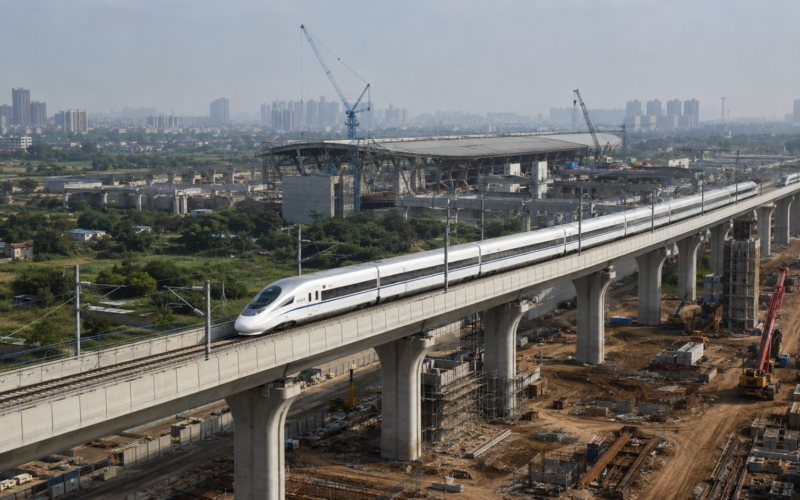
The Mumbai–Ahmedabad High-Speed Rail Project is India’s first high-speed railway corridor, running 508 kilometres between Mumbai in Maharashtra and Sabarmati near Ahmedabad in Gujarat. The corridor is being implemented by National High Speed Rail Corporation Limited, the special purpose vehicle owned by the Government of India, Government of Maharashtra and Government of Gujarat in a 50:25:25 equity structure.
The project is being executed with technical and financial assistance from Japan and is based on Japanese Shinkansen high-speed rail technology adapted for Indian conditions. NHSRCL lists the estimated project cost at ₹1.08 lakh crore excluding taxes, with around 81% of the total cost funded through Japan International Cooperation Agency official development assistance.
The corridor will have 12 stations: Mumbai, Thane, Virar and Boisar in Maharashtra; Vapi, Bilimora, Surat, Bharuch, Vadodara, Anand, Ahmedabad and Sabarmati in Gujarat. The system is designed for a maximum operating speed of 320km/h, with the Mumbai-Ahmedabad journey expected to take about 2 hours and 7 minutes with limited stops, compared with much longer conventional rail and road journeys.
In 2026, the project has moved deeper into systems and finishing-stage construction, not only viaduct building. Recent updates show track installation, electrification, station works, tunnel boring and bridge construction advancing across different packages. Union Railway Minister Ashwini Vaishnaw said in July 2026 that 80% of work in the Gujarat section had been completed, the first operational section from Surat to Bilimora was scheduled to open in 2027, and the full corridor was expected by the end of 2029.
Where is the Mumbai–Ahmedabad High-Speed Rail Project located and what route will it follow?
The Mumbai–Ahmedabad High-Speed Rail Project runs between Mumbai and Ahmedabad across western India’s most economically important transport corridor. The route passes through Maharashtra, Gujarat and a short Dadra and Nagar Haveli section, linking India’s financial capital with one of the country’s leading industrial and manufacturing regions.
The 508km alignment includes 156km in Maharashtra and around 352km across Gujarat and Dadra and Nagar Haveli. This makes the Gujarat section the largest part of the corridor and explains why early civil progress has been most visible there.
The station plan is central to the project’s economic logic. The 12 stations are designed not only as rail stops, but as future urban and regional development nodes. Sabarmati, Ahmedabad, Anand, Vadodara, Bharuch, Surat, Bilimora and Vapi serve the Gujarat section, while Boisar, Virar, Thane and Mumbai serve Maharashtra.
About 90% of the alignment is elevated, using viaducts to reduce land conflict, avoid level crossings and support safe high-speed operations. The project also includes underground and undersea tunnelling near Mumbai, river bridges, steel bridges over roads and rail tracks, mountain tunnels, depots and high-speed rail systems.
The corridor’s location gives it national importance because western India already has intense movement of people, capital, goods and industrial activity. A working high-speed rail corridor could change business travel patterns between Mumbai, Surat, Vadodara and Ahmedabad, while creating a reference model for future Indian high-speed rail corridors.

Who owns, funds and implements the Mumbai–Ahmedabad High-Speed Rail Project?
The project is implemented by National High Speed Rail Corporation Limited, or NHSRCL. The company was incorporated in 2016 to finance, construct, maintain and manage high-speed rail corridors in India.
NHSRCL is a joint-sector special purpose vehicle with equity participation from the central and state governments. The Government of India, through the Ministry of Railways, holds 50%, while the Government of Maharashtra and the Government of Gujarat hold 25% each.
Japan is central to the project’s financing and technology structure. NHSRCL says the project is being executed with Japan International Cooperation Agency official development assistance, with about 81% of the project cost funded by Japan through JICA. The loan structure has been important because high-speed rail requires heavy upfront capital investment before passenger revenue begins.
The remaining funding is linked to the Indian side of the equity and project structure. That makes the project both a bilateral infrastructure partnership and a domestic railway modernisation programme.
This ownership and financing model matters because the corridor is not a private rail project. It is a state-backed strategic infrastructure project intended to create high-speed rail capability, transfer technology, build domestic supply chains and set the operating template for future corridors.
What capacity and travel-time benefits will the bullet train corridor deliver?
The Mumbai–Ahmedabad corridor is designed for a maximum operating speed of 320km/h. At that speed, the project would create a very different travel market between Mumbai, Surat, Vadodara and Ahmedabad compared with conventional rail and road journeys.
NHSRCL says the full journey will take about 2 hours and 7 minutes with limited stops at Surat, Vadodara and Ahmedabad. An all-stops service covering the full station list is expected to take about 2 hours and 58 minutes.
Those travel times matter because the corridor connects cities that are already economically linked but separated by journey times that can limit same-day business travel. If the service performs as planned, it could compete with short-haul air travel on reliability and city-centre accessibility while offering a faster alternative to conventional rail.
The system is also being designed for high-frequency operations with significant passenger-carrying capacity. Actual ridership will depend on fares, station accessibility, reliability, integration with metro and conventional rail, business-travel demand, and how well surrounding station areas are developed.
The corridor’s value should therefore be measured beyond headline speed. The project’s full impact will depend on whether passengers can move smoothly from city transport systems into high-speed rail stations and onward to business districts, industrial clusters and residential areas.
What are the latest construction updates on the Mumbai–Ahmedabad Bullet Train Project in 2026?
The latest 2026 updates show the project shifting from mainly civil structures into a broader construction phase that includes track, power systems, station works and tunnelling.
In March 2026, the Ministry of Railways said the project had completed 430km of piers, 341km of girders, 174km of track bed and 153km of overhead equipment masts. That update also noted that foundation works for the underground BKC station in Mumbai were almost complete and that base slab work had been taken up.
The Gujarat section has advanced further than the Maharashtra section. In July 2026, Union Railway Minister Ashwini Vaishnaw said 80% of work in the Gujarat section had been completed and that the project would open in phases, starting with the Surat-Bilimora section in 2027.
NHSRCL’s 2026 updates also show the corridor moving into electrification and track-systems work. The project will use a 2x25kV overhead traction system suitable for 320km/h operations, with over 20,000 masts planned along the corridor. NHSRCL says 12 traction substations, 2 depot traction substations and 16 distribution substations are being built to meet the energy requirements of the project.
Station works are also progressing across the corridor. At Vadodara, foundation, structural and finishing works have moved forward, while later project updates indicated slab and roof-related works advancing at different station levels. These station updates show why the project is now best understood as a multi-front delivery programme, not just a viaduct construction story.
How is the Mumbai–Ahmedabad corridor being built above ground?
The above-ground alignment is dominated by elevated viaduct construction. NHSRCL has used full-span launching and segmental launching techniques to accelerate viaduct work and reduce disruption along the route.
The full-span launching method is especially important because it allows large precast girders to be placed more quickly than conventional segment-by-segment construction. NHSRCL says the technique is being used at scale in India for the first time and is significantly faster than conventional segmental viaduct construction.
The corridor also includes 28 planned steel bridges over national and state highways, irrigation canals, railway tracks and other infrastructure. These bridges are needed where standard viaduct spans are not suitable because the high-speed rail corridor must cross existing transport and utility corridors without transferring loads or creating operational conflicts.
River bridges form another important part of the route. NHSRCL has described 25 river bridges along the alignment, with major crossings including the Sabarmati, Mahi, Narmada, Tapi and Vaitarna systems. Each bridge has its own construction risks because of water flow, foundations, environmental controls and local access conditions.
The elevated design reduces the need for level crossings and helps maintain high-speed safety standards. However, it also increases the importance of quality control because piers, girders, bearings, noise barriers, track beds and overhead electrification systems must all meet high-speed railway tolerances.
What makes the Mumbai underground and undersea tunnel section technically important?
The Mumbai end of the project is one of the most technically complex parts of the corridor. NHSRCL is building a 21km underground tunnel section in Maharashtra, including a 7km undersea tunnel beneath Thane Creek.
The tunnel will connect the Mumbai station at Bandra Kurla Complex with the elevated section toward Shilphata. This underground section is critical because dense urban development, existing infrastructure and environmental constraints make a surface or elevated alignment much harder in the Mumbai metropolitan area.
The 21km underground stretch is being built through a combination of methods. About 5km is being excavated using the New Austrian Tunnelling Method, while the remaining 16km is being constructed using tunnel boring machines.
The TBM system is a major engineering feature of the project. NHSRCL says a 13.6-metre cutterhead, the largest used for any railway project in India, is being deployed for the tunnel boring machines. A single tube of 13.1 metres in diameter will carry both high-speed rail tracks through the tunnel.
The tunnelling section is important because it will probably remain one of the project’s highest-risk execution zones. Urban tunnelling below roads, buildings, rivers and sensitive ground requires settlement control, groundwater management, safety monitoring, segment manufacturing and precise interface management with the BKC station works.
Which companies and contractors are supporting the bullet train project?
The Mumbai–Ahmedabad High-Speed Rail Project has a large contractor ecosystem across civil works, track, electrification, tunnelling, stations, project management and rail systems.
Larsen & Toubro has been one of the most important contractors on the civil works side. NHSRCL awarded the C4 package to L&T for design and construction of civil and building works covering 237km of viaducts, four stations, a depot and one mountain tunnel in the Gujarat section. NHSRCL later awarded the C3 civil package in Maharashtra, covering about 135km of alignment including viaducts, bridges, mountain tunnels and three stations between Shilphata and Zaroli, to L&T.
Track construction is another major contracting area. IRCON International was awarded track-related work for 237km between Vapi and Vadodara under the T-2 package, while L&T received the T-3 package between Vadodara and Sabarmati and later track-related work in Maharashtra. The project uses the J-slab ballastless track system based on Japanese Shinkansen technology, being deployed in India for the first time.
Electrification is being carried out through a Sojitz and L&T consortium under the EW-1 package. That contract is significant because high-speed trains require stable traction power, advanced overhead line systems and tight safety standards.
Project management consultancy has involved a joint venture of Tata Consulting Engineers, Consulting Engineers Group, Aarvee Associates and PADECO. The involvement of both Indian and Japanese-linked engineering expertise reflects the project’s technology-transfer character.
The contractor structure shows that MAHSR is not one single construction contract. It is a corridor made of many interdependent packages, with civil works, track, power, signalling, stations, depots and rolling-stock readiness all needing to converge before passenger operations can begin.
How is Japanese Shinkansen technology being adapted for India?
The Mumbai–Ahmedabad corridor is being developed with Japanese Shinkansen technology, but it is not simply a copy-paste of Japan’s railway system. NHSRCL and Indian Railways have repeatedly framed the project as customised for Indian climatic, geographic and operational requirements.
The J-slab ballastless track system is one example. The system uses reinforced concrete track beds, cement asphalt mortar, precast track slabs and rails with fasteners. NHSRCL says this system is being used in India for the first time, with track slab manufacturing facilities set up at Kim near Surat and Anand in Gujarat.
The electrification system is another example. The corridor will use a 2x25kV overhead traction system designed to provide stable power for trains operating at up to 320km/h. NHSRCL has also highlighted Indian manufacturing of OHE masts and other power-system elements conforming to Japanese design and specification requirements.
Safety systems are being incorporated into the rail infrastructure. NHSRCL has said the corridor will include systems and operating practices linked to Japanese high-speed rail standards, while Indian engineers and technicians are being trained and certified for specialised high-speed rail construction tasks.
The technology-transfer value is one of the project’s biggest long-term arguments. Even if the first corridor takes longer and costs more than early expectations, India can use the skills developed in track construction, signalling, rolling stock maintenance, high-speed electrification, tunnelling and project management for future high-speed rail corridors.
What role could the corridor play in western India’s economy?
The corridor could reshape business travel in western India by reducing travel time between Mumbai, Surat, Vadodara and Ahmedabad. These cities already form a major economic arc, with finance, diamonds, textiles, manufacturing, chemicals, ports, technology, pharmaceuticals and services all concentrated along the route.
Surat and Vadodara are especially important because they sit between Mumbai and Ahmedabad and could benefit from faster intercity connectivity. A working high-speed line can expand same-day travel options for business, skilled labour, events, tourism and professional services.
Station-area development is also part of the project’s wider economic story. NHSRCL has said areas around Sabarmati, Surat, Virar and Thane have been shortlisted by state authorities for station-area development schemes. If executed well, these areas could become transit-oriented development nodes.
The corridor may also influence future high-speed rail planning. The Ministry of Railways has said experience from MAHSR in track construction, advanced signalling, rolling-stock manufacturing and maintenance, and project management is expected to support future corridors.
The economic impact will depend on integration. High-speed rail stations must connect smoothly with metro networks, suburban rail, buses, airport links, taxis and road access. Without strong last-mile connectivity, the corridor’s headline speed will not fully translate into user value.
What regulatory, land and community issues shaped the project?
The project’s most difficult early challenge was land acquisition, particularly in Maharashtra. The Ministry of Railways has said the delay in land acquisition in Maharashtra affected the project until 2021, before land acquisition picked up in 2022.
NHSRCL and the Ministry have said the entire required land for the project has now been acquired. The Ministry has also said statutory clearances were obtained and utilities were shifted, removing several pre-construction constraints that had slowed execution earlier.
Land acquisition for a high-speed rail corridor is complex because the project crosses urban areas, industrial zones, agricultural land, rivers, roads and existing railway corridors. It also involves compensation, rehabilitation, resettlement and coordination between central and state authorities.
Construction impacts remain important even after land acquisition. Elevated viaducts, station works, tunnelling, bridge launching, road diversions, noise barriers, utility shifting and heavy equipment movement can all affect local communities and businesses during the construction period.
The project’s long-term public acceptance will depend on whether benefits are visible after operations begin. If passengers experience reliable, fast and accessible travel, the construction disruption may be seen differently. If commissioning slips or fares limit adoption, scrutiny of the project’s cost and disruption will increase.
What could limit the Mumbai–Ahmedabad High-Speed Rail Project’s rollout?
The first major limitation is systems integration. High-speed rail is not just civil construction. Track, signalling, electrification, telecom, rolling stock, stations, depots, tunnel systems, safety protocols and operating rules must all work together before commercial service can begin.
The second risk is the Maharashtra section. Compared with much of the Gujarat section, Maharashtra has more complex tunnelling, dense urban conditions, BKC station works, mountain tunnels, major river crossings and earlier land-acquisition delays. This makes it a critical path for full-corridor completion.
The third issue is rolling stock and operating readiness. The corridor is designed around high-speed train operations, and passenger service will require trains, trained staff, maintenance systems, test running, safety certification and regulatory readiness.
Cost sensitivity is another factor. NHSRCL’s project overview lists the estimated cost at ₹1.08 lakh crore excluding taxes, but large infrastructure projects face pressure from delays, inflation, tunnelling complexity, land issues and systems integration. Cost control will remain an important public-policy issue as the project moves toward operations.
Ridership and fare acceptance will also matter. The project is designed to compete with air, road and existing rail services. Its commercial and economic value will depend on ticket pricing, frequency, reliability, station access and how well business travellers and other passengers shift to the new system.
What is the future outlook for the Mumbai–Ahmedabad High-Speed Rail Project?
The future outlook for the Mumbai–Ahmedabad High-Speed Rail Project is constructive, but execution-sensitive. The project has cleared land-acquisition hurdles, achieved major civil progress, moved into track and electrification work, advanced station construction and started major tunnelling activity near Mumbai.
The first major operational test is the Surat-Bilimora section, scheduled to open in 2027. That section will be watched closely because it will determine how India’s first bullet train service performs in real passenger conditions.
The larger test is full-corridor completion. Union Railway Minister Ashwini Vaishnaw has expressed confidence that the entire Ahmedabad-Mumbai high-speed rail corridor will be completed by the end of 2029. To meet that ambition, the project must align civil works, tunnels, stations, power, signalling, rolling stock, safety systems and commissioning across all sections.
If MAHSR succeeds, it will give India a working high-speed rail reference corridor, deepen railway technology transfer from Japan, support Make in India manufacturing and provide a base for future high-speed rail planning. It could also change how India evaluates long-distance intercity mobility between major economic centres.
If the project faces further delays or cost pressure, it will still remain strategically important, but it will also intensify debate over whether India should expand high-speed rail at scale or focus more heavily on semi-high-speed and conventional railway upgrades.
In 2026, the Mumbai–Ahmedabad High-Speed Rail Project has moved past the stage of abstract promise. Viaducts, stations, tunnels, track systems and electrification assets are now visible across the corridor. The next question is whether India’s first bullet train can convert construction momentum into the country’s first true high-speed passenger service.
Discover more from Business-News-Today.com
Subscribe to get the latest posts sent to your email.