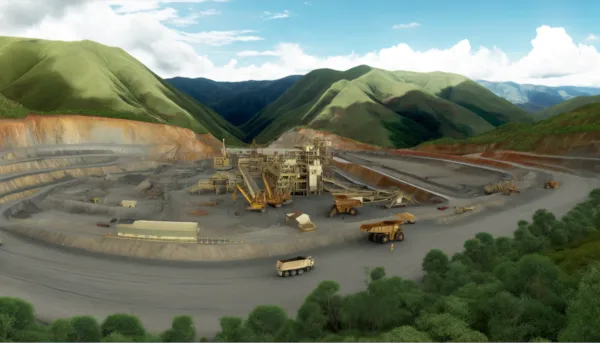




Alamos Gold Inc. (TSX: AGI; NYSE: AGI) has announced new high-grade exploration results across multiple targets within the Island Gold District in Ontario, reinforcing the company’s strategy of using near-mine drilling to support higher-grade mill feed and future production growth. The results include a newly defined Island Gold West Extension zone, continued high-grade mineralization in the Island West up-plunge area, additional hanging wall structures and regional intercepts near the past-producing Cline-Pick and Edwards mines. The update matters because Alamos Gold is expanding the Magino mill and trying to increase the proportion of higher-grade ore processed through the combined Island Gold District. AGI recently traded around $31.59 on the NYSE, within an intraday range of $30.43 to $33.97, giving the company a market value of about $13.1 billion as investors assess gold price leverage, Canadian mine expansion potential and operating execution.
Why do Alamos Gold’s Island Gold drill results matter for AGI’s growth strategy?
Alamos Gold’s Island Gold drill results matter because the company is trying to turn the Island Gold District into a larger, lower-cost Canadian gold platform. Exploration results are not always market-moving on their own, but the latest update is more strategically relevant because the high-grade zones sit near existing or planned infrastructure. That makes the drilling story less about distant blue-sky exploration and more about whether Alamos Gold can feed an expanded processing circuit with better-quality ore over time.
The Island Gold District already sits at the center of Alamos Gold’s long-term growth plan. The company has combined the Island Gold underground mine with the Magino open pit and processing infrastructure, creating a district-scale operating platform in Ontario. The current drilling update supports the idea that the district may contain multiple sources of incremental high-grade mill feed, including extensions of the main Island Gold structure, near-surface up-plunge targets, hanging wall structures and regional deposits within trucking distance of the Magino mill.
This matters for investors because grade can have an outsized effect on mining economics. Higher-grade ore can support stronger production, better unit costs and improved margins, especially when processing capacity is available. Alamos Gold is not only trying to find more ounces. It is trying to identify ounces that can be processed efficiently through an expanded mill and potentially improve the production mix.
The strategic question is whether these exploration results can eventually translate into reserve growth, mine-plan flexibility and higher throughput. The latest drilling does not answer that fully, but it supports the direction of travel. Alamos Gold is showing that the Island Gold District still has room to expand beyond the established reserve and resource base, which is the core reason the update deserves BNT attention.
How could the Island Gold West Extension support future higher-grade mill feed?
The Island Gold West Extension is important because Alamos Gold has defined a new high-grade zone west of the existing Island Gold mineral reserves and resources. The zone has been outlined over an initial area of roughly 200 metres by 300 metres based on drilling to date and remains open down-plunge and to the west. For a mining company, that kind of geometry matters because open-ended mineralization can support further drilling, resource growth and potential mine planning optionality.
The reported drill highlights include 12.05 grams per tonne gold over 5.20 metres, including 36.67 grams per tonne gold over 1.50 metres. Another interval returned 8.07 grams per tonne gold over 5.60 metres, including narrower high-grade sections of 45.90 grams per tonne and 30.20 grams per tonne gold. These are early-stage results, and additional assays remain pending, but the grades are strong enough to make the extension a meaningful target for follow-up exploration.
The location is also central to the business case. The new zone sits along strike to the west of the current Island Gold deposit and south of the Magino deposit. Because the area is near the company’s existing district infrastructure, successful follow-up drilling could eventually create a more capital-efficient source of future mill feed than a remote standalone discovery. That is why the market often pays closer attention to near-mine exploration results from producing companies.
For Alamos Gold, the Island Gold West Extension supports a larger thesis: the district may still be underexplored despite its existing production base. If drilling continues to expand the zone and convert mineralization into resources, the company could gain more flexibility in sequencing higher-grade ore into the expanded mill. That would be especially valuable if gold prices remain strong and investors continue rewarding producers with visible organic growth.
Why is the Island West up-plunge area commercially important for Alamos Gold?
The Island West up-plunge area is commercially important because it could support higher combined underground mining rates beyond the 3,000 tonnes per day expected to be skipped to surface through the shaft. Its proximity to surface and ability to be mined through the ramp system make it more operationally relevant than a deeper target that would require longer development timelines. In mining, proximity to infrastructure can be as important as grade because it affects capital intensity, timing and execution risk.
Alamos Gold’s latest results show continued high-grade mineralization across multiple zones in the Island West up-plunge area. Drill highlights include 14.51 grams per tonne gold over 5.21 metres, 4.55 grams per tonne gold over 16.05 metres, 12.56 grams per tonne gold over 4.73 metres and 27.11 grams per tonne gold over 1.65 metres. The company also intersected high-grade mineralization in yet-to-be-defined hanging wall and footwall zones, creating additional follow-up targets.
This could matter for production growth because up-plunge areas that are closer to surface may be easier to access from the ramp system. If additional drilling confirms continuity and mineability, Alamos Gold could potentially increase the amount of higher-grade ore delivered to the expanded Magino mill. That would support the company’s broader goal of improving the ore blend and maximizing the value of its processing capacity.
The key caveat is that drill results must still move through the normal mining sequence. Mineralization needs to be defined, modeled, converted into resources and reserves, and incorporated into a practical mine plan. Still, the up-plunge results are strategically important because they point to near-term and medium-term optionality within the existing operating footprint. For BNT readers tracking AGI stock, that is the part that matters most.
How do the Cline-Pick and Edwards targets expand the Island Gold District opportunity?
The Cline-Pick and Edwards targets expand the Island Gold District opportunity because they are located about seven kilometres from the Magino mill and may provide additional higher-grade feed sources beyond the main Island Gold deposit. Regional targets can be valuable when they sit within trucking distance of existing processing infrastructure. They do not need to become standalone mines to create value if they can supplement the central mill with higher-grade material.
Alamos Gold’s regional drilling continued to intersect high-grade mineralization at the past-producing Cline-Pick mine and the nearby Edwards mine. New Cline-Pick highlights include 67.93 grams per tonne gold over 3.05 metres, including 127.72 grams per tonne gold over 1.35 metres, as well as 5.63 grams per tonne gold over 10.77 metres. The company also reported additional high-grade results from the 88-60 zone, including 24.12 grams per tonne gold over 3.88 metres.
The business significance is straightforward. If Alamos Gold can prove up additional satellite deposits near the Magino mill, it could improve the district’s long-term feed flexibility. That could extend the life of the operation, lift average grade, improve production scheduling and support better use of mill capacity. For a company already investing in district expansion, nearby satellite targets can become valuable even if each individual target is not massive.
This also gives Alamos Gold a broader exploration story. The company is not relying only on one underground structure. It is testing multiple sources of potential growth across the district, including near-mine zones and regional targets. That diversification can reduce geological dependence on a single area and strengthen the case that Island Gold is a district-scale asset rather than a single-mine growth project.
What does the 2026 exploration budget reveal about Alamos Gold’s capital allocation priorities?
Alamos Gold has budgeted $43 million for exploration at the Island Gold District in 2026, up from $24 million spent in 2025. That increase signals that the company is willing to allocate meaningful capital to organic reserve and resource growth around a core asset. In a gold market where acquisition prices can be expensive, near-mine exploration can be an attractive way to add ounces without paying takeover premiums.
The program includes 50,000 metres of underground exploration drilling, 48,000 metres of surface exploration drilling and 16,000 metres of regional exploration drilling. This structure shows that Alamos Gold is pursuing several objectives at once. It is drilling near existing production horizons, testing the area between Island Gold and Magino, exploring down-plunge extensions and following up on regional high-grade targets. That balanced approach can support both near-term mine planning and longer-term district growth.
Capital allocation is especially important for gold producers because investors often punish companies that overpay for growth or spend heavily without clear returns. Alamos Gold’s Island Gold strategy is different from a risky frontier acquisition because it builds around a producing platform and existing processing infrastructure. That does not remove execution risk, but it gives the investment case a more disciplined shape.
The larger question is whether exploration spending can convert into reserves, production growth and cash flow. Drill results are the early evidence. The real value will come if Alamos Gold can use the expanded exploration program to improve mine life, grade profile and throughput through the Magino mill. Investors will likely watch later 2026 drilling updates for signs that today’s high-grade intercepts are becoming a more durable operating advantage.
What does AGI stock performance suggest about investor expectations for Alamos Gold?
AGI stock remains closely tied to both company execution and the broader gold equity trade. The shares recently traded around $31.59 on the NYSE, within an intraday range of $30.43 to $33.97. The company’s market capitalization of about $13.1 billion shows that Alamos Gold is being valued as a significant intermediate gold producer rather than a speculative exploration name. That matters because exploration results are being evaluated through the lens of production growth, cost control and capital efficiency.
The stock’s reaction environment is complicated. Gold producers can deliver strong exploration news and still face pressure if investors are focused on guidance, costs, mine sequencing or broader metal price movements. Alamos Gold has to show that Island Gold strength can translate into a more predictable operating profile across the portfolio. The latest drilling update helps the long-term growth narrative, but the market will still demand evidence that expansion plans are being executed on schedule and within cost expectations.
Investors are likely to focus on whether the Island Gold District can become a higher-margin engine inside Alamos Gold’s portfolio. The company operates Island Gold and Young-Davidson in Ontario, as well as the Mulatos District in Mexico. Island Gold is the asset with the strongest expansion narrative, so high-grade drilling there can carry more weight than routine exploration elsewhere. If the district becomes larger and lower cost, it could help support a premium valuation.
The risk is that investors may not reward exploration immediately unless it improves near-term production assumptions. Mining equity markets often wait for resource updates, reserve conversions, technical reports or production guidance before fully pricing exploration results. That makes Alamos Gold’s latest update strategically positive, but not automatically transformative. The company must keep converting geological success into mine-plan value.
Which risks could limit the value of Alamos Gold’s latest high-grade discoveries?
The main risk is that high-grade drill intercepts do not always convert neatly into economic mineable ounces. Continuity, geometry, dilution, mining method, development access and metallurgical performance all matter. Some zones may look attractive in isolated drill holes but become less compelling once modeled at scale. Alamos Gold will need further drilling to determine whether the newly defined and expanded zones can support resource growth and practical mine sequencing.
Execution risk also matters because the Island Gold District growth plan depends on integrating exploration, underground development, mill expansion and production scheduling. Expanding processing capacity is valuable only if the company can deliver the right mix of ore to the mill at the right time. If development is delayed or ore access is more complex than expected, the production benefit from higher-grade targets could take longer to materialize.
Gold price volatility remains a broader risk. Strong gold prices can make higher-grade discoveries more valuable, but a weaker gold market can reduce investor appetite for producers and compress valuations. Alamos Gold’s operating quality can help, but it cannot fully escape commodity price cycles. AGI stock will continue to move with both company-specific updates and the wider precious metals environment.
Cost inflation is another issue for Canadian mining projects. Labor, energy, equipment, development and construction costs can pressure margins even when grades are strong. Alamos Gold’s challenge is to use the Island Gold District’s grade and infrastructure advantages to offset those pressures. The exploration story is promising, but the market will ultimately judge whether it produces stronger cash flow, not just better drill maps.
What does Alamos Gold’s update signal for the broader Canadian gold mining sector?
Alamos Gold’s update signals that near-mine exploration remains one of the most important value-creation tools in the Canadian gold sector. Producers with existing mills, permits, underground access and technical teams can often generate attractive growth by extending known systems and identifying satellite targets. This can be more capital-efficient than building a new mine from scratch or buying ounces through acquisitions.
The Island Gold District also reflects a broader industry trend toward district consolidation and infrastructure leverage. Companies increasingly want mining camps where multiple deposits can feed shared processing capacity. That model can improve flexibility, reduce capital intensity per ounce and support longer mine lives. Alamos Gold’s combination of Island Gold and Magino fits that trend, and the latest drilling update strengthens the argument that the district has more room to grow.
For competitors, the lesson is that high-quality gold operations are not only defined by current reserves. They are also defined by exploration potential around existing infrastructure. Investors may continue to reward producers that can show organic growth without taking on excessive balance-sheet risk. That is especially relevant in a gold market where asset quality, jurisdiction and cost discipline matter as much as production scale.
For Alamos Gold, the update reinforces the Island Gold District as the centerpiece of its Canadian growth narrative. The company still has to convert high-grade results into reserves, mine plans and production. However, the direction is clear. The more Alamos Gold can demonstrate repeatable exploration success across the district, the stronger its case becomes that Island Gold is not just a mine expansion story, but a long-term platform for higher-grade Canadian gold production.
Key takeaways on what Alamos Gold’s Island Gold results mean for AGI and gold investors
- Alamos Gold announced new high-grade exploration results across multiple targets within the Island Gold District in Ontario.
- The results support the company’s strategy of increasing higher-grade mill feed for the expanded Magino mill.
- A newly defined Island Gold West Extension zone has been outlined west of existing Island Gold reserves and resources.
- Island West up-plunge drilling could support higher combined underground mining rates because the area can be accessed through the ramp system.
- Regional drilling at Cline-Pick and Edwards adds potential satellite feed sources within seven kilometres of the Magino mill.
- Alamos Gold has increased its 2026 Island Gold District exploration budget to $43 million from $24 million in 2025.
- The 2026 program includes underground, surface and regional drilling aimed at reserve growth, resource expansion and production flexibility.
- AGI recently traded around $31.59 on the NYSE, giving Alamos Gold a market value of about $13.1 billion.
- The upside depends on converting high-grade intercepts into resources, reserves, mine plans and cash flow.
- The update strengthens the case that Island Gold could remain one of Alamos Gold’s most important long-term production growth platforms.
Discover more from Business-News-Today.com
Subscribe to get the latest posts sent to your email.