





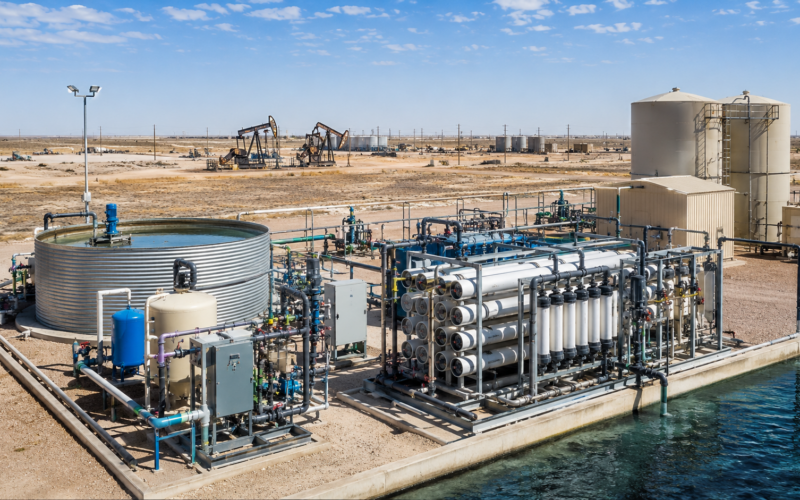
Western Midstream Partners, LP (NYSE: WES) has started its second produced-water treatment pilot facility near the Red Bluff Reservoir in Reeves County, Texas, alongside Chevron U.S.A. Inc., ConocoPhillips Company, Devon Energy Corporation and Exxon Mobil Corporation. The facility can receive approximately 2,000 barrels of produced water per day and generate about 1,000 barrels of reclaimed freshwater, giving the project ten times the freshwater output of the partners’ first pilot. The start-up moves Western Midstream closer to determining whether highly treated oilfield wastewater can support industrial cooling, irrigation and other beneficial uses beyond traditional disposal or recycling within drilling operations. Although the project remains small compared with Western Midstream’s existing water volumes, its strategic value lies in testing whether produced-water treatment can become a regulated, scalable and commercially viable infrastructure business.
Why does Western Midstream see produced water as a strategic Permian infrastructure opportunity?
Produced water has traditionally been treated as an unavoidable operating burden associated with oil and natural gas production. Large volumes must be gathered, transported, recycled for additional drilling activity or injected underground through disposal wells. Western Midstream is attempting to change that economic equation by determining whether some of this water can be treated to a sufficiently high standard for applications outside the oilfield, creating a potential product from a stream that historically generated handling and disposal costs.
The scale of Western Midstream’s existing water operations explains why even an early-stage treatment project deserves attention. The partnership handles approximately 3 million barrels of produced water per day through sourcing, gathering, transportation, recycling, treatment and disposal infrastructure. That existing network provides access to large and relatively predictable feedstock volumes, which could become an advantage if beneficial reuse develops into a meaningful commercial market.
JIP 2 remains extremely small relative to that platform. Its planned reclaimed freshwater output of about 1,000 barrels per day represents only a fraction of Western Midstream’s daily produced-water throughput. Investors should therefore view the facility as a technology and regulatory demonstration rather than a material near-term contributor to revenue or distributable cash flow.
However, successful infrastructure businesses often begin with small projects that clarify treatment performance, operating costs and customer demand before large amounts of capital are committed. Western Midstream can use JIP 2 to identify where equipment fails, how water chemistry changes over time and what level of treatment is required for different end uses. Those lessons could determine whether a commercial facility should process tens of thousands of barrels per day or whether the economics remain too challenging for large-scale deployment.
The project also aligns with a broader shift in the Permian Basin, where water management is becoming nearly as strategically important as hydrocarbon processing. Higher production volumes create more associated water, while underground disposal capacity faces operational and regulatory constraints in parts of West Texas. Midstream companies capable of offering gathering, recycling, disposal and beneficial reuse could become more deeply embedded in producer operations than businesses providing only one water-management service.

How does the second Western Midstream pilot build on two years of treatment testing?
Western Midstream and its collaborators launched the first joint industry pilot in 2023 to evaluate produced-water treatment technologies under field conditions. During the 24-month programme, technical teams collected more than 50,000 water-quality data points and assessed whether treatment systems could consistently produce water suitable for industrial cooling, irrigation and potential surface discharge. JIP 2 moves the programme from initial technology selection toward a larger demonstration of operational consistency.
That distinction matters because treating produced water once is not the same as treating it reliably every day. Water chemistry can vary by formation, producer, location and stage of well development. Salinity, hydrocarbons, suspended solids, metals and treatment chemicals can create different technical challenges, meaning a process that performs well on one sample may become less effective when feedwater conditions change.
The second facility is designed to receive twice as much water as it returns in reclaimed freshwater. This indicates that treatment will also create a concentrated residual stream that must still be managed safely and economically. The commercial case will therefore depend not only on the value of the freshwater output but also on energy consumption, chemical usage, equipment maintenance and the cost of handling remaining waste.
Scaling from JIP 1 to a facility with ten times the freshwater output should provide better evidence on operating costs. It can also reveal whether treatment efficiency improves as equipment becomes larger or whether fouling and maintenance expenses increase with throughput. These are the details that determine whether a promising technology becomes infrastructure or remains a permanent science project.
The participation of Chevron, ConocoPhillips, Devon Energy and ExxonMobil broadens the relevance of the data. Each company has substantial exposure to large-scale upstream operations and therefore shares an interest in reducing disposal pressure and freshwater dependence. Their involvement may also improve the chances of future commercial adoption because potential customers are helping to evaluate the technology rather than being asked to accept an unfamiliar solution after development is complete.
Could reclaimed oilfield water strengthen long-term water security across West Texas?
West Texas combines intensive oilfield activity with limited freshwater resources, making water availability an economic and community issue rather than solely an environmental consideration. Industrial users, municipalities, agriculture and energy producers can compete directly or indirectly for the same constrained supplies. A dependable alternative source could therefore reduce pressure on conventional freshwater systems, particularly for applications that do not require drinking-water quality.
Industrial cooling is one of the most practical early markets because large facilities can consume significant volumes and may be able to use reclaimed water meeting defined technical standards. Growing power demand from data centres, manufacturing facilities and energy infrastructure could expand this opportunity if new industrial developments require additional cooling capacity in water-stressed regions. Western Midstream’s project may consequently have relevance beyond oil and gas if the treatment process proves reliable.
Irrigation represents a larger but more sensitive opportunity. Treated water must be shown to be safe for soil, crops, groundwater and surrounding ecosystems over extended periods, not merely after a limited laboratory test. Regulators and landowners will require evidence that salts, metals and other constituents do not accumulate or create long-term liabilities.
Public acceptance will be another critical factor. Communities may support technologies that conserve freshwater and reduce disposal volumes, but they are unlikely to accept treatment claims based only on company testing. Independent verification, transparent water-quality data and clearly defined monitoring obligations will be essential if beneficial reuse moves from demonstration facilities to wider deployment.
The strategic opportunity is therefore substantial, but so is the burden of proof. Western Midstream must establish that reclaimed water can be produced consistently, transported economically and used without transferring an oilfield waste problem to agricultural land or surface water. A commercial project that meets those conditions could provide a meaningful regional resource, while an early failure could slow industry adoption for years.
What commercial model could Western Midstream build around beneficial water reuse?
Western Midstream’s existing midstream model is based largely on fee-generating infrastructure supported by long-term customer relationships. Beneficial reuse could eventually follow a similar structure, with producers paying to have produced water gathered and treated while industrial or agricultural customers pay for the reclaimed output. This would create potential revenue on both sides of the treatment facility, although the viability of that model has not yet been demonstrated.
The strongest commercial proposition may involve avoided costs rather than premium pricing for reclaimed water. Producers currently incur expenses to move, recycle or dispose of produced water, while industrial customers incur costs to secure freshwater supplies. A treatment project does not need to generate an unusually high water price if it can reduce the combined cost and regulatory exposure faced by both groups.
Western Midstream’s network could also provide a structural advantage over standalone treatment developers. Treatment technology is only one component of the required system. Commercial-scale reuse also needs gathering pipelines, storage, pumping capacity, residual management and connections to end users, areas where a large midstream operator already possesses relevant expertise.
However, infrastructure capital cannot be justified by environmental benefits alone. Western Midstream will need long-term contracts, predictable treatment costs and confidence that regulations will remain stable over the operating life of a commercial facility. Without contracted demand, the partnership could invest in expensive equipment that produces water customers are unwilling or unable to purchase.
The company must also decide where beneficial reuse ranks against its other investment opportunities. Western Midstream recently completed the approximately $1.6 billion acquisition of Brazos Delaware II, significantly expanding its natural gas gathering and processing presence in the Delaware Basin. Management is therefore balancing acquisition integration, conventional midstream growth projects, distributions and emerging water technologies within the same capital allocation framework.
Why could disposal restrictions make advanced water treatment more economically attractive?
Underground injection remains an essential component of Permian water management, but it is not an unlimited solution. Regulators have increased scrutiny of disposal-well pressure, injection volumes and geological conditions in response to concerns involving containment and seismic activity. These restrictions can increase transportation distances, reduce available disposal capacity and raise the value of alternative treatment routes.
Recycling produced water for hydraulic fracturing already reduces some demand for newly sourced water. However, drilling and completion activity cannot absorb all the water generated from producing wells, particularly as mature operations continue producing water even when new well completions slow. Beneficial reuse could address part of the surplus that remains after oilfield recycling demand is satisfied.
This creates a potential economic inflection point. Advanced treatment may appear expensive when disposal capacity is abundant and inexpensive, but the comparison changes when operators face longer pipelines, constrained permits or higher injection costs. Technology does not necessarily need to become cheap in absolute terms if the conventional alternative becomes more difficult and costly.
Western Midstream’s decision to advance a second pilot suggests that the partnership sees enough potential to continue collecting commercial evidence. It does not yet prove that beneficial reuse will outperform disposal across the Permian Basin. The most likely outcome is that treatment becomes attractive in selected locations where water volumes, disposal constraints, nearby customer demand and pipeline access create favourable economics.
Geography will therefore matter as much as chemistry. A technically successful facility located far from industrial or agricultural customers may still struggle commercially because reclaimed water is heavy and expensive to transport. Western Midstream will need to identify demand centres located close enough to treatment infrastructure to preserve the value created by the process.
What does the JIP 2 project mean for Western Midstream’s financial outlook and WES sentiment?
Western Midstream entered the project from a relatively strong operating position. The partnership generated first-quarter 2026 adjusted EBITDA of $683.1 million, operating cash flow of $469.9 million and free cash flow of $242.3 million. It also raised its quarterly distribution to $0.93 per unit, equivalent to $3.72 on an annualised basis.
Those figures give Western Midstream the capacity to fund pilot projects without making them central to the investment case. At the same time, first-quarter free cash flow after distributions was negative because capital spending and cash distributions exceeded free cash generation during the period. Investors will therefore expect management to remain disciplined when deciding whether JIP 2 warrants a much larger commercial investment.
Western Midstream units traded near $42.89 during June 18 trading, down approximately 3% from the June 11 closing level and about 9% below the May 18 close. The units remained within a 52-week range of roughly $36.90 to $48, placing the price below its recent high but comfortably above the annual low. Based on the annualised distribution, the indicated yield was approximately 8.7%, reinforcing the importance of cash generation and distribution security to investor sentiment.
The water-treatment announcement is unlikely to materially alter near-term earnings expectations because JIP 2 is a demonstration facility with limited throughput. The market is more likely to focus on Brazos Delaware integration, producer activity, natural gas processing volumes, leverage and distribution coverage. Beneficial reuse currently represents strategic option value rather than a reason to reprice the partnership’s existing cash flows.
That does not make the project irrelevant. If Western Midstream develops a commercial treatment model, it could add another fee-based service to its Permian platform and strengthen relationships with major producers. A proven model could also improve the long-term value of its water network by reducing dependence on disposal capacity and creating additional outlets for growing produced-water volumes.
What execution risks could prevent Western Midstream from reaching commercial-scale treatment?
Treatment reliability remains the first major risk. Produced water is chemically complex, and large-scale systems must operate continuously rather than only under carefully controlled test conditions. Membrane fouling, corrosion, high energy consumption or inconsistent output quality could make the process too costly for commercial deployment.
The second risk is regulatory timing. Western Midstream can demonstrate that its technology produces highly treated water, but regulators must determine where and how that water can be used. Different standards may apply to industrial cooling, irrigation, land application or surface discharge, potentially requiring separate permits and monitoring programmes.
Customer demand presents a third challenge. Industrial and agricultural users may express interest in reclaimed water while remaining reluctant to sign long-term contracts until quality, liability and availability are fully understood. Without committed buyers, Western Midstream may struggle to finance commercial facilities at an acceptable return.
Capital competition is equally important. Conventional gathering and processing projects often have identifiable producer commitments and established fee structures. Beneficial reuse infrastructure may carry greater technology and permitting uncertainty, meaning it must offer sufficiently attractive returns to compete for funding.
The most encouraging element is Western Midstream’s staged approach. The company is not jumping directly from laboratory testing to a massive treatment complex. It is increasing capacity, gathering data and working with large producer partners before making a commercial-scale decision, which reduces the risk of committing substantial capital to an unproven system.
What are the key takeaways from Western Midstream’s second Permian water pilot?
- Western Midstream has increased reclaimed freshwater output tenfold from its first pilot, but JIP 2 remains a demonstration project rather than a material earnings contributor.
- The project tests whether produced water can become a saleable resource instead of remaining primarily a recycling or disposal expense.
- Western Midstream’s handling of approximately 3 million barrels of produced water per day gives it substantial feedstock and infrastructure advantages.
- Participation by Chevron, ConocoPhillips, Devon Energy and ExxonMobil increases the project’s technical relevance and potential customer alignment.
- Industrial cooling may offer an earlier commercial market than irrigation because agricultural use carries greater soil, crop and public-acceptance concerns.
- Tightening disposal conditions could improve treatment economics even if advanced desalination remains relatively expensive.
- Commercial success will depend on locating treatment facilities near customers because transporting reclaimed water over long distances can destroy project economics.
- Western Midstream must demonstrate consistent water quality, manageable residual disposal and acceptable energy consumption before scaling capacity.
- The partnership’s recent Brazos Delaware acquisition means beneficial reuse must compete with conventional midstream projects for capital.
- WES investors are likely to treat JIP 2 as long-term strategic option value while focusing on cash flow, distribution coverage and acquisition integration.
Discover more from Business-News-Today.com
Subscribe to get the latest posts sent to your email.

