



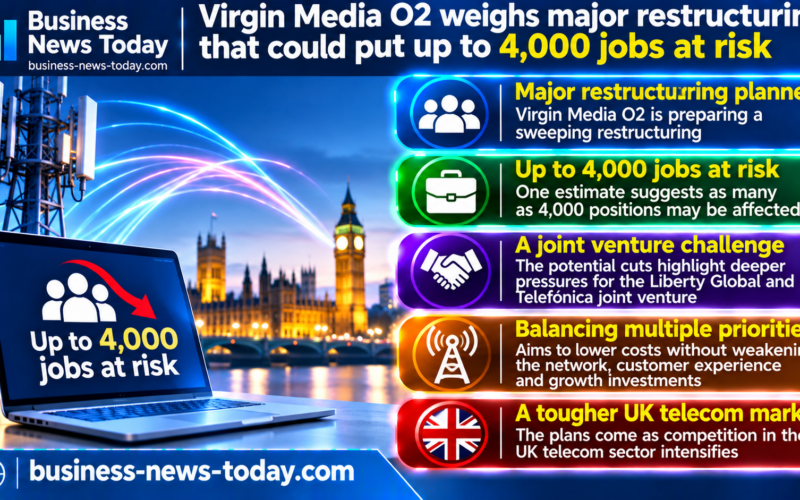
Virgin Media O2 is reportedly preparing to cut thousands of jobs as the UK telecom operator confronts high leverage, declining fixed-line customer numbers and pressure from its shareholders to deliver a materially leaner cost base. Reports suggest that as many as 4,000 of approximately 15,000 to 16,000 positions could ultimately be affected, although the final number has not been confirmed and Virgin Media O2 has declined to comment publicly on the redundancy plans. Most of the reductions are expected to fall on non-customer-facing functions, while senior leadership changes and a broader review of contractors and suppliers are also reported to be under way. If the upper estimate were implemented, the restructuring would amount to roughly one quarter of the workforce and would represent far more than a routine efficiency programme. The central question is whether such a large organisational reset can materially improve Virgin Media O2’s financial flexibility without compromising the operating capabilities needed to defend its broadband and mobile position.
Why could Virgin Media O2 cut thousands of jobs when its network investment still needs to remain competitive?
The reported workforce plan is best understood as one component of a much wider balance-sheet and operating-model reset. Virgin Media O2’s owners, Liberty Global Ltd. and Telefónica, S.A., have reportedly been examining approximately £600 million of potential cost reductions spanning employment expenses, operating expenditure and capital spending. That creates an unusually difficult management equation because the company cannot simply cut its way out of competitive pressure. Broadband customers increasingly have access to BT Group’s Openreach fibre infrastructure and a growing range of alternative fibre networks, while mobile competition has also been reshaped by the creation of VodafoneThree.
Virgin Media O2 therefore needs to reduce expenditure while simultaneously maintaining the network quality, service performance and product investment required to retain customers. Its second-quarter numbers illustrate the tension. Consumer fixed-line customers fell by 29,900 during the quarter to around 5.5 million, while total mobile connections declined by 17,800 to 46.4 million. Total service revenue of £2.04 billion was down 3.9% year on year on a rebased basis adjusted for the Daisy transaction, while adjusted EBITDA of £975.2 million declined by 2.9% on the same basis.
Those declines are not catastrophic in isolation, but they matter significantly when combined with a heavily leveraged capital structure. At June 30, Virgin Media O2 reported approximately £22.5 billion of total third-party debt and lease obligations. Its covenant calculation showed £17.15 billion of third-party net debt, while a broader leverage measure that included vendor financing, leases and certain other obligations stood at 5.89 times annualised adjusted EBITDA.
That is why reported job reductions potentially numbering in the thousands cannot be viewed simply as an attempt to improve near-term margins. They are part of an effort to create more financial headroom in a business where falling revenue, high financing requirements and continuing infrastructure needs compete for the same cash.
Could cutting as many as 4,000 roles generate enough savings to change the financial picture?
A workforce reduction approaching 4,000 employees would unquestionably reduce the operating cost base, but it would not by itself solve Virgin Media O2’s leverage challenge. External estimates have suggested the proposed reductions could potentially generate roughly £200 million of annual gross personnel savings once fully implemented. Even if supplier and contractor spending were reduced alongside employee costs, the savings would remain modest compared with a debt and lease obligation base exceeding £22 billion.
That comparison explains why management decisions around capital expenditure may ultimately matter at least as much as headcount. Virgin Media O2 has spent heavily building and upgrading fixed and mobile infrastructure, and the company said in its second-quarter update that its full-fibre footprint had reached around nine million premises. Management has also been expanding 5G+ coverage and introducing services such as O2 Satellite while attempting to improve customer-service performance.
The financial challenge is that infrastructure investment must increasingly pass a tougher return threshold. Building fibre into locations where multiple competing networks already exist can destroy value if customer take-up does not justify the construction cost. Virgin Media O2 therefore has an incentive to shift some infrastructure economics from direct ownership and capital expenditure towards wholesale access arrangements where those arrangements are commercially superior.
That logic appears consistent with reports that Virgin Media O2 has been exploring greater use of BT Group’s Openreach network outside parts of its own footprint. Such a strategy could lower incremental construction requirements, but it would also gradually reshape the organisation from one focused heavily on owning infrastructure towards one more willing to optimise between owned and wholesale networks.
Why does the reported restructuring go beyond ordinary telecom layoffs?
The breadth of the reported measures is one of the strongest signals that Virgin Media O2 is reconsidering how the business should operate, rather than merely removing a layer of excess staffing. The potential programme includes employee reductions, management changes, supplier scrutiny and contractor reviews, while separate reports have pointed to lower capital spending as part of the shareholder-led savings agenda. Taken together, those moves indicate that management is being asked to reconsider which capabilities genuinely need to sit inside the organisation.
Non-customer-facing functions becoming the principal target would fit a broader corporate strategy of simplifying support structures while protecting frontline operations. The risk is that administrative and technical functions that appear distant from customers can still influence billing, network planning, product development, regulatory compliance and service recovery. Removing organisational layers can accelerate decisions, but excessive reductions can simply transfer workloads elsewhere or increase reliance on external suppliers.
The contractor review is therefore particularly significant. A company can reduce its employee count without reducing its real cost base if work is simply shifted to consulting firms, technology providers or outsourced service partners. Conversely, bringing selected functions in-house while reducing expensive contractor dependence could generate savings without an equivalent reduction in operational capability.
For executives, the relevant measurement will consequently be broader than the eventual redundancy number. The meaningful indicators will include total operating expenditure, adjusted EBITDA trends, cash conversion, customer retention, service quality and the company’s ability to execute network and digital transformation with a smaller organisational structure.
How did a £22.5bn debt burden become such an important part of Virgin Media O2’s workforce strategy?
Virgin Media O2 was created in 2021 through the combination of Liberty Global’s Virgin Media business and Telefónica’s O2 operation in the United Kingdom. The 50:50 joint venture was designed to create a converged national challenger combining fixed broadband and mobile scale. The strategic rationale remains understandable, but telecommunications businesses are capital intensive, and debt that appears manageable during stable operating conditions can become more restrictive when revenue growth weakens and refinancing markets become less accommodating.
The company’s capital structure has increasingly attracted attention from debt investors. At the end of June, Virgin Media O2’s blended fully swapped borrowing cost was approximately 5.3%, with an average third-party debt tenor, excluding vendor financing, of about 4.6 years. The company also had more than £1.1 billion of undrawn commitments, meaning the immediate issue is not simply a shortage of available liquidity.
The more important concern is the longer-term relationship between leverage, earnings and refinancing. Falling EBITDA can push leverage ratios higher even when nominal debt remains unchanged, while expensive refinancing can absorb additional cash that might otherwise support network investment or shareholder distributions. That makes sustained operating improvement more important than achieving a single year of headline cost savings.
Bond-market weakness has provided a particularly visible expression of that concern. The pricing of some Virgin Media O2 debt instruments deteriorated sharply during 2026, indicating that creditors were demanding more compensation for perceived financial risk. Workforce restructuring therefore becomes part of a broader effort to convince lenders and investors that management can protect cash generation before upcoming refinancing needs become more restrictive.
Why are broadband competition and the nexfibre strategy becoming important to the job-cut equation?
Virgin Media O2’s challenge is complicated by structural change in the UK fibre market. BT Group’s Openreach continues to expand fibre-to-the-premises coverage, while alternative operators have spent billions of pounds creating competing networks. The result is increasing infrastructure overlap in some areas, putting pressure on customer acquisition economics and making indiscriminate network construction less attractive.
Virgin Media O2 and its shareholders have attempted to address that challenge through nexfibre, the fibre network venture backed by Liberty Global, Telefónica and InfraVia Capital Partners. Earlier in 2026, nexfibre agreed a £2 billion transaction to acquire Substantial Group, which owns Netomnia and related businesses. Under the proposed structure, Virgin Media O2 would obtain the retail operations associated with YouFibre and Brsk while moving substantial traffic onto the enlarged nexfibre platform.
The Competition and Markets Authority subsequently raised concerns about the transaction, complicating a deal that was expected to strengthen the group’s position against Openreach and improve the economics of its fibre strategy. The transaction is particularly relevant to Virgin Media O2’s finances because the broader structure was expected to generate approximately £1.1 billion of cash for the operator in connection with transferring and upgrading millions of premises through nexfibre.
Regulatory uncertainty therefore intersects directly with the restructuring story. If the planned fibre reorganisation proceeds substantially as intended, Virgin Media O2 could gain additional financial flexibility and reduce parts of its future capital burden. If it is blocked or materially altered, management may need alternative ways to improve cash generation, potentially increasing pressure on operating expenditure and capital discipline.
What do the reported cuts mean for Liberty Global and Telefónica investors?
Virgin Media O2 is not separately listed, so public-market exposure comes primarily through its shareholders. Liberty Global Class A shares closed at $7.77 on October 30, leaving the stock around 30% lower for 2026 and close to the bottom of its 52-week range. That performance reflects Liberty Global’s wider portfolio and should not be attributed solely to Virgin Media O2, but the UK joint venture remains strategically important to the investment case.
Telefónica shares were trading around €3.37 on November 2, roughly flat on the session after recovering during the preceding week, but still substantially below their 52-week high. Telefónica also has a diversified international portfolio, which makes it inappropriate to interpret movements in its share price as a direct referendum on the reported UK workforce cuts.
For both shareholders, the more meaningful signal will come from whether Virgin Media O2 can improve cash generation and reduce leverage while protecting the underlying value of the business. A restructuring that produces meaningful recurring savings without accelerating customer losses would strengthen that case. A programme that cuts costs but weakens service, technology execution or commercial competitiveness would simply exchange one financial problem for another.
What should executives and employees watch when Virgin Media O2 reports its third-quarter results?
Virgin Media O2 is scheduled to publish third-quarter 2026 financial results on November 3, making the update an unusually important test of the current reporting. The most immediate question will be whether management formally confirms a restructuring programme and, if so, whether it provides a financial savings target rather than a definitive employee number.
That distinction matters because a cost programme can change significantly during consultation. A reported upper estimate of 4,000 positions should therefore not be treated as a confirmed redundancy figure unless Virgin Media O2 formally adopts that number. Redeployment, voluntary departures, contractor reductions, natural attrition and changes to implementation timing could all alter the final impact.
Investors should also watch the underlying operating numbers. Fixed-line customer trends, service revenue, adjusted EBITDA, capital expenditure, cash generation and leverage will reveal whether the restructuring is responding to deterioration that continued during the third quarter or whether management is acting pre-emptively to strengthen the company before financial pressure becomes more severe.
The strategic test is ultimately larger than a headcount target. Virgin Media O2 needs to become materially more efficient while preserving enough investment capacity to compete with Openreach, VodafoneThree, alternative fibre providers and other telecom challengers. The reported workforce reduction suggests management and shareholders believe incremental efficiencies are no longer sufficient. The next results will begin to show whether the emerging solution is primarily a cost-cutting exercise or the first stage of a more fundamental redesign of the business.
What are the key takeaways from Virgin Media O2’s reported plan to cut thousands of jobs?
- Virgin Media O2 is reportedly preparing substantial workforce reductions, with one estimate suggesting as many as 4,000 positions could ultimately be affected, although no final redundancy number has been formally confirmed.
- The upper estimate would represent roughly one quarter of a workforce currently reported at around 15,000 to 16,000 employees, making the programme potentially one of the more significant recent UK telecom restructurings.
- Non-customer-facing positions are expected to bear much of the impact, while senior management, contractors and suppliers are also reportedly being reviewed as part of the broader efficiency programme.
- The restructuring comes as Virgin Media O2’s shareholders, Liberty Global and Telefónica, confront a capital structure containing approximately £22.5 billion of third-party debt and lease obligations.
- Second-quarter service revenue fell 3.9% on a rebased basis adjusted for the Daisy transaction, while adjusted EBITDA declined 2.9%, increasing the importance of cost control and cash generation.
- Fixed-line customer losses and intense competition from Openreach and alternative fibre networks make aggressive cost reduction more difficult because Virgin Media O2 must continue investing sufficiently to protect its market position.
- Reported shareholder ambitions to find approximately £600 million of savings extend beyond payroll and could include operating expenditure, capital expenditure, contractor costs and broader organisational simplification.
- The proposed nexfibre and Netomnia transaction remains financially relevant because the structure could reshape Virgin Media O2’s fibre investment requirements and deliver substantial cash proceeds, subject to regulatory outcomes.
- Liberty Global’s weak share performance provides evidence of broader investor caution around its portfolio, but Virgin Media O2 should not be treated as the sole explanation for movements in either Liberty Global or Telefónica shares.
- Virgin Media O2’s November 3 third-quarter results are the immediate catalyst, with investors and employees looking for confirmation of the restructuring, financial savings targets and evidence that operating trends are stabilising.
Discover more from Business-News-Today.com
Subscribe to get the latest posts sent to your email.