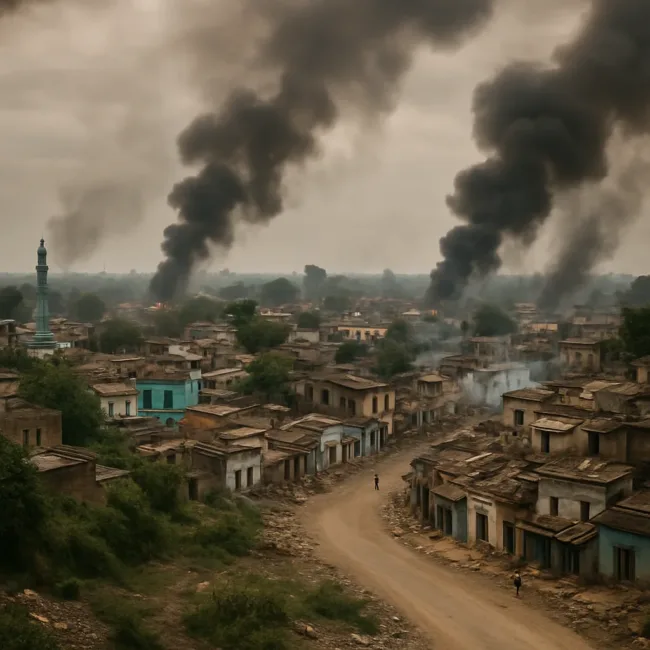




Ukraine has accused Russian forces of using a rare six-day humanitarian ceasefire around the occupied southern city of Oleshky to reinforce military positions, rotate troops and improve battlefield logistics even as the truce successfully allowed nearly 800 civilians to escape one of the most isolated communities on the front line.
The ceasefire, which began on October 27 and expired late on November 1, was negotiated to allow humanitarian aid into Oleshky and enable civilians trapped under Russian occupation to leave. Ukrainian and Russian officials have both said the humanitarian commitments associated with the agreement were fulfilled, making the operation one of the most significant localized pauses in fighting since Russia launched its full-scale invasion in 2022.
Ukraine’s military said on November 2 that it observed Russian units strengthening defensive positions, expanding anti-drone measures along roads and increasing logistical movements during the pause, including deliveries of ammunition. Kyiv said Ukrainian forces respected the ceasefire and acted only within the agreed humanitarian framework.
The Kremlin responded cautiously. Spokesperson Dmitry Peskov said he did not have detailed information about the specific Ukrainian accusations but argued that repositioning forces during a ceasefire would not be unusual and suggested Ukrainian units may also have used the pause to adjust their positions. That exchange illustrates the central tension surrounding the operation: a humanitarian agreement succeeded in moving civilians to safety but did little to reduce military mistrust between the two sides.
Nearly 800 residents escaped Russian-held Oleshky during rare six-day humanitarian truce
The ceasefire created a temporary corridor around Oleshky, a heavily damaged city on the eastern bank of the Dnipro River opposite Ukrainian-controlled Kherson. Russian forces have occupied the city since the opening stages of the 2022 invasion, and residents have endured years of fighting, disrupted utilities and increasingly restricted access to food, medicine and transportation.
The temporary pause allowed roads around the city to be cleared of mines and enabled humanitarian convoys to enter areas that had become extremely difficult to reach because of artillery fire and drone activity. Residents were transported out using buses and ambulances, with evacuees eventually splitting between those who wanted to travel toward Russia and those who wanted to reach Ukrainian-controlled territory.
US First Lady Melania Trump said nearly 800 people were evacuated during the operation. Some Ukrainians traveled through Russian-controlled Crimea and southern Russia before flying to Belarus, from where they crossed back into Ukrainian-controlled territory in a complicated journey reflecting how heavily militarized the direct front line remains.
The return produced emotional reunions for families separated for years. Some evacuees arrived exhausted and visibly underweight after prolonged shortages inside Oleshky, while Ukrainian authorities provided food, medical support and temporary accommodation after their arrival.
The six-day pause became the longest localized ceasefire associated with a specific humanitarian operation since Russia’s full-scale invasion began. Its success has generated interest in whether similar arrangements could be negotiated elsewhere even as fighting continues across most of the front.
Ukraine says Russian troops strengthened fortifications and moved ammunition during ceasefire
Ukraine’s General Staff said its forces observed several types of Russian military activity while the humanitarian truce was in effect. According to Kyiv, Russian units rotated personnel, reinforced defensive positions, expanded protection against drones along supply routes and increased logistical movements.
Ukrainian officials specifically alleged that ammunition and other military supplies were transported into Russian positions during the pause. Kyiv argues that these movements allowed Russian forces to improve their readiness while Ukrainian troops were observing restrictions intended to protect the humanitarian operation.
The accusation does not mean Ukraine claims Russia directly violated the ceasefire by attacking civilians during the evacuation. Ukrainian officials have separately acknowledged that the agreed humanitarian activities were completed and that both sides largely respected the immediate terms required to move residents safely.
Instead, the dispute centers on whether the ceasefire’s humanitarian purpose should have prevented either military from exploiting the reduction in fighting for tactical advantage. The agreement’s precise restrictions on troop movement have not been publicly disclosed in enough detail to determine independently whether the activities described by Ukraine constituted a formal breach.
That ambiguity is likely to complicate future negotiations. Humanitarian pauses often require both sides to suspend offensive activity while still allowing forces to maintain their positions, creating difficult questions about what constitutes ordinary defensive preparation and what amounts to using a truce to prepare for renewed combat.
Kremlin says troop repositioning during a ceasefire would not be unusual
Russia has not provided a detailed rebuttal to every Ukrainian allegation. Peskov said he lacked specific information about the General Staff’s claims but suggested that changing troop positions during a ceasefire could be considered routine military practice.
The Kremlin spokesperson also argued that Ukraine may have conducted similar adjustments during the pause, although Russia did not immediately present evidence supporting that suggestion. Ukraine says its forces acted exclusively within the ceasefire arrangements and did not use the operation to gain an improper battlefield advantage.
Both governments nevertheless publicly recognized the humanitarian outcome. Russian and Ukrainian officials confirmed that civilians were able to leave Oleshky and that relief supplies reached the area, making the operation an unusual example of practical cooperation during a war characterized by almost continuous hostility.
That creates a complicated picture in which both sides can simultaneously regard the humanitarian mission as successful and accuse the other of exploiting it strategically. Such disagreements are common in localized ceasefires because military commanders remain deeply suspicious that any temporary reduction in fighting could be used by the opponent to regroup.
The dispute therefore matters beyond Oleshky. If both sides believe humanitarian pauses create unacceptable military risks, negotiating similar arrangements for other front-line communities could become significantly harder.
Melania Trump and Pope Leo played roles in securing unusual humanitarian agreement
The agreement attracted international attention because the mediation effort involved Melania Trump and Pope Leo XIV. The White House has said the first lady helped facilitate discussions surrounding the evacuation, while the pope publicly supported efforts to secure humanitarian access to Oleshky.
Melania Trump described the operation as a potential foundation for broader peace, emphasizing that civilians trapped by the conflict should not be treated as bargaining tools. Ukrainian officials thanked her for helping create the conditions necessary for residents to leave the city.
The Vatican’s involvement reflects Pope Leo’s wider diplomatic engagement in the Russia-Ukraine war. He has repeatedly called for humanitarian corridors, prisoner exchanges and negotiations capable of reducing civilian suffering even when broader political negotiations remain stalled.
The unusual combination of American and Vatican involvement may have helped create political cover for both Moscow and Kyiv to participate without framing the agreement as a concession to the opposing side. Humanitarian diplomacy can sometimes succeed in circumstances where broader peace negotiations fail because the parties can agree on narrowly defined objectives without addressing territorial or security disputes.
The Oleshky operation therefore provides a possible model for limited future agreements. Whether it becomes one will depend heavily on whether the new accusations surrounding military activity during the ceasefire undermine trust between negotiators.
Fighting resumes around Kherson as ceasefire expires without broader peace breakthrough
The truce expired at midnight Moscow time after six days, and there was no agreement to extend it into a wider ceasefire. Fighting continued elsewhere throughout the humanitarian operation and has resumed around parts of the Kherson region since the pause ended.
Russian forces attacked multiple Ukrainian-held settlements in the region, while a drone struck Kherson city after the truce expired. Ukrainian authorities reported damage but no immediate casualties from that particular incident.
The broader war never stopped during the Oleshky operation. Russian attacks continued in other Ukrainian regions while Ukrainian forces maintained operations elsewhere along the front, reinforcing the limited nature of the agreement.
That distinction is important because the humanitarian truce was never intended to become a nationwide ceasefire. Its objective was to create enough security around one specific city to deliver aid, clear dangerous routes and move civilians who had been unable to leave.
Ukrainian officials have warned that combat could intensify now that the pause has ended. If Russian forces did strengthen positions during the ceasefire as Kyiv alleges, military planners may closely monitor whether those preparations translate into increased operations around Kherson in the coming days.
Oleshky remains devastated after more than four years under Russian occupation
Oleshky lies only a short distance across the Dnipro River from the Ukrainian-held city of Kherson, but years of occupation and fighting have made the two communities effectively worlds apart. Russian troops seized Oleshky shortly after the invasion began and have maintained control despite Ukraine recapturing the western bank of the river later in 2022.
The city suffered further devastation after the destruction of the Kakhovka dam in 2023 caused catastrophic flooding across the lower Dnipro region. Homes, roads and infrastructure were damaged, while the continuing military confrontation made reconstruction extremely difficult.
Residents remaining in Oleshky subsequently faced worsening shortages as roads became dangerous or impassable because of mines, artillery and drones. Humanitarian organizations struggled to reach the city consistently, leaving many residents dependent on limited local supplies.
Russian officials say fewer than 750 people now remain in Oleshky after the latest evacuation. Moscow’s human-rights commissioner has said monthly aid deliveries are planned, although access will continue to depend on security conditions along the front.
The sharp reduction in population illustrates the scale of displacement caused by the war. Communities that once supported ordinary civilian life have been transformed into heavily damaged settlements where remaining residents live only a few kilometers from active military positions.
Successful evacuation could become model for future localized humanitarian ceasefires
Despite the new military accusations, both sides have expressed interest in continuing some forms of humanitarian cooperation. Ukrainian human-rights ombudsman Dmytro Lubinets and his Russian counterpart have discussed whether similar operations could be arranged elsewhere.
Localized agreements could potentially support evacuations, prisoner exchanges, recovery of bodies or aid deliveries without requiring either government to accept a broader political settlement. Such arrangements have historically played an important role in wars where comprehensive ceasefires remain impossible.
The challenge is ensuring that both sides believe future pauses will not create unacceptable military disadvantages. Ukraine’s claim that Russia strengthened positions during the Oleshky truce could make Ukrainian commanders more reluctant to accept similar restrictions unless future agreements contain clearer limits on troop and ammunition movements.
Russia may raise equivalent concerns about Ukrainian forces, particularly because frontline positions in southern Ukraine can be separated by only a few kilometers. Verification mechanisms could therefore become important if mediators attempt to organize another humanitarian ceasefire.
The Oleshky experience demonstrates that even deeply hostile governments can temporarily coordinate when civilian suffering becomes severe enough. It also shows how quickly military suspicions return once a humanitarian operation ends.
What happens next after the Oleshky ceasefire expires?
Attention will now focus on whether Russian military activity around Kherson increases and whether Ukraine provides additional evidence supporting its allegation that Moscow used the ceasefire to reinforce positions. Russia may also release information intended to show that Ukrainian forces adjusted their own deployments during the pause.
Humanitarian officials will monitor conditions for those who remained in Oleshky, particularly access to food, medicine and utilities. Any renewed escalation could make regular aid deliveries difficult and again isolate civilians who chose not to leave.
Diplomatically, Melania Trump, the Vatican and Ukrainian and Russian human-rights officials may attempt to preserve the communication channel created during the operation. Even if a broader peace agreement remains distant, the ability to negotiate limited humanitarian arrangements could still save lives.
The political significance of Oleshky therefore extends beyond the nearly 800 people evacuated. It provided one of the clearest recent examples of Russia and Ukraine successfully observing a temporary local pause for humanitarian reasons while continuing to fight elsewhere.
Whether that success can be repeated now depends partly on what follows the accusations emerging after the ceasefire. If the pause is remembered primarily as an effective evacuation, it could become a template for future operations. If both militaries conclude the other side exploited it to gain battlefield advantages, Oleshky may instead demonstrate why even humanitarian ceasefires remain extraordinarily difficult to sustain.
Key takeaways from the Oleshky humanitarian ceasefire
- A six-day humanitarian ceasefire around Russian-occupied Oleshky ended late on November 1 after enabling nearly 800 civilians to evacuate.
- Ukraine now accuses Russian forces of rotating troops, reinforcing fortifications and moving ammunition during the pause.
- Kyiv says Ukrainian forces observed the ceasefire and acted only within the humanitarian agreement.
- The Kremlin has not confirmed the specific Ukrainian allegations but says troop repositioning during a ceasefire would not be unusual.
- Both Ukraine and Russia say the humanitarian commitments were fulfilled, including civilian evacuations and delivery of essential supplies.
- Melania Trump helped mediate the agreement, while Pope Leo XIV also supported efforts to secure humanitarian access.
- Fighting continued elsewhere during the truce and resumed around Kherson after the local ceasefire expired.
- Ukrainian and Russian human-rights officials are exploring whether similar humanitarian agreements could be arranged in the future.
Discover more from Business-News-Today.com
Subscribe to get the latest posts sent to your email.