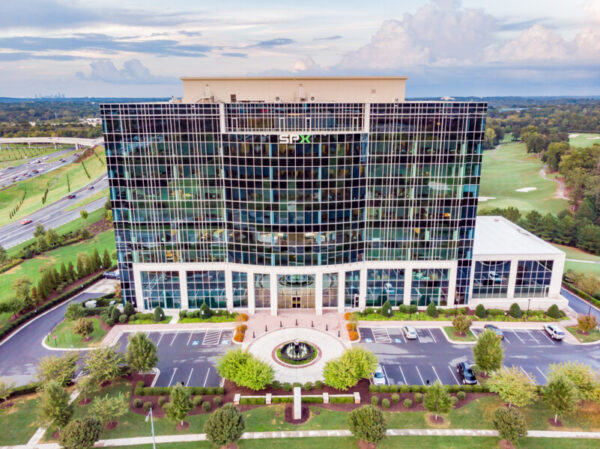



Vertiv Holdings Co (NYSE: VRT), the Ohio-based manufacturer of power, cooling and infrastructure systems for artificial intelligence data centres, surged 16.48% to US$242.94 on October 28, 2026, after delivering record quarterly revenue and an extraordinary acceleration in customer orders. Third-quarter sales increased 61% to US$4.31 billion, while organic orders grew more than 100% year over year, significantly outpacing recognised revenue growth. Management raised its full-year sales guidance to US$14.65 billion at the midpoint and projected continued strong expansion into 2027, supported by additional manufacturing capacity and demand for high-density computing infrastructure. However, the rally lifted Vertiv’s equity market capitalisation to approximately US$93.5 billion, leaving investors to assess whether the order surge can translate into sufficiently higher earnings and cash flow to justify its valuation.
Why did Vertiv shares surge 16% after reporting more than 100% organic order growth?
Vertiv’s October 28 results exceeded market expectations across several important measures. Revenue reached US$4.313 billion, compared with US$2.676 billion in the corresponding quarter of 2025, representing growth of approximately 61%. Organic growth accounted for 55 percentage points, while acquisitions contributed approximately six percentage points. The distinction demonstrates that the expansion was driven overwhelmingly by the existing business rather than the consolidation of acquired companies.
Profitability strengthened alongside sales. Adjusted operating profit increased 83% to US$1.087 billion, while the adjusted operating margin expanded 290 basis points to 25.2%. Adjusted diluted earnings rose 78% to US$2.21 per share, compared with US$1.24 a year earlier. The company also reported US$764.5 million in statutory net income, an increase of approximately 92%.
These figures were substantially stronger than analysts had anticipated. Reported revenue exceeded market expectations by approximately 15%, while adjusted earnings per share surpassed the prevailing consensus of around US$1.82. The results also exceeded management’s previous guidance, providing evidence that Vertiv had converted strong demand into financial performance more rapidly than expected.
The market reaction was immediate. Vertiv shares advanced US$34.38 from the previous closing price of US$208.56, with approximately 19.5 million shares changing hands. That volume was more than three times its recent average daily trading activity, confirming unusually concentrated market interest.
However, the most important development was arguably the order figure rather than the earnings surprise. Management disclosed that organic orders had increased more than 100% compared with the previous year’s third quarter. That suggests demand for future deliveries is expanding faster than the already substantial increase in current revenue.
The distinction is central to the investment case because orders provide information about potential future business, while recognised sales demonstrate completed commercial activity. Stronger orders can support future earnings, but their ultimate value depends on the timing, pricing and profitability of the deliveries.
What does Vertiv’s doubling of AI infrastructure orders really reveal about future revenue?
Vertiv supplies equipment that enables data centres to operate reliably, including electrical power systems, uninterruptible power supplies, liquid cooling, thermal management equipment and prefabricated infrastructure modules. These products are essential components of facilities housing increasingly powerful AI processors. As computing density increases, operators require more sophisticated systems to distribute electricity, remove heat and protect expensive hardware from interruptions.
The latest order acceleration suggests customers are investing heavily in this supporting infrastructure. Chief Executive Officer Giordano Albertazzi indicated during the October 28 earnings discussion that demand was strong across major cloud providers, enterprise customers and newer specialist AI infrastructure operators. Management also described the order momentum as broad-based across regions rather than being concentrated in a single customer category.
However, the company did not disclose the absolute dollar value of third-quarter orders or provide a sufficiently detailed updated backlog figure to calculate precisely how much revenue the new commitments could generate. Management also indicated that it does not intend to publish order-growth figures routinely going forward. Investors therefore have evidence of unusually strong demand but limited visibility into the precise value and delivery schedule of the latest bookings.
More than 100% organic order growth also does not mean that Vertiv’s backlog doubled or that annual revenue will increase by the same percentage. The growth comparison relates to orders received during a particular quarter, measured against the corresponding period a year earlier. A relatively large contract, changes in project schedules or differences in the comparison period can influence that percentage.
The more useful interpretation is that customer demand remains strong enough to support management’s continued investment in manufacturing capacity. Vertiv expects significant above-market organic sales growth in 2027, but it has not yet issued a detailed full-year numerical revenue forecast for that period.
The investment case will therefore depend on whether the company can maintain a high rate of order conversion while preserving the profitability demonstrated in the September quarter.
Can Vertiv expand manufacturing capacity quickly enough to deliver its AI data centre backlog?
Manufacturing capacity has become one of the most important constraints across the AI infrastructure supply chain. Data centres require numerous specialised electrical and cooling components, and delays in one system can prevent customers from commissioning expensive computing equipment. Vertiv has responded by expanding production facilities, increasing supplier capacity and investing in modular infrastructure that can be assembled and tested before reaching customer sites.
The company reported capacity expansion across the Americas, Europe and Asia during its October earnings call. Its new manufacturing facility in Johor, Malaysia, is now operational, while additional investment is supporting electrical infrastructure, thermal management and rack systems. Vertiv is also expanding its Slovakia operations and power-related manufacturing capacity in Ireland.
Management expects to double chiller production capacity by the end of 2026. This is particularly relevant because liquid cooling and advanced thermal systems are becoming more important as AI processors generate greater heat and operate at higher rack densities. Increasing manufacturing capacity could help Vertiv reduce delivery constraints and strengthen its position in complex infrastructure projects.
The operational challenge has not disappeared entirely. Chief Financial Officer Craig Chamberlin acknowledged that approximately US$100 million to US$150 million of revenue delayed during the second quarter had contributed to the September-quarter recovery. The improvement demonstrates progress in overcoming earlier delivery constraints, but it also means part of the latest sequential performance benefited from work carried over from the previous period.
Vertiv must therefore demonstrate that stronger manufacturing execution can continue without depending on delayed orders from earlier quarters. Management has indicated that capacity additions are already contributing to fourth-quarter performance, although commissioning new production lines can create temporary inefficiencies.
A sustained improvement would be visible through consistent delivery performance, higher productivity and stable or improving operating margins. If production expansion fails to keep pace with orders, revenue could be delayed even while customer demand remains strong.
That possibility does not undermine the commercial opportunity, but it explains why manufacturing execution is increasingly important to Vertiv’s valuation.
Why are Vertiv’s operating margins improving despite heavy investment in new factories?
Vertiv’s adjusted operating margin reached 25.2% during the September quarter, compared with 22.3% a year earlier. The improvement was supported by higher production volumes, operating leverage and manufacturing productivity. As revenue expands, the company can spread certain fixed engineering, manufacturing and administrative costs across a larger sales base.
The strongest contribution came from the Americas, where quarterly revenue increased 75% to approximately US$3 billion. Organic growth reached 66%, while the region’s adjusted operating margin stood at 29.4%. Demand from North American AI infrastructure projects remains a major driver, although the company is also benefiting from broader digital infrastructure investment.
Asia-Pacific revenue increased 50% to US$779 million, with organic growth of 48%. Adjusted operating margin reached approximately 17%, supported by stronger utilisation and operational efficiency. Europe, the Middle East and Africa generated US$545 million in revenue, an increase of 23%, while the region’s adjusted operating margin improved to approximately 28%.
These figures indicate that Vertiv is benefiting from geographically diversified demand, although regional profitability remains different because of product mix, services, manufacturing arrangements and operating costs.
Management expects fourth-quarter adjusted operating margin of approximately 25.8% at the midpoint of its guidance, suggesting further improvement. However, it has also acknowledged that rapidly expanding manufacturing capacity can initially create inefficiencies before new facilities achieve more stable utilisation.
The key question is whether productivity gains and stronger revenue can continue offsetting these expansion costs. Maintaining margins near current levels while substantially increasing sales would support further earnings growth, but sustained margin expansion cannot be assumed simply because orders are increasing.
How much cash is Vertiv generating from the AI infrastructure investment boom?
Vertiv’s cash-flow performance offers important evidence that its growth is producing financial returns rather than remaining confined to order announcements. Operating cash flow reached US$794 million during the third quarter, compared with approximately US$483 million a year earlier. Adjusted free cash flow increased 50% to US$652 million, reflecting stronger operating profitability partly offset by additional working-capital requirements and investment expenditure.
Capital expenditure reached approximately US$139 million during the quarter, while investment in capitalised software totalled another US$2.7 million. The resulting adjusted free-cash-flow figure demonstrates that Vertiv remains cash-generative despite expanding manufacturing capacity. The company is not relying exclusively on new borrowing or equity issuance to fund its existing growth programme.
However, rapid expansion is also absorbing working capital. At September 30, inventories stood at approximately US$3.29 billion, compared with US$1.46 billion at the end of 2025. Accounts receivable increased to approximately US$4.38 billion from US$3.11 billion over the same period. These changes reflect the financial requirements of supporting greater manufacturing activity and customer deliveries.
The balance sheet remained comparatively strong. Vertiv reported approximately US$3.51 billion in cash and cash equivalents, alongside US$199 million in short-term investments. Current and long-term financial debt totalled approximately US$2.93 billion, placing the group in a net cash position before other obligations.
Management also reported approximately US$6.2 billion in total liquidity, including available financing facilities. This provides flexibility to support manufacturing expansion, research and development and selected acquisitions.
Vertiv raised its full-year adjusted free-cash-flow guidance to between US$2.6 billion and US$2.8 billion, with a midpoint of US$2.7 billion. The company expects capital expenditure to remain around 4% of annual revenue during 2026, implying investment of approximately US$586 million at the sales guidance midpoint.
The important financial distinction is that strong cash generation improves Vertiv’s ability to finance growth, but it does not guarantee that future orders will generate similar margins or cash conversion. Continued expansion in receivables and inventories could absorb additional funds as the business scales.
Is Vertiv stock expensive at a $93.5 billion valuation after its 16% rally?
Vertiv shares closed at US$242.94 on October 28, compared with US$208.56 in the preceding session. The latest closing price was approximately 14.5% above the October 21 close but around 0.5% below its September 28 closing price of US$244.04. This distinction shows that the exceptional one-day rebound largely restored value lost during the preceding month rather than establishing a new monthly high.
The stock’s observed 52-week trading range extended from US$147.82 to US$379.94, illustrating substantial volatility around expectations for AI infrastructure investment. Despite the October rally, the shares remained approximately 36% below their annual high. The large trading range indicates that investor assessments of growth, competitive positioning and future capital expenditure have changed considerably.
Using approximately 385 million outstanding shares, the October 28 closing price implied an equity market capitalisation of US$93.5 billion. Against management’s updated 2026 revenue guidance midpoint of US$14.65 billion, that represents approximately 6.4 times expected annual sales.
The earnings valuation is more demanding. Dividing the latest closing price by the company’s updated full-year adjusted earnings guidance midpoint of US$7.15 per share produces a multiple of approximately 34 times expected 2026 adjusted earnings. This is a Business News Today calculation based on management’s non-GAAP guidance rather than a forecast of statutory earnings.
The free-cash-flow comparison provides another perspective. At US$93.5 billion in equity value and guided adjusted free cash flow of US$2.7 billion, the shares trade at approximately 34.6 times expected 2026 adjusted free cash flow, equivalent to an indicative yield of 2.9%.
These measures suggest that the market continues pricing Vertiv as a business capable of delivering substantial earnings growth beyond 2026. The valuation is not based solely on existing earnings, but on expectations that AI infrastructure investment will support additional sales, operating leverage and cash generation.
That expectation could prove reasonable if order growth remains robust and manufacturing expansion produces attractive returns. Nevertheless, a valuation near 34 times current-year adjusted earnings leaves the shares sensitive to changes in growth assumptions, margins or the timing of customer projects.
What could prevent Vertiv’s record AI orders from becoming equally strong earnings in 2027?
The most immediate uncertainty concerns the pace of data centre construction. Customer demand for power and cooling equipment ultimately depends on facilities receiving electricity, securing permits and progressing through construction. Management has identified power availability, permitting and skilled construction labour as factors influencing project schedules, although it believes Vertiv’s integrated infrastructure offering can help customers manage some of these constraints.
A second consideration is the complexity of manufacturing and delivering increasingly advanced products. Higher-density AI infrastructure requires more sophisticated thermal management and electrical systems, raising the importance of engineering quality and operational reliability. Faster product development can create commercial advantages but also requires careful testing, manufacturing discipline and customer support.
Vertiv’s October earnings discussion addressed questions about product reliability and supply-chain execution. Management maintained that its quality indicators were improving and highlighted continued investment in manufacturing and technical capabilities. Those comments should be understood as management’s assessment rather than independent proof that all potential delivery or reliability challenges have been eliminated.
Competitive pressure also remains relevant. Schneider Electric SE, Eaton Corporation plc and other electrical and thermal infrastructure suppliers are expanding their exposure to AI data centres. Vertiv’s integrated power, cooling and services portfolio provides differentiation, but customers may compare pricing, technical capabilities and delivery schedules across multiple suppliers.
The strongest competitive position would come from reliably delivering complex systems while maintaining attractive margins. Merely increasing manufacturing capacity would not be sufficient if competing suppliers eventually reduce delivery times or introduce more cost-effective technologies.
The available evidence nevertheless supports a business experiencing substantial real demand, not one whose prospects depend exclusively on speculative future product launches. The uncertainty concerns how long the exceptional growth rate can be maintained and what profitability will look like when the investment cycle becomes more mature.
What should investors watch next as Vertiv targets further growth in 2027?
The immediate milestone is delivery against fourth-quarter guidance. Vertiv expects revenue between US$4.313 billion and US$4.513 billion, with a midpoint of US$4.413 billion. Adjusted diluted earnings are projected between US$2.22 and US$2.28 per share, while adjusted operating margin is expected to reach approximately 25.8% at the midpoint.
Achieving those targets would provide evidence that the September-quarter improvement is continuing. It would also help establish whether the company’s expanded manufacturing operations can support higher deliveries without significant margin deterioration.
The second milestone is management’s first detailed financial outlook for 2027. Vertiv has indicated that it expects continued substantial organic growth above the broader market and further progress in profitability. However, the company has not yet provided the specific annual revenue, earnings and free-cash-flow guidance needed to calculate the next year’s investment case more precisely.
That guidance will be particularly important following the October share-price rally. At approximately 34 times guided 2026 adjusted earnings, future growth assumptions already play a substantial role in the valuation. A stronger 2027 outlook supported by orders, production capacity and cash-flow evidence could strengthen confidence, while a material slowdown would make the current multiple harder to justify.
The third milestone is sustained cash conversion as manufacturing investment continues. Vertiv’s current net cash position provides financial flexibility, and management expects substantial free cash flow during 2026. Future results should demonstrate whether receivables, inventories and capital expenditure remain manageable as revenue scales.
Vertiv’s latest earnings provide strong evidence that demand for AI data centre infrastructure is translating into measurable commercial performance. Revenue increased 61%, adjusted operating profit rose 83%, organic orders more than doubled and free cash flow improved substantially. These achievements support the view that the company occupies an important position in the expanding market for power, cooling and integrated data centre systems.
What remains unresolved is whether this exceptional growth can persist long enough to support the market’s valuation expectations. The strongest confirmation would be another period of robust orders, successful manufacturing expansion, sustained margins and higher cash generation. Following the October 28 rally, Vertiv’s next investment test is not simply whether AI infrastructure spending continues growing, but whether the company can keep converting that demand into profitable deliveries at a pace consistent with its market value.
Key takeaways: What should investors watch after Vertiv’s 16% share-price surge?
- Vertiv shares surged 16.48% to US$242.94 on October 28 after reporting stronger-than-expected quarterly results and demand.
- Third-quarter revenue increased 61% to US$4.313 billion, with organic sales growth of 55% and acquisitions contributing approximately six percentage points.
- Organic orders increased more than 100% year over year, although management did not disclose the absolute value of new orders or an updated backlog figure sufficient to calculate future revenue precisely.
- Adjusted operating margin expanded to 25.2%, while adjusted diluted earnings increased 78% to US$2.21 per share.
- Management raised full-year revenue guidance to US$14.65 billion and adjusted free-cash-flow guidance to US$2.7 billion at their respective midpoints.
- The shares trade at approximately 34 times guided 2026 adjusted earnings, making continued growth, manufacturing execution and margin resilience important.
- Fourth-quarter results, detailed 2027 guidance and sustained cash conversion will provide the clearest evidence of whether Vertiv can support its valuation after the rally.
Primary headline: Vertiv (NYSE: VRT) jumps 16% as AI orders double. Can earnings keep up?
SEO headline: Vertiv stock (VRT): 16% rally, AI orders surge and 2027 earnings outlook
Social headline: Vertiv’s AI orders more than doubled and shares jumped 16%. Is a $93.5bn valuation justified?
Meta description: Vertiv shares jumped 16% as AI orders more than doubled. Can higher margins, cash flow and 2027 growth support its $93.5bn valuation?
LinkedIn hook: Vertiv delivered 61% quarterly revenue growth, an 83% increase in adjusted operating profit and more than 100% organic order growth. Shares surged 16%, lifting its market valuation to US$93.5 billion. The real question is whether manufacturing capacity and future deliveries can keep pace with the expectations now built into the stock.
Content tags: Vertiv Holdings Co, Giordano Albertazzi, Craig Chamberlin, Dave Cote, NVIDIA, Schneider Electric, Eaton Corporation, EdgeConneX, Polar Data Centers, Johor, Malaysia, Ohio, United States
X hashtags: $VRT #Vertiv #AIInfrastructure #DataCenters #LiquidCooling #NYSE #NVIDIA #ArtificialIntelligence #DataCenterPower #RetailInvestors
Discover more from Business-News-Today.com
Subscribe to get the latest posts sent to your email.