

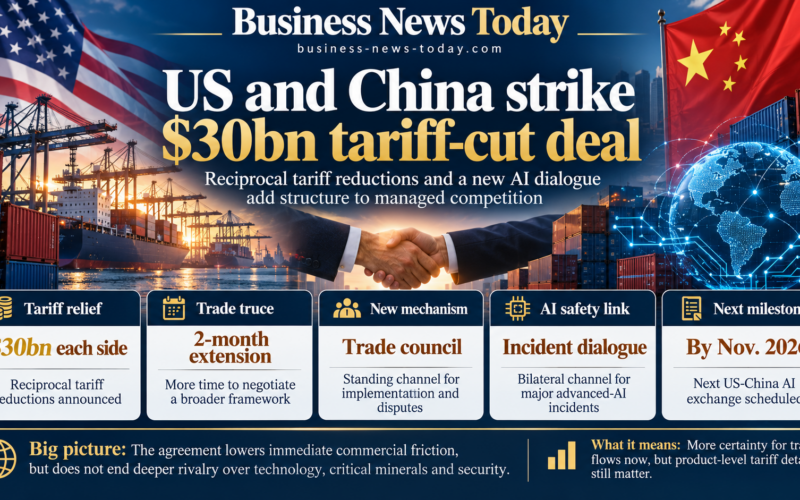
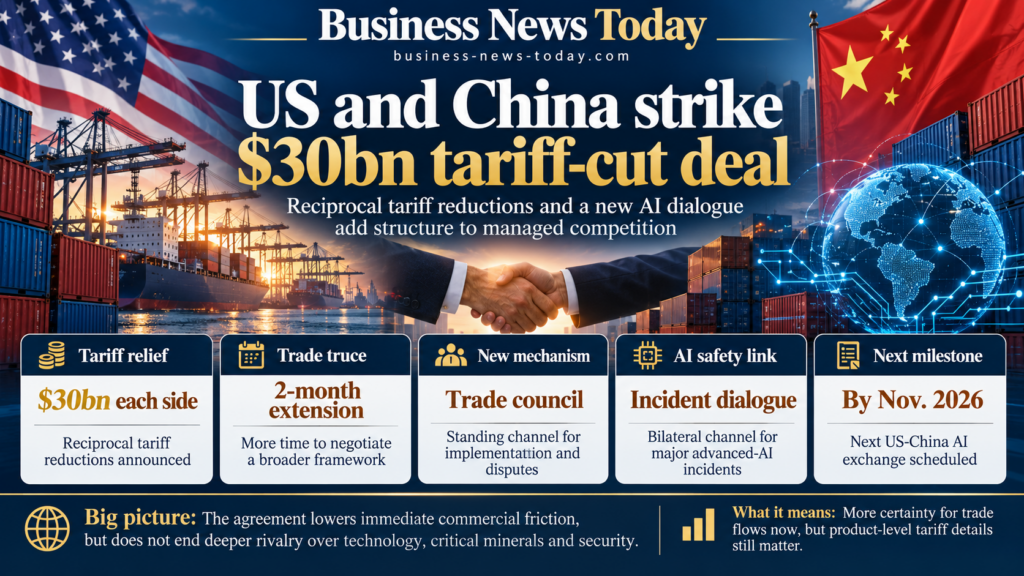
China and the United States have agreed to reciprocal tariff reductions worth $30 billion on each side and will establish a formal bilateral dialogue on advanced artificial intelligence, turning President Xi Jinping’s Washington state visit into a more substantive economic outcome than appeared immediately after the summit. China’s Foreign Ministry said on September 26 that the two governments had reached an eight-point consensus covering tariff reductions, a new trade council and extensions of earlier agreements, while the White House separately confirmed the creation of a bilateral communication channel dealing with major AI-related incidents.
The outcome is materially different from the summit-preview stage because businesses now have specific mechanisms and financial commitments to assess rather than broad statements about stabilising relations. The agreement follows a separate two-month extension of the existing tariff truce, giving Washington and Beijing additional time to negotiate a larger trade framework without allowing previously threatened duties to return automatically. The immediate effect is therefore a modest reduction in commercial friction rather than an end to the deeper rivalry over technology, industrial policy, critical minerals and Taiwan.
What exactly does the new $30 billion US-China reciprocal tariff agreement cover?
China described the arrangement as a reciprocal tariff reduction valued at $30 billion for each country, although detailed product lists were not immediately released with the September 26 announcement. That means the headline number establishes the scale of the relief while companies still need to know which industrial, agricultural and consumer goods will receive lower duties before the commercial impact can be calculated precisely. Earlier Chinese Commerce Ministry briefings had acknowledged that the two sides were negotiating such an arrangement but said product-level details remained under discussion.
The decision nevertheless matters because tariff reductions can lower landed costs almost immediately once implemented. Companies importing components from China could see some cost pressure ease, while US exporters may gain better pricing access to Chinese customers if their products fall within the agreed categories. The commercial value will depend heavily on whether reductions concentrate on politically sensitive goods or on large-volume categories that materially change bilateral trade flows.
The deal also creates a new trade council, according to Beijing. A standing institution can be more valuable than one-off presidential agreements because technical disputes over customs rules, licensing, implementation and product classification can continue to be handled even when political relations deteriorate.
Why did Donald Trump and Xi Jinping create a dedicated bilateral AI safety channel?
The White House said the countries established what it calls the US-China Super Intelligence Dialogue and agreed to create a bilateral communication mechanism for significant incidents involving advanced AI systems. The next exchange is scheduled by November 2026, giving the framework a concrete timetable rather than leaving AI cooperation as a general aspiration.
Washington and Beijing remain competitors across chips, data centres, models, robotics and military applications, but increasingly capable AI systems create risks that do not respect national boundaries. A serious cyber incident, model failure or misunderstanding involving an AI-enabled military or infrastructure system could escalate rapidly if officials lack a direct communications channel.
The arrangement therefore resembles crisis-management mechanisms used in other strategic fields. It does not require either country to surrender competitive advantage, but it gives both governments a way to communicate when an incident could be misinterpreted as deliberate hostile action.
Does the Trump-Xi agreement reduce the risk of another full US-China trade war?
It reduces the immediate risk without eliminating it. The two governments had already agreed to extend their trade truce by two months beyond the November 10 deadline, and the latest tariff reductions deepen that stabilisation process. The agreements give businesses additional time to plan sourcing and investment without confronting an abrupt return to tariffs above 100% on some categories.
The structural disputes remain significant. Washington continues to restrict certain advanced semiconductor technologies, while Beijing controls important parts of global rare-earth processing and magnet production. Both countries also subsidise strategic industries and accuse the other of using economic policy to gain security advantages.
The current direction is therefore better described as managed competition than economic reconciliation. Tariff relief makes commercial activity easier, but neither government has abandoned efforts to reduce dependence on the other in strategically important sectors.
Why are agricultural purchases and Boeing aircraft still important unfinished business?
Earlier US-China economic agreements included commitments involving American agricultural products and potential purchases of 200 Boeing aircraft, but implementation has lagged. Those categories are politically valuable to Washington because they translate diplomatic agreements into measurable orders supporting farmers, factories and employment across multiple states.
China likewise has incentives to use purchases as negotiating leverage rather than commit all demand upfront. Large aircraft orders, soybean purchases and energy contracts can be accelerated or delayed depending on the broader political relationship.
That means the $30 billion tariff arrangement should not be viewed in isolation. The larger test is whether it encourages implementation of older commercial promises and creates enough trust for new purchases to proceed.
How do rare earths and semiconductor controls still threaten the latest US-China thaw?
Rare-earth materials remain one of Beijing’s strongest economic leverage points because China dominates key stages of processing and magnet manufacturing. Advanced semiconductor technology remains one of Washington’s strongest leverage points because US companies and allies control important equipment, intellectual property and computing technologies.
Neither issue was solved by the tariff agreement. Washington still wants predictable access to Chinese critical minerals, while Beijing continues to oppose export controls restricting Chinese access to high-end chips and manufacturing equipment.
A new trade council could provide a structured venue for these disputes, but resolution will be difficult because both governments increasingly treat economic supply chains as national-security infrastructure rather than ordinary commerce.
What are the key takeaways from the $30 billion Trump-Xi tariff and AI agreement?
The most important change since the state visit began is that the summit now has measurable outcomes. Each side has announced $30 billion in reciprocal tariff reductions, a trade council has been agreed and an AI dialogue with a dedicated incident-communication channel is scheduled to continue by November.
Those steps provide companies with more certainty than ceremonial diplomacy alone. They do not resolve deeper US-China competition, but they reduce the probability that a disagreement immediately escalates into another uncontrolled tariff cycle.
For global businesses, the practical signal is that Washington and Beijing are currently trying to create buffers around their rivalry. That matters to manufacturers in Europe, Japan, South Korea, India and elsewhere because shocks between the world’s two largest economies quickly spread through commodity, electronics and industrial supply chains.
Could the Trump-Xi framework become a durable model for managed US-China competition?
The answer will depend on implementation rather than summit language. If tariff reductions occur on schedule, the trade council handles disputes and the AI channel is actually used during difficult incidents, the agreement could establish an institutional layer that survives periods of political tension.
Failure to implement older purchasing commitments remains a warning sign, and neither side has removed the strategic policies driving the rivalry. Yet the combination of tariff relief and crisis communications suggests both governments see value in preventing economic and technological competition from becoming uncontrollable.
That makes the latest agreement strategically important even without a sweeping grand bargain. Its success will be measured less by declarations of friendship and more by whether supply chains, tariffs and high-risk technology disputes become more predictable over the coming months.
Discover more from Business-News-Today.com
Subscribe to get the latest posts sent to your email.