


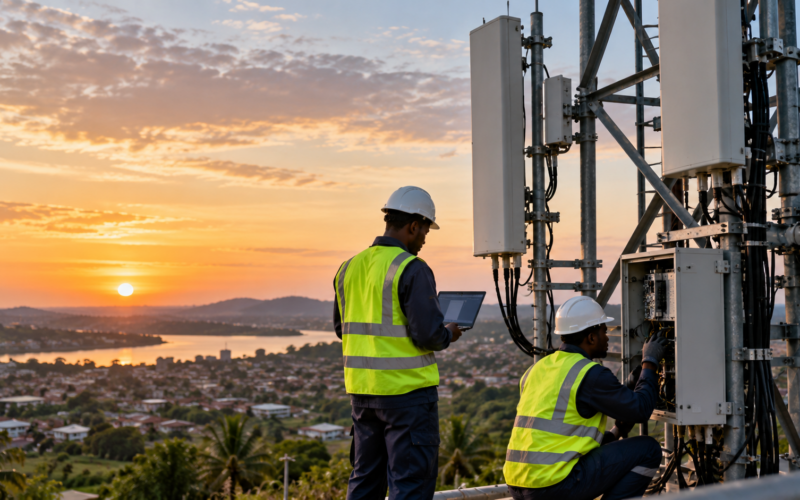
The United States is backing Africell with a $99.6 million Export-Import Bank loan designed to expand telecommunications infrastructure using American and allied technology, giving Washington a new commercial instrument in its effort to challenge Huawei’s entrenched position across African mobile networks. Africell is the only United States-owned mobile network operator on the continent and operates in Angola, the Democratic Republic of Congo, Sierra Leone and Gambia.
The financing is expected to support network investment particularly in Angola, where Africell has been building out mobile infrastructure using equipment supplied by companies from the United States and allied countries. The company serves around 15 million customers across its markets, giving the financing strategic significance well beyond the size of the individual loan.
Why is Washington putting nearly $100 million behind Africell in Africa?
Telecommunications infrastructure has become part of geopolitical competition because mobile networks carry government communications, corporate data, financial transactions and an increasing share of everyday economic activity. The supplier controlling critical network equipment can consequently become part of a wider national-security debate.
Huawei has built an enormous presence across Africa by supplying cost-competitive equipment and financing networks in markets where connectivity has expanded rapidly. Reuters reported that Huawei accounts for roughly 52% of Africa’s 5G infrastructure market, underlining the scale of the competitive challenge facing Western suppliers.
The Africell loan gives Washington a way to compete economically rather than rely exclusively on diplomatic pressure. Instead of simply asking governments or telecom operators not to use Huawei equipment, financing can help make alternative technology commercially viable.
Why has Huawei become central to the US-China technology contest in Africa?
Washington has spent years warning that equipment supplied by Huawei could create security vulnerabilities or expose sensitive communications to Chinese state influence. Huawei has repeatedly rejected allegations that its products provide Beijing with improper access to customer networks.
African governments, however, often evaluate telecommunications projects primarily through price, financing terms, reliability and speed of deployment. Chinese companies have succeeded partly because they have been able to combine equipment, financing and construction into packages suitable for rapidly expanding markets.
That makes the competitive problem more complicated than choosing between individual brands. Western governments need financing mechanisms capable of matching the commercial packages offered by Chinese suppliers if they want operators to shift procurement strategies.
Could the Africell financing create opportunities for American and European suppliers?
The loan is intended to finance technology from American and allied suppliers, potentially benefiting companies providing radio equipment, servers, cloud infrastructure, data-centre systems and network management technology. Africell has previously worked with companies including Nokia, Hewlett Packard Enterprise, Dell Technologies and Oracle.
The strategic objective is also to establish reference networks. If Africell demonstrates that large African mobile operations can expand competitively using non-Huawei infrastructure, the model could influence future procurement decisions elsewhere on the continent.
That does not mean Huawei’s position will disappear quickly. Existing networks require ongoing maintenance, equipment replacement is expensive, and operators are reluctant to abandon suppliers without a compelling commercial reason.
Why does African digital infrastructure matter beyond mobile phone service?
Africa’s rapidly expanding digital economy increasingly depends on the same infrastructure that supports smartphones. Mobile banking, cloud computing, artificial intelligence applications, government digital services and data centres all require reliable connectivity.
That turns telecom networks into strategic infrastructure comparable with ports, electricity grids and transport corridors. Competition over network equipment is therefore part of the larger United States-China contest involving critical minerals, semiconductor supply chains, artificial intelligence and data governance.
The $99.6 million Africell financing is small relative to China’s accumulated infrastructure footprint across Africa, but its significance lies in the model Washington is attempting to build. If government-backed financing repeatedly converts into commercially viable networks using US and allied technology, the contest with Huawei could shift from diplomatic warnings toward genuine infrastructure competition.
Discover more from Business-News-Today.com
Subscribe to get the latest posts sent to your email.