
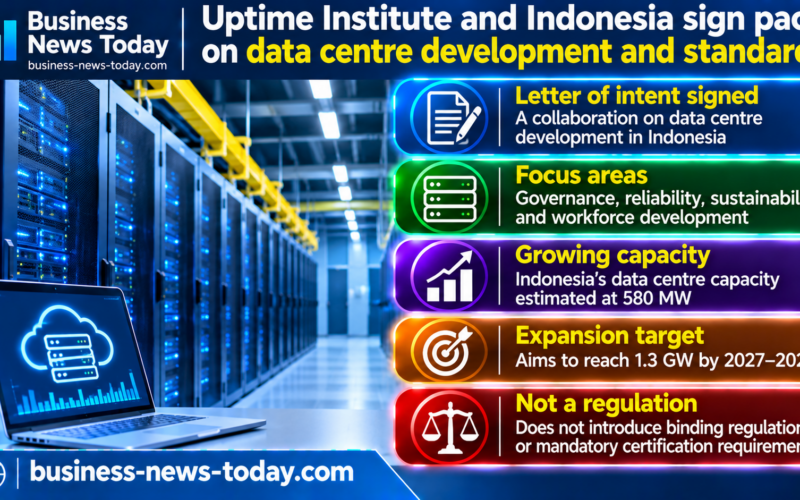
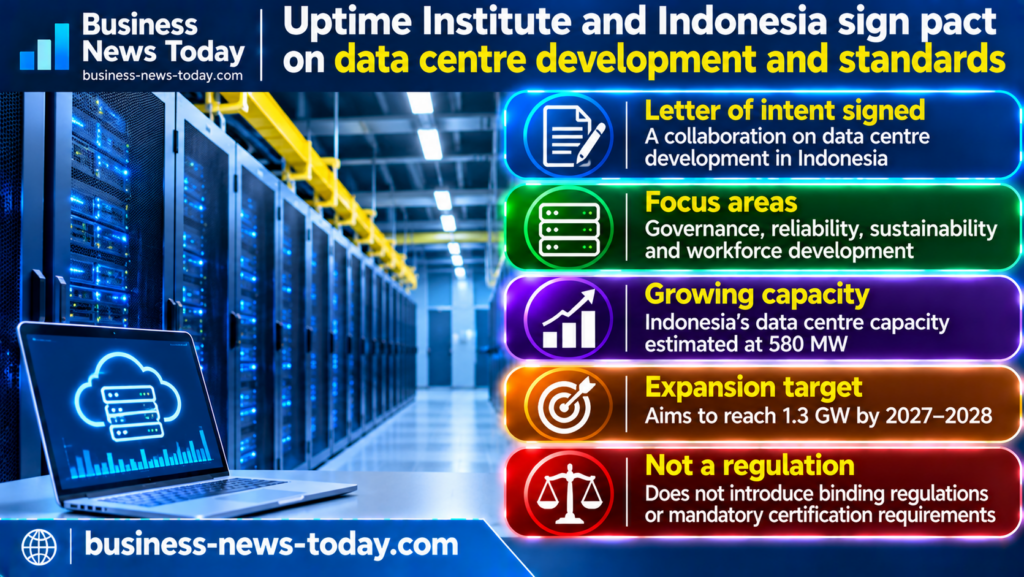
Uptime Institute, the global data centre standards and infrastructure advisory organization, has entered into a letter of intent with Indonesia’s Ministry of Communication and Digital Affairs, known as KOMDIGI, to explore cooperation on national data centre policy, operational resilience, security and sustainability. The agreement was signed in Jakarta on October 27, 2026, and announced internationally on November 2, creating a framework for technical discussions as Indonesia prepares for substantial expansion of its artificial intelligence and cloud infrastructure. The initiative comes as Indonesian officials estimate existing national data centre capacity at approximately 580 megawatts, with a target of 1.3 gigawatts by 2027–2028. The collaboration could influence how policymakers evaluate facility reliability, energy efficiency and technical standards, but the letter of intent does not establish new mandatory rules, guarantee certification contracts or transfer regulatory authority to Uptime Institute. Its commercial significance will depend on whether technical recommendations are translated into practical policies that support investment without imposing unnecessary development costs.
The agreement was signed by Mustapha Louni, chief business officer of Uptime Institute, and Wayan Toni Supriyanto, Indonesia’s director general of digital infrastructure. Their discussions cover policy development, international standards, operational performance, security, sustainability and training for data centre professionals.
The latest announcement follows an earlier non-disclosure agreement signed on June 2 and a three-day technical workshop conducted from October 27 to 29. It therefore represents a continuation of established engagement rather than the beginning of an entirely new relationship.
KOMDIGI has explicitly characterized the cooperation as non-exclusive. The ministry intends to consult other standards bodies, certification organizations and international institutions, while maintaining government control over the direction and implementation of national policy.
Why is Indonesia working with Uptime Institute as its data centre capacity approaches a planned 1.3 GW?
Indonesia’s digital infrastructure expansion is creating new requirements for reliable computing capacity, particularly as enterprises and public institutions adopt cloud services and artificial intelligence applications. Growing demand is encouraging investment in data centres capable of supporting higher computing densities, more complex cooling systems and uninterrupted digital services.
The Ministry of Communication and Digital Affairs has estimated existing national capacity at approximately 580 MW and identified a target of 1.3 GW during 2027–2028. Reaching that level would require an additional 720 MW, representing an increase of approximately 124% over the current estimate.
The calculation illustrates the potential scale of expansion, but the 1.3 GW figure is a forward-looking capacity objective rather than evidence of commissioned facilities. Actual delivery will depend on investment decisions, construction schedules, electrical connections and sufficient customer demand.
Physical capacity also provides only a partial measure of industry readiness. Facilities need reliable utility services, suitable network connections, effective operating procedures and skilled personnel to support the workloads installed within them.
A rapid increase in data centre construction without comparable improvements in operations could expose customers to higher reliability and maintenance risks. Conversely, clear technical expectations may help investors assess projects and identify infrastructure requirements earlier in the development process.
Uptime Institute’s involvement introduces an established international reference point for these discussions. However, Indonesia has not announced that the organization’s standards will become mandatory across the national data centre industry.
What does the Uptime Institute and KOMDIGI letter of intent actually commit the parties to?
The agreement establishes a framework for exploring cooperation across five broad areas: data centre policy and regulation, international standards and performance practices, operational reliability and security, energy efficiency and sustainability, and professional education.
Its immediate purpose is technical consultation and knowledge exchange. Uptime Institute can contribute expertise acquired through data centre assessments, certifications, operational reviews and research, while KOMDIGI can consider how those practices relate to Indonesian infrastructure requirements.
The government has emphasized that international approaches must be evaluated against domestic conditions. Regulatory frameworks designed for one country may not be appropriate elsewhere without considering electricity infrastructure, climate, industrial capabilities and existing legislation.
The agreement does not disclose a financial value, implementation budget or procurement arrangement. It also does not establish that Uptime Institute has been appointed Indonesia’s exclusive certification provider or granted authority to approve new facilities.
This limitation is commercially relevant because technical cooperation can produce several different outcomes. Policymakers may use external expertise to improve guidance, develop new requirements or strengthen existing frameworks without awarding a corresponding commercial contract to the organization providing advice.
The October workshop provided a mechanism for officials and industry representatives to examine those questions. Future value will depend on the recommendations produced and whether the government incorporates them into its regulatory or industry development programme.
Could Uptime Institute’s Tier Standards become part of Indonesia’s future data centre regulations?
Uptime Institute is widely associated with its Tier Classification System, which evaluates data centre infrastructure against different levels of availability and resilience. The framework is used internationally by operators seeking independent assessment of facility design, construction and operating practices.
The system provides several certification stages, including assessments of design documents, completed facilities and operational sustainability. These stages address related but different aspects of data centre performance.
Certification of design documents does not, by itself, establish that the completed facility has been constructed and is operating according to those requirements. Similarly, infrastructure topology alone does not address every operational, cybersecurity or environmental risk.
For Indonesian developers, internationally recognized standards can provide a common technical reference when discussing reliability with customers, financiers and engineering contractors. However, certification also involves expenditure and compliance requirements that may affect project economics.
Indonesia has not announced a national requirement for every new data centre to obtain Uptime Institute certification. The letter of intent concerns consideration of international practices, not automatic adoption of a particular commercial certification scheme.
The government’s non-exclusive approach is significant because it leaves room to consider alternative standards and technical frameworks. A future policy could incorporate performance objectives without requiring every operator to purchase the same certification service.
The commercially important issue is therefore how requirements are defined and enforced. Performance-based regulation could encourage reliable infrastructure while allowing operators flexibility in choosing technologies and demonstrating compliance.
How does the agreement fit Indonesia’s proposed data centre and subsea cable regulations?
KOMDIGI is already developing a broader policy framework for digital infrastructure. In October, officials confirmed that a draft presidential regulation covering data centres and subsea cables had been prepared and was entering public consultation.
The proposal reflects the government’s intention to coordinate data centre development with the networks and supporting infrastructure needed to operate facilities reliably. A large computing campus may have substantial installed capacity but limited commercial usefulness if external connectivity is inadequate.
The draft regulation remains under development and has not been presented as a completed, enforceable national framework. Its final provisions will depend on the relevant consultation and government processes.
Another institutional consideration is the division of authority among Indonesian government departments. Officials have indicated that construction licensing involves ministries responsible for investment and industrial affairs, rather than falling exclusively within KOMDIGI’s jurisdiction.
Consequently, technical cooperation between Uptime Institute and KOMDIGI does not automatically change construction permits or investment approval procedures. Any regulatory changes affecting those processes would need to follow the appropriate governmental arrangements.
Indonesia is also considering whether certain data centre developments should receive National Strategic Project status. That proposal remains under discussion and should not be confused with an approved designation covering the sector.
The Uptime Institute engagement could contribute technical evidence to these policy discussions. Its influence will be determined by the extent to which recommendations are adopted through established government processes.
Why are electricity reliability, cooling efficiency and water consumption becoming central to Indonesia’s AI infrastructure ambitions?
Higher-density computing is increasing the importance of electrical capacity and cooling performance within data centres. AI servers can impose substantial power requirements, while reliable cooling is necessary to maintain equipment within acceptable operating conditions.
Uptime Institute’s 2026 Global Data Center Survey identified limited power availability, rising infrastructure costs, supply-chain constraints and staffing shortages among the principal challenges facing operators internationally. The findings provide broader industry context for Indonesia’s policy discussions.
The survey also reported increasing use of high-density computing racks, with more operators encountering peak rack densities of at least 30 kilowatts. Such installations can require different engineering approaches from conventional enterprise computing environments.
Energy efficiency is commonly evaluated through Power Usage Effectiveness, which compares total facility electricity consumption with the electricity used by computing equipment. A lower figure generally indicates less overhead consumption, although results must be interpreted alongside operating conditions and measurement boundaries.
Water consumption introduces a separate concern. Some cooling technologies can reduce electrical demand while increasing water use, making it necessary to consider both energy and water efficiency rather than treating a single metric as sufficient.
These considerations are especially relevant to Indonesia because climate, regional water availability and electrical infrastructure can vary substantially between proposed development locations.
A technical framework could help policymakers establish appropriate performance indicators and reporting expectations. However, the parties have not announced numerical energy or water-efficiency thresholds under the letter of intent.
Any future requirements would need to balance environmental performance with reliability, cost and the practical availability of suitable technology.
Can stronger data centre governance support Indonesia’s plan to expand infrastructure beyond Java and Batam?
Indonesia is seeking a more geographically distributed digital infrastructure network rather than allowing development to remain concentrated in established markets.
During Bali Tech Week in October, Wayan Toni Supriyanto outlined plans to encourage data centre investment in eastern Indonesia. The government’s approach involves identifying locations with sufficient customer demand, reliable electricity, suitable connectivity and an appropriate surrounding industrial ecosystem.
This presents a different challenge from constructing additional capacity within established data centre clusters. Regions with limited telecommunications redundancy or electrical infrastructure may require substantial supporting investment before facilities can operate at the expected reliability level.
KOMDIGI has also identified backup connectivity as an important part of developing facilities outside Java and Batam. Without suitable redundancy, a data centre could face operational interruptions even if its internal power and cooling systems are appropriately designed.
Standards and governance frameworks could help investors assess these requirements before committing capital. Clearer technical expectations may also make it easier to compare potential development sites based on operational readiness rather than land availability alone.
However, standards cannot substitute for infrastructure investment. A facility may meet an appropriate design specification while still depending on external electricity and telecommunications systems that require improvement.
The national opportunity involves expanding the geographic reach of computing services while maintaining acceptable operational economics. Successful implementation would require coordination among infrastructure developers, utilities, connectivity providers and government agencies.
How does Uptime Institute’s separate agreement with Indonesia’s data centre industry association strengthen its local presence?
Uptime Institute has also announced a memorandum of understanding with the Indonesia Data Center Provider Organization, known as IDPRO, the industry association representing data centre providers and digital infrastructure businesses in the country.
The agreement with IDPRO focuses on promoting international practices across facility design, construction, commissioning and operations. It also includes industry knowledge exchange, sustainability and workforce development.
The two agreements create complementary channels for engagement. KOMDIGI provides the governmental policy perspective, while IDPRO offers access to organizations directly involved in developing and operating digital infrastructure.
The IDPRO memorandum was signed by Uptime Institute’s Mustapha Louni and IDPRO Chairman Hendra Suryakusuma. It was witnessed by Uptime Institute’s regional leadership and representatives of the association.
The combination may help technical discussions reflect both regulatory objectives and practical operating requirements. Industry participation can be useful when proposed standards have consequences for equipment selection, staffing, maintenance and construction costs.
However, the IDPRO memorandum does not establish that all member companies have adopted Uptime Institute’s certifications or committed to purchasing advisory services. The agreement is a cooperation framework rather than a quantified sales contract.
For Uptime Institute, the dual engagement could expand access to Indonesian policymakers and operators. Any direct commercial benefit will depend on subsequent advisory assignments, training programmes, certifications or other separately agreed services.
Why is professional training becoming a strategic requirement for Indonesia’s data centre expansion?
Data centre reliability depends on operational procedures and workforce capability as well as equipment quality. Facilities require qualified personnel to manage maintenance, respond to incidents and coordinate changes without disrupting customer services.
Uptime Institute’s 2026 global survey found that more than half of participating operators experienced difficulty recruiting qualified candidates for open positions. Staffing and employee retention remain significant industry challenges even as demand for additional computing capacity increases.
Indonesia’s proposed increase from approximately 580 MW to 1.3 GW would expand the infrastructure requiring technical operation and maintenance if the planned capacity is delivered. The workforce requirements will depend on facility design, automation levels and operating models rather than increasing mechanically in proportion to megawatts.
Uptime Institute says more than 100,000 data centre professionals have completed its education programmes internationally. Its training capabilities could contribute to discussions about professional development and operating standards within Indonesia.
However, no specific Indonesian training target, funding commitment or participant volume has been announced through the KOMDIGI agreement.
A practical workforce programme would need to consider the skills required across different roles, including electrical engineering, mechanical systems, maintenance, operations management and infrastructure security.
Indonesia’s ability to develop local expertise could reduce dependence on imported specialist services while supporting long-term industry employment. The economic benefits would become measurable through completed training, workforce recruitment and improved operational performance.
What does the collaboration mean for Indonesia’s competitive position in Southeast Asia’s data centre market?
Indonesia’s infrastructure ambitions are developing within an increasingly competitive Southeast Asian market. Governments and private investors across the region are seeking to attract cloud services, enterprise computing and AI infrastructure.
Indonesian officials have recently compared the country’s approximately 580 MW of existing data centre capacity with an estimated 3 GW in Malaysia. These figures are government-reported estimates and may depend on differing definitions of installed or planned capacity, limiting their usefulness as direct measures of competitive performance.
Indonesia has a substantial domestic market for digital services, creating potential demand for local computing infrastructure. However, investors also consider electricity costs, regulatory predictability, network availability and the ease of developing facilities.
A clearer governance framework could help project developers understand expected performance standards and operational responsibilities. That may improve investment planning, provided requirements are proportionate and consistently administered.
Conversely, complex or uncertain rules could increase development costs and delay projects. Policymakers therefore face the challenge of strengthening reliability without creating unnecessary barriers to investment.
International technical cooperation may support this balance by identifying practices that have been adopted elsewhere. Yet Indonesia must determine whether those approaches fit local industrial priorities and infrastructure conditions.
The longer-term competitive position will depend on delivered capacity, customer demand and operational performance rather than the number of cooperation agreements signed.
What commercial opportunities could the Uptime Institute agreement create for data centre operators and infrastructure suppliers?
A stronger emphasis on performance and operational reliability could influence procurement decisions across the Indonesian data centre supply chain.
Developers may require engineering services, backup power systems, cooling technologies, monitoring equipment and cybersecurity capabilities to meet evolving customer expectations or future technical requirements.
Infrastructure owners may also invest in operational assessments and training as they expand existing facilities or commission new campuses.
Uptime Institute’s services cover certification, operational reviews, infrastructure risk assessments, sustainability evaluations and professional education. These activities could benefit from greater industry interest in standardized performance practices.
However, the announcement does not identify a new certification order, consulting contract or government procurement award. It would therefore be premature to estimate revenue or earnings arising from the letter of intent.
The same limitation applies to equipment manufacturers and data centre developers. A policy collaboration may strengthen the outlook for technical infrastructure investment, but it does not establish that any particular supplier has won additional business.
Commercial consequences will become clearer if Indonesia introduces specific requirements, publishes technical guidance or announces funded implementation programmes.
For facility operators, the value of improved practices would be demonstrated through reliability, operational efficiency and customer confidence. The cost of achieving those improvements must also be considered when evaluating returns on investment.
What milestones will show whether the Uptime Institute and KOMDIGI partnership delivers measurable results?
The immediate evidence of progress is the completed October 27 to 29 workshop and the continuation of technical discussions that began earlier in 2026. These activities provide a foundation for collaboration but do not establish a regulatory outcome.
The next milestone would be publication of technical recommendations or policy proposals addressing data centre reliability, security, sustainability and operational capability.
Progress on Indonesia’s draft presidential regulation covering data centres and subsea cables will provide another indication of how the government intends to organize the sector. Any formal requirements would need to emerge through the relevant regulatory process rather than through the letter of intent alone.
Workforce development could provide a more immediately measurable outcome if the parties announce training programmes, professional qualifications or specific participation targets.
The country’s wider infrastructure expansion will be tested against its 1.3 GW capacity objective for 2027–2028. However, installed megawatts should be evaluated alongside commissioning status, operational readiness and customer utilization.
The collaboration creates an opportunity to align technical standards with Indonesia’s infrastructure ambitions while retaining national regulatory control. Its success will be established through adopted guidance, better operating practices and measurable improvements in workforce capability and facility resilience, not merely through the expansion of planned data centre capacity.
What are the key takeaways from Uptime Institute’s agreement with Indonesia’s KOMDIGI on data centre governance?
- Uptime Institute and Indonesia’s Ministry of Communication and Digital Affairs signed a letter of intent in Jakarta on October 27, 2026, with the agreement announced internationally on November 2.
- The cooperation covers data centre policy, performance standards, operational resilience, security, energy efficiency and workforce development.
- Indonesia estimates current data centre capacity at approximately 580 MW and is targeting 1.3 GW by 2027–2028, implying a potential increase of about 124%.
- The agreement is non-exclusive, and the Indonesian government retains authority over national policy and regulatory standards.
- No mandatory Uptime Institute certification requirement, government procurement contract or financial consideration has been announced.
- The partnership builds on an earlier June 2026 non-disclosure agreement and a three-day technical workshop conducted from October 27 to 29.
- Indonesia is separately developing a draft presidential regulation covering data centres and subsea cables, with public consultation underway.
- Uptime Institute has also signed an industry cooperation memorandum with the Indonesia Data Center Provider Organization.
- Power availability, cooling efficiency, network redundancy and skilled personnel will influence whether Indonesia can expand data centre capacity reliably.
- Published technical recommendations, regulatory developments, training programmes and commissioned infrastructure will provide the clearest evidence of progress.
Discover more from Business-News-Today.com
Subscribe to get the latest posts sent to your email.