


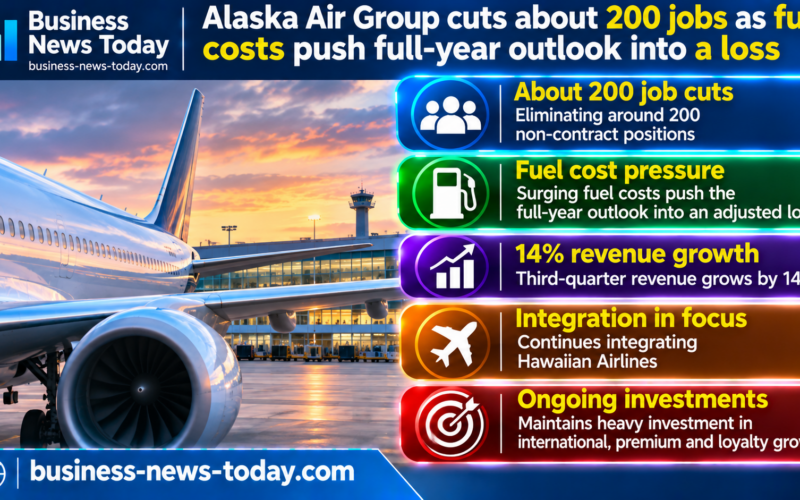
Alaska Air Group, Inc. (NYSE: ALK) is eliminating approximately 200 non-contract positions as Chief Executive Officer Ben Minicucci moves to reduce overhead after fuel costs overwhelmed otherwise strong commercial momentum. The reductions affect less than 1% of the group’s roughly 32,500 employees, including 125 positions in Washington state and 48 in Hawaii, while frontline non-management roles are not being eliminated under the current action. The decision follows third-quarter revenue growth of 14% to $4.3 billion, but Alaska now expects a full-year adjusted loss of $5.00 to $5.50 per share after fuel expense rose approximately $1.8 billion above its original 2026 plan. The central tension is whether Alaska can preserve the premium, international and Hawaiian Airlines growth strategy it outlined only weeks ago while restoring the cost discipline needed to absorb an external fuel shock that has fundamentally changed this year’s earnings profile.
Why is Alaska Air cutting jobs when third-quarter revenue increased 14%?
Alaska’s problem is not weak passenger demand. Third-quarter revenue increased to approximately $4.3 billion on capacity growth of just 2.4%, producing nearly 12% growth in unit revenue. September yield was approximately 17% higher than a year earlier, while premium revenue increased around 25%, loyalty-program cash remuneration rose 21% to $721 million and managed corporate revenue grew 30%.
Those numbers would ordinarily support a strong earnings quarter, but fuel moved in the opposite direction. Alaska’s economic fuel cost reached $3.94 per gallon during Q3, above its earlier expectation of $3.75, and management now expects fourth-quarter fuel of $4.65 to $4.85 per gallon. That compares with roughly $2.50 per gallon built into the company’s original 2026 planning assumptions.
The consequence is visible in margins. Adjusted pretax margin fell to 1.1% from 4.6% a year earlier despite strong revenue growth. Alaska reported a GAAP net loss of $147 million and an adjusted net loss of $35 million, although excluding a tax-rate adjustment it generated adjusted net income of $49 million.
Minicucci subsequently told employees that if current conditions persist, the company could record an adjusted pretax loss of as much as approximately $700 million for the year. That figure came through an internal communication rather than Alaska’s formal earnings guidance, so the company’s official public outlook remains the adjusted loss-per-share range disclosed with Q3 results.
The 200 job cuts target overhead rather than Alaska’s frontline operating workforce
The current action is relatively small compared with Alaska Air Group‘s total employment base, but management’s choice of roles provides a clearer signal about what it is trying to change. The company is eliminating non-contract positions rather than frontline non-management jobs such as pilots, flight attendants and airport operating staff.
That approach allows Alaska to reduce corporate and management overhead without immediately cutting the capacity required to operate the schedule. It also aligns with Minicucci’s message that overhead costs had grown faster than revenue over several years, creating an expense base that management now believes needs to be reset.
Affected employees are expected to have their final working day on November 13 while continuing to receive pay through December 31, alongside severance and transition support. The publicly identified reductions include 125 positions in Washington and 48 in Hawaii, leaving a smaller number distributed elsewhere.
The cuts should also be distinguished from previously announced Hawaiian Airlines workforce actions connected directly with the Alaska-Hawaiian combination. Hawaii’s labour authorities separately recorded a small number of non-union positions scheduled for elimination in December 2026 and January 2027 because of merger integration. The latest 200-role programme has instead been presented as a response to higher operating costs, fuel pressure and the need for tighter financial discipline.
Why a $1.8 billion fuel headwind changes Alaska’s economics despite strong ticket pricing
Fuel represents one of an airline’s largest variable expenses and can move much faster than carriers can redesign networks or adjust fares. Alaska now estimates that 2026 fuel expenditure will be approximately $1.8 billion above its original plan, an extraordinary swing relative to a company with a current market value of roughly $4 billion.
Higher fares have helped offset some of that pressure. Industry pricing strengthened during the year, while Alaska’s unit revenue increased sharply and September yields improved. The Q3 figures demonstrate that the airline has substantial pricing power in parts of its network, particularly premium and corporate travel.
Yet fare increases cannot necessarily offset a sudden doubling of planned fuel prices without damaging demand. Airlines must balance revenue management against the risk that consumers shift travel dates, choose competitors or reduce discretionary trips when fares climb too aggressively.
That leaves cost control as another immediate lever. Alaska cannot control global energy prices, but it can decide how much corporate overhead it carries, how quickly capacity grows and which investments remain essential. The 200 layoffs therefore represent a relatively modest first response to a much larger earnings disruption.
Alaska still plans to invest in premium cabins, international routes and the Hawaiian Airlines strategy
The workforce reduction does not signal that Alaska is abandoning its Alaska Accelerate strategy. Management has said investment in the fleet, network and customer experience will continue even as spending elsewhere is tightened.
Only a month before the layoffs, Alaska told investors it had captured roughly two-thirds of a planned $1 billion in incremental profit improvements and remained on track to achieve the full amount by 2027. That target includes approximately $500 million of merger synergies from the Hawaiian Airlines combination.
The company has already completed three of four major integration milestones, including a single loyalty programme, single operating certificate and unified passenger-service system. Joint collective bargaining remains the major unfinished integration step.
Alaska is simultaneously expanding long-haul flying from Seattle, with plans for at least 15 intercontinental destinations by 2030. New and planned services include markets such as London, Rome, Tokyo, Seoul, Paris, Athens, Osaka and Papeete, while investments in premium cabins and lounge infrastructure are intended to increase revenue from higher-value travellers.
Those investments create the core capital-allocation tension. Cutting growth spending too aggressively could weaken the diversification strategy just as it begins producing results. Continuing every project unchanged during a severe fuel shock could instead allow expenses to outrun earnings for longer than shareholders are prepared to tolerate.
Premium, loyalty and international revenue are becoming more important to Alaska’s resilience
Alaska’s strategy increasingly depends on revenue outside the conventional main cabin. Diversified revenue represented approximately 54% of total revenue during the third quarter, reflecting expansion in premium products, loyalty, cargo and other services.
Premium revenue grew roughly 25% and represented more than 36% of total revenue. Loyalty cash remuneration increased 21% to $721 million, highlighting the growing financial significance of the Atmos Rewards programme and associated financial partnerships.
At Investor Day, Alaska said it ultimately wants around 60% of revenue to come from areas outside the main cabin. The company also expects Atmos Rewards to generate nearly $4 billion of annual cash flow by 2030, although that remains a long-term management objective rather than a realised result.
A larger contribution from loyalty and premium products can make airline economics less dependent on selling basic seats at commodity-like prices. It cannot eliminate fuel exposure, but it can create higher revenue per customer and make the network more resilient when input costs rise.
The success of the current workforce action therefore should not be measured merely by payroll savings. The more important test is whether Alaska can reduce corporate overhead without slowing the commercial businesses that are gradually making the airline’s revenue mix more diversified.
Does Alaska have enough liquidity to withstand the current fuel shock?
Alaska entered the final quarter with substantial financial resources. At September 30, it held approximately $835 million of cash and cash equivalents and $1.40 billion of marketable securities. Total available liquidity, including undrawn credit facilities, was approximately $3.3 billion.
The company also reported roughly $20 billion of unencumbered assets, including 134 aircraft and unencumbered portions of its loyalty-program assets. Operating cash flow during the first nine months reached $755 million despite the pressure on earnings.
Those figures indicate that the job reductions are not being driven by an immediate inability to meet financial obligations. Alaska retains liquidity and asset flexibility, but maintaining those resources becomes more important when annual profitability moves sharply below previous expectations.
Fuel volatility can absorb cash quickly, particularly while the airline is also investing in aircraft, premium products, international routes and Hawaiian integration. Management’s decision to protect strategic investments while cutting overhead suggests it is trying to preserve long-term earnings capacity rather than simply maximising near-term cash conservation.
The financial position therefore offers Alaska time, but not immunity. A prolonged period of fuel costs near current levels would continue pressuring margins and could force further adjustments to capacity, spending or capital deployment.
Alaska Air shares remain close to their 52-week low after a 30% year-to-date decline
Alaska Air Group shares closed at $35.71 on October 30, down 1.2% for the session. The stock had nevertheless recovered approximately 3.8% from its October 23 close of $34.40.
The shares remained about 41% below their 52-week high of $60.63 and only modestly above the 52-week low of $32.33. Year-to-date performance was approximately negative 30%, giving Alaska a market capitalisation close to $4 billion.
The October 30 decline occurred on the same day the workforce action became public, but it would be inappropriate to attribute the entire move to the layoffs. The stock had already been under substantial pressure because investors were assessing fuel prices, full-year loss guidance, integration spending and the economics of Alaska’s international expansion.
The valuation now embeds significantly weaker near-term earnings than investors expected earlier in the year. A durable recovery would likely require evidence that fuel pressure is moderating or that Alaska can restore acceptable margins even if energy prices remain elevated.
That makes non-fuel unit costs increasingly important. Management cannot control the commodity price, but stronger productivity and overhead discipline could narrow the portion of the earnings decline attributable to controllable expenses.
Could the Hawaiian Airlines acquisition become harder to justify if fuel prices stay elevated?
Alaska completed its approximately $1.9 billion acquisition of Hawaiian Holdings in 2024 with the objective of creating a larger network, strengthening its position in Hawaii and building a more globally connected airline. The combination also provides the scale behind Alaska’s international ambitions from Seattle.
Management says roughly two-thirds of the $1 billion Alaska Accelerate incremental-profit target has already been captured, including progress toward the $500 million merger-synergy objective. Major technology and loyalty integration milestones are also substantially complete, reducing some of the execution risk that existed immediately after the acquisition.
Fuel inflation does not invalidate those synergies, but it changes the earnings environment in which they are being realised. Savings that would otherwise have expanded profit margins can instead be absorbed by higher operating costs, making underlying integration progress less visible in headline earnings.
The current job cuts are not being described as merger-driven, which is an important distinction. The strategic issue is broader: Alaska now needs the combined network and revenue diversification created by Hawaiian to produce enough structural earnings improvement to withstand external shocks that a smaller standalone airline might have found even harder to absorb.
The acquisition thesis therefore becomes more demanding rather than automatically weaker. International growth, premium products and loyalty must generate durable returns while management prevents the larger combined organisation from accumulating excessive overhead.
What will show whether Alaska Air’s management cuts are enough to restore financial discipline?
Fuel prices remain the largest near-term variable. Alaska’s Q4 assumption of $4.65 to $4.85 per gallon is almost twice the level embedded in its original annual planning, so any material easing could improve the earnings outlook without additional workforce reductions.
Non-fuel unit costs provide the cleaner measure of management execution. Alaska expects those costs to increase in the mid-single digits during Q4, partly because capacity growth is slowing. Sustained productivity improvements will be needed if the airline wants to rebuild margins while continuing its strategic investments.
Commercial momentum also needs to hold. Unit revenue, premium revenue, loyalty cash generation and corporate demand were all strong in Q3. A slowdown in those metrics while fuel remains elevated would create a much harder operating environment because Alaska would lose the revenue buffer currently offsetting part of the cost shock.
The 200 job cuts are therefore significant as a signal but modest relative to the scale of Alaska’s challenge. Management is choosing to protect the growth strategy while reducing overhead around it. The strategy becomes credible if the airline exits the fuel shock with Hawaiian integration intact, higher diversified revenue and a structurally leaner cost base rather than simply a temporary reduction in management headcount.
Key takeaways from Alaska Air Group’s 200 job cuts and fuel-cost pressure
- Alaska Air Group is eliminating approximately 200 non-contract positions, affecting less than 1% of its workforce.
- The reductions include 125 positions in Washington state and 48 in Hawaii.
- Frontline non-management roles are not included in the current programme.
- Q3 revenue increased 14% to approximately $4.3 billion despite the earnings pressure.
- Alaska expects 2026 fuel expense to be around $1.8 billion above its original plan.
- Formal full-year guidance calls for an adjusted loss of $5.00 to $5.50 per share.
- CEO Ben Minicucci separately warned employees that the adjusted pretax loss could reach roughly $700 million if current conditions persist.
- Alaska had approximately $3.3 billion of available liquidity at September 30.
- ALK closed at $35.71 on October 30, about 41% below its 52-week high.
- Fuel prices, non-fuel unit costs, Hawaiian integration and continued premium and international revenue growth will determine whether the current workforce reset proves sufficient.
Discover more from Business-News-Today.com
Subscribe to get the latest posts sent to your email.