



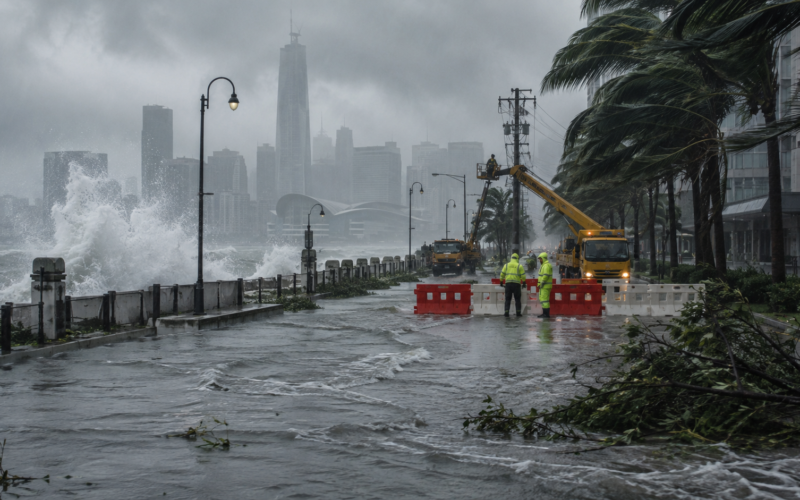
Typhoon Dolphin made landfall on China’s eastern coast on Sunday, August 9, 2026, bringing winds of around 151 kilometres per hour, torrential rain and widespread disruption after authorities evacuated more than one million people from vulnerable communities across Zhejiang, Fujian, Shanghai and surrounding areas.
The storm reached land near Yuhuan in Zhejiang province at approximately 5:30 p.m. local time, becoming the most powerful tropical cyclone to hit China so far in 2026. Chinese forecasters warned that Dolphin could dump between 250 and 500 millimetres of rain across parts of central and eastern Zhejiang, creating a significant danger of flash floods, swollen rivers and landslides even after the typhoon begins weakening inland.
Wenzhou, one of the major coastal cities in Zhejiang, relocated more than 900,000 residents and opened over 1,000 emergency shelters. Fujian evacuated almost 99,000 people from high-risk areas, while Shanghai moved more than 30,000 residents and cancelled around 1,500 flights as the storm disrupted one of Asia’s busiest aviation and logistics hubs.
Dolphin’s arrival in China follows its destructive passage across Japan’s Okinawa islands, where six people were injured and more than 50,000 buildings lost electricity. The storm has therefore evolved into a multi-country weather emergency stretching across some of East Asia’s busiest transport, manufacturing and population centres.
Where did Typhoon Dolphin make landfall and how powerful was the storm when it hit China?
Typhoon Dolphin came ashore near Yuhuan in Taizhou city, Zhejiang province, with sustained winds of approximately 42 metres per second, equivalent to around 151 kilometres per hour.
That intensity is broadly comparable with a Category 1 hurricane on the Saffir-Simpson scale, although China uses its own tropical cyclone classification system.
The wind speed alone does not capture the main danger facing eastern China. Dolphin is expected to slow after moving inland, allowing heavy rain to remain over some areas for an extended period.
Slow-moving tropical systems can be especially destructive because rainfall accumulates over the same river basins and mountain slopes for many hours.
Chinese forecasters expect rain to affect Zhejiang, Shanghai, northern Fujian, northeastern Jiangxi, central and southern Anhui and large areas of Jiangsu through August 10.
The National Meteorological Centre expects Dolphin to track westward after landfall before gradually slowing and weakening over central and southwestern China.
That route increases the possibility that the storm’s most damaging legacy will come from inland flooding rather than coastal wind damage.

Why have more than one million people been evacuated ahead of Typhoon Dolphin?
Chinese authorities conducted large-scale evacuations because Dolphin threatens densely populated coastal areas containing cities, fishing communities, industrial facilities and mountain settlements vulnerable to floods and landslides.
Wenzhou alone moved more than 900,000 residents away from exposed areas and opened over 1,000 emergency shelters.
The scale is striking even for China, which regularly manages major typhoon evacuations along its eastern and southern coasts.
Fujian province evacuated approximately 98,900 people from areas considered at risk. Shanghai relocated more than 30,000 residents while local governments elsewhere ordered evacuations from low-lying neighbourhoods, coastal villages and mountain communities.
Authorities also moved offshore workers back to land, ordered fishing and commercial vessels into protected harbours and increased inspections of reservoirs, construction sites, tourist attractions and areas previously identified as landslide risks.
These evacuations are preventative rather than evidence that every community will experience catastrophic damage.
However, typhoon emergencies become considerably more dangerous once roads flood, trees fall or landslides block evacuation routes. Moving vulnerable residents before the strongest weather arrives substantially reduces the possibility of people becoming trapped.
The enormous Wenzhou evacuation also reflects the city’s geography. Mountainous terrain sits relatively close to a heavily populated coastline, creating simultaneous threats from wind, storm runoff and slope failure.
Why could 500 millimetres of rainfall create a bigger disaster than Dolphin’s 151 km/h winds?
Wind usually produces the most dramatic images from a typhoon, but rainfall frequently causes the greatest number of casualties.
Parts of Zhejiang could receive between 250 and 500 millimetres of rain as Dolphin moves inland. Five hundred millimetres represents half a metre of rainfall, enough to overwhelm drainage systems and rapidly raise smaller rivers when concentrated over a short period.
China’s Ministry of Water Resources has warned that several major waterways, including the Qiantang, Yong, Jiao and Shuiyang rivers, could experience significant flooding.
Smaller rivers and mountain streams present an even more immediate danger because their water levels can rise extremely quickly.
Authorities issued red mountain-torrent warnings in some areas and instructed residents to comply immediately with evacuation orders.
Mountainous sections of Zhejiang are especially vulnerable to landslides because heavy rain saturates soil and reduces its ability to remain stable on steep slopes.
Even after Dolphin weakens below typhoon strength, its remaining moisture can continue producing dangerous rainfall hundreds of kilometres inland.
This is why emergency planning cannot end once the storm’s winds decline. Flooding, reservoir pressure and geological hazards may continue worsening for hours or even days after landfall.
How badly has Typhoon Dolphin disrupted Shanghai flights and China’s transport network?
Shanghai has emerged as one of the largest centres of transport disruption despite lying north of Dolphin’s landfall point.
Around 1,500 flights were cancelled in the city, affecting Shanghai Pudong International Airport and Shanghai Hongqiao International Airport.
The cancellations are particularly significant because Shanghai is one of Asia’s largest aviation markets and an important international business and tourism gateway.
Passengers travelling elsewhere across China can also experience disruptions when aircraft and crews become stranded in Shanghai, creating knock-on delays far beyond the immediate storm area.
Marine transport has been heavily restricted.
Shanghai’s Yangshan deep-water port removed vessels from exposed berths and moved more than 500 small and medium-sized ships into sheltered areas.
Yangshan is an essential component of the Port of Shanghai, the world’s busiest container port by throughput in recent years. Even temporary restrictions can influence shipping schedules when vessels must delay arrival or remain offshore until conditions improve.
Fujian suspended 55 coastal passenger ferry routes, halted all 115 offshore construction projects and ordered around 290 construction vessels into protected waters.
Rail services have also faced cancellations and restrictions, including high-speed routes connecting Hong Kong with Shanghai and Guangzhou.
The extent of disruption demonstrates why modern typhoons create economic consequences even when industrial facilities avoid direct physical damage.
Could Typhoon Dolphin affect factories, ports and supply chains across eastern China?
Eastern China contains one of the world’s largest concentrations of manufacturing and logistics infrastructure.
Zhejiang is home to major manufacturing centres producing machinery, electrical equipment, textiles, chemicals, automotive components and consumer goods.
Shanghai and neighbouring Jiangsu form another enormous industrial and commercial corridor.
Factories do not need to be physically damaged for production to be affected.
Workers may be unable to travel, suppliers can miss deliveries, ports may suspend operations and warehouses can become inaccessible because of flooding or road closures.
Exporters also depend on predictable vessel schedules. When ports move ships to shelter and restrict loading operations, containers can accumulate at terminals while vessels arrive late at subsequent destinations.
These disruptions are generally manageable when closures last only a short period.
The risk increases if heavy rain causes widespread inland flooding that damages highways, railways or industrial parks after coastal port operations resume.
Dolphin’s slow expected movement inland therefore matters for business continuity.
The immediate wind threat may pass relatively quickly, but the rainfall footprint could affect supply chains for considerably longer.
What happened when Typhoon Dolphin passed through Japan before reaching China?
Before striking China, Dolphin crossed Japan’s southern islands, particularly Okinawa and nearby areas.
The storm injured six people and left more than 50,000 buildings without electricity as powerful winds and heavy rain affected the region.
Hundreds of flights were cancelled during its Japanese phase, and authorities ordered large-scale evacuations across Okinawa and Kagoshima.
Toyota Motor Corporation also temporarily suspended production at nine factories as a precaution while the storm threatened transport links and worker safety.
Dolphin’s journey therefore illustrates how the same tropical cyclone can create different types of disruption as it moves through the region.
In Japan, the focus was on island communities, power outages, aviation and manufacturing.
In eastern China, the scale of population exposure is dramatically larger, while river flooding and landslides have become more prominent dangers because of the storm’s expected inland track.
China’s emergency response also benefits from observing Dolphin’s earlier behaviour around Okinawa, allowing forecasters to update models using data collected while the storm moved through Japan.
Why is Wenzhou particularly exposed to flooding and landslide risks from Typhoon Dolphin?
Wenzhou sits along Zhejiang’s southeastern coast near mountainous terrain and extensive river systems.
This geography creates several overlapping typhoon hazards.
Coastal areas can experience strong winds and high waves, while intense rainfall drains rapidly from mountains into rivers and lower-lying urban areas.
Mountain communities face landslide and flash-flood risks when heavy rainfall saturates slopes.
The relocation of more than 900,000 people indicates authorities believe the potential risk footprint extends far beyond the immediate coastline.
China has spent heavily on flood-control infrastructure, reservoirs and urban drainage, but exceptionally concentrated rainfall can still overwhelm systems designed around historical weather conditions.
Rapid urbanisation creates an additional challenge because roads, buildings and other impermeable surfaces prevent rainwater from soaking naturally into the ground.
Instead, large volumes of water move quickly into drains and waterways.
The coming night will therefore be crucial for Wenzhou and surrounding districts. Dolphin is already inland, but the heaviest rainfall can occur after landfall as moist air continues feeding into the storm.
Could Shanghai and Zhejiang face major river flooding after Dolphin moves inland?
Chinese water authorities are specifically monitoring several rivers that may rise above warning levels.
Flood risk depends not only on total rainfall but also on where the heaviest bands become stationary.
If hundreds of millimetres of rain fall over the same watershed, tributaries can rise rapidly and send large volumes of water downstream towards towns and cities.
Reservoir managers may also need to release water to preserve safe storage capacity.
Those decisions can become extremely difficult when downstream rivers are already elevated.
Urban flooding is another concern.
Shanghai has sophisticated drainage and flood-management infrastructure, but extremely heavy rainfall can still produce waterlogging, disrupt metro operations and close roads.
Zhejiang’s mountainous areas present a different risk profile, with landslides and flash floods potentially isolating villages.
Chinese authorities have therefore inspected mountain streams, reservoirs and known geological hazard areas before the storm.
The effectiveness of those preparations will become clearer as rainfall totals accumulate through August 10.
What does Typhoon Dolphin reveal about East Asia’s exposure to increasingly disruptive extreme weather?
Dolphin arrives during a summer already marked by significant weather emergencies across Asia and other regions.
Extreme heat, wildfires, floods and tropical cyclones are increasingly interacting with densely populated cities and complex infrastructure networks.
Individual typhoons have always affected China and Japan. The western Pacific is one of the world’s most active tropical cyclone regions.
The emerging concern is how warmer atmospheric and ocean conditions can influence the intensity of rainfall and other characteristics of extreme storms.
Warmer air can hold more moisture, increasing the amount of water potentially available to tropical systems.
That does not mean climate change can be identified as the sole cause of any individual typhoon.
However, climate scientists increasingly warn that global warming can amplify some impacts associated with tropical cyclones, particularly extreme rainfall.
For governments, the practical implication is straightforward.
Flood-control infrastructure, evacuation planning, electricity networks and urban drainage systems must increasingly be designed around conditions that may exceed historical assumptions.
What are the key takeaways from Typhoon Dolphin’s August 9 landfall in eastern China?
Typhoon Dolphin made landfall near Yuhuan in Zhejiang province at approximately 5:30 p.m. local time on August 9 with sustained winds of around 151 kilometres per hour, making it the strongest tropical cyclone to strike China so far in 2026.
More than one million people have been evacuated across eastern China, with Wenzhou alone relocating over 900,000 residents and opening more than 1,000 emergency shelters.
Shanghai has cancelled around 1,500 flights while moving more than 30,000 residents from vulnerable areas, creating major disruption across one of Asia’s largest aviation centres.
Parts of central and eastern Zhejiang could receive between 250 and 500 millimetres of rain, creating serious risks of flash flooding, river flooding and landslides even as Dolphin weakens inland.
China’s water authorities are monitoring the Qiantang, Yong, Jiao and Shuiyang rivers, while smaller rivers in the hardest-hit areas could rise above warning levels.
Shanghai’s Yangshan port moved more than 500 small and medium-sized vessels into shelter, while Fujian suspended dozens of ferry routes, stopped offshore construction work and evacuated almost 99,000 people.
Dolphin previously crossed Japan’s Okinawa region, where six people were injured and more than 50,000 buildings lost electricity before the storm moved towards China.
The largest remaining risk is prolonged heavy rainfall after landfall, particularly because Dolphin is forecast to slow while moving westward across China.
Why Typhoon Dolphin’s inland rainfall may now matter more than the landfall itself
The dramatic moment of Typhoon Dolphin’s Chinese landfall has already passed, but the most dangerous phase may not be over.
At 151 kilometres per hour, Dolphin reached the coast with enough wind to damage trees, power infrastructure and buildings. Yet eastern China has spent decades preparing for tropical cyclone landfalls, and large-scale evacuations have reduced immediate exposure.
Rainfall is less straightforward.
A slowing storm can continue drawing moisture inland and repeatedly dump heavy rain over the same watersheds. Rivers rise, slopes become saturated and drainage systems lose capacity.
That creates the possibility of serious flooding well after coastal residents believe the worst winds have passed.
The enormous evacuation in Wenzhou shows authorities are taking that risk seriously.
For Shanghai, the challenge is maintaining transport and logistics operations without reopening too quickly. The city’s airports and Yangshan port connect China with markets across the world, creating pressure to resume activity as soon as conditions improve.
For Zhejiang, the priority is different. Mountain communities and river valleys must remain alert until rainfall declines and water levels begin falling.
Dolphin has already affected Japan, disrupted international aviation and forced more than one million people from their homes in China.
The next 24 hours will determine whether it is remembered primarily as an enormous precautionary evacuation or as one of eastern China’s most damaging flood events of 2026.
Discover more from Business-News-Today.com
Subscribe to get the latest posts sent to your email.