


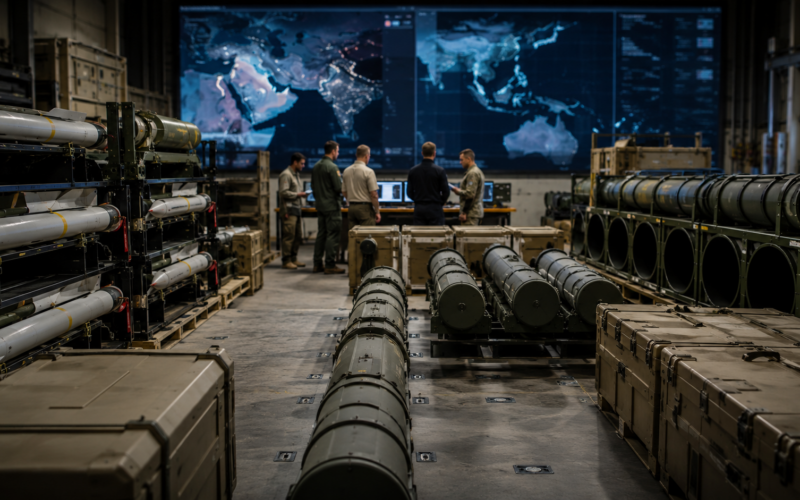
The United States may need several years to rebuild key missile stockpiles depleted during the recent Iran war, raising new questions about American military readiness, defence industrial capacity and deterrence planning for future conflicts involving China, Taiwan, Ukraine and other allied security commitments.
A new assessment by the Center for Strategic and International Studies has warned that the United States used large quantities of advanced weapons during the 39-day air and missile campaign against Iran. The affected systems include Tomahawk cruise missiles, Terminal High Altitude Area Defense interceptors, Patriot interceptors, Standard Missiles and other precision weapons.
The analysis indicates that replenishing some of the most heavily used systems could take until 2029 or 2030, depending on the weapon type, existing production lines and already committed deliveries. Tomahawk missile inventories could be among the slowest to recover, while Patriot and Terminal High Altitude Area Defense interceptors are also under pressure because they are central to missile defence for the United States and its allies.
The issue is not simply whether the United States has enough money to buy more weapons. The larger constraint is time. Missile production depends on specialised components, trained labour, defence contractor capacity, long supplier chains and predictable long-term procurement. Even with higher defence spending, factories cannot instantly replace years of inventory used during a short, high-intensity conflict.
The stockpile warning matters because the United States is simultaneously managing several strategic theatres. Washington is supporting Ukraine against Russian strikes, backing Israel and Gulf security in the Middle East, sustaining Indo-Pacific deterrence against China, and attempting to reassure Taiwan and Japan that American commitments remain credible.
Why has the Iran war exposed pressure on United States missile stockpiles?
The Iran war exposed pressure on United States missile stockpiles because the campaign required heavy use of advanced strike and missile defence systems over a relatively short period. These systems are expensive, technically complex and slow to manufacture.
The confirmed assessment from the Center for Strategic and International Studies is that several key munitions were used heavily during the 39-day campaign. The institutional concern is that the United States Department of Defense and defence contractors now face a replenishment challenge that cannot be solved quickly.
The broader consequence is that modern high-intensity warfare consumes precision weapons faster than many peacetime production systems can replace them. Missiles such as Tomahawk cruise missiles and interceptors such as Patriot and Terminal High Altitude Area Defense rounds are not simple commodities. They depend on advanced electronics, propulsion systems, sensors, guidance systems, warheads and certified production lines.
This creates a readiness gap. The United States may remain militarily powerful, but sustained operations against a major adversary can rapidly reduce stockpiles of specialised weapons. That matters because the United States must maintain credible options across multiple regions at the same time.

How long could it take to replenish Tomahawk, Patriot and Terminal High Altitude Area Defense inventories?
Replenishment timelines vary by system, but the most concerning estimates extend into 2029 and 2030. Tomahawk cruise missiles may take until around 2030 to fully rebuild to prewar inventory levels. Patriot and Terminal High Altitude Area Defense interceptors could also require several years to recover, depending on production expansion and demand from allies.
The confirmed policy concern is that production speed has become as important as inventory size. The United States Department of Defense can place new orders, but defence contractors must have enough workers, suppliers, facilities and parts to deliver them. That process is slow because missile production involves highly specialised manufacturing.
The institutional response is likely to involve pressure on contractors to increase output, longer-term procurement contracts and expanded investment in missile production capacity. Raytheon, Lockheed Martin and other defence manufacturers are likely to remain central to replenishment efforts, given their roles in major missile and interceptor programmes.
The broader consequence is that defence planning must now account for industrial endurance. A country can have advanced weapons and still face vulnerability if production cannot keep pace with wartime usage. The Iran war has therefore turned missile stockpiles into a test of industrial readiness, not just battlefield performance.
Why does the missile shortage matter for a possible Taiwan conflict with China?
The missile shortage matters for Taiwan because any conflict involving China would likely require large quantities of precision weapons, air defence interceptors, anti-ship missiles and long-range strike systems. United States planners have long viewed the Western Pacific as a theatre where missile volume, speed and survivability would be decisive.
The confirmed concern in the stockpile analysis is that weapons used in the Iran war would also be critical in a potential Western Pacific conflict. Tomahawk cruise missiles could be important for long-range strike missions. Patriot and Terminal High Altitude Area Defense systems could be used to defend bases, forces and allied territory from missiles and drones. Standard Missiles could be central to naval air and missile defence.
The broader consequence is that the United States cannot treat regional conflicts as separate inventory problems. Weapons used in the Middle East may reduce availability for Indo-Pacific contingencies. Weapons sent to Ukraine may affect readiness for Taiwan. Weapons promised to Japan may be delayed if the United States prioritises its own replenishment.
This is the strategic dilemma. United States deterrence depends on convincing China that Washington has both the will and the capacity to respond to aggression. If stockpile pressure becomes visible, Beijing may reassess American readiness, even if the United States Department of Defense insists that forces remain combat-ready.
How could missile production delays affect Ukraine, Japan and other United States allies?
Missile production delays could affect allies because many countries depend on United States weapons for their own defence planning. Ukraine depends heavily on Western air defence support to protect cities, infrastructure and military positions from Russian missile and drone attacks. Japan is investing in long-range strike capability, including Tomahawk missiles, as part of its effort to strengthen deterrence against China and North Korea.
The confirmed stockpile concern is that the United States may need years to replenish systems heavily used in the Iran war. The institutional consequence is that Washington may have to prioritise between domestic stockpile recovery and allied deliveries.
For Ukraine, any pressure on Patriot interceptors is especially serious because Patriot systems are among the most valuable defences against ballistic missiles. For Japan, delays in Tomahawk deliveries could complicate its planned shift toward counterstrike capability. For Taiwan, the issue is wider because arms delivery backlogs already shape the debate over whether the island can build deterrence quickly enough.
The broader consequence is alliance confidence. United States allies do not only measure American commitment through speeches and treaties. They also measure it through delivery timelines, munitions availability and operational credibility. If weapons promised to allies are delayed because United States stockpiles are depleted, allied governments may accelerate domestic production or seek alternative suppliers.
Why is money not enough to solve the United States defence industrial capacity problem?
Money is not enough because missile production is limited by industrial capacity, not simply procurement budgets. Advanced missile systems require skilled workers, specialised factories, certified suppliers, rare components, electronics, propulsion systems and long testing cycles. These constraints cannot be removed overnight.
The United States has increased defence spending and has strong bipartisan support for rebuilding military capacity. However, the post-Cold War defence industrial base was not designed for repeated high-volume missile expenditure across several theatres at once. Production lines were often sized for peacetime replacement and limited contingencies, not sustained multi-region conflict.
The institutional challenge is to move from efficiency-focused procurement to surge-capable production. That may require multi-year contracts, greater investment in manufacturing facilities, stronger supply-chain mapping, workforce training and stockpile planning based on realistic wartime consumption.
The broader consequence is that the United States defence system is being forced to relearn an old lesson: deterrence depends on production depth. Advanced platforms matter, but wars are often shaped by whether a country can replace losses, sustain firepower and keep allies supplied.
How does the Iran war change the debate over United States military readiness?
The Iran war changes the readiness debate because it shows that even a technologically dominant military can face inventory stress after a short but intense campaign. The United States retains enormous military capability, but readiness is not only about aircraft carriers, bombers or fighter jets. It is also about missile inventories, interceptor availability and production resilience.
The confirmed analysis shows that several important missile systems could take years to replenish. The institutional response from the United States Department of Defense is likely to emphasise that the United States remains combat-ready while also pushing industry to increase output.
The broader consequence is a more complicated public debate over military strength. A country can win battlefield engagements while still exposing vulnerabilities in its supply chain. A campaign can demonstrate capability and depletion at the same time.
This matters for deterrence. Potential adversaries watch not only what the United States can strike, but how much the United States expends and how quickly the United States can recover. The Iran war may have shown United States firepower, but it also created new questions about endurance.
What could the United States do to close the missile replenishment gap?
The United States could close the replenishment gap through a combination of expanded production, multi-year procurement, supply-chain investment, allied co-production, stockpile reforms and clearer theatre prioritisation. No single measure will solve the problem quickly.
The most immediate step is increasing orders for critical systems such as Tomahawk missiles, Patriot interceptors and Terminal High Altitude Area Defense interceptors. However, orders must be matched by production capacity. Defence contractors may need new facilities, more shifts, more skilled labour and more resilient supplier networks.
A second step is allied industrial cooperation. Japan, Australia, South Korea and European allies may become more important in joint production, component supply and maintenance ecosystems. If allies can help produce or assemble parts of critical systems, the replenishment burden on the United States may ease over time.
A third step is smarter stockpile planning. The United States may need to model munitions consumption more realistically for simultaneous crises in the Middle East, Europe and the Indo-Pacific. That means planning for longer wars, faster expenditure and the possibility that deterrence fails in more than one region at once.
What happens next as the United States tries to rebuild advanced weapons stockpiles?
The next phase will depend on how quickly the United States Department of Defense and defence contractors can expand production capacity. The stockpile warning is likely to intensify congressional scrutiny, budget debates and pressure on major defence contractors to accelerate delivery schedules.
The United States may also reassess how it allocates weapons among its own forces and allies. Deliveries to Japan, Ukraine, Taiwan and other partners could face greater prioritisation pressure if replenishment remains slow. The Pentagon will need to balance immediate military demand with long-term deterrence needs.
The broader strategic question is whether the United States can sustain global commitments in an era of simultaneous crises. Iran, Russia, China, North Korea and regional security challenges all place demands on different parts of the United States arsenal. Missile stockpiles are now one of the clearest measures of whether Washington’s defence strategy matches its industrial base.
For now, the warning is unmistakable. The United States has the world’s most powerful military, but the Iran war has shown that advanced missile inventories are finite, slow to rebuild and central to whether American deterrence can hold across multiple regions.
What are the key takeaways from the United States missile stockpile warning after the Iran war?
- The United States may need several years to rebuild key missile stockpiles used during the Iran war. The affected systems include Tomahawk cruise missiles, Patriot interceptors, Terminal High Altitude Area Defense interceptors and Standard Missiles.
- The Center for Strategic and International Studies assessed that the 39-day campaign against Iran consumed large quantities of advanced munitions. Some systems could take until 2029 or 2030 to return to prewar inventory levels.
- The problem is driven by production capacity as much as funding. Advanced missiles require specialised parts, skilled labour, certified suppliers and long manufacturing timelines.
- The stockpile strain has implications for Taiwan and a possible future conflict with China. Weapons used in the Iran war are also relevant to deterrence and operations in the Western Pacific.
- Ukraine, Japan and other United States allies could also feel the effects of slower replenishment. Patriot interceptors and Tomahawk missiles are central to several allied defence plans.
- The United States now faces a defence industrial readiness test. Washington must rebuild inventories while maintaining commitments across the Middle East, Europe and the Indo-Pacific.
Discover more from Business-News-Today.com
Subscribe to get the latest posts sent to your email.