




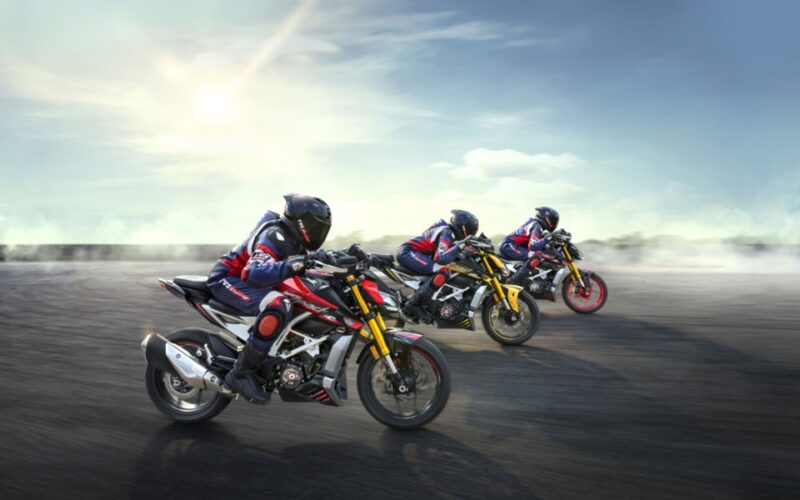
TVS Motor Company Limited (BSE: 532343, NSE: TVSMOTOR) has launched the TVS Apache RTR 310 in Morocco, marking the model’s first commercial entry into the African continent and positioning the Chennai-based two-wheeler manufacturer at the top of the region’s fastest-growing premium motorcycle segment. The launch, held in Casablanca on March 28, 2026 in partnership with local distributor Motorsport Maroc (Hindi Motors), targets the 201-350cc category, which currently accounts for 6.6% of Morocco’s total two-wheeler market and is forecast to reach 10% by 2030. TVS Motor is arriving at a moment of structural opportunity: Morocco’s two-wheeler industry expanded 42% in the past year, and the country’s motorsport culture and proximity to European markets give it an outsized strategic weight relative to its volume. With TVSMOTOR trading at approximately Rs 3,445 as of March 27, down roughly 7.4% over the past month against a 52-week range of Rs 2,221 to Rs 3,970, the stock sits well below its January 2026 peak, making the Africa expansion an important signal to investors watching the international revenue thesis.
Why is TVS Motor Company choosing Morocco as the entry point for its Africa premium motorcycle strategy?
Morocco is not a random choice. It is the most logical gateway TVS Motor could have selected for a premium performance play on the African continent. The country has the infrastructure, the regulatory framework, and the consumer profile that makes a Rs 2.5 lakh-plus motorcycle viable. Unlike the bulk of sub-Saharan Africa where two-wheelers function almost entirely as commercial transport, Morocco’s market is increasingly segmented, with a growing cohort of performance-oriented urban riders aligned with European tastes. The country’s trade ties with the European Union under the EU-Morocco Association Agreement also mean that vehicles meeting European safety and emissions standards face relatively frictionless movement, and TVS Motor’s Apache RTR 310 has already been sold in European markets.
The distributor relationship with Motorsport Maroc (Hindi Motors) provides immediate retail and service infrastructure, which is the most critical success variable for a brand with no prior physical presence in the market. TVS Motor has consistently used motorsport-aligned distributor partnerships in frontier markets, a strategy that reinforces brand credibility in segments where performance credentials matter to purchase decisions. Morocco also serves as a visible showcase market for the broader African continent, meaning a strong reception here carries demonstrational value for future entries into Egypt, South Africa, Kenya, and West African markets where the premium two-wheeler opportunity is emerging.
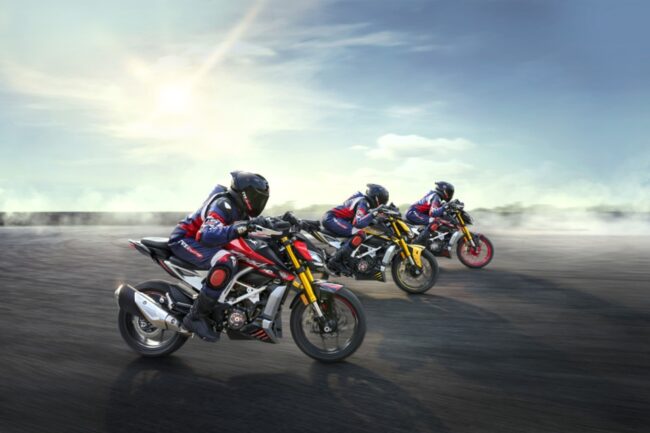
What does the Apache RTR 310 bring to the Moroccan market that existing competitors do not currently offer?
The Apache RTR 310 is technically ambitious for its price bracket. The 312.2cc reverse-inclined DOHC engine, producing 35.6 PS at 9,700 rpm and 28.7 Nm of torque at 6,650 rpm, is engineered with a forged aluminium piston that is 5% lighter than conventional designs, enabling a claimed 0-60 kmph sprint of 2.81 seconds. That specific figure has become a marketing anchor for TVS Motor because no rival in the 201-350cc category has publicly matched it. The motorcycle also ships with features that are genuinely segment-first for this price point: cruise control, a bidirectional quickshifter, a 5-inch TFT cluster with GoPro connectivity, voice assist, and navigation integration.
The electronics stack includes a 6D IMU-based Race Tuned Dynamic Stability Control system covering cornering ABS, cornering traction control, wheelie control, slope control, and rear lift-off prevention. For context, this level of electronic rider assistance is more typically associated with European middleweight motorcycles priced significantly higher. TVS Motor’s competitive advantage in this segment derives from its ability to transfer race-derived engineering from its domestic motorsport programme into production motorcycles at a price point that undercuts European rivals, a strategy the company has executed across 60 countries over the past two decades. In Morocco, the key competitive pressure will come from Japanese manufacturers, particularly Yamaha and Honda, which have established distribution networks and brand familiarity, though neither currently offers a direct equivalent in the 310cc streetfighter category.
How does the Apache RTR 310’s Africa debut fit into TVS Motor Company’s broader international expansion strategy?
TVS Motor Company operates across 90 countries and has accumulated 6.5 million Apache customers globally across markets including Colombia, Mexico, pan-Africa, Europe, and Southeast Asia. The international business has become an increasingly important segment as domestic two-wheeler growth in India faces competitive intensity from Hero MotoCorp, Honda, and Bajaj Auto. Premium product exports carry meaningfully better margins than volume commuter models, and the Apache RTR 310 sits at the top of TVS Motor’s margin ladder for international sales.
The Africa premium strategy also links directly to the company’s broader asset base. TVS Motor’s subsidiary Norton Motorcycles in the United Kingdom provides premium brand credibility and engineering cross-pollination. The company’s Swiss electric mobility subsidiary, TVS Ebike Company AG, gives it a footprint in the European premium mobility conversation. Within this portfolio structure, the Apache RTR 310’s Africa launch represents the performance-ICE layer of a multi-segment international architecture, where TVS Motor is attempting to build aspiration at multiple price points across multiple geographies simultaneously. The execution risk is real: managing distributor quality, service network training, and spare parts logistics across a fragmented continent is operationally demanding, and the company’s track record in sub-Saharan Africa for premium products remains thin.
What are the execution risks for TVS Motor Company as it tries to scale the Apache RTR 310 across African markets?
The premium motorcycle business in Africa carries fundamentally different execution challenges than volume commuter sales. At the price points required to position the Apache RTR 310 competitively, the addressable buyer pool is narrow and highly sensitive to ownership experience. A single service failure, whether caused by inadequate technician training, parts unavailability, or warranty handling gaps, can permanently damage brand perception in a market that relies heavily on word-of-mouth and community networks. Motorsport Maroc’s stated commitment to service network training is operationally necessary rather than merely aspirational, and TVS Motor’s ability to audit that capability from Chennai is inherently limited.
Currency exposure is also a material risk. The Apache RTR 310 is priced in Moroccan Dirham with pricing listed as dealer-contact only at launch, which likely reflects a need for pricing flexibility as TVS Motor calibrates the competitive positioning. Moroccan Dirham is pegged to a euro-dollar basket, which provides relative stability, but downstream African market entries would face considerably more volatile currency dynamics. There is also a long-term structural question about the direction of Morocco’s motorcycle market. The Moroccan government is actively promoting electric vehicle adoption, with a USD 5.6 billion battery gigafactory under construction set to begin production in 2026. If the premium segment begins migrating toward electric motorcycles faster than TVS Motor’s current ICE-focused Apache strategy anticipates, the company may need to accelerate the deployment of electric variants to defend the beachhead it is now establishing.
How does the TVSMOTOR stock reflect the current phase of international expansion and what should investors watch?
TVSMOTOR closed at approximately Rs 3,445 on March 27, 2026, sitting roughly 13% below its 52-week high of Rs 3,970 reached in early January 2026 and approximately 55% above its 52-week low of Rs 2,221. The stock has declined around 7.4% over the past month, underperforming the Nifty Auto index over the same period amid broader sector softness. The market capitalisation stands at approximately Rs 1.64 lakh crore at the March 27 price, with a P/E ratio near 73 times trailing earnings, a valuation that prices in continued premium mix expansion and international growth acceleration.
The Morocco launch is unlikely to move the stock on a standalone basis given the market’s absolute size today. What investors will monitor is whether the Africa premium strategy accelerates into meaningful volume across additional markets over the next 12-18 months, which would validate the international revenue premium embedded in the current valuation. TVS Motor has also declared an interim dividend of Rs 12 per share for FY 2025-26, with March 31, 2026 as the record date, signalling confidence in near-term cash generation. The next earnings disclosure, scheduled for May 30, 2026, will be the first opportunity to see whether international premium growth is tracking the pace required to sustain the current multiple.
What does TVS Motor Company’s Morocco launch mean for Indian two-wheeler competitors pursuing their own Africa strategies?
TVS Motor Company is not the only Indian manufacturer tracking Africa’s premiumisation trend. Bajaj Auto has a significant presence across sub-Saharan Africa with its Boxer and Pulsar ranges and has been building distribution depth for years. Hero MotoCorp has been expanding its African footprint, particularly in East and West Africa. The Apache RTR 310’s Morocco positioning is notable because it is staking the premium 310cc performance category before any Indian rival has explicitly targeted it in North Africa. If TVS Motor can establish the Apache as the performance benchmark in Morocco’s 201-350cc segment before Bajaj’s KTM partnership or Honda’s CB300R reach distribution parity in the market, it will have created a first-mover advantage that is difficult to dislodge in aspirational categories.
The broader competitive signal is that Indian two-wheeler manufacturers are now competing explicitly in premium segments globally rather than defaulting to the low-cost commuter positioning that dominated international expansion strategies in the previous decade. This shift has structural implications for how global motorcycle industry margin pools are distributed. Yamaha, Honda, and KTM have historically owned the premium international two-wheeler category from Japan, Japan, and Austria respectively. An Indian challenger commanding genuine technical credentials in that space, at a price point that undercuts European rivals by a meaningful margin, is a competitive development the incumbents will not ignore.
Key takeaways: What TVS Motor Company’s Morocco launch means for investors, competitors, and the African motorcycle industry
- TVS Motor Company has launched the Apache RTR 310 in Morocco, becoming the first Indian manufacturer to target Africa’s 201-350cc premium performance segment with a top-spec product.
- Morocco’s two-wheeler market grew 42% in the past year, and the premium 201-350cc category, currently at 6.6% of total volume, is forecast to reach 10% by 2030 as consumer incomes and performance aspirations rise.
- The Africa launch is strategically positioned at the top of TVS Motor’s international margin ladder, with the Apache RTR 310 carrying premium electronics including a 6D IMU stability system, bidirectional quickshifter, and cruise control that undercut European rivals on price.
- The Motorsport Maroc (Hindi Motors) distribution partnership is the critical near-term execution variable. Service network quality will determine brand positioning far more than the product specification sheet.
- TVSMOTOR trades at approximately Rs 3,445, roughly 13% below its January 2026 52-week high, with a P/E near 73 times. The Africa expansion needs to scale meaningfully across additional markets to justify the valuation premium over Indian two-wheeler peers.
- Currency stability in Morocco (Dirham is pegged to a euro-dollar basket) provides a low-risk entry environment, but downstream African market entries will expose TVS Motor to more volatile currency dynamics that require careful hedging strategy.
- Morocco’s government-backed electric vehicle push, including a USD 5.6 billion battery gigafactory coming online in 2026, creates a medium-term technology risk for an ICE-only Apache strategy if premium consumer preference begins shifting toward electric motorcycles earlier than forecast.
- Bajaj Auto, Honda, and Yamaha have deeper Africa distribution networks. TVS Motor’s first-mover advantage in the 310cc performance category in North Africa is defensible only if it executes on service infrastructure and brand-building before rivals respond.
- The Apache RTR 310’s Africa entry is the ICE performance layer of a multi-segment international strategy that includes Norton Motorcycles at the premium heritage end and TVS Ebike Company AG in European electric mobility.
- The next investor catalyst is the May 30, 2026 earnings release, which will be the first financial disclosure to partially reflect the international premium growth trajectory that the current valuation assumes.
Discover more from Business-News-Today.com
Subscribe to get the latest posts sent to your email.