





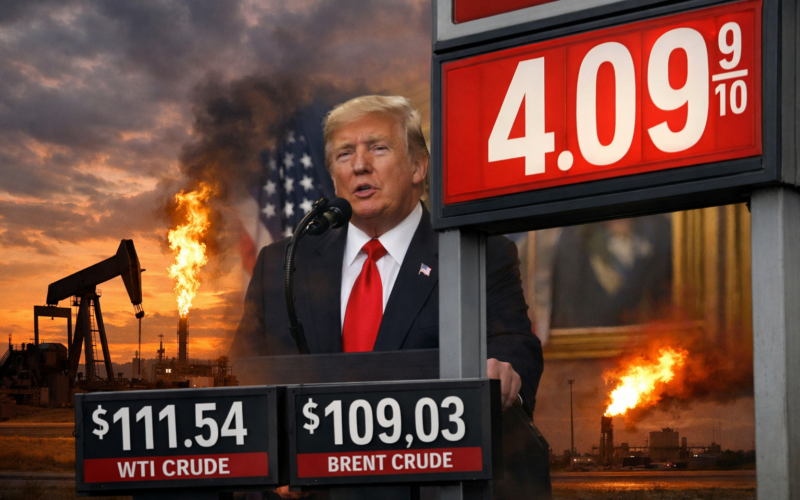
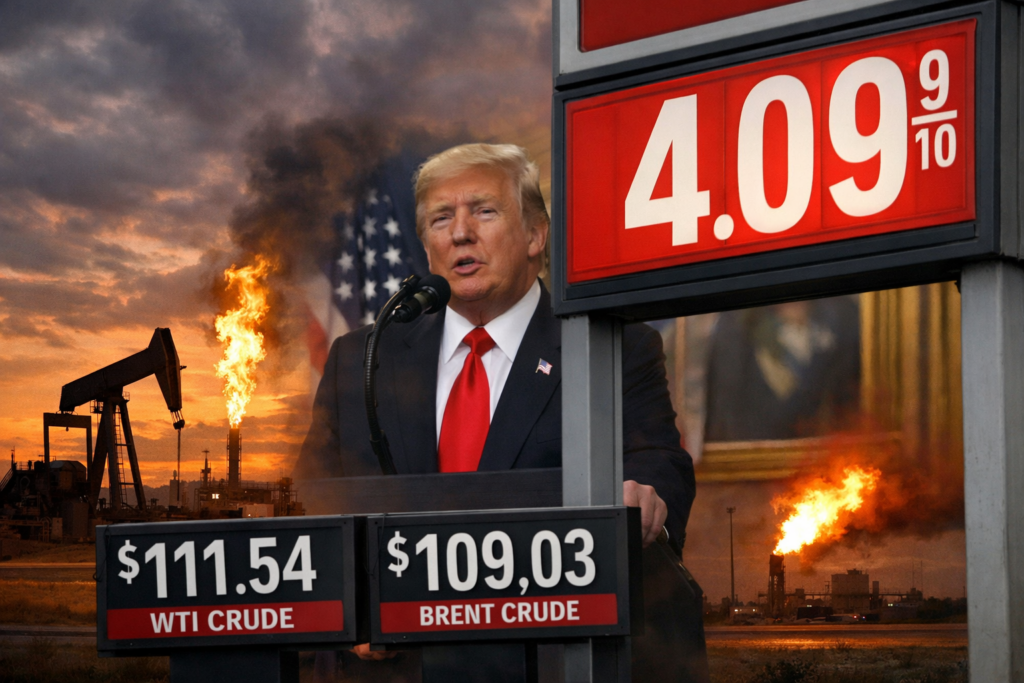
U.S. crude oil prices recorded their largest one-day dollar gain in six years on April 3, 2026, surging nearly $12 per barrel after President Donald Trump delivered a primetime national address the previous evening that reinforced military escalation against Iran and provided no structured plan to restore tanker traffic through the Strait of Hormuz. West Texas Intermediate crude futures for May delivery rose more than 11 percent, or $11.42, to close at $111.54 per barrel. International benchmark Brent crude gained nearly 8 percent, or $7.87, to settle at $109.03 per barrel. The gains represented the largest single-day dollar movement for U.S. crude benchmarks since 2020.
The price spike occurred in volatile trading ahead of the three-day Good Friday holiday weekend, with markets reacting to the absence of any new exit strategy from Trump’s 19-minute speech delivered Wednesday evening from the White House. Trump told the nation that U.S. armed forces were on track to complete all military objectives in Iran, which he described as nearing completion, but simultaneously stated that U.S. forces would continue to hit Iran extremely hard over the next two to three weeks. The president offered no timeline for reopening the Strait of Hormuz, saying only that it would open up naturally.
Stock markets opened sharply lower in the hours following the address before recovering some ground by the close of trading. The S&P 500 ended April 3 up 0.11 percent, the Nasdaq Composite closed 0.18 percent higher, and the Dow Jones Industrial Average fell 61 points. Asian equity markets posted significant losses in Thursday morning trading following Trump’s speech, with Japan’s Nikkei 225 falling 2.4 percent, South Korea’s Kospi losing 4.5 percent, Hong Kong’s Hang Seng declining 1.3 percent, and India’s Sensex dropping 1.9 percent.
Why did Trump’s Iran speech cause U.S. crude oil prices to spike to six-year highs on April 3, 2026?
Markets had entered Wednesday with cautious optimism following signals earlier in the week that the Trump administration was considering accelerating the pace of the conflict toward a conclusion. That optimism evaporated during and after Trump’s address, which reaffirmed continued military operations without a ceasefire framework and made no direct commitment to reopening the Strait of Hormuz. Traders interpreted the speech as signaling a prolonged supply disruption rather than imminent resolution, driving oil futures higher in after-hours and early-morning trading across global exchanges.
The Strait of Hormuz, through which approximately 20 percent of the world’s oil supply and a significant portion of global liquefied natural gas exports typically transit, has been effectively closed since early March 2026 following Iran’s retaliatory response to the U.S. and Israeli-led Operation Epic Fury, which commenced on February 28, 2026. The closure has been described by the International Energy Agency as the largest supply disruption in the history of the global oil market, surpassing even the oil shocks of the 1970s in the volume of barrels removed from global circulation.
Over the course of March 2026, global benchmark Brent crude surged more than 60 percent, marking the largest monthly price gain since records began in the 1980s. Brent had risen from $71.32 per barrel on February 27, 2026, the last trading day before the war started, to above $113 per barrel at its intraday peak on March 27, 2026. Physical market prices diverged significantly from futures prices, with buyers of physical barrels of U.S. crude willing to pay close to $120 per barrel at Houston delivery points, according to independent oil analysts.
What did Trump say about the Iran war and the Strait of Hormuz in his April 1 address to the nation?
In his address broadcast on April 1, 2026, President Trump stated that U.S. forces had delivered swift, decisive, and overwhelming battlefield victories during the four weeks since Operation Epic Fury commenced. He claimed that Iran’s offensive capabilities had been essentially decimated, referring to the operation as something no prior president had been willing to undertake. However, Trump simultaneously pledged that U.S. forces would continue to strike Iran extremely hard over the next two to three weeks, without providing details on specific military objectives that remained outstanding.
Trump did not outline any plan to reopen the Strait of Hormuz to oil tanker traffic, a central concern for global energy markets. He stated that the United States did not need the strait for its own supply, citing domestic oil and gas production, and suggested that countries reliant on Hormuz transit must take care of that passage themselves. Trump stated that the strait would open up naturally, a formulation that analysts and market participants did not interpret as a concrete commitment to restored shipping access within any defined timeframe.
Iran’s military responded to the address with renewed missile attacks on Israel and Persian Gulf states, underscoring the continued distance between the two sides. Iran’s military also characterized Trump’s assessment of its degraded capabilities as incomplete, and pledged more destructive attacks across the Middle East in retaliation for ongoing U.S.-Israeli strikes. Iranian state news agency IRNA reported separately that Iran was working with Oman to draft a protocol to monitor transit through the strait, which injected some temporary optimism into markets mid-session on April 3, before that sentiment faded.
How has the closure of the Strait of Hormuz affected global oil supply and energy markets since February 2026?
The closure of the Strait of Hormuz has created energy market conditions with no direct historical precedent in terms of volume removed from circulation. The International Energy Agency Executive Director Fatih Birol stated publicly that the global supply loss from the conflict exceeded 12 million barrels per day, more than twice the scale of either the 1973 or 1979 oil shocks. Birol described the situation as the greatest global energy security challenge in history and warned that April 2026 would be materially worse than March, as vessels that had been in transit through the strait before the war began completed their voyages and the pipeline of arriving cargo dried up.
Energy supply disruptions have cascaded across multiple commodity categories simultaneously. Liquefied natural gas flows from Qatar, which handles a significant share of global LNG exports, were disrupted following an Iranian strike on the Ras Laffan Industrial City complex on March 18, 2026, which damaged the facility and caused an estimated 17 percent reduction in Qatari LNG production capacity. Fertilizer supply chains have also been affected, as more than 30 percent of globally traded urea typically transits the Strait of Hormuz, and disruptions in fertilizer availability have raised concerns about food security in import-dependent regions.
Strategic petroleum reserve releases have been coordinated in an effort to soften the impact. The International Energy Agency authorized emergency stock releases from member country reserves. Japan released 80 million barrels from its strategic reserves beginning in mid-March, equivalent to approximately 15 days of domestic demand. The Federal Reserve Bank of Dallas, in a published research note, modeled the economic impact of the closure, estimating that a one-quarter disruption removing close to 20 percent of global oil supply would raise average West Texas Intermediate prices to approximately $98 per barrel and reduce annualized global real GDP growth by 2.9 percentage points during the affected quarter.
What are the downstream effects on U.S. gasoline prices and the broader domestic economy after Trump’s Iran war?
U.S. retail gasoline prices rose above $4 per gallon for the first time in more than three years following the outbreak of the conflict. By April 3, 2026, the national average for unleaded gasoline stood at $4.08 per gallon according to data from AAA, compared with $2.98 per gallon before the war began. Diesel prices climbed above $5.51 per gallon, representing a significant cost increase for trucking, freight, agriculture, and other sectors that are heavily dependent on diesel-powered transport. Analysts noted that the elevated fuel cost was beginning to transmit into grocery and food supply chains, with price increases in agricultural and consumer goods expected to accelerate in the coming weeks.
While the United States is less directly exposed to Strait of Hormuz supply disruptions than Asian or European importers due to its large domestic production base, global crude oil prices set in dollar terms transmit directly into domestic refining economics and retail fuel pricing. U.S. crude oil production averaged a record 13.58 million barrels per day in 2025 according to U.S. Energy Information Administration data, and U.S. LNG exports have provided some insulation to domestic natural gas markets. However, the global repricing of oil has negated the buffer that domestic production would otherwise provide for American consumers.
How have energy analysts and oil industry executives assessed the risk of prolonged supply disruption from the Iran conflict?
Energy industry executives and market analysts have consistently warned that the Strait of Hormuz needs to be reopened by mid-April 2026 to prevent a significant further escalation of supply disruptions and downstream price impacts. Scott Shelton, an energy analyst at TP ICAP, estimated in public remarks to CNBC that the total losses for the duration of the war so far amounted to approximately 500 million barrels of crude oil and refined products, sufficient to wipe out the storage buffer that existed before the war began. Shelton noted that if the war ends within Trump’s stated two-to-three-week window and the strait reopens, the market may have sufficient oil to absorb the shock. [SINGLE SOURCE – VERIFY]
Rapidan Energy Group projected a total net supply loss of 630 million barrels of oil and refined products by the end of June 2026, after accounting for redirected pipeline flows, emergency stockpile releases, and inventory drawdowns. McKay, an energy strategist cited by CNBC, estimated that nearly 1 billion barrels would be lost by the end of April, comprising up to 600 million barrels of crude oil and approximately 350 million barrels of refined products including jet fuel, diesel, and gasoline, with each additional month of conflict adding approximately 450 million combined barrels to total losses. [SINGLE SOURCE – VERIFY]
Shell Chief Executive Officer Wael Sawan, speaking at the CERAWeek by S&P Global energy conference in Houston on March 24, 2026, described a ripple effect in which fuel shortages were progressing from South Asia through Southeast Asia and Northeast Asia before reaching Europe. Geopolitical strategist Marko Papic of BCA Research estimated that the world had lost between 4.5 and 5 million barrels per day of oil supply due to the conflict as of early April, representing approximately 5 percent of global supply, and projected that figure would double by mid-April. Bank of America forecast that Brent crude would likely remain near the $100 per barrel level for the remainder of 2026, assuming the conflict concludes within the timeframe Trump described. [SINGLE SOURCE – VERIFY]
What diplomatic efforts are underway to reopen the Strait of Hormuz and reduce oil supply disruptions?
International diplomatic efforts to restore transit through the Strait of Hormuz have proceeded independently of the U.S.-led military campaign. British Foreign Secretary Yvette Cooper hosted a video call on April 3, 2026, with representatives from 35 nations, including a number of Persian Gulf states, to discuss how to reopen the strait. The United States did not participate in that meeting. Pakistan’s foreign ministry confirmed that Islamabad was actively pursuing diplomatic efforts to achieve a cessation of hostilities in the Middle East, the Persian Gulf, and Iran, with regional partners backing the initiative.
Iran’s Foreign Minister Abbas Araghchi announced on March 26, 2026, that ships owned by five nations, specifically China, Russia, India, Iraq, and Pakistan, would be permitted to transit the Strait of Hormuz. Malaysia and Thailand subsequently obtained access following direct discussions with Iranian President Masoud Pezeshkian. Iran agreed to a United Nations request on March 27 to allow humanitarian and fertilizer shipments through the strait to address disruption to the fertilizer supply during the spring planting season. On April 2, Iran stated it would allow Philippine-flagged vessels and Filipino seafarers to cross the strait following bilateral talks. Iranian state media reported separately on April 3 that Iran was in coordination with Oman on a protocol to govern transit monitoring through the waterway.
Australia’s Prime Minister Anthony Albanese, speaking at the National Press Club on April 3, stated that Iran’s air force, navy, and military-industrial base had been degraded as had its capacity to launch missiles, but questioned what further military objectives remained to be achieved and what the endpoint of the conflict looked like. Albanese, who had repeatedly called for de-escalation and for the Trump administration to account for the war’s economic impact on allies, noted that all 81 oil tankers expected in Australia during March had arrived, but that future shipments could be disrupted and panic buying had already emerged among Australian consumers.
What does the broader context of Operation Epic Fury and the U.S.-Iran war mean for global energy security in April 2026?
Operation Epic Fury, launched on February 28, 2026, targeted Iranian command and control infrastructure, Islamic Revolutionary Guard Corps headquarters, ballistic missile sites, naval vessels, anti-ship missile positions, air defense systems, and military airfields. The operation was conducted jointly with Israeli forces. U.S. Central Command reported that at least 17 Iranian ships had been destroyed by early March, and the Iranian Islamic Revolutionary Guard Corps subsequently announced that the strait was closed to commercial traffic. The closure was enforced through a combination of direct military threat and the withdrawal of war-risk insurance coverage for commercial vessels, which effectively shut down tanker traffic irrespective of the physical presence of Iranian naval forces.
Iran’s military claimed on April 3, 2026, to have intercepted and destroyed two additional U.S. MQ-9 Reaper drones near Shiraz, bringing the total number of Reaper drones lost during the conflict to at least 18 by Iranian military counts. Two U.S. officials had separately confirmed to CBS News on April 2 that the U.S. military had lost two additional MQ-9 Reaper drones near Isfahan, bringing the U.S.-acknowledged total to 16 since the start of the conflict. The continued loss of surveillance and strike assets pointed to the ongoing capacity of Iranian air defenses despite Trump’s assertions that those capabilities had been essentially eliminated.
The economic modeling published by the Federal Reserve Bank of Dallas indicated that if the Strait of Hormuz remains closed for two quarters, annualized global real GDP growth could fall by 0.3 percentage points relative to the baseline, rising to a 1.3 percentage point reduction if the disruption persists for three quarters. The International Energy Agency’s Birol noted that strategic reserve releases were providing temporary relief but were not a structural solution, stating publicly that the only cure was reopening the Strait of Hormuz. Oil markets remained highly sensitive to any statement from the Trump administration or Iranian officials regarding the trajectory of the conflict, with Brent prices having fallen sharply in late March when Trump signaled openness to negotiation before recovering when those signals were not followed by concrete developments.
Key takeaways: What the April 2026 oil price surge means for energy markets, the U.S.-Iran war, and the global economy
- U.S. West Texas Intermediate crude futures surged nearly $12 per barrel on April 3, 2026, to close at $111.54 per barrel, the largest one-day dollar gain since 2020, driven directly by President Trump’s April 1 address in which he pledged continued heavy strikes on Iran for two to three more weeks with no plan to reopen the Strait of Hormuz.
- The Strait of Hormuz, which handles approximately 20 percent of global seaborne oil trade, has been effectively closed since early March 2026, triggering what the International Energy Agency has characterised as the largest supply disruption in the history of the global oil market, with the IEA estimating a daily loss exceeding 12 million barrels.
- U.S. retail gasoline prices reached a national average of $4.08 per gallon and diesel exceeded $5.51 per gallon by April 3, with analysts warning that grocery and food costs are expected to increase as elevated transport and agricultural input costs transmit through supply chains.
- Diplomatic efforts to restore Hormuz transit are proceeding through multiple bilateral channels, including Iranian permission for vessels from China, Russia, India, Pakistan, Malaysia, Thailand, and the Philippines, alongside a British-convened multilateral video conference involving 35 nations, in which the United States did not participate.
- Energy industry analysts and executives have identified mid-April 2026 as a critical threshold beyond which supply disruptions would intensify significantly, with Federal Reserve Bank of Dallas modelling indicating a potential 1.3 percentage point reduction in annualized global real GDP growth if the Strait closure persists for three quarters.
Discover more from Business-News-Today.com
Subscribe to get the latest posts sent to your email.
