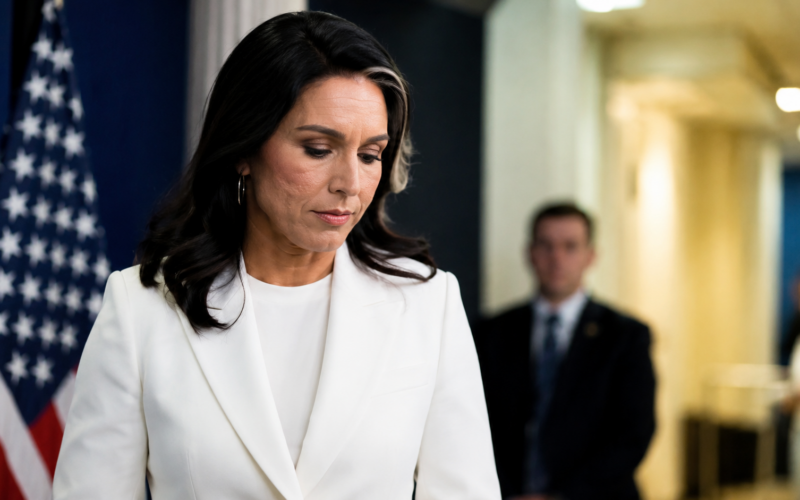
Tulsi Gabbard has resigned as United States director of national intelligence, telling President Donald Trump that she will step down on June 30, 2026, after her husband, Abraham Williams, was diagnosed with a rare form of bone cancer.
The resignation removes one of the most closely watched and politically contentious figures from President Donald Trump’s national security team. Tulsi Gabbard had been confirmed by the United States Senate in February 2025 to lead the Office of the Director of National Intelligence, the agency responsible for coordinating the United States Intelligence Community and advising the President of the United States, the National Security Council, and the Homeland Security Council on intelligence matters.
President Donald Trump said Principal Deputy Director of National Intelligence Aaron Lukas will serve as acting director of national intelligence after Tulsi Gabbard’s departure. Aaron Lukas is expected to take over the Office of the Director of National Intelligence at a time when the United States intelligence apparatus remains central to decisions on Iran, Russia, China, counterterrorism, election security, cyber threats, and broader national security policy.
Tulsi Gabbard said she was grateful for the opportunity to lead the Office of the Director of National Intelligence, but said Abraham Williams’ diagnosis meant she could not continue in a demanding post while her husband faced treatment. President Donald Trump publicly praised Tulsi Gabbard’s service and framed her resignation as a personal decision tied to her family’s health situation.
The resignation is also politically significant because Tulsi Gabbard was one of President Donald Trump’s most unconventional national security appointments. A former Democratic member of the United States House of Representatives from Hawaii, an Iraq War veteran, and later a Republican-aligned political figure, Tulsi Gabbard entered the intelligence post with a profile that drew both strong support and sharp scrutiny.
Why does Tulsi Gabbard’s resignation matter for the Office of the Director of National Intelligence?
Tulsi Gabbard’s resignation matters because the director of national intelligence is not merely another Cabinet-level official. The director of national intelligence oversees the United States Intelligence Community, coordinates the National Intelligence Program, and serves as the principal intelligence adviser to the President of the United States and senior national security bodies.
The Office of the Director of National Intelligence was created after the September 11, 2001 attacks to improve coordination across intelligence agencies. Its central purpose is to reduce fragmentation among agencies and ensure that intelligence reaches national decision-makers in a timely and integrated way. That makes continuity at the Office of the Director of National Intelligence especially important during periods of foreign policy pressure or domestic political turbulence.
Tulsi Gabbard’s resignation therefore creates both an administrative transition and a political opening. Aaron Lukas can assume the acting role, but a permanent successor would still require a nomination and Senate confirmation if President Donald Trump moves to install a long-term director. That process could reopen questions about the independence, experience, and priorities of the intelligence leadership under President Donald Trump.
The timing also matters because the United States intelligence system is operating in a dense threat environment. The United States remains engaged in intelligence collection and assessment related to Iran’s nuclear posture, Russia’s war-related strategy, China’s military and technological expansion, cyber operations, foreign influence campaigns, terrorism threats, and instability across multiple regions.

How did Tulsi Gabbard’s confirmation shape scrutiny of her intelligence leadership?
Tulsi Gabbard was confirmed by the United States Senate on February 12, 2025, in a 52 to 48 vote. The confirmation reflected strong partisan support from Republicans, but it also showed how divisive her nomination had become. Her background as a former Democratic lawmaker, military veteran, anti-interventionist voice, and later supporter of President Donald Trump made her appointment unusual from the start.
Supporters presented Tulsi Gabbard as a figure who could challenge what they viewed as politicization inside the intelligence system. Critics questioned whether Tulsi Gabbard had the intelligence management experience and foreign policy judgment required for one of the most sensitive roles in the United States government.
Once confirmed, Tulsi Gabbard entered the Office of the Director of National Intelligence with a mandate from President Donald Trump to reshape intelligence priorities and address what the administration described as political bias inside the system. That made her leadership closely tied to President Donald Trump’s broader view of the intelligence community, especially on questions of institutional loyalty, classification, security clearances, and past intelligence assessments.
The result was a tenure that remained under public and political scrutiny. Tulsi Gabbard’s supporters viewed her as a disruptive reformer. Her critics viewed her as a politically polarizing figure in a role traditionally expected to maintain distance from partisan conflict.
What role will Aaron Lukas play after Tulsi Gabbard leaves the intelligence post?
Aaron Lukas is expected to serve as acting director of national intelligence after Tulsi Gabbard’s resignation becomes effective on June 30, 2026. As principal deputy director of national intelligence, Aaron Lukas is positioned to manage the immediate transition inside the Office of the Director of National Intelligence.
The acting director role is operationally important because the Office of the Director of National Intelligence must continue coordinating intelligence priorities across agencies even during leadership changes. Aaron Lukas will be responsible for helping maintain continuity in intelligence briefings, interagency coordination, congressional engagement, and national security support to the White House.
The appointment of Aaron Lukas also gives President Donald Trump time to decide whether to nominate a permanent successor quickly or allow acting leadership to continue for a period. That decision could affect how aggressively the administration pursues any further restructuring inside the Office of the Director of National Intelligence.
For the United States Intelligence Community, the immediate question is whether the transition remains administrative or becomes part of a larger reset in national security leadership. Because the director of national intelligence touches intelligence collection, analysis, counterintelligence, cyber threats, counterterrorism, and foreign influence monitoring, even a temporary leadership change can affect internal priorities.
Why was Tulsi Gabbard such a politically unusual director of national intelligence?
Tulsi Gabbard’s political path made her a highly unusual director of national intelligence. She represented Hawaii in the United States House of Representatives, ran for the Democratic presidential nomination in 2020, left the Democratic Party, endorsed President Donald Trump, and became aligned with conservative political circles before entering the Trump administration.
That trajectory gave Tulsi Gabbard a distinctive national profile before she entered the intelligence role. Her military service and her criticism of foreign military interventions helped define her public identity. At the same time, her positions on Russia, Syria, surveillance, and United States foreign policy drew criticism from Democrats and some Republicans.
As director of national intelligence, Tulsi Gabbard was expected to lead an intelligence system that prizes analytic rigor, institutional continuity, and nonpartisan judgment. Her appointment placed a politically combative public figure inside one of the most sensitive national security posts in Washington.
That tension shaped much of the debate around her tenure. The central question was not only whether Tulsi Gabbard could manage intelligence agencies, but whether the Office of the Director of National Intelligence could remain insulated from the partisan battles surrounding President Donald Trump’s second administration.
How does Tulsi Gabbard’s departure affect President Donald Trump’s national security team?
Tulsi Gabbard’s departure adds another high-profile personnel change to President Donald Trump’s second-term administration. Cabinet and senior leadership departures can matter beyond the individual officeholder because they affect policy continuity, internal power balances, and congressional oversight.
For President Donald Trump’s national security team, the departure of Tulsi Gabbard could shift influence toward other senior figures involved in intelligence, defense, foreign policy, and law enforcement. The Office of the Director of National Intelligence has a coordinating role, but the power of the director depends heavily on access to the president, credibility with intelligence agencies, and relationships with congressional oversight committees.
If Aaron Lukas remains acting director for an extended period, the Office of the Director of National Intelligence may emphasize continuity rather than major new initiatives. If President Donald Trump nominates a new permanent director quickly, the Senate confirmation process could become another test of how the administration wants intelligence leadership to function during the remainder of the term.
The broader question is whether Tulsi Gabbard’s resignation marks a personal departure only or a strategic recalibration of intelligence leadership. For now, the official explanation centers on Abraham Williams’ health, while the institutional consequence is a leadership transition at the top of the United States Intelligence Community.
What are the key takeaways from Tulsi Gabbard resigning as director of national intelligence?
- Tulsi Gabbard has resigned as United States director of national intelligence, with the resignation set to take effect on June 30, 2026.
She cited the health of her husband, Abraham Williams, who was diagnosed with a rare form of bone cancer. - President Donald Trump said Principal Deputy Director of National Intelligence Aaron Lukas will serve as acting director of national intelligence.
Aaron Lukas is expected to lead the Office of the Director of National Intelligence through the immediate transition. - Tulsi Gabbard was confirmed by the United States Senate on February 12, 2025, in a 52 to 48 vote.
Her confirmation followed significant scrutiny over her experience, foreign policy positions, and political transformation. - The Office of the Director of National Intelligence oversees the United States Intelligence Community and the National Intelligence Program.
The director of national intelligence also advises the President of the United States, the National Security Council, and the Homeland Security Council. - Tulsi Gabbard’s resignation removes one of President Donald Trump’s most politically distinctive national security appointees.
Her background as a former Democratic lawmaker, military veteran, and Trump-aligned Republican figure made her tenure unusually contentious. - The next phase will depend on whether President Donald Trump nominates a permanent successor or relies on acting leadership.
Any Senate confirmation process for a new director of national intelligence could reopen debates over experience, independence, and politicization.
Discover more from Business-News-Today.com
Subscribe to get the latest posts sent to your email.