


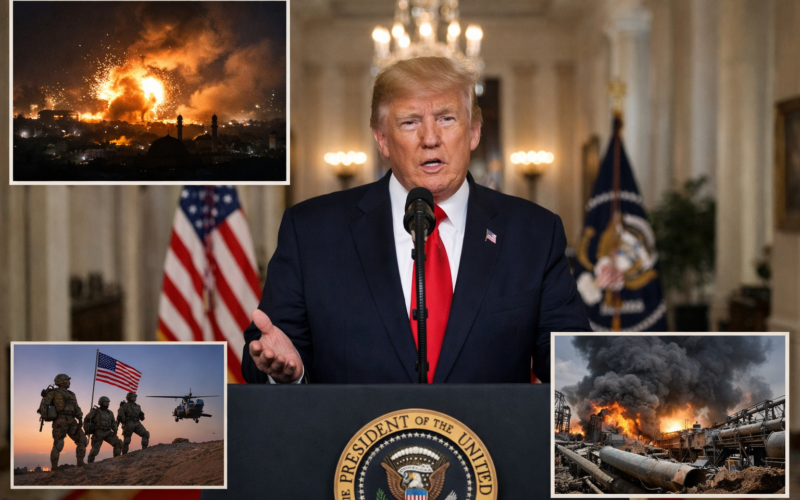
United States President Donald Trump declared on 20 April 2026 that the ceasefire between the United States and Iran would end on Wednesday evening Washington time, and stated it was highly unlikely he would extend it if a peace deal was not reached before that deadline. The declaration came as Iran’s Foreign Ministry publicly refused to confirm attendance at a second round of negotiations in Islamabad, the guided-missile destroyer USS Spruance’s seizure of the Iranian-flagged cargo ship Touska a day earlier pushed both sides toward confrontation, and oil prices surged more than six percent in a single trading session.
Trump told Bloomberg in a late Monday phone interview that he was not going to be rushed into making a bad deal and that the United States had all the time in the world. Trump told reporters separately during 20 April 2026 that lots of bombs would start going off if no deal was reached before the ceasefire expired. Despite the warnings, Trump projected confidence that Iran would come to the negotiating table and confirmed that United States Vice President JD Vance, Special Envoy Steve Witkoff, and presidential son-in-law Jared Kushner would depart Washington on Tuesday, 21 April 2026, for Islamabad to prepare for a potential second round of talks. Vance told Fox News on Monday that the ball was in Iran’s court, stating the United States had put a lot on the table and that whether further conversations happened ultimately depended on Tehran.
Iran’s Foreign Ministry spokesman Esmaeil Baghaei said on 20 April 2026 that Tehran had no plans to reengage the United States for now. Baghaei cited the United States naval blockade of the Strait of Hormuz, which has been in effect since 13 April 2026, and the seizure of the Iranian-flagged cargo ship Touska on 19 April 2026, as specific breaches of the ceasefire agreement and of international law. Baghaei described the United States naval blockade as unlawful and criminal, and said it amounted to a war crime and a crime against humanity. Iran’s state news agency IRNA said no clear prospect for productive negotiations was foreseen under current conditions and dismissed United States statements about talks as a media game aimed at pressuring Iran. Despite the official position, Iranian sources told CNN that a delegation was still expected to arrive in Pakistan on Tuesday, and Iranian Foreign Minister Abbas Araghchi told his Pakistani counterpart Ishaq Dar in a phone call that Iran was taking all aspects into consideration and would decide on how to proceed.
What was the Touska seizure and why did it push the United States-Iran ceasefire to the brink ahead of the Wednesday deadline?
The seizure of the Iranian-flagged cargo ship Touska on 19 April 2026 was the single most significant military escalation since the two-week ceasefire was agreed on 8 April 2026, and the first direct boarding action by United States forces since the naval blockade of Iranian ports was announced on 13 April 2026. The guided-missile destroyer USS Spruance, part of the USS Abraham Lincoln Carrier Strike Group operating in the Arabian Sea, fired on the Touska after a six-hour standoff in which the vessel failed to comply with repeated United States instructions to turn around. USS Spruance disabled the Touska’s propulsion system, after which Marines from the 31st Marine Expeditionary Unit departed the amphibious assault ship USS Tripoli by helicopter and rappelled onto the deck of the Touska to take full custody of the vessel. United States Central Command released footage of the operation. Trump wrote on Truth Social that United States forces had blown a hole in the engine room of the Touska and that Marines were examining the cargo.
The Touska is an Iranian-flagged container ship owned by Islamic Republic of Iran Shipping Lines, Iran’s national maritime carrier, which has been under United States Treasury Department and Office of Foreign Assets Control sanctions since 2018. The vessel is 294 metres in length. United States Central Command had publicly stated on 16 April 2026 that it would search and seize all Iranian vessels, vessels under active Office of Foreign Assets Control sanctions, and vessels suspected of carrying contraband including military-use equipment, petroleum products, and fissile material. Iran’s joint military command, Khatam al-Anbiya, accused the United States of violating the ceasefire and vowed retaliation. Iran’s First Vice President Mohammad Reza Aref stated the choice was either a free oil market for all nations or the risk of high costs for everyone, framing the confrontation as a global energy security question. Iran’s Foreign Minister Abbas Araghchi described recent United States actions as proof of a lack of seriousness in diplomacy.
Newsweek reported that the Touska had made many visits to Chinese ports, according to analysis of shipping data. China’s Ministry of Foreign Affairs responded to the seizure on 20 April 2026, urging all relevant parties to adopt a responsible attitude, abide by the ceasefire agreement, and avoid escalating tensions or intensifying contradictions.
Why did the first round of Islamabad talks fail and what are the fundamental obstacles to a United States-Iran peace agreement?
The first round of direct United States-Iran peace negotiations was held in Islamabad on 11 and 12 April 2026, representing the highest-level talks between Washington and Tehran since the 1979 Islamic Revolution. The United States delegation was led by Vice President JD Vance alongside Special Envoys Steve Witkoff and Jared Kushner. The Iranian delegation was led by parliament Speaker Mohammad Bagher Ghalibaf alongside Foreign Minister Abbas Araghchi. Pakistani Prime Minister Shehbaz Sharif, Army Chief Field Marshal Asim Munir, and Deputy Prime Minister and Foreign Minister Ishaq Dar led the Pakistani mediation team. The talks lasted 21 hours across three rounds and ended without an agreement or a memorandum of understanding.
Vance said on departure that Iran had refused to make an affirmative commitment not to develop nuclear weapons, stating this was the simple central issue. The White House said Iran had chosen the pursuit of a nuclear weapon over peace. Iranian state broadcaster Islamic Republic of Iran Broadcasting attributed the breakdown to what it described as excessive United States demands that prevented any agreement. Araghchi posted on the social media platform X that Tehran’s negotiating team was met with maximalism, shifting goalposts, and blockade. During the Islamabad talks, Washington reportedly proposed a 20-year pause on Iranian uranium enrichment while Iran countered with a five-year limit, reflecting a gap that the 21-hour negotiating session could not bridge.
The two fundamental sticking points remain Iran’s nuclear programme and unconditional Strait of Hormuz access. The United States and Israel have pushed for complete and verifiable restrictions on Iranian uranium enrichment. Iran insists its enrichment programme is for civilian purposes only. Iran’s five-point counter-proposal from late March 2026 demanded an end to United States-Israeli attacks, security guarantees against future aggression, war reparations, and international recognition of Iranian sovereignty over the Strait of Hormuz. A senior Iranian source separately stated that Iran was not open to discussing its ballistic missile programme at all. In March 2025, United States Director of National Intelligence Tulsi Gabbard had testified to Congress that the United States continued to assess that Iran was not building a nuclear weapon, a statement in tension with the administration’s core public negotiating demand.
What is at stake globally if the ceasefire expires Wednesday without an extension or agreement?
The expiry of the ceasefire on Wednesday evening Washington time without an extension or a framework agreement would risk a resumption of active hostilities between the United States, Israel, and Iran, carrying severe consequences for global energy markets, regional stability, and the broader architecture of the 2026 Iran war diplomatic effort. More than 500 million barrels of crude oil and condensate had been removed from global markets since the conflict began, according to data from Kpler, which described the disruption as the largest energy supply shock in modern history. West Texas Intermediate crude oil futures jumped more than six percent to approximately 89 United States dollars per barrel on 20 April 2026, and Brent crude climbed 5.6 percent to approximately 95.50 United States dollars per barrel on the same day.
Only 16 ships traversed the Strait of Hormuz on Monday, 20 April 2026, with captains and vessel owners remaining cautious in the face of the shaky ceasefire. The International Monetary Fund warned that global growth would inevitably take a hit even if the ceasefire held, citing persistent uncertainty over the Strait of Hormuz as a drag on energy costs and inflation. International Energy Agency Director Fatih Birol had warned earlier that week that Europe had approximately six weeks of jet fuel reserves remaining and that flight cancellations could follow if the Strait of Hormuz was not permanently reopened within weeks.
Pakistan’s Foreign Ministry stated on 20 April 2026 that diplomatic channels remained open. Pakistani officials were pressing for a second round of talks with the immediate aim of extending the ceasefire rather than reaching a final comprehensive agreement, framing the engagement as a multi-stage Islamabad process. The second round, if held, was expected to run for several days. Oman’s Foreign Minister Badr Albusaidi urged that the ceasefire be extended and talks continue, warning that painful concessions from all sides were necessary but manageable compared to the consequences of failure.
The human cost of the 2026 Iran war remained severe throughout the ceasefire period. Iran’s forensics chief reported more than 3,300 people killed in Iran since United States-Israeli strikes began on 28 February 2026. More than 2,100 people have been killed in Lebanon, 32 in Gulf states, 23 in Israel, and 13 United States service members were killed in combat, with two additional noncombat deaths. The 2026 Iran war began on 28 February 2026 when the United States and Israel launched airstrikes against Iran, killing its supreme leader and a number of other senior officials, and destroying military and government targets. Iran responded with missile and drone strikes against Israel, United States military bases, and United States-allied states in the Middle East, and by closing the Strait of Hormuz.
What Trump’s Wednesday ceasefire deadline and the Touska seizure mean for the 2026 Iran war and global energy markets
- United States President Donald Trump declared on 20 April 2026 that the United States-Iran ceasefire would end on Wednesday evening Washington time and that a further extension was highly unlikely if no deal was reached, as United States Vice President JD Vance and envoys Steve Witkoff and Jared Kushner prepared to depart for Islamabad on Tuesday for a second round of talks.
- Iran’s Foreign Ministry said on 20 April 2026 that Tehran had no plans to reengage the United States for now, citing the United States naval blockade of the Strait of Hormuz and the seizure of the Iranian-flagged cargo ship Touska by Marines from the 31st Marine Expeditionary Unit on 19 April 2026 as ceasefire violations and acts of international illegality, while Iranian sources simultaneously indicated a delegation was still expected in Islamabad.
- The Touska, owned by Islamic Republic of Iran Shipping Lines and under United States Treasury sanctions since 2018, was the first Iranian commercial vessel seized under the United States naval blockade of Iranian ports imposed on 13 April 2026; Iran’s joint military command Khatam al-Anbiya vowed retaliation while China’s Foreign Ministry urged all parties to abide by the ceasefire.
- The first round of Islamabad talks on 11 and 12 April 2026 collapsed after 21 hours without agreement, with the central unresolved issues being Iran’s nuclear enrichment programme and unconditional Strait of Hormuz access; the second round is expected to focus on securing a ceasefire extension as an immediate near-term objective rather than a comprehensive peace agreement.
- West Texas Intermediate crude jumped more than six percent to approximately 89 United States dollars per barrel and Brent climbed 5.6 percent to approximately 95.50 United States dollars per barrel on 20 April 2026, as more than 500 million barrels of crude oil and condensate have been removed from global markets since the conflict began, constituting what Kpler described as the largest energy supply disruption in modern history.
Discover more from Business-News-Today.com
Subscribe to get the latest posts sent to your email.