


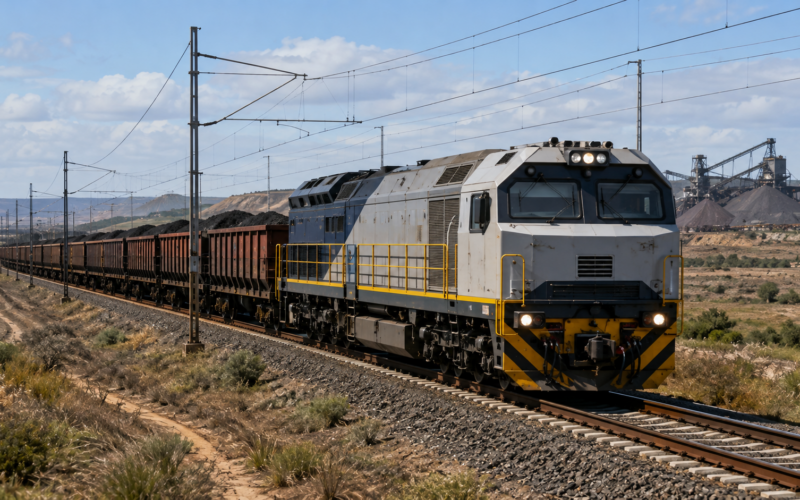
Traxtion is positioning a R3.4 billion rolling-stock investment at the centre of a major shift in Southern Africa’s freight rail market. The private rail operator is adding 46 locomotives and 920 wagons as South Africa and several neighbouring mineral economies open rail networks to greater private participation. Chief executive James Holley said on August 14 that the company sees the regional reforms as an opportunity to expand alongside growing copper, lithium and other commodity flows. The timing is particularly significant because South Africa is moving from rail-policy reform toward actual multi-operator access. The central test is whether regulatory change and stronger mineral demand can turn new rolling stock into reliably utilised, cash-generating capacity.
Traxtion first announced the programme in December 2025, splitting the R3.4 billion investment between R1.8 billion for locomotives and R1.6 billion for wagons. The company subsequently secured an $86 million equity capital raise involving STANLIB Infrastructure Investments, Standard Bank and long-standing investor Harith, completing the equity funding required for the programme. The investment is therefore no longer simply an expression of confidence in future rail reform. Capital has been committed and the company must now convert that commitment into utilisation across a changing regional logistics market.
The scale is notable for a private African rail operator. Traxtion currently operates or supports rail services across multiple African markets and already has more than 50 locomotives in its existing fleet. The new programme would substantially increase that asset base while adding 920 wagons suited to high-volume freight flows. Traxtion has said the investment could address approximately 5% of South Africa’s freight rail capacity shortfall, although the ultimate contribution will depend on routes, commodities, train configuration and network availability.
Why is Traxtion committing R3.4 billion before South Africa’s private rail market fully matures?
The investment is effectively a bet on regulatory implementation arriving quickly enough to justify putting capital-intensive rolling stock into the market. Rail locomotives and wagons create value only when they are moving freight, which means utilisation is as important as fleet size. Traxtion is therefore investing ahead of the point at which South Africa’s open-access rail model has reached mature commercial scale.
The policy direction has become considerably clearer. The Transnet Rail Infrastructure Manager has concluded rail access agreements with 11 private train operating companies across strategic corridors. Those operators are expected to introduce about 24 million tonnes of additional annual capacity initially, with the potential to reach 52 million tonnes over the following five years.
Traxtion itself was not among the 11 operators named in that first allocation. That distinction matters because Traxtion’s opportunity extends beyond operating trains under its own access rights. Its business includes locomotive leasing, freight operations, technical services, maintenance and training, creating opportunities to supply rolling stock and capability to operators that secure network access but do not want to own every locomotive or wagon they require.
That model can be particularly attractive during the early stages of liberalisation. New operators may prefer leasing to purchasing because locomotives are capital-intensive assets with long economic lives. Leasing allows operators to match fleet requirements more closely with contracted freight volumes while reducing the upfront funding burden.
For Traxtion, however, the same structure creates counterparty and utilisation risk. The company needs enough credible operators and freight customers to deploy its expanding fleet at acceptable returns. Policy reform can create the market, but contracted freight creates the cash flow.

How large could the capacity opportunity become as South Africa tries to shift freight back to rail?
South Africa’s government wants rail volumes to reach approximately 250 million tonnes annually by the end of the decade. Recent government figures have placed freight moved by rail at around 160 million to 180 million tonnes, depending on the reporting period and measurement basis. That leaves a substantial gap between current throughput and the longer-term policy target.
An illustrative calculation helps show the scale involved. Using 160 million tonnes as a recent government reference and the 250 million-tonne target produces a gap of roughly 90 million tonnes annually. If Traxtion’s statement that its investment could address about 5% of the national rail capacity shortfall were applied to that simplified gap, it would imply capacity on the order of 4.5 million tonnes a year.
That is a Business News Today illustration rather than a Traxtion production or volume forecast. The company’s own 5% estimate may use different assumptions around theoretical capacity, route constraints and unmet freight demand. The comparison nevertheless demonstrates why a 46-locomotive and 920-wagon investment can be commercially meaningful without needing to transform the entire national freight system.
South Africa also has a structural reason to move more bulk commodities away from roads. President Cyril Ramaphosa said in March that about 69% of freight was moving by road, contributing to congestion, road damage and higher logistics costs. Government has estimated that inefficiencies in the broader logistics system have been costing the economy close to R1 billion a day.
Rail reform therefore has both corporate and national economic significance. Mining companies need dependable export routes, road infrastructure needs relief from heavy freight and private capital needs a regulatory system capable of providing reliable access to state-owned rail infrastructure.
Why does Traxtion’s 46-locomotive programme depend on more than simply gaining access to Transnet tracks?
Network access is only one part of a functioning freight railway. A private operator also needs reliable train paths, working signalling, terminal capacity, port access, locomotive availability, maintenance capability and freight contracts that justify operating each service.
Traxtion has been explicit about some of those dependencies. When announcing the programme, the company said future investment would depend on rail access arrangements becoming sufficiently bankable, including clearer service commitments, balanced legal protections and recognition of lender rights.
That point is important because private capital responds not only to permission to operate but also to the quality of the commercial framework. A locomotive financed over many years cannot generate its expected return if allocated train slots are repeatedly unavailable because of infrastructure failure, congestion or port constraints.
South Africa has made measurable progress. The first private operators have signed access agreements and some are targeting operations from late 2026, with broader activity expected during 2027. Government has also separated infrastructure management from Transnet Freight Rail’s train operations, creating a clearer distinction between the entity managing track access and the state-owned operator competing for freight.
The remaining challenge is operational reliability. Opening the network to competitors will not automatically repair damaged infrastructure or eliminate maintenance backlogs. The success of private participation will therefore depend on whether reform and infrastructure recovery advance together.
Why could Southern Africa’s copper and critical-mineral boom matter more to Traxtion than South Africa alone?
Traxtion’s opportunity is increasingly regional rather than purely South African. The company already operates across several African markets, including countries linked to major mineral corridors. Copper-producing Zambia and the Democratic Republic of Congo are especially important because rising copper demand is encouraging governments and mining companies to seek additional export routes.
One of the most significant developments is the revival of the Lobito Corridor. The railway provides a western export route from the copper-producing regions of Central Africa toward Angola’s Atlantic coast. A consortium involving Trafigura, Mota-Engil and Vecturis holds a long-term concession covering the Lobito Atlantic Railway.
Traxtion already has commercial exposure to that corridor. It previously secured work supplying locomotives and technical support to the Lobito Atlantic Railway operation in Angola, extending a relationship that had already involved work in the Democratic Republic of Congo. That gives the company operating experience inside one of the region’s most strategically important emerging freight routes.
The Lobito investment programme itself includes significant new rolling stock. The concession framework envisages more locomotives and more than 1,500 wagons as freight volumes increase. Copper producers have also started committing export volumes to the corridor, creating a clearer link between mining expansion and rail utilisation.
For Traxtion, this creates a market beyond South Africa’s first phase of open access. Locomotives can potentially be deployed, leased, maintained or refurbished across several jurisdictions as regional corridors expand. That geographical flexibility can reduce dependence on any single regulatory regime, although cross-border operations introduce their own complexities.
How does the $1.4 billion TAZARA rehabilitation strengthen the regional freight rail investment case?
The Tanzania-Zambia Railway Authority is undergoing another major transformation. Zambia, Tanzania and China agreed a $1.4 billion revitalisation programme covering the railway linking Zambia with the Tanzanian port of Dar es Salaam.
The investment includes rehabilitation of the approximately 1,860-kilometre line, new signalling infrastructure, workshops and a substantially renewed rolling-stock fleet. Plans include 34 locomotives, 760 wagons and passenger coaches, alongside logistics infrastructure at Kapiri Mposhi.
Freight volumes are expected to increase materially following rehabilitation. Zambian authorities have indicated that throughput could rise from roughly 400,000 to 500,000 tonnes annually toward approximately 2.4 million tonnes after the upgrade, with longer-term expectations above 3 million tonnes.
The commercial importance is straightforward. Zambia is a major copper producer and requires multiple reliable routes to international markets. TAZARA provides an eastern outlet through Tanzania, while the Lobito Corridor increasingly offers a western route through Angola.
That creates competition between logistics corridors, but it can also enlarge the addressable market for private rail-service providers. Mining companies benefit when they can choose between several functioning routes rather than being dependent on one congested corridor.
Traxtion’s broader regional strategy is therefore positioned around a shift from isolated national rail systems toward interconnected commercial freight corridors. The opportunity becomes larger if regional governments harmonise open-access rules, safety requirements and border procedures.
Why does Traxtion’s Rosslyn hub matter as much as the locomotives being purchased?
Traxtion is not importing a fully finished fleet and placing it directly into service. Much of the locomotive-modernisation work is being carried out at its Rail Services Hub in Rosslyn, Pretoria.
The 50,000-square-metre facility provides locomotive maintenance, refurbishment, component work and major overhaul services. It can handle multiple rebuilds simultaneously and already services third-party rolling stock as well as Traxtion’s own assets.
The new programme includes 42 U26C locomotives acquired from KiwiRail in New Zealand and four C30-8MMI units. The U26C locomotives are being modernised with newer engines, controls and other equipment before deployment.
This refurbishment approach changes the economics compared with purchasing an equivalent number of completely new locomotives. Rebuilding existing rolling stock can reduce capital costs while extending asset life, provided the modernised units achieve acceptable reliability and operating efficiency.
Traxtion has also targeted at least 60% local content across its broader investment programme and previously projected hundreds of direct jobs connected to manufacturing, assembly, commissioning and operation. Wagons are expected to be manufactured locally, increasing the portion of the investment captured within South Africa’s rail industrial base.
That makes the programme partly a manufacturing story. If private rail access expands, the opportunity is not limited to train operators. Maintenance companies, wagon manufacturers, parts suppliers, engineering firms and training providers could all benefit from a larger privately financed rail fleet.
Can Traxtion’s $86 million capital raise support another round of rail investment after this programme?
Traxtion strengthened its funding position in June when it completed an $86 million equity capital raise involving STANLIB Infrastructure Investments, Standard Bank and Harith-linked infrastructure funds. The financing completed the equity requirement for the R3.4 billion rolling-stock programme.
The significance extends beyond funding the current locomotives and wagons. Institutional infrastructure investors generally require long-duration assets and relatively predictable cash flows. Their willingness to commit capital suggests that private freight rail is beginning to be treated as an investable infrastructure theme rather than merely a policy experiment.
That does not guarantee attractive returns. Rail businesses remain exposed to freight volumes, commodity cycles, infrastructure reliability, regulatory frameworks and customer concentration. The investment still needs to convert into contracted utilisation.
The funding structure nevertheless gives Traxtion more flexibility than a company attempting to finance expansion solely from operating cash flow. It also establishes relationships with institutions capable of supporting additional projects if the initial deployment performs well.
The next stage could therefore become self-reinforcing. Successful fleet deployment would improve evidence that private African rail assets can support institutional returns. That could attract more capital, which could finance more rolling stock and widen the capacity available to mining and logistics customers.
The opposite outcome is also possible. Delays in network access, weak utilisation or unreliable infrastructure could make lenders and equity investors more cautious about committing the next round of capital.
Key takeaways from Traxtion’s R3.4 billion Southern African rail expansion strategy
- Traxtion is investing R3.4 billion in 46 locomotives and 920 wagons as freight rail markets across Southern Africa become more open to private participation.
- The programme includes approximately R1.8 billion for locomotives and R1.6 billion for wagons.
- An $86 million equity raise involving STANLIB Infrastructure Investments, Standard Bank and Harith completed the equity requirement for the investment.
- Traxtion is not among the first 11 private operators named for South African rail slots, but its leasing, operating and maintenance model allows it to serve companies that hold network access.
- South Africa’s first group of private operators is expected to add about 24 million tonnes of freight capacity, potentially increasing toward 52 million tonnes over five years.
- Government is targeting rail volumes of roughly 250 million tonnes annually by the end of the decade, leaving significant room for additional private rolling stock and services.
- Traxtion estimates that its new fleet could address about 5% of South Africa’s rail capacity shortfall, although actual throughput will depend on routes, infrastructure and utilisation.
- The company already has exposure to the Lobito Corridor, giving it a foothold in the growing copper logistics market connecting Angola and the Democratic Republic of Congo.
- The $1.4 billion TAZARA revitalisation adds another major regional rail investment tied to copper and other commodity exports.
- Reliable network access, infrastructure performance and long-term freight contracts will determine whether Traxtion’s expanding fleet generates attractive returns.
What will prove whether Traxtion’s R3.4 billion rail investment was made at the right time?
The strongest part of Traxtion’s strategy is timing. The company is expanding rolling stock just as South Africa moves from discussing private rail access to signing actual operator agreements. At the same time, major regional corridors are attracting investment because mining companies need more reliable routes for copper, lithium and other bulk commodities.
The risk is that policy reform moves faster than physical infrastructure recovery. Private locomotives cannot overcome every signalling failure, damaged track section, congested terminal or constrained port. Traxtion therefore needs both regulatory access and an improving public rail network.
The regional strategy provides some protection against that risk. Exposure across South Africa, Zambia, the Democratic Republic of Congo, Angola and other markets gives the company more options for deploying assets. The Lobito and TAZARA developments also show that railway investment is occurring across several competing corridors rather than in one isolated market.
The next measurable proof points are now operational. Investors in Traxtion and the broader freight sector need evidence that private operators can begin running services at scale, that locomotives can achieve high utilisation and that mining customers are willing to enter contracts capable of supporting long-term rolling-stock investment.
If those pieces fall into place, the R3.4 billion programme could look less like an aggressive expansion made ahead of the market and more like an early positioning move before Southern Africa’s freight rail system becomes meaningfully more competitive. If access and infrastructure remain unreliable, the same fleet could become a reminder that rail reform creates value only when policy, physical networks and freight demand move together.
Discover more from Business-News-Today.com
Subscribe to get the latest posts sent to your email.