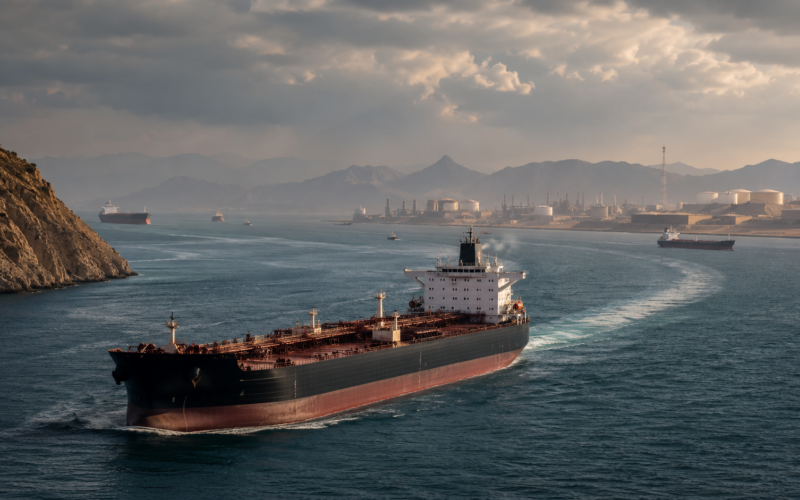
Iran’s re-imposition of shipping restrictions across the Strait of Hormuz over the weekend of 12 to 13 July 2026, following the collapse of the interim peace framework announced by President Donald Trump earlier in the month, has returned the world’s most consequential energy chokepoint to effective closure and has drawn a fresh warning from oil market traders that global stockpile buffers are close to exhaustion after nearly five months of intermittent disruption. Approximately 20 million barrels of oil and refined products transit the Strait of Hormuz daily under normal conditions, representing roughly 20 percent of seaborne global oil trade and a similar share of the seaborne LNG trade. The current sequence of events dates to 28 February 2026, when the United States and Israel launched Operation Epic Fury against Iranian military and nuclear facilities, and to 4 March 2026, when Iran formally declared the strait closed. Since then, the International Energy Agency has coordinated an emergency release of more than 400 million barrels from government stockpiles, of which 301 million barrels were crude, providing an approximate 2.5 million barrel per day buffer over a four-month window.
Analysts including Marshall Adkins of Raymond James have warned that the buffer is now largely spent, and Piper Sandler energy strategists have argued that the strait is likely to remain largely closed for months yet, with oil prices at risk of new highs during the summer. The central tension for markets is that the reduction in temporary buffers is now colliding with an expected rise in Asian and Chinese import demand into the second half of 2026, in a market already stripped of most flexible supply-side responses.
What “Hormuz shuts again” actually means in the July 2026 sequence of events
The 12 to 13 July 2026 sequence marks the third distinct phase of the Strait of Hormuz crisis that began on 28 February 2026. Phase one ran from the initial airstrikes on Iran through 4 March 2026, when Iran officially declared the strait closed, and included the initial diversion of maritime traffic, the stranding of approximately 20,000 mariners and 2,000 ships in the Persian Gulf as reported by the International Maritime Organization on 21 April, and the initial 400 million barrel emergency release coordinated by the International Energy Agency. Phase two included the United States naval blockade of Iranian ports from 13 April to 29 May 2026, the Islamic Revolutionary Guard Corps announcement on 27 March that the strait was closed to vessels going to or from the United States, Israel or their allies, and the sequence of Omani mediation efforts that led to a June 2026 proposal for shipping companies to pay service fees to use the strait. Phase three began with President Trump’s declaration earlier in July that the interim peace framework was over, following renewed exchanges of drones and rockets, and includes the reported United States self-defense strikes against Iranian missile launch sites and mine-laying vessels in the strait. The 12 to 13 July shutdown is a formal re-imposition of the closure, and it lands at the point at which the temporary supply buffers assembled to bridge the first phase have largely been drawn down.
Why global oil stockpiles are close to running on empty after five months of disruption
Global oil stockpile depletion has been the most consequential single trajectory across the crisis. The Brookings Institution estimated in late May 2026 that the International Energy Agency’s initial coordinated emergency release, at more than 400 million barrels including 301 million barrels of crude, translated to approximately 2.5 million barrels per day of supply relief across a four-month window. That window has now largely elapsed. Fortune reported earlier this week that nearly 1 billion barrels of worldwide petroleum reserves are now depleted and are not being replenished, based on analyst estimates. The United States Strategic Petroleum Reserve was one of the largest sources of the coordinated release, and its refill schedule cannot begin until commercial supply is available at reasonable prices. Foreign government reserves face similar constraints. Once the buffer is spent, additional emergency releases will draw from already-reduced national reserves rather than from the surplus positions that existed at the crisis onset. That is the mechanism by which stockpiles running on empty translates into forward oil price pressure. It is not that consuming countries have literally exhausted their reserves. It is that they have used the flexible portion of those reserves, and any additional release comes with reduced buffer for future shocks.
How the IEA’s 400 million barrel emergency release has been drawn down over the first buffer window
The International Energy Agency’s coordinated emergency release, at more than 400 million barrels between March and June 2026, was one of the largest in the organization’s history, exceeding the 240 million barrel release coordinated in response to Russia’s invasion of Ukraine in 2022. The design of the release was intended to bridge the supply gap while diplomatic efforts sought to reopen the strait and while structural adjustments in the crude oil trade, including pipeline bypasses and new crude sources, could scale up. The theory behind the release was that a temporary buffer could absorb the shock while permanent adjustments developed. In practice, the theory has held up better than initial expectations. Oil benchmarks remained below their 2022 highs through the first four months of the crisis, with Brent trading around $76 per barrel and West Texas Intermediate above $71 per barrel in the days before the July shutdown. The buffer worked. The question now is whether the buffer can be extended in the absence of a diplomatic resolution. Additional coordinated releases are possible, but each subsequent tranche depletes national reserves further and reduces the flexibility available for other supply shocks. The Piper Sandler view, that the strait remains largely closed for months yet and that oil hits new highs during summer, reflects the assessment that the buffer cannot indefinitely absorb an unresolved supply gap.
What the return to closure implies for Brent and WTI pricing over the next 90 days
Oil market analysts have moved from expecting a rapid crisis resolution to expecting an extended supply constraint. Marshall Adkins, head of energy at Raymond James, told Fortune that the market view of a return to normal is unlikely to hold. The Raymond James baseline call is for oil prices to move back toward $90 per barrel in coming weeks, materially higher than the current mid-$70 range but below the initial $200 doomsday scenarios that circulated at the crisis onset. Prediction markets, which trade contracts on specific price levels, showed odds of West Texas Intermediate reaching $130 per barrel during July increasing through the week, though the current probability remains modest at a few percent. The dispersion of analyst views reflects the difficulty of forecasting the specific magnitude of any price spike, given that the primary variable is not supply and demand but the duration of a political impasse. What is more clearly indicated is directional. If the strait remains closed and the emergency stockpile buffer continues to deplete, oil prices should trend higher. The pace and magnitude will depend on the extent to which Asian import demand, particularly from China, ramps back up during the second half of 2026, and on whether OPEC producers outside the Persian Gulf can sustainably expand output.
Which regional markets are most exposed to the extended Hormuz disruption
The regional distribution of the crisis impact has been asymmetric and instructive. Daniel Yergin, vice chairman of S&P Global, described the Asian situation as an energy crisis with rationing, shortages, no fertiliser for agriculture and no diesel for farming, reflecting Asia’s structural dependence on Middle East crude supply. Japan, which sources approximately 95 percent of its crude from Saudi Arabia, Kuwait, the United Arab Emirates and Qatar and receives approximately 70 percent of its Middle Eastern oil via the strait, has drawn on strategic stockpiles at the request of domestic refiners. Pakistan requested a Saudi rerouting via the Red Sea port of Yanbu on 4 March. South Korea and Taiwan face comparable exposure. In Europe, the crisis has manifested primarily as a jet fuel shortage, with commercial aviation carriers rerouting or adjusting schedules. In the United States, the impact has been felt at the retail gasoline pump, though the direct import exposure to the strait is limited given United States shale production and Canadian pipeline supply. The regional asymmetry means that the political incentives to resolve the crisis are also asymmetric. Asian governments have the strongest immediate exposure and therefore the strongest incentive to underwrite diplomatic solutions or to support commercial rerouting mechanisms such as the Omani service fee proposal.
How refineries, floating storage and sanctions waivers have shaped the supply response
The supply-side response to the closure has drawn on three primary channels. First, structural adjustments in the crude oil trade including pipeline bypass routes, most notably the Saudi Arabia East-West pipeline connecting Abqaiq to the Red Sea, and the United Arab Emirates Habshan-Fujairah pipeline that bypasses the strait entirely. These pipelines were significantly underutilised prior to the crisis and have absorbed a portion of the diverted flow. Second, floating storage and sanctions waivers. At the start of the crisis, a substantial volume of laden oil tankers were already at sea, and their arrival at destinations provided a rolling supply cushion during the initial weeks. Sanctions waivers on specific Iranian oil exports were adjusted to allow limited flows through non-Hormuz routes. Third, expanded production from non-OPEC sources including United States shale, Canadian oil sands, Brazilian pre-salt fields and West African producers. These sources have less flexibility than OPEC swing capacity but have contributed to the supply response. What has not yet fully materialised is a coordinated OPEC production increase from producers such as Saudi Arabia, which retains substantial spare capacity but has been reluctant to fully deploy it without a durable political settlement. That reluctance is one of the levers that could shift materially if the crisis extends further.
What the next phase of the crisis will require from OPEC+ producers and non-Hormuz shipping routes
The next phase of the crisis will require decisions from multiple actors. On the demand side, China is expected to resume large-scale oil imports in the second half of 2026 as strategic reserve refilling resumes, and Chinese refiners are expected to increase throughput as global refined product margins remain elevated. On the supply side, Saudi Arabia and other Persian Gulf producers face increasing pressure to deploy spare capacity via non-Hormuz routes, either through expanded pipeline utilisation or through third-country rerouting arrangements. On the diplomatic side, the Omani service fee proposal continues to be discussed, though the Trump administration has publicly opposed any arrangement that would provide Iran with revenue from transit fees. Additional emergency stockpile releases are possible but will require coordinated action across International Energy Agency member states. Insurance markets have adjusted materially, with war-risk premiums for strait transits rising from 0.125 percent to a range of 0.2 to 0.4 percent of ship insurance value per transit, translating to an increase of approximately a quarter of a million dollars for very large crude carriers. Those premiums will need to reset before a durable resumption of normal traffic. For listed oil majors including Shell plc (LSE: SHEL, NYSE: SHEL), BP plc (LSE: BP., NYSE: BP), Exxon Mobil Corporation (NYSE: XOM), Chevron Corporation (NYSE: CVX), TotalEnergies SE (NYSE: TTE) and Saudi Aramco (Tadawul: 2222), the second half will require careful calibration of production, refining and offtake positioning against a materially wider range of possible oil price outcomes.
Key takeaways from the July 2026 re-closure of the Strait of Hormuz and the depleted global oil buffer
- Iran re-imposed shipping restrictions across the Strait of Hormuz over the weekend of 12 to 13 July 2026, marking the third distinct phase of the crisis that began on 28 February 2026.
- The Strait of Hormuz normally handles approximately 20 million barrels of oil and refined products daily, representing roughly 20 percent of seaborne global oil trade.
- Nearly 1 billion barrels of worldwide petroleum reserves have been drawn down since the initial closure, and the International Energy Agency’s 400 million barrel emergency release has been largely deployed.
- Brent traded around $76 per barrel and West Texas Intermediate above $71 per barrel in the days before the July shutdown, held below 2022 highs by the emergency buffer.
- Raymond James expects oil prices to move back toward $90 per barrel in coming weeks; Piper Sandler expects the strait to remain largely closed for months.
- Asia faces a full energy crisis with rationing, fertiliser shortages and diesel shortages, particularly in Japan, South Korea, Taiwan and Pakistan.
- Europe faces a specific jet fuel supply issue affecting commercial aviation.
- Non-Hormuz supply channels including the Saudi Arabia East-West pipeline and the United Arab Emirates Habshan-Fujairah pipeline have absorbed part of the diverted flow but cannot fully replace strait volumes.
- Omani proposals for shipping service fees continue to be discussed but face United States opposition.
- The next major variables are Chinese import demand recovery, Saudi spare capacity deployment, additional International Energy Agency coordinated stockpile releases and any resumption of diplomatic mediation.
Discover more from Business-News-Today.com
Subscribe to get the latest posts sent to your email.