



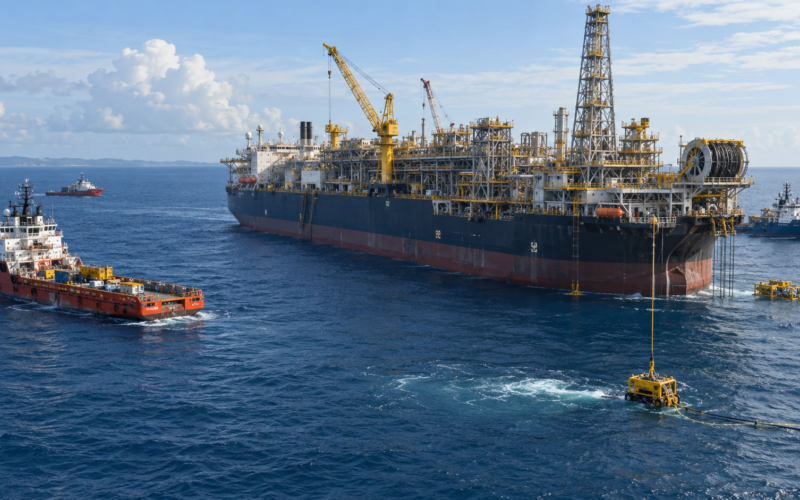
TotalEnergies SE (Euronext Paris: TTE; NYSE: TTE) and its partners are on schedule to begin production from Suriname’s $12 billion GranMorgu offshore oil and gas development in mid-2028. Reuters reported that TotalEnergies, APA Corporation (NASDAQ: APA) and state-owned Staatsolie have already spent about half of the planned investment. The update turns a long-dated national ambition into a project with a visible construction midpoint and first-output target.
GranMorgu will be Suriname’s first offshore producing development and is located in the 1.4 million-acre Block 58, adjacent to Exxon Mobil Corporation’s prolific Stabroek Block in Guyana. Components manufactured in Malaysia, including wellheads and tubing hangers, are due to be installed as subsea construction advances. Staatsolie Chief Executive Annand Jagesar also indicated that four additional exploration wells are planned in the block next year, creating the possibility of further resources around the initial development.
The current $12 billion project estimate is higher than the roughly $10.5 billion cited when TotalEnergies took the final investment decision in October 2024. That difference underscores why schedule discipline, procurement execution and offshore installation progress remain important even when the production date is unchanged. With about half the capital already deployed, delays would increasingly affect returns through both extra cost and deferred cash flow.
The higher figure is not automatically proof of an uncontrolled overrun because project scope, currencies, financing assumptions and reported cost bases can differ between announcements. Investors nevertheless need a clear reconciliation of the change and confirmation of which partners bear each component. Without that bridge, it is harder to judge whether the remaining budget contains sufficient contingency for installation and commissioning risk.
What will the GranMorgu project produce from Suriname’s Block 58?
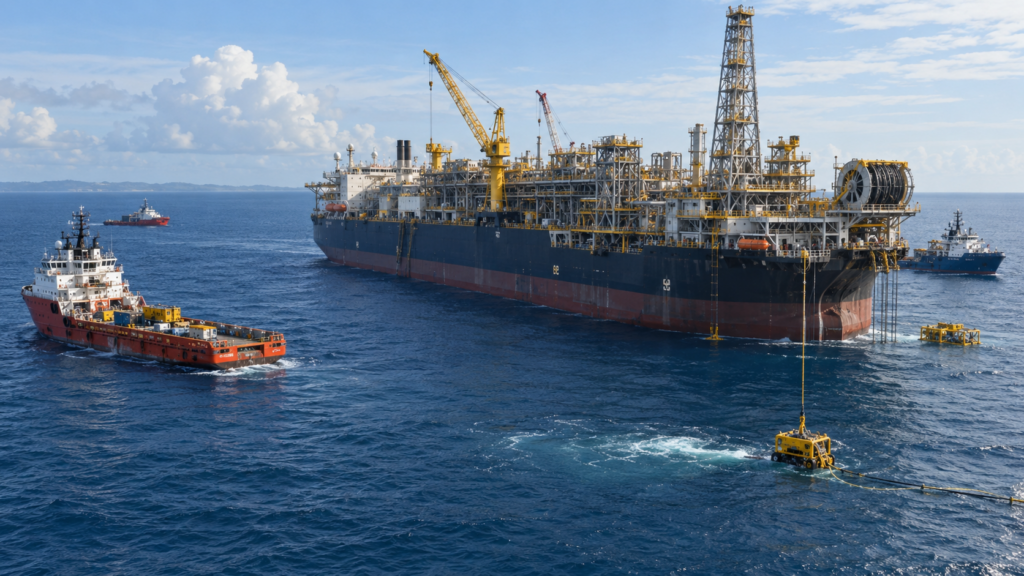
GranMorgu will develop the Sapakara and Krabdagu discoveries around 150 kilometres off Suriname’s coast. In its final investment decision announcement, TotalEnergies estimated recoverable reserves above 750 million barrels. The project centres on a floating production, storage and offloading vessel designed for capacity of 220,000 barrels of oil a day.
That production rate would immediately establish Suriname as a meaningful offshore producer, although actual output will ramp rather than begin at full plateau. The floating facility is designed to accept future tie-backs, allowing nearby discoveries to use installed infrastructure and potentially extend the plateau. Four planned exploration wells could therefore affect not only reserves but also the economics and lifespan of the existing development.
Reuters cited Wood Mackenzie estimates from 2024 that Suriname’s waters contain more than 2.4 billion barrels of discovered oil and liquids and over 12.5 trillion cubic feet of gas. GranMorgu monetises only part of that resource base, but it creates pipelines, subsea expertise, logistics and regulatory capability that could lower barriers for subsequent projects. Staatsolie’s interest in a second floating facility reflects that wider basin ambition.
Why is GranMorgu economically transformative for Suriname?
The $12 billion development is enormous relative to Suriname’s economy and can reshape government revenue, employment, foreign-exchange flows and infrastructure demand. TotalEnergies originally estimated more than $1 billion of local content and over 6,000 direct, indirect and induced jobs. Paramaribo is intended to serve as the hub for administrative, logistics and support activity.
The opportunity also creates a policy challenge familiar from other resource-rich economies. Large oil receipts can strengthen public finances, but volatile prices, currency appreciation, weak project selection and premature spending can erode the benefit. Suriname’s institutions will need transparent revenue rules and realistic assumptions about when production, royalties, taxes and dividends begin.
Project partners face a different timing challenge because capital leaves years before production cash arrives. A movement from the original $10.5 billion estimate to the current $12 billion figure increases the amount exposed to oil prices, interest rates and schedule risk before first output. Returns will depend on plateau performance, operating costs and the realised crude price over decades, not simply on meeting the start-up month.
Neighbouring Guyana demonstrates the speed with which a major offshore province can alter national growth and investor attention. GranMorgu gives Suriname a comparable opening, but it does not guarantee the same development path or fiscal outcome. Local capacity, contract management and the distribution of benefits will determine whether the project’s economic impact extends beyond headline gross domestic product.
The timing of public expectations deserves particular attention because first oil is still nearly two years away and government cash receipts will not arrive all at once. Borrowing or expanding recurring expenditure against optimistic future revenue can leave the state exposed if production slips or crude prices weaken. A phased fiscal plan, transparent project reporting and disciplined treatment of one-off receipts would make the eventual income more resilient.
How is TotalEnergies trying to limit emissions at a new oil development?
TotalEnergies says GranMorgu is designed for scope 1 and 2 emissions intensity below 16 kilograms of carbon dioxide equivalent per barrel of oil equivalent. The design uses an all-electric floating facility, zero routine flaring, reinjection of associated gas, waste-heat recovery and permanent methane detection. Those are operating-intensity measures, not a claim that the produced oil has no lifecycle emissions.
The distinction matters because the project will add large-scale hydrocarbon supply into the 2030s. Lower production emissions can improve competitiveness if carbon rules and buyer scrutiny tighten, but combustion of the oil remains the dominant climate impact. Investors assessing the project should therefore separate facility efficiency from the broader debate over new long-life fossil-fuel capacity.
Execution can also affect environmental performance. Subsea installation, offshore commissioning and the operation of a large floating facility require robust safety and spill-prevention systems. The proximity of a biodiverse Atlantic coastline raises the consequence of any failure, making regulatory oversight and emergency capability as important as the stated emissions design.
The next phase requires multiple construction streams to converge. Wells, subsea trees, flowlines, risers, control systems and the floating facility must be completed, tested and integrated before hydrocarbons can move safely. Progress on one component cannot compensate indefinitely for delay elsewhere, so investors should treat commissioning readiness as a system-wide measure rather than focus only on the visible completion of the vessel.
What are the next financial and construction signals for TotalEnergies investors?
The most important near-term signals are subsea equipment installation, floating-vessel construction, drilling progress and confirmation that spending remains within the revised $12 billion envelope. Any movement in the mid-2028 first-output date would have a magnified effect because half the investment has already been committed. The planned 2027 exploration wells could add upside, but they should not distract from delivery of the sanctioned base project.
Oil prices will shape returns even if construction remains on plan. A lower realised price would lengthen capital recovery and reduce fiscal receipts, while sustained higher prices would strengthen cash generation but could intensify political scrutiny of how benefits are shared. Investors need project-level breakeven and operating-cost evidence to judge that sensitivity rather than infer economics from the 220,000-barrel headline alone.
TotalEnergies’ US-listed shares closed at $90.82 on 18 September, down 0.84% in the session, with a market value near $211 billion. The project update arrived during the weekend, so the stock had not yet provided a direct reaction. Investors are likely to weigh schedule confidence against the larger cost estimate, oil-price volatility and the company’s total capital-allocation programme.
For APA, GranMorgu provides exposure to a large discovered resource and future tie-back potential, but also requires sustained capital before first production. For Staatsolie and Suriname, the project is both a commercial asset and a national financing obligation. The mid-2028 target will become more credible as physical milestones replace spending percentages, especially when the floating facility, subsea network and wells begin to converge offshore.
Discover more from Business-News-Today.com
Subscribe to get the latest posts sent to your email.