

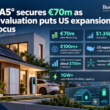



THEON International PLC reported a 38.4% increase in second-quarter revenue as European military modernization programs and stronger demand for night-vision, surveillance and vehicle-awareness systems continued to accelerate its growth. The Euronext Amsterdam-listed defence technology company, which trades under $THEON, generated quarterly revenue of €128.6 million, while adjusted EBIT climbed 44.3% to €35.1 million. Its adjusted EBIT margin expanded to 27.3%, demonstrating that the company preserved strong profitability while investing in production capacity, new technology and acquisitions. THEON International PLC also entered the second half with a €1.46 billion soft backlog and reiterated its ambition to reach €1 billion in annual revenue by 2029, although its increasingly acquisition-driven expansion will raise leverage and integration risks.
First-half revenue increased 35.4% to €248.7 million, including organic growth of 24.7%. Order intake rose 38.5% to €232.5 million, while adjusted EBITDA increased 40.2% to €69 million and adjusted EBIT advanced 37.5% to €65.1 million. The first-half adjusted EBIT margin reached 26.2%, compared with 25.8% a year earlier.
THEON International PLC maintained its 2026 guidance for revenue of €570 million to €600 million and an adjusted EBIT margin in the mid-twenties. It also continues to target organic annual growth above 15%, supported by selective acquisitions, while maintaining a full-year book-to-bill ratio above one.
The results position THEON International PLC as one of the faster-growing publicly listed European defence suppliers. Its challenge is now to turn military procurement momentum into durable growth while integrating businesses that take it beyond traditional soldier-carried night-vision equipment.
Why European soldier modernization programs continue driving THEON’s revenue growth
THEON International PLC’s core night-vision business remained the principal foundation of its first-half performance. Demand continued across NATO and allied countries as governments increased procurement of night-vision goggles, thermal imaging equipment and digitally connected soldier systems.
The company has more than 300,000 systems in service with armed and special forces in 73 countries, including 26 NATO members. In 2025, it secured a procurement program covering more than 100,000 night-vision goggles for the Belgian and German armed forces, with an estimated value of approximately €1 billion.
That contract provides THEON International PLC with greater revenue visibility than smaller individual orders. Large multiyear framework agreements can support manufacturing planning, supplier negotiations and capacity investment while reducing dependence on short-term procurement cycles.
The company also received an order connected to the German Bundeswehr’s Future Soldier program for products within its A.R.M.E.D. ecosystem. The system combines equipment and digital capabilities intended to improve situational awareness and information sharing for soldiers operating in complex environments.
THEON International PLC’s ability to expand margins while handling higher volumes is particularly important. Adjusted EBIT rose faster than revenue in the second quarter, and the margin improved by 1.1 percentage points to 27.3%. That performance indicates that operating leverage, product mix and manufacturing execution outweighed the cost of continued expansion.
The profitability level also differentiates THEON International PLC from many defence manufacturers burdened by complex fixed-cost structures and long development cycles. Its comparatively asset-light model and focus on specialized electro-optical equipment allow the company to scale production without constructing the sort of enormous industrial facilities that can turn a delayed military contract into a financial crater.
That advantage should not be taken for granted. Governments can change procurement schedules, customer testing can delay deliveries and supply-chain constraints can affect specialized optical and electronic components. As the company’s order book grows, maintaining quality and delivery performance will become more difficult.
The first-half figures nevertheless show that THEON International PLC is converting the defence-spending cycle into actual revenue and profit rather than relying only on announcements about future opportunities. Organic growth of 24.7% indicates that acquisitions were not the sole reason for the expansion.
How THEON’s €1.46 billion backlog strengthens its path toward €1 billion revenue
THEON International PLC ended June with a soft backlog of €1.46 billion, up 2.5% from the end of March. The company also reported approximately €902 million of options associated with existing programs, giving it additional potential orders beyond the formal backlog.
Management said the backlog represented approximately 2.4 times forward coverage based on the upper end of its 2026 revenue forecast. This provides visibility across several years and supports the argument that current growth is not dependent on a single exceptional quarter.
The description “soft backlog” requires some caution. Defence framework agreements and procurement programs may include options, schedules and funding decisions that can change before all anticipated revenue is recognized. Backlog provides useful evidence of demand, but it should not be treated as guaranteed cash.
Order intake of €232.5 million during the first half produced a book-to-bill ratio of approximately one. That means new orders broadly replaced the revenue delivered during the period, preserving future coverage rather than allowing the backlog to fall sharply as sales increased.
Management expects stronger order activity during the second half because defence procurement often follows a seasonal pattern. The company reiterated its expectation for a full-year book-to-bill ratio above one, which would mean 2026 orders exceed recognized revenue.
Reaching €1 billion in annual revenue by 2029 would require THEON International PLC to grow far beyond the €570 million to €600 million expected in 2026. The target therefore depends on continued organic expansion, conversion of backlog, additional programs and contributions from acquired businesses.
The company has increased its addressable market estimate to nearly €8 billion, more than twice the level it identified roughly one year earlier. The increase reflects its expansion from man-portable and land systems into drones, intelligence, surveillance and reconnaissance equipment, counter-unmanned aircraft systems and artificial intelligence-enabled technologies.
A larger addressable market does not automatically create revenue, but it reduces THEON International PLC’s dependence on any single equipment category. The company can use its existing military relationships to introduce vehicle systems, drone payloads, surveillance equipment and artificial intelligence capabilities to customers already familiar with its night-vision products.
This cross-selling opportunity may be one of the most valuable elements of the strategy. Defence ministries prefer proven suppliers because equipment reliability, security and interoperability matter more than the novelty of a product demonstration. THEON International PLC’s installed base could therefore provide a useful entry point into adjacent procurement programs.
Why acquisitions are moving THEON into drones, counter-UAS and artificial intelligence
THEON International PLC is accelerating diversification through acquisitions and partnerships rather than relying exclusively on internal product development. The company has agreed to acquire an 80% stake in MERIO SAS, a French manufacturer of compact stabilized gimbals and turret systems used on drones, loitering munitions, ground vehicles, maritime platforms and counter-unmanned aircraft systems.
MERIO SAS is expected to generate more than €15 million in 2026 revenue and over €3.5 million in EBIT. THEON International PLC plans to finance the transaction using a combination of debt and internally generated cash, with completion expected by the end of the third quarter, subject to regulatory and other customary conditions.
The acquisition gives THEON International PLC an immediate position in compact airborne electro-optics. MERIO SAS also brings embedded artificial intelligence video-processing capabilities, providing a bridge between traditional optical hardware and software-supported target detection, tracking and surveillance.
THEON International PLC has separately agreed to acquire SAS Stéropès, the holding company of HGH Systèmes Infrarouges, for an enterprise value of approximately €300 million. HGH Systèmes Infrarouges develops infrared surveillance and counter-drone technology, including artificial intelligence software that could be used across THEON International PLC’s wider product range.
The company expects the HGH Systèmes Infrarouges transaction to close by early 2027 and plans to fund it entirely through debt without an associated equity issuance. The deal would represent THEON International PLC’s largest acquisition to date and deepen its exposure to fixed-site surveillance, border protection, maritime monitoring and counter-unmanned aircraft systems.
THEON International PLC has also invested $3 million in Twin Prime, a United States artificial intelligence research business developing specialized models for defence and security. It signed a memorandum of understanding with Safran Electronics & Defense to establish a joint venture focused on airborne electro-optical and infrared systems for unmanned aerial vehicles.
These moves reflect changes in modern warfare, where optical sensors increasingly operate as part of connected networks involving drones, vehicles, artificial intelligence and autonomous systems. A night-vision device remains valuable, but the larger commercial opportunity lies in combining sensors with software that can interpret, share and act on information.
The strategy also introduces new execution risks. MERIO SAS and HGH Systèmes Infrarouges operate in adjacent but technically distinct markets. Integrating research teams, sales organizations, intellectual property and manufacturing processes could become difficult if THEON International PLC expands faster than its management structure can support.
Acquisitions may also change the company’s financial profile. Its historical business model has generated high margins and strong cash conversion. Investors will watch whether acquired drone and surveillance businesses preserve those economics or introduce heavier development spending and longer customer-approval cycles.
Can THEON preserve cash generation as capital spending and leverage increase?
THEON International PLC reported first-half cash conversion of 82.9%, compared with 86.3% a year earlier. Although the percentage declined, it remained strong as the company increased investment and prepared for a larger operating footprint.
Capital expenditure increased 74.7% to €11.8 million. Management continues to expect approximately €30 million of capital expenditure during 2026 as THEON International PLC expands production capacity, develops new products and supports growth across its wider technology portfolio.
Net working-capital absorption improved to 39.3% of trailing revenue from 43.1% a year earlier. Defence contracts can require substantial inventory and production spending before final delivery, making working-capital management an important part of cash generation.
Net debt stood at €234.3 million at the end of June, compared with €228.2 million at the end of March. Financial leverage improved slightly to 1.7 times trailing adjusted EBITDA from 1.8 times.
The picture will change after the MERIO SAS and HGH Systèmes Infrarouges transactions close. THEON International PLC expects pro forma leverage to reach approximately three times before falling toward 2.5 times during 2027.
A leverage ratio near three times is not automatically excessive for a profitable business with a large backlog, but it reduces financial flexibility. Delayed orders, acquisition underperformance or unexpected working-capital needs could slow deleveraging and restrict the company’s ability to pursue further deals.
Management’s decision to fund the HGH Systèmes Infrarouges acquisition entirely with debt avoids immediate shareholder dilution. It also concentrates more transaction risk on the balance sheet, making cash flow and integration performance central to the investment case.
THEON International PLC’s current margins provide a substantial cushion. However, investors should distinguish between maintaining strong profitability in the existing business and generating adequate returns on the new capital committed to acquisitions.
The company’s expansion is strategically coherent because each transaction extends its electro-optical capabilities into adjacent defence markets. Financial discipline will determine whether the result is a stronger integrated platform or an expensive collection of technically impressive businesses.
What the THEON share price says about investor sentiment before the results
THEON International PLC shares closed at €34.80 on July 27, rising approximately 1.5% and valuing the company at roughly €2.7 billion. The stock remained close to its 52-week high of €36.70 and substantially above its €10 initial listing price from February 2024.
The trading update was published after the Amsterdam market had closed. The July 27 gain therefore reflected expectations and broader defence-sector sentiment rather than a complete market response to the reported figures. The following trading session will provide a clearer indication of how investors view the revenue growth, margin expansion and unchanged guidance.
Sentiment appears broadly constructive because THEON International PLC has consistently converted European defence spending into revenue, orders and profit. The valuation also indicates that investors expect growth to continue, leaving less room for operational disappointment.
The maintained guidance could be interpreted in two ways. It confirms that management remains confident in its 2026 plan, but investors hoping for an immediate forecast increase may question why 35.4% first-half revenue growth did not justify a higher full-year range.
The company expects stronger activity during the second half, but acquisitions, increased capital spending and higher prospective leverage may encourage management to retain a degree of caution. Keeping guidance unchanged also reduces the risk of raising expectations before major transactions have closed.
The bullish case rests on THEON International PLC’s backlog, high margins, expanding market and exposure to sustained NATO procurement. The more cautious view is that the stock already discounts substantial growth and that execution becomes harder as the company enters drones, software and surveillance while integrating multiple acquisitions.
THEON International PLC has delivered financial evidence supporting its strategy. The next phase will test whether it can scale from a specialist night-vision manufacturer into a broader European defence optronics group without sacrificing the profitability that made the expansion possible.
Key takeaways from THEON International PLC’s second-quarter 2026 update
- THEON International PLC’s second-quarter revenue rose 38.4% to €128.6 million, while adjusted EBIT increased 44.3% to €35.1 million, showing that profit expanded faster than sales.
- The quarterly adjusted EBIT margin improved to 27.3%, indicating that higher production volumes and product mix offset investment and integration costs.
- First-half revenue increased 35.4% to €248.7 million, including 24.7% organic growth, confirming that acquisitions were not the only driver of expansion.
- Order intake climbed 38.5% to €232.5 million, while the book-to-bill ratio remained near one ahead of the company’s seasonally stronger second half.
- THEON International PLC’s €1.46 billion soft backlog provides substantial revenue visibility, although framework options and procurement schedules mean not every amount should be treated as guaranteed sales.
- Acquisitions of MERIO SAS and HGH Systèmes Infrarouges are expanding the company into drone gimbals, counter-unmanned aircraft systems, surveillance and artificial intelligence-enabled defence technologies.
- THEON International PLC now estimates its addressable market at nearly €8 billion, more than twice the level identified approximately one year earlier.
- Financial leverage stood at 1.7 times at the end of June but is expected to approach three times after planned acquisitions, increasing the importance of cash generation and rapid integration.
- The company retained its 2026 revenue guidance of €570 million to €600 million and its target of €1 billion in annual revenue by 2029.
- THEON International PLC shares closed 1.5% higher at €34.80 before the after-market results release, leaving the next session as the clearer test of investor sentiment.
Discover more from Business-News-Today.com
Subscribe to get the latest posts sent to your email.