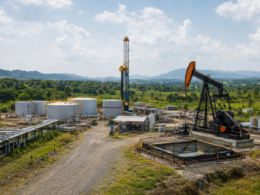
Technip Energies N.V. (Euronext Paris: TE), the France-based engineering and energy technology group, has secured a major engineering, procurement and construction contract from Hindustan Petroleum Corporation Limited for the modernisation of its Mumbai refinery in Maharashtra. Announced on 12 October 2026, the contract covers two processing units designed to improve lubricant base-oil production and upgrade heavier refinery streams into higher-value petroleum products. Technip Energies classifies the award as a large contract, representing between €250 million and €500 million in revenue under its established contract-size reporting convention. The development expands the company’s project portfolio in India at a time when its record order backlog is being weighed against pressure on project-delivery margins.
The contract forms part of Hindustan Petroleum Corporation Limited’s Lube Modernization and Bottom Upgradation project, an initiative intended to improve the commercial value generated from existing refining infrastructure. The two processing units will be integrated into an operating refinery, requiring close coordination between construction activities and established refinery systems. Although Technip Energies has secured a substantial new revenue opportunity, the ultimate profitability of the contract will depend on detailed engineering, equipment procurement, construction productivity and delivery performance.
What does Technip Energies’ new HPCL Mumbai refinery contract include, and why is it commercially important?
The contract covers a 550,000-tonne-per-annum integrated hydrocracker and catalytic dewaxing unit and an 850,000-tonne-per-annum solvent deasphalting unit. Together, these facilities are intended to improve the refinery’s ability to process selected petroleum streams into products with stronger commercial applications. Their capacity ratings describe different processing functions and should not be added together as though they represent a single volume of finished lubricant production.
Hydrocracking and catalytic dewaxing technologies are particularly relevant to lubricant base-oil manufacturing because they help refineries produce materials with properties suited to modern engine oils and industrial lubricants. Solvent deasphalting allows refiners to separate heavier feedstocks into streams that can be processed or marketed more effectively. Their integration can therefore improve flexibility in how a refinery allocates incoming petroleum molecules across different product categories.
For Hindustan Petroleum Corporation Limited, the investment is about more than increasing physical processing capacity. Refinery profitability depends on the difference between the value of products sold and the combined cost of crude oil, processing, energy, maintenance and capital investment. By expanding its ability to manufacture higher-value lubricant base stocks and upgrade lower-value streams, the company is seeking to improve the economic performance of an existing industrial asset.
The commercial opportunity will ultimately depend on product yields, quality specifications, operating reliability and market demand. Higher-value output does not automatically guarantee higher margins if the new facilities require substantial energy consumption or if selling prices weaken. The important operating test will be whether the completed units can produce the targeted product mix efficiently enough to justify the capital employed.
Why is the Mumbai refinery modernisation project strategically relevant to India’s lubricant industry?
India’s lubricant market serves a broad range of customers across passenger vehicles, commercial transportation, industrial machinery, manufacturing and infrastructure. These markets require base oils that can meet increasingly demanding performance requirements, especially as vehicle manufacturers and industrial users seek longer equipment life and higher operating efficiency. Refinery investments that improve domestic production capabilities can help strengthen the local supply chain for these industrial inputs.
The Mumbai project gives Hindustan Petroleum Corporation Limited an opportunity to improve the value obtained from existing refinery infrastructure rather than relying exclusively on conventional fuel production. This is commercially relevant because refineries face evolving demand patterns across petrol, diesel, aviation fuel, petrochemical feedstocks and specialty petroleum products. Facilities capable of supporting a wider product portfolio may have more options when margins vary across individual markets.
There is also a competitive dimension. Domestic refiners seeking to expand specialty petroleum production must balance technical product quality, processing economics, customer qualifications and distribution relationships. Installing upgraded processing units can improve the production platform, but market-share gains will depend on whether finished products meet customer requirements at competitive prices.
The integration of new facilities within an operating refinery introduces a separate engineering challenge. Contractors must manage interfaces with existing utilities, control systems, pipelines, safety infrastructure and refinery operations. Successful commissioning requires the new units to function reliably within the wider complex, not simply to achieve mechanical completion as standalone installations.
How does the HPCL contract strengthen Technip Energies’ order backlog after a difficult first half of 2026?
Technip Energies reported adjusted order intake of approximately €12.7 billion during the first half of 2026, increasing its adjusted order backlog to about €25 billion at 30 June. The backlog was approximately 57% higher than at the end of 2025, giving the company substantial visibility over future project activity. The Mumbai refinery award adds another contract to that pipeline, with the company stating that the order intake will be recognised within its Project Delivery segment backlog in the third quarter of 2026.
The financial context is important because growth in engineering backlog does not necessarily translate into an immediate improvement in profitability. Technip Energies generated first-half adjusted revenue of approximately €3.65 billion, broadly unchanged from the comparable period of 2025. However, adjusted recurring EBITDA declined from €319 million to €212.3 million, reducing the corresponding margin from 8.7% to 5.8%.
Profitability pressure was particularly visible in Project Delivery, where first-half recurring EBITDA fell to €117.6 million from €214.7 million a year earlier. The segment’s recurring EBITDA margin declined from 7.8% to 4.3%, partly reflecting project-related provisions associated with the Middle East situation. The company’s Technology, Products and Services segment was comparatively resilient, generating recurring EBITDA of €136.6 million on revenue of €889 million.
For Technip Energies, the financial value of the HPCL contract will therefore be determined by more than its addition to the order book. A well-executed project could support revenue conversion and help rebuild earnings confidence as existing project challenges are addressed. Conversely, engineering changes, supply-chain costs or construction delays could reduce the profitability generated from the headline contract value.
Can Technip Energies rebuild project-delivery margins while expanding its international EPC portfolio?
Following its first-half results, Technip Energies maintained its conditional 2026 Project Delivery revenue guidance at between €5.7 billion and €6.3 billion, but revised the segment’s expected EBITDA margin to above 5%, compared with the earlier range of 6.5% to 7.5%. The revision reflected pressure on profitability even as the company’s order backlog expanded substantially. This creates a clear distinction between securing new business and earning the returns that shareholders expect from that business.
Management has also been expanding the company’s geographical exposure, reporting that approximately 75% of new awards over the preceding 24 months originated outside the Middle East. The HPCL contract fits that diversification strategy by adding a significant refining project in India. A geographically broader portfolio can reduce dependence on a single market, although it also introduces different regulatory, procurement, labour and currency exposures.
Technip Energies has worked with Hindustan Petroleum Corporation Limited for more than two decades, and the latest award builds on that established commercial relationship. Previous experience with a customer may support engineering coordination and project planning, particularly where contractors understand the operational requirements of existing facilities. Nevertheless, each major EPC award must ultimately be evaluated on its own execution economics.
The contractor’s backlog also extends well beyond the current financial year. At June-end, its adjusted backlog included approximately €6.89 billion scheduled for 2027 and €14.41 billion for 2028 and later, based on the company’s reported scheduling estimates. This provides considerable multi-year workload visibility, although project timing and financial recognition remain dependent on execution progress and contract terms.
What does the share-price performance of Technip Energies indicate ahead of its next financial update?
Technip Energies shares closed at €30.20 in Paris on 14 October 2026, down 0.4% during the session but above the €29.14 closing price recorded on 9 October. The stock advanced following the HPCL announcement, although the movement should not be attributed entirely to one contract given the influence of broader energy markets, financial expectations and the company’s wider backlog. The market valuation at the latest close was approximately €5.2 billion.
The company’s share-price performance reflects a business with substantial contracted activity but an unresolved near-term earnings recovery challenge. A €25 billion backlog provides significant revenue visibility, yet shareholders still need evidence that project-delivery margins can improve as the current portfolio progresses. That makes profitability, provision movements and working-capital management particularly relevant in assessing the value of new awards.
Technip Energies is expected to provide its next financial update on 29 October 2026. The results should offer further information on third-quarter order intake, segment performance and whether the pressures identified during the first half have moderated. Confirmation that new projects are progressing within their expected cost structures would strengthen confidence in the company’s ability to convert its large backlog into earnings.
The HPCL contract reinforces Technip Energies’ relevance to India’s refining modernisation programme and gives the company another substantial source of future project revenue. Its importance will ultimately be measured through successful integration of the new refinery units and profitable execution within the Project Delivery business. The next results will provide an immediate financial test, while the Mumbai project’s construction and commissioning milestones will determine the longer-term commercial outcome.
Key takeaways from Technip Energies’ HPCL refinery contract and earnings outlook
- Technip Energies secured a major EPC contract for the Mumbai refinery.
- The award falls within its €250 million to €500 million large-contract category.
- The project includes a 550,000-tonne-per-annum hydrocracker and catalytic dewaxing unit.
- An 850,000-tonne-per-annum solvent deasphalting unit is also included.
- The facilities are intended to improve lubricant base-oil production and heavy-stream upgrading.
- Technip Energies reported a €25 billion adjusted backlog at June 2026.
- First-half recurring EBITDA declined to €212.3 million.
- Project Delivery margins remain a central financial consideration.
- The company’s next results are expected on 29 October 2026.
Discover more from Business-News-Today.com
Subscribe to get the latest posts sent to your email.