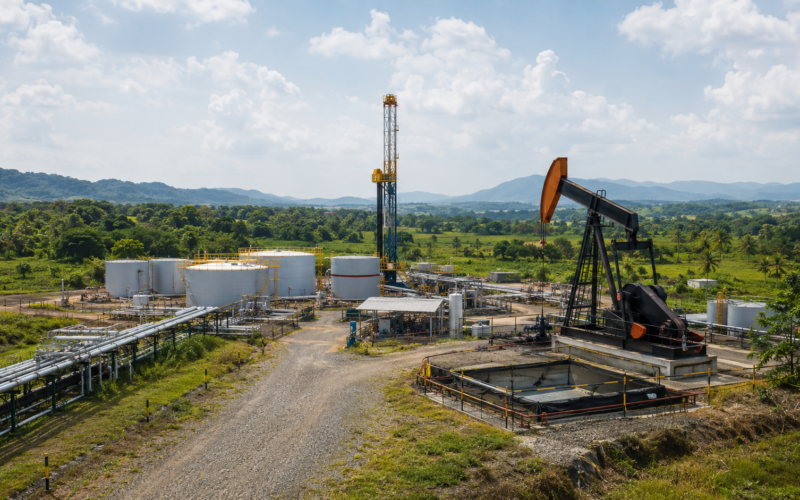
Parex Resources Inc. (TSX: PXT) has completed its acquisition of Frontera Energy Corporation’s Colombian exploration and production assets, turning the Calgary-based company into Colombia’s largest independent upstream producer by scale. The transaction includes US$500 million in cash consideration, assumed net debt, and a contingent US$25 million payment linked to a possible Quifa contract extension. The acquired assets are expected to add about 37,000 barrels of oil equivalent per day and support second-half 2026 production guidance of 82,000 to 91,000 barrels of oil equivalent per day. Parex Resources stock recently traded near C$26.31, below its 52-week high of C$30.20 but sharply above its 52-week low of C$13.79, suggesting investors have already started to price in a partial recovery. The strategic question now is whether Parex Resources can convert a larger Colombian operating base into stronger free funds flow, lower portfolio risk and a more credible long-term capital return story.
Why does Parex Resources’ Frontera E&P acquisition change Colombia’s independent oil producer landscape?
Parex Resources has not merely added production through the Frontera E&P acquisition. It has changed its operating identity. Before this transaction, Parex Resources was already a significant Colombia-focused conventional oil and gas producer, but the Frontera assets move the company into a different scale category, with broader acreage, larger production guidance and a deeper opportunity set across mature and emerging basins.
The acquisition is strategically important because Colombia’s upstream sector has long been shaped by a small group of operators with meaningful exposure to mature oilfields, infrastructure constraints and shifting political priorities. By absorbing Frontera Energy Corporation’s Colombian exploration and production portfolio, Parex Resources becomes a larger counterweight among independents, with more flexibility to allocate capital between base production, enhanced oil recovery, exploration and shareholder returns. Scale does not automatically solve geology, politics or cost inflation, but it does give management more levers to pull when one asset disappoints and another performs.
The immediate risk is that bigger can also mean messier. Parex Resources must integrate assets, people, field practices and operating priorities without losing momentum in its existing portfolio. Colombia is not a spreadsheet jurisdiction where every field politely follows the annual plan. Weather, community access, regulatory timing, security conditions, pipeline logistics and reservoir performance can all shape delivery. The deal gives Parex Resources a stronger platform, but it also raises the standard by which investors will judge execution.

How does the Frontera E&P portfolio alter Parex Resources’ production guidance and reserves optionality?
The most visible impact of the transaction is production scale. Parex Resources expects the acquired assets to add about 37,000 barrels of oil equivalent per day, supporting second-half 2026 guidance of 82,000 to 91,000 barrels of oil equivalent per day. That is a significant step up from the company’s first-quarter 2026 average production of 44,735 barrels of oil equivalent per day and gives Parex Resources a materially larger operating base heading into the second half of the year.
The acquisition also helps address one of the most common investor concerns around upstream independents: production replacement. Mature oil-weighted portfolios can look attractive when commodity prices are supportive, but they need continuous reinvestment to offset declines. By adding Frontera E&P’s production base, land position and development inventory, Parex Resources gains more room to sequence capital across lower-risk field optimisation and higher-impact exploration.
The reserve and resource angle is particularly important because Parex Resources has been working to rebuild confidence after prior operational disappointments in parts of its legacy portfolio. A broader asset base can reduce dependence on any single block, but it also requires sharper capital ranking. The company must decide where each dollar does the most work: sustaining cash flow from mature assets, improving recovery through technology, scaling Putumayo, advancing LLA-111, or preparing higher-risk foothills exploration. The acquisition increases the size of the menu. It also makes poor ordering more expensive.
Why is Parex Resources using debt-funded expansion while keeping dividends in the investment case?
Parex Resources funded the cash portion of the Frontera E&P transaction through a US$500 million senior unsecured notes offering. The notes carry an 8.50% annual interest rate and mature in 2031. That financing decision is central to the investment case because the company is buying scale while also adding a more explicit debt service obligation.
This is not necessarily negative. If the acquired assets generate reliable cash flow and support the company’s second-half 2026 guidance, the financing can be framed as a disciplined use of debt to acquire producing barrels rather than a speculative bet on unproven acreage. The company’s target capital allocation framework still includes dividends, debt reduction and reinvestment in growth opportunities, which tells investors that management wants the enlarged portfolio to support both income and development.
The pressure point is oil price exposure. Parex Resources has highlighted an unhedged portfolio, which gives shareholders full upside in a supportive Brent environment. It also means lower oil prices would feed more directly into cash flow at exactly the time the company is integrating a larger asset base and servicing new debt. That creates a cleaner but sharper risk profile. Investors get more upside torque, but also less cushioning if the commodity tape becomes rude, as it often does without booking a meeting first.
What does Parex Resources stock performance suggest about investor confidence after the deal?
Parex Resources stock is trading in a more constructive zone than it was during its weaker period, but the market is not treating the Frontera E&P acquisition as a finished success story. At around C$26.31, PXT remains below its 52-week high of C$30.20 while sitting well above its 52-week low of C$13.79. That positioning suggests investors have rewarded the improved scale and guidance story, while still leaving room for doubt around integration, Colombian risk and execution.
The market data also points to a stock that is being valued with a mix of income and recovery expectations. Parex Resources has a quoted dividend yield of about 5.85%, a market capitalisation near C$2.53 billion and a low beta profile relative to many upstream names. Recent analyst coverage is not euphoric, with one buy rating and two hold ratings reflected in current Google Finance data. That is important because the stock has not been given a free pass merely because the acquisition is big.
The valuation debate now depends on delivery. If Parex Resources shows that Frontera E&P barrels can be integrated smoothly, operating costs can be controlled and debt can be reduced without squeezing the dividend, investor sentiment could strengthen. If field performance disappoints or free funds flow falls short, the acquisition could be reinterpreted as an expensive attempt to buy scale at the wrong point in the cycle. The market likes growth, but it likes growth more when it arrives with cash flow and fewer surprises.
What does Frontera Energy Corporation gain by selling its Colombian upstream assets to Parex Resources?
For Frontera Energy Corporation, the transaction is just as strategic, but in the opposite direction. The company is exiting Colombian upstream production and repositioning as an infrastructure-focused business anchored by energy logistics assets. That means Frontera Energy Corporation is trading upstream operating complexity for a more focused platform built around pipelines, terminal infrastructure, liquefied natural gas regasification and liquefied petroleum gas import opportunities.
The shareholder return element is central to that strategy. Frontera Energy Corporation has announced a return of capital distribution of C$8.34 per share, representing approximately US$430 million in aggregate. That gives investors a direct cash outcome from the divestment while leaving Frontera Energy Corporation with capital to pursue infrastructure growth projects. In corporate strategy terms, Frontera Energy Corporation is simplifying its identity after years of asset reshaping.
The risk is that infrastructure businesses are judged differently from upstream producers. Investors will now look more closely at contract quality, utilisation, counterparty strength, regulatory treatment and project execution. Frontera Energy Corporation may reduce commodity exposure by leaving upstream production, but it does not eliminate operating risk. It simply moves the risk from reservoirs and drilling schedules toward infrastructure contracts, project delivery and volume commitments.
How could the deal reshape competition in Colombia’s oil and gas sector?
The enlarged Parex Resources portfolio creates a more powerful independent operator in Colombia, and that matters for partners, service providers and state-linked counterparties. A producer with greater scale can negotiate more efficiently, allocate rigs across a wider opportunity base, optimise field services and use technology across multiple assets. That can improve capital efficiency if management maintains discipline.
The transaction also strengthens Parex Resources’ relevance to Ecopetrol S.A. and other Colombian stakeholders. Parex Resources already has partnerships and development exposure in the country, including the Magdalena Basin agreement involving Casabe and Llanito. With the Frontera E&P assets added, the company becomes more important to Colombia’s independent production profile, which may improve strategic visibility but also increases public and regulatory attention.
For competitors, the transaction raises the bar. Smaller independents may find it harder to match Parex Resources’ operating scale, portfolio breadth and capital options. Larger companies may watch whether Parex Resources can unlock improved recovery from mature assets through enhanced oil recovery, horizontal drilling, multilateral wells and seismic imaging. If those methods translate into durable production growth, the deal could become a template for consolidation in mature Latin American oil basins.
What integration risks could undermine Parex Resources’ larger Colombia growth platform?
The first integration risk is operational continuity. Frontera E&P’s assets bring production, acreage and people, but Parex Resources must absorb those elements without disrupting existing activity across Llanos, Magdalena and Putumayo. The company is entering the second half of 2026 with a heavier operating agenda, including Frontera integration, Magdalena Basin activity, Putumayo development, LLA-111 follow-up work and Llanos Foothills preparation.
The second risk is capital prioritisation. A larger portfolio can produce better returns only if capital is allocated ruthlessly. Parex Resources must avoid the classic upstream trap of funding too many assets at once because every team believes its field is the future. Investors will want evidence that management is ranking opportunities by return, risk, reservoir confidence, infrastructure access and speed to cash flow.
The third risk is country concentration. Although Parex Resources has become larger, it remains heavily tied to Colombia. That gives the company deep operating familiarity, but it also concentrates exposure to local fiscal, political, security and regulatory conditions. The deal reduces single-asset risk, but not country risk. That distinction matters for institutional investors who are assessing whether the enlarged company deserves a higher valuation multiple or merely a bigger production number.
What should investors watch next as Parex Resources moves from deal closing to execution?
The first checkpoint is whether second-half 2026 production lands within the 82,000 to 91,000 barrels of oil equivalent per day guidance range. That guidance is the easiest number for the market to track and the quickest way for management to show that the enlarged portfolio is performing as expected. Missing the range would reopen questions about decline rates, integration challenges and field reliability.
The second checkpoint is free funds flow. Parex Resources has guided to second-half 2026 funds flow provided by operations of US$475 million to US$525 million and free funds flow of about US$215 million at the midpoint. Those numbers matter more than headline production because they determine how quickly the company can reduce debt, sustain dividends and fund development without stretching the balance sheet.
The third checkpoint is whether the acquired portfolio produces measurable synergies. Management has pointed to marketing, tax and portfolio optimisation benefits, but investors will need proof through realised costs, improved netbacks, smoother field operations and stronger cash conversion. For now, Parex Resources has bought scale. Over the next several quarters, it has to prove that scale can behave like value.
Key takeaways on what Parex Resources’ Frontera E&P acquisition means for investors and Colombia’s oil sector
• Parex Resources has moved into a larger operating category in Colombia, with the Frontera E&P acquisition expected to support second-half 2026 production guidance of 82,000 to 91,000 barrels of oil equivalent per day.
• The transaction gives Parex Resources greater scale, but the investment case now depends on integration discipline, field reliability, operating cost control and the ability to convert production growth into free funds flow.
• The cash portion of the acquisition was funded through US$500 million of senior unsecured notes, making debt reduction and cash flow delivery central to investor confidence.
• Parex Resources stock is trading below its 52-week high but well above its 52-week low, indicating that investors have recognised recovery potential while still leaving room for execution risk.
• Frontera Energy Corporation is using the divestment to reposition as an infrastructure-focused company, with a major return of capital to shareholders and growth plans linked to energy logistics assets.
• The acquisition increases Parex Resources’ exposure to mature Colombian oil assets, where enhanced recovery, horizontal drilling, multilateral wells and seismic imaging could improve capital efficiency if executed well.
• Colombia concentration remains a key risk, as the enlarged company is still exposed to local regulatory, political, community access, logistics and security conditions.
• The deal could pressure smaller independents by giving Parex Resources more operating scale, broader capital allocation flexibility and stronger strategic relevance in Colombia’s upstream sector.
• Investors should watch second-half 2026 production, free funds flow, net debt reduction and dividend sustainability as the main proof points after deal completion.
• The executive read is constructive but cautious: Parex Resources has bought a stronger platform, but the market will judge whether management can turn bigger into better.
Discover more from Business-News-Today.com
Subscribe to get the latest posts sent to your email.