




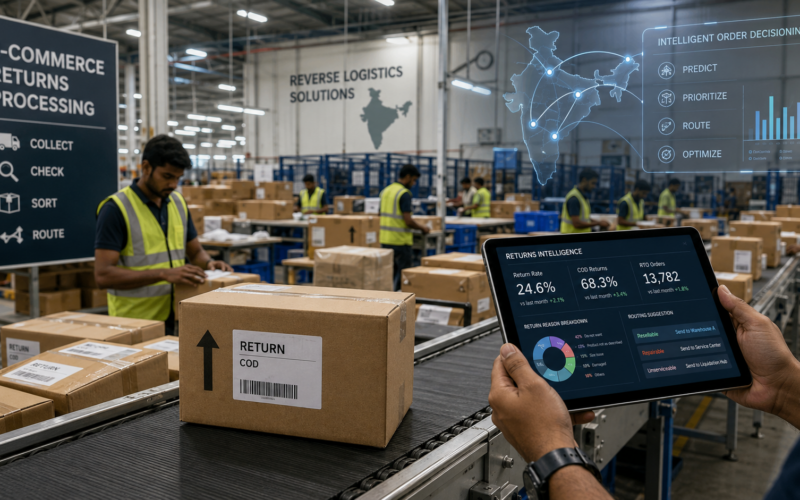
Tech Mahindra Limited (NSE: TECHM, BSE: 532755) has been recognised by FICO for developing a real-time decisioning solution aimed at reducing the heavy losses generated by cash-on-delivery returns in India’s e-commerce market. Built on FICO Platform, the system evaluates more than 70 risk and operational signals before deciding whether cash on delivery should be offered, whether a prepaid incentive is appropriate and how an order should be routed. Tech Mahindra and FICO estimated that the solution could reduce return-to-origin rates by 6% to 9% and lower monthly losses by about ₹1 crore for an e-commerce operator processing one million orders. The award gives Tech Mahindra a potentially reusable commerce decisioning proposition, but the decisive question is whether the hackathon prototype can be converted into paid enterprise deployments.
The development was announced on July 23, 2026, after Tech Mahindra was named among the winners of FICO’s second annual Global System Integrator Partner Hackathon in Bengaluru. The winning team subsequently demonstrated the solution at FICO World 2026 in Orlando, giving the concept visibility among banks, technology providers and enterprise decision-makers. However, neither company disclosed a signed e-commerce customer, pilot contract, implementation timeline or revenue opportunity connected with the solution.
Why does Tech Mahindra’s FICO award matter beyond a one-off technology hackathon victory?
Corporate hackathons frequently produce impressive demonstrations that never progress into commercially supported products. Tech Mahindra’s proposition is more strategically relevant because it is focused on a measurable operational problem rather than a generic artificial intelligence experiment.
Return-to-origin orders impose costs across packaging, outward transportation, failed delivery, reverse logistics, customer service, inventory handling and product depreciation. For low-margin products, a failed cash-on-delivery transaction can erase the profit generated by several successful orders. The financial impact becomes particularly severe when returns are concentrated in particular customer profiles, delivery locations, product categories or logistics partners.
FICO said cash-on-delivery orders in India can experience return-to-origin rates of 25% to 30%, compared with 2% to 3% for prepaid orders, citing industry reports. These figures should be viewed as broad market estimates rather than universal benchmarks because return rates can differ substantially by platform, geography, product value and customer segment. Nevertheless, the gap illustrates why Indian e-commerce companies are searching for more sophisticated ways to manage cash-on-delivery eligibility without abandoning a payment method that remains important for customer acquisition.
Tech Mahindra’s opportunity is therefore not limited to identifying customers who may reject an order. The larger commercial proposition involves coordinating payment strategy, customer incentives, fulfilment and logistics through a single decisioning layer.
How could real-time decisioning improve the economics of cash-on-delivery orders in India?
Many retailers manage return risk through static rules. Cash on delivery may be blocked for certain postal codes, restricted above a particular order value or disabled after a customer records repeated failed deliveries. These controls can reduce losses, but they may also reject legitimate customers and suppress sales in markets where prepaid adoption remains uneven.
Tech Mahindra’s system is designed to make a more granular decision. The platform assesses signals across the customer’s journey from cart creation to payment selection, while simultaneously determining cash-on-delivery eligibility, prepaid incentives, delivery partner selection and dark-store routing.
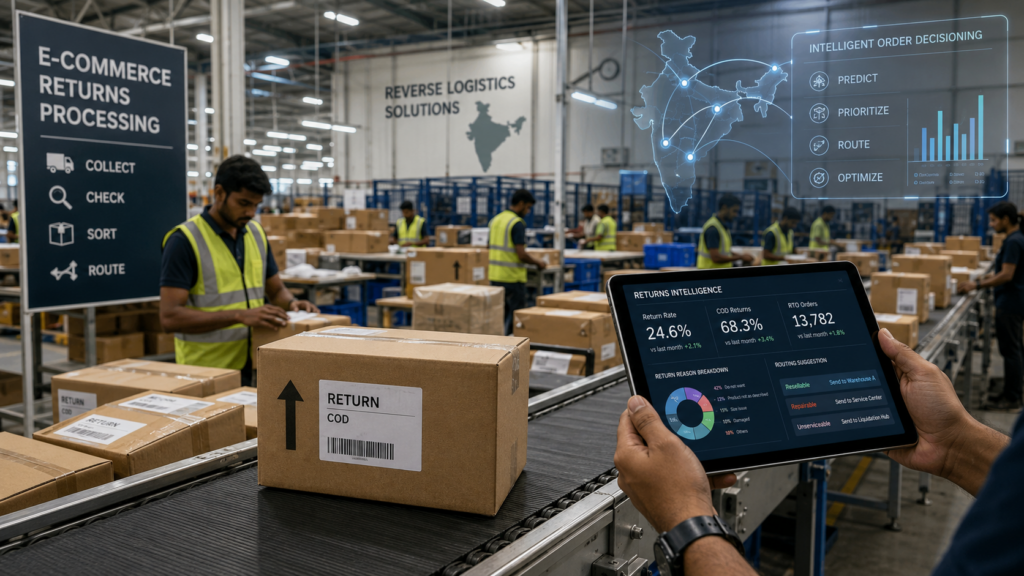
This approach matters because the risk attached to an order is rarely determined by one variable. A new customer purchasing a low-value product from a reliable delivery location may present a different risk from an established customer placing an unusually large order in a region with weak delivery performance. Product characteristics, historical acceptance rates, address quality, customer behaviour, fulfilment distance and courier reliability can all influence the probability of successful delivery.
A well-calibrated decision engine could allow retailers to retain cash on delivery for lower-risk transactions while introducing deposits, prepaid discounts, confirmation requirements or alternative fulfilment arrangements for higher-risk orders. That is commercially more useful than simply banning cash on delivery across broad customer categories.
The potential benefit is not only a reduction in failed deliveries. Better decisioning could improve inventory availability, warehouse productivity, delivery-partner utilisation and working-capital efficiency. It could also reduce the volume of goods travelling repeatedly through forward and reverse logistics networks.
What makes the solution’s 70-signal architecture commercially relevant for large retailers?
The use of more than 70 signals indicates that Tech Mahindra is attempting to build a multidimensional decisioning system rather than a narrow fraud score. The number of variables alone, however, does not determine whether the solution will perform effectively.
The commercially important questions concern data quality, decision speed and explainability. An e-commerce platform may process thousands of transactions every minute during promotional events. Any decisioning layer must respond quickly enough to avoid slowing the checkout process, while remaining reliable during sudden increases in order volumes.
The model must also be continuously recalibrated. Customer behaviour, fraudulent practices, courier performance and promotional strategies change over time. A model trained on historical patterns can lose effectiveness if new behaviour is not recognised promptly.
Tech Mahindra and FICO have emphasised that the architecture is intended to produce transparent, explainable and audit-ready decisions. That feature may be valuable for enterprises seeking to understand why cash on delivery was restricted for a particular order and whether decision rules are creating unintended customer exclusions.
Explainability can also support operational teams. Instead of receiving only a risk score, retailers could potentially identify whether the principal issue was customer history, address quality, product characteristics, courier performance or another factor. That creates a pathway for targeted intervention rather than automatic rejection.
Can Tech Mahindra turn the FICO prototype into repeatable retail technology revenue?
The award does not represent a disclosed contract, and the projected savings should not be treated as realised customer benefits. The ₹1 crore monthly loss reduction was based on a model involving one million monthly orders and an assumed 6% to 9% reduction in return-to-origin rates. Actual results would depend on order mix, fulfilment costs, customer behaviour and the retailer’s existing control systems.
Commercialisation could take several forms. Tech Mahindra may offer the capability as part of a broader digital-commerce transformation programme, integrate it into managed services contracts or package it as a reusable industry solution supported by FICO Platform.
The strongest opportunity may be with large retailers that already possess extensive order, payment and logistics data but lack an integrated system capable of converting that information into real-time decisions. Tech Mahindra could provide implementation, systems integration, model governance, cloud infrastructure and ongoing support, while FICO supplies the underlying decisioning technology.
Such an arrangement would align with the traditional strengths of global information technology service providers. The principal revenue may not come from selling a standalone software product. It could instead arise from integration work, data engineering, platform configuration and long-term managed services.
The commercial challenge is that major e-commerce businesses frequently develop proprietary risk systems. Tech Mahindra will need to demonstrate that its FICO-backed architecture can improve results beyond existing internal tools, integrate without disrupting checkout performance and justify its implementation cost.
How does the FICO relationship support Tech Mahindra’s broader artificial intelligence strategy?
The e-commerce solution builds on a broader relationship announced by Tech Mahindra and FICO in January 2026. That partnership was initially focused on helping banking, financial services and insurance organisations modernise core systems and introduce artificial intelligence-powered decisioning.
Tech Mahindra also committed to establishing a dedicated centre of excellence for FICO Platform. The objective was to develop implementation expertise that could support large-scale banking modernisation and analytics programmes.
The returns-management solution suggests that the underlying capabilities may be applicable beyond financial services. Payment eligibility, fulfilment routing and customer incentives are different use cases, but they involve the same fundamental requirement: converting large volumes of data into governed operational decisions.
For Tech Mahindra, this is strategically important because the information technology services market is moving away from broad artificial intelligence announcements toward domain-specific deployments with measurable financial outcomes. Customers increasingly want technology providers to connect models with business workflows, regulatory controls and existing enterprise systems.
A reusable solution capable of reducing identifiable operating costs could help Tech Mahindra differentiate its artificial intelligence and analytics offering. It would also provide its sales teams with a clearer commercial discussion than a general promise of automation.
The risk is that the proposition remains a customised demonstration rather than becoming a repeatable capability. Establishing reusable data models, integration templates, governance controls and implementation methodologies will determine whether Tech Mahindra can scale the solution efficiently across multiple customers.
Does Tech Mahindra’s improving financial performance provide room to commercialise new platforms?
Tech Mahindra entered the development with improving operating momentum. For the quarter ended June 30, 2026, the company reported revenue of ₹15,712 crore, an increase of 17.7% from the previous year. Earnings before interest and tax rose 53.3% to ₹2,264 crore, while the operating margin expanded by approximately 330 basis points to 14.4%.
Profit after tax increased 28.4% to ₹1,465 crore, and new deal wins reached $1.078 billion, marking the third consecutive quarter in which bookings exceeded $1 billion. Tech Mahindra ended the quarter with cash and cash equivalents of ₹9,695 crore and generated free cash flow of $167 million.
These results suggest that the company has strengthened its capacity to invest in industry platforms without abandoning margin discipline. Management has been prioritising domain-specific artificial intelligence, enterprise platforms and differentiated capabilities as part of its effort to improve growth and profitability.
However, awards and demonstrations will contribute little to financial performance unless they generate contracts. The investment case requires Tech Mahindra to convert platform partnerships and industry prototypes into measurable bookings, recurring revenue and operating leverage.
The e-commerce returns solution is therefore best viewed as an early commercial asset rather than a financial catalyst. Its significance will rise materially if Tech Mahindra announces a retailer deployment, publishes verified performance data or incorporates the capability into a larger commerce transformation contract.
What does Tech Mahindra’s recent share-price recovery indicate about investor sentiment?
Tech Mahindra shares closed at ₹1,575 on the National Stock Exchange of India on July 27, 2026, giving the company a market capitalisation of approximately ₹1.54 trillion. The stock was almost unchanged across the five trading sessions beginning July 21, but it had risen about 9.8% from its June 29 closing price of ₹1,433.80.
At ₹1,575, the shares remained approximately 15% below their 52-week high of ₹1,854, while trading about 20.8% above their 52-week low of ₹1,304.10. The recovery followed stronger quarterly revenue, margin expansion and deal bookings, rather than the FICO hackathon announcement alone.
Current sentiment appears constructive but selective. Investors have received clearer evidence that Tech Mahindra’s operating turnaround is progressing, particularly through improving margins and billion-dollar quarterly bookings. The market is nevertheless likely to demand continued revenue growth and execution before assigning a sustained premium to the company’s artificial intelligence strategy.
The FICO recognition strengthens Tech Mahindra’s innovation narrative, but it is unlikely to alter earnings expectations without an accompanying customer contract. Shareholder value would be more directly affected by the size of future deployments, the proportion of recurring revenue and the margins available from the solution.
What could prevent the decisioning solution from reaching production-scale adoption?
Access to usable data represents the first major obstacle. The platform’s effectiveness depends on accurate order histories, delivery outcomes, address information and logistics performance. Retailers with fragmented systems may need extensive data preparation before the decision engine can operate reliably.
Customer experience is another consideration. Aggressive restrictions on cash on delivery could reduce return losses while also lowering conversion rates. The solution must distinguish between genuinely risky transactions and legitimate customers who prefer cash because of trust, convenience or limited familiarity with digital payments.
Model governance will also matter. Decision rules must be monitored for bias, false positives and unintended exclusion of particular regions or customer categories. Retailers will need clear procedures for exceptions, appeals and model updates.
Integration could create additional complexity. The platform must connect with checkout systems, payment gateways, warehouse-management software, courier networks and customer databases. Large retailers may operate several systems across different brands and fulfilment models.
Finally, the economics must be independently demonstrated. A projected ₹1 crore monthly saving may appear compelling, but a customer will evaluate implementation expenses, FICO licensing, Tech Mahindra service fees, internal integration costs and the possibility of lost sales. The relevant measure is net economic benefit after all costs and customer-experience effects are included.
Which proof point will show whether Tech Mahindra has created a scalable e-commerce product?
The next meaningful milestone would be a production deployment with a major retailer or logistics platform. A credible case study would ideally disclose the customer’s order volumes, baseline return rate, reduction achieved, conversion-rate impact and implementation period.
Evidence that the system can maintain performance during high-volume shopping events would strengthen its enterprise relevance. Verified improvements across several product categories, regions and delivery partners would also indicate that the architecture is reusable rather than dependent on one dataset.
Commercial adoption could deepen Tech Mahindra’s relationship with FICO and open opportunities across retail, logistics, telecommunications and other industries requiring high-volume operational decisions. Success would also demonstrate that Tech Mahindra can use partner platforms to develop domain-specific solutions instead of competing only through labour-intensive technology services.
For now, the FICO award establishes technical credibility and identifies a commercially significant problem. What remains unresolved is whether Tech Mahindra can move from an award-winning demonstration to a supported product that generates repeatable revenue.
The first disclosed customer implementation, accompanied by measured return reductions and evidence that sales conversion was protected, would provide the clearest test of that proposition.
What are the key takeaways from Tech Mahindra’s FICO e-commerce returns solution?
- Tech Mahindra won recognition in FICO’s second Global System Integrator Partner Hackathon for an e-commerce decisioning solution.
- The system is designed to address costly cash-on-delivery return-to-origin orders in India.
- It evaluates more than 70 signals across payment eligibility, customer incentives, fulfilment and logistics routing.
- Tech Mahindra and FICO projected a 6% to 9% reduction in return-to-origin rates under a model involving one million monthly orders.
- The model indicated potential monthly loss reductions of approximately ₹1 crore, although no customer results have been disclosed.
- The solution extends the relevance of Tech Mahindra’s FICO capabilities beyond their initial banking and financial-services focus.
- No commercial customer, contract value, production deployment or implementation timeline was announced.
- Tech Mahindra’s improving margins, cash generation and deal bookings provide financial capacity to invest in reusable industry solutions.
- Enterprise adoption will depend on data quality, integration, model governance and protection of legitimate cash-on-delivery sales.
- The next decisive proof point will be a production deployment supported by independently measurable operating results.
Discover more from Business-News-Today.com
Subscribe to get the latest posts sent to your email.