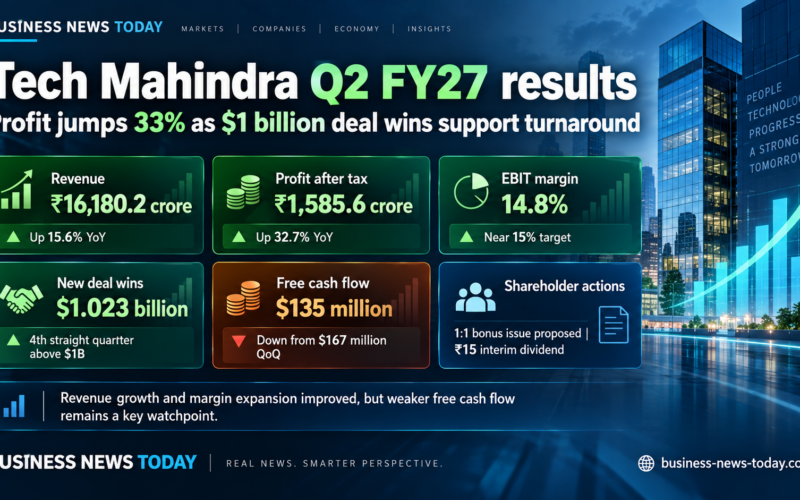
Tech Mahindra Limited (NSE: TECHM, BSE: 532755) reported a 32.7% year-over-year increase in consolidated profit after tax to ₹1,585.6 crore for the quarter ended September 30, 2026, supported by stronger revenue, improved operating efficiency and continued demand for enterprise technology transformation. The Mahindra Group technology services company generated ₹16,180.2 crore in consolidated revenue, up 15.6% year over year, while constant currency revenue increased 7.2% and new deal bookings reached $1.023 billion. Its earnings before interest and taxes margin improved to 14.8%, extending a twelve-quarter sequence of margin expansion and bringing the business closer to management’s 15% profitability objective. The board also recommended a one-for-one bonus share issue and declared an interim dividend of ₹15 per share, adding shareholder distributions to the earnings announcement. However, free cash flow declined to $135 million from $167 million in the preceding quarter, while weakness in manufacturing and only modest banking and financial services growth underscored the uneven nature of the recovery.
Why did Tech Mahindra’s September-quarter revenue grow 15.6% when dollar growth was only 6.8%?
Tech Mahindra’s consolidated revenue increased from approximately ₹13,995 crore in the corresponding quarter of 2025 to ₹16,180 crore, adding about ₹2,185 crore over the year. Sequentially, revenue increased 3.0% from ₹15,712 crore in the June quarter. The improvement reflects a combination of underlying business growth and currency translation, with the company’s international revenue base making exchange-rate movements relevant to reported rupee performance. The distinction is particularly important for investors comparing Indian IT services companies using different revenue measures.
In US dollars, revenue reached $1.693 billion, increasing 2.0% sequentially and 6.8% year over year. On a constant currency basis, which removes the impact of exchange-rate fluctuations, the company recorded 2.4% sequential growth and 7.2% annual growth. The gap between rupee and dollar growth was substantial, reflecting a weaker rupee against the dollar compared with the prior-year reporting period. Tech Mahindra’s disclosed average exchange rate increased from ₹88.2 per dollar in the September 2025 quarter to ₹95.5 in the latest quarter.
The underlying growth rate provides a more useful measure of customer demand than the headline rupee increase alone. Constant currency expansion of 2.4% sequentially indicates that Tech Mahindra’s recovery is being supported by operating activity rather than depending exclusively on favorable currency translation. The company also reported 1.7% sequential growth in its information technology segment and 3.3% growth in business process services. These results suggest that the improvement extended beyond a single delivery category, although some industry verticals performed considerably better than others.
Chief Executive Officer and Managing Director Mohit Joshi attributed the business momentum partly to sustained customer relationships and new contract wins. The company reported more than $1 billion in new deal bookings for a fourth consecutive quarter, providing a continuing pipeline of potential future work. However, the pace at which contracted services translate into recognized revenue depends on project commencement, delivery schedules and customer spending decisions. Maintaining the current growth trajectory will require continued conversion of that pipeline rather than relying solely on previously secured contracts.
How did Tech Mahindra improve its operating margin to 14.8% for a twelfth consecutive quarter?
Tech Mahindra’s profitability recovery remains one of the strongest elements of its turnaround strategy. Earnings before interest and taxes increased 40.5% year over year to ₹2,387 crore, while EBIT margin rose from 12.1% in the September 2025 quarter to 14.8%. The margin also improved approximately 40 basis points from 14.4% in the June quarter. This progression demonstrates that the company has generated operating improvements alongside revenue growth rather than depending exclusively on a larger sales base.
The improvement has been sustained across several reporting periods. EBIT margin increased from 12.1% in the September 2025 quarter to 13.1% in December, 13.8% in March, 14.4% in June and 14.8% in September 2026. Chief Financial Officer Rohit Anand attributed the continued expansion to disciplined execution while maintaining investment in artificial intelligence, workforce capabilities and future growth. Management has also retained its objective of delivering a 15% operating margin for FY27, according to comments reported by Reuters following the results.
At the latest quarterly revenue level, the remaining 20-basis-point gap between the reported margin and 15% represents approximately ₹32 crore of quarterly operating profit, assuming revenue and other conditions remain unchanged. This illustrative calculation shows that the company is approaching its profitability objective, although achieving the full-year target requires consideration of margins across the entire reporting period. Future performance will depend on pricing, employee utilization, delivery efficiency and investments needed to support new contracts. The company must also demonstrate that productivity gains can coexist with sustainable revenue growth.
The financial improvement extends beyond EBIT. Consolidated EBITDA increased from ₹2,168 crore a year earlier to ₹2,878.5 crore, representing growth of approximately 32.8%. Profit before tax rose to ₹2,296.1 crore from ₹1,659.3 crore, while diluted earnings per share increased to ₹17.84 from ₹13.46. These movements indicate a broad operating recovery, although consolidated profit after tax grew slightly less rapidly than EBIT because other income, financing costs and taxation also influence final earnings.
What does Tech Mahindra’s fourth consecutive quarter of $1 billion deal wins reveal about future revenue?
New contract bookings provide an important measure of whether Tech Mahindra’s improved operating performance can translate into sustained growth. The company secured $1.023 billion in new deal wins during the September quarter, compared with $816 million a year earlier. The 25.4% annual increase demonstrates stronger contracting activity, while management highlighted that new wins have exceeded $1 billion in each of the past four quarters. However, bookings declined approximately 5.1% sequentially from $1.078 billion, showing that the latest quarter was not the strongest in the recent sequence.
The trailing 12-month value of new deal wins reached $4.270 billion, compared with $3.168 billion a year earlier, representing growth of 34.8%. This measure reduces some of the volatility associated with individual quarterly contract awards and indicates that commercial momentum has improved over a longer period. However, total contract value does not represent revenue immediately available for recognition because engagements may span several years and include phased implementation. The financial contribution of these contracts will depend on the delivery schedule, scope and profitability of individual agreements.
Recent contract awards illustrate how the company’s growth strategy is evolving. Tech Mahindra secured a five-year managed services engagement with an Australian telecommunications operator covering application development, maintenance, testing and AI engineering. It also won a Canadian insurance application management contract, a United Kingdom communications infrastructure modernization engagement and a European energy contact center transformation project. These engagements demonstrate opportunities across established enterprise technology services and newer AI-enabled delivery models, although individual contract values were not disclosed.
The client portfolio provides another indication of progress. Tech Mahindra reported 33 customers generating at least $50 million in annual revenue, compared with 26 a year earlier. The number of customers in the $10 million-plus category increased from 106 to 118, while the $1 million-plus category declined from 520 to 516. These movements suggest deeper relationships with larger accounts, potentially supporting more predictable revenue from established customers.
However, the company’s top 20 clients represented 38.0% of revenue, compared with 37.1% a year earlier. Greater concentration can improve delivery efficiency and support larger strategic relationships, but it also increases exposure to spending decisions by a relatively small group of customers. Continued expansion of high-value accounts would be more compelling if accompanied by broader client diversification and consistent revenue conversion.
Why are telecommunications and European customers driving Tech Mahindra’s growth while manufacturing contracts?
Tech Mahindra’s industry performance shows that the recovery is not evenly distributed across its business. Communications, the company’s largest vertical, contributed 33.5% of quarterly revenue and expanded 6.0% sequentially and 9.5% year over year. Its scale means that stronger telecommunications spending has an outsized influence on consolidated performance. The segment continues to benefit from demand for network transformation, infrastructure modernization and managed services.
Retail, logistics and transport recorded the strongest sequential growth among the major industry categories, increasing 9.6% while accounting for 8.7% of revenue. Technology, media and entertainment increased 2.8%, and healthcare and life sciences expanded 1.4%. Banking, financial services and insurance grew only 0.4% sequentially, despite recording 4.6% annual growth. Manufacturing declined 3.9% from the preceding quarter, partially offsetting the gains elsewhere.
The manufacturing performance is particularly relevant because the vertical represents 18.2% of Tech Mahindra’s revenue. Its sequential decline occurred despite 7.0% year-over-year growth, suggesting that the latest weakness should not automatically be interpreted as a sustained annual contraction. Management expects banking and financial services growth to improve during the December quarter, with Mohit Joshi indicating that the segment could return towards its earlier annual growth pace of approximately 8.5%, according to Reuters. That expectation remains dependent on client spending and execution.
Geographic performance also differed significantly. Europe delivered 16.2% year-over-year growth and 2.5% sequential expansion, making it the strongest major region on an annual basis. The Americas, which accounted for 48.5% of revenue, increased 4.1% year over year and 1.9% sequentially. The rest of the world contributed 23.8% of revenue and grew 2.5% annually.
Europe’s stronger performance may support further growth if the company maintains momentum in modernization and managed services contracts. However, the Americas remain the largest source of revenue, meaning sustained overall acceleration will require improvements across that region as well. The mix also illustrates why the company’s reliance on communications creates both a competitive advantage and a degree of sector concentration.
Why did Tech Mahindra’s free cash flow decline despite stronger quarterly profits?
Cash generation presents a more cautious aspect of Tech Mahindra’s otherwise improving earnings. Free cash flow declined from $167 million in the June quarter to $135 million in September, a reduction of approximately 19.2%. Compared with the $237 million generated a year earlier, the decline was approximately 43%. This divergence occurred while operating profit and consolidated earnings improved, indicating that stronger accounting profitability did not produce equivalent growth in free cash flow during the quarter.
Free cash flow conversion relative to profit after tax fell from 108% in the preceding quarter to 81%, compared with 176% in the September 2025 quarter. Days sales outstanding increased from 84 to 88 days sequentially, although the measure remained below the 94 days recorded a year earlier. These movements suggest that cash collection and working capital performance require continued attention. However, a single quarter does not establish a structural deterioration in cash conversion because collections and customer payment timing can fluctuate.
The company reported $765 million in cash, cash equivalents and investments at September 30, compared with $1.026 billion at the end of June. The corresponding rupee balance was approximately ₹7,330 crore. Borrowings excluding lease obligations remained limited at approximately $6 million, providing considerable balance-sheet flexibility. Nevertheless, the decrease in reported liquidity should be considered alongside shareholder distributions and other financing or investing cash movements rather than attributed solely to operating performance.
Maintaining stronger cash conversion will become more important as Tech Mahindra expands investment in AI platforms, partnerships and workforce capabilities. The company’s ability to fund growth, sustain shareholder distributions and preserve financial flexibility depends on converting profits into cash over successive periods. A recovery in free cash flow towards earlier levels, particularly alongside improving earnings, would strengthen the quality of the turnaround.
What does Tech Mahindra’s workforce expansion to 152,206 employees reveal about its AI strategy?
Tech Mahindra ended September with 152,206 employees, an increase of 5,446 from the preceding quarter. The workforce expansion included 1,928 additional IT employees and 3,440 employees in business process services, while sales and support headcount increased by 78. The company therefore expanded its workforce while improving operating margins, indicating that its efficiency gains were not driven simply by reductions in employee numbers. The relationship between hiring and productivity remains particularly relevant as AI adoption changes service delivery requirements.
IT employee utilization increased from 87.0% in June to 88.9% in September, compared with 84.4% a year earlier. Higher utilization generally supports profitability because a greater proportion of the available delivery workforce contributes to billable projects. However, utilization approaching 90% can reduce flexibility if customer demand increases rapidly or new contracts require specialized capabilities. The company will need to balance efficient deployment with sufficient capacity for training, project transitions and new engagements.
Voluntary IT attrition declined marginally to 11.7%, compared with 11.8% in the preceding quarter and 12.8% a year earlier. Greater workforce stability can help reduce recruitment and replacement costs while preserving project knowledge. Meanwhile, the onsite proportion of IT employees increased from 21.7% a year earlier to 23.6%, suggesting a changing delivery mix. That shift may support customer proximity and specialized engagement requirements, although it can also influence employee costs.
The workforce figures challenge a simplistic assumption that AI investment must immediately produce lower employment. Tech Mahindra is simultaneously improving utilization, adding employees and investing in automation capabilities. This suggests that near-term demand for implementation, transformation and managed services remains sufficient to support additional hiring. The longer-term relationship between AI productivity and employment will depend on whether new service opportunities offset reductions in conventional labour-intensive work.
How will Tech Mahindra’s Helix AI strategy turn enterprise automation into measurable revenue?
Tech Mahindra is positioning Helix as its enterprise-wide response to changes in the artificial intelligence market. The strategy combines industry-specific use cases, technology partnerships, research and development, workforce capabilities and revised commercial models. Its objective is to embed AI into existing service delivery while developing new offerings around autonomous agents and AI-enabled business processes. This represents a broader shift than simply introducing AI tools into software development.
The company has identified Orion as a central AI development environment and is pursuing domain-specific language models alongside industry solutions. It has also introduced Zero Gravity Telco Architecture, designed to support autonomous operations within telecommunications environments. Other initiatives include the Consumer Agentic Experience Studio and expanded partnerships with Google Cloud, ServiceNow, Cisco, Uniphore and additional technology providers. These relationships could provide access to new customer opportunities, although partnership announcements alone do not establish incremental revenue.
During the quarter, Tech Mahindra disclosed AI-related engagements spanning healthcare, insurance, transportation, financial services and enterprise software. Examples include a multi-agent solution supporting post-market surveillance complaints for a US healthcare technology business and an AI transformation programme covering more than 40 customer-facing applications for a European professional services organization. Such projects are relevant because they connect AI capabilities with business processes where efficiency, compliance and service quality can be measured. Their commercial value will depend on implementation scale, repeatability and contract economics.
According to Reuters, Mohit Joshi indicated that almost all major recent deals included an AI component and that Tech Mahindra planned to begin disclosing AI-related revenue in defined categories during the second half of FY27. This could provide a more useful way to evaluate the strategy than counting AI partnerships or capabilities launched. However, the company has not yet provided a comparable financial series that separates AI revenue from conventional technology services. Without those figures, it is difficult to determine how much of the current revenue acceleration is directly attributable to new AI offerings.
AI also creates a commercial tension for technology service providers. Automation can reduce the hours required for certain existing projects, potentially creating pressure on traditional time-and-materials revenue models. At the same time, customers require assistance integrating AI systems, managing data, modernizing applications and implementing governance controls. Tech Mahindra’s Helix programme seeks to capture those opportunities while adapting commercial pricing and delivery methods. The strategy would become more convincing if AI-related revenue increased alongside margins and customer retention rather than merely replacing existing service revenue.
What does Tech Mahindra’s one-for-one bonus issue and ₹15 dividend mean for shareholders?
Tech Mahindra’s board recommended a one-for-one bonus share issue as part of the company’s 40th anniversary celebrations. Under the proposed arrangement, eligible shareholders would receive one additional equity share for every existing share held, subject to the necessary approvals and record-date requirements. The company expects the bonus process to be completed during December 2026, although the record date had not been announced with the quarterly results. The proposal changes the number of outstanding shares without automatically increasing the aggregate economic value of the business.
A shareholder holding 100 shares before an effective one-for-one bonus issue would ordinarily hold 200 shares afterward. However, the market price per share adjusts to reflect the enlarged share count, subject to ordinary trading movements. The bonus issue is therefore different from a cash dividend and should not be interpreted as doubling shareholder wealth. Its effect is primarily on share denomination, trading price and related per-share financial measures.
The board separately declared an interim dividend of ₹15 per equity share with a face value of ₹5. October 23, 2026, has been fixed as the dividend record date, with payment scheduled by November 13. The cash distribution represents a direct return of capital to eligible shareholders, unlike the proposed bonus issue. Future dividend capacity will depend on earnings, cash generation and the company’s investment requirements.
The combination of a bonus proposal and interim dividend may strengthen investor attention around the results, but the more consequential financial developments remain operating growth and cash generation. Shareholder distributions can be sustained more comfortably when free cash flow remains consistently strong. The decline in quarterly free cash flow therefore deserves consideration alongside the improved profitability and announced shareholder benefits.
Why did Tech Mahindra shares rise 4.6% ahead of the earnings announcement, and what are investors expecting?
Tech Mahindra shares closed at ₹1,648.70 on BSE Limited on October 15, 2026, increasing 4.61% during the session. On the National Stock Exchange of India, the stock finished at approximately ₹1,650, gaining 4.75%. The increase exceeded the broader market’s advance, with the S&P BSE Sensex rising 2.11% and the Nifty 50 gaining approximately 1.7%. However, the company’s quarterly results were announced after the regular trading session, meaning the October 15 closing-price gains cannot be attributed directly to the reported earnings.
At the BSE closing price, Tech Mahindra’s market capitalization was approximately ₹1.62 lakh crore. The stock remained around 10.9% below its 52-week high of ₹1,850, recorded in February 2026, while trading substantially above its March low of ₹1,304.25. The recent recovery suggests improving market attention towards technology services, although the price already reflected expectations formed before the earnings announcement. A stronger post-results valuation would require investors to become more confident in the company’s ability to sustain growth and margins.
The valuation debate is complicated by the difference between revenue and profit expectations. Reuters reported that Tech Mahindra’s quarterly revenue exceeded the average estimate compiled by LSEG, while profit after tax fell short of the corresponding expectation. This suggests that the company delivered a stronger top-line performance than anticipated without fully translating that revenue upside into the level of profit expected by the surveyed analysts. However, consensus comparisons depend on the available analyst sample and the precise financial definitions used.
Tech Mahindra’s sequential constant currency revenue growth of 2.4% also compares favorably with Wipro’s broadly flat IT services performance during the September quarter and is close to the 2.3% reported by HCL Technologies. Differences in business mix and contract timing prevent these comparisons from establishing a definitive competitive ranking. They nevertheless provide context for assessing Tech Mahindra’s recovery relative to other large Indian technology services providers.
What will determine whether Tech Mahindra sustains its revenue recovery and reaches a 15% operating margin?
Tech Mahindra has moved closer to its profitability objective while delivering meaningful constant currency revenue growth and maintaining a consistent flow of new contracts. Communications and European operations have supported the improvement, while higher utilization and operating discipline have contributed to stronger margins. The company is also investing in AI-enabled delivery, an area that could create new service opportunities while changing the economics of conventional outsourcing. However, weaker cash conversion and uneven industry demand remain relevant constraints.
The next quarterly results will provide an important test of whether the company can sustain growth beyond the current contract ramp-up. Management’s expectation of improving financial services demand will be relevant, particularly after the segment’s subdued sequential performance. Investors will also be able to assess whether manufacturing stabilizes, whether deal wins continue above $1 billion and whether free cash flow improves. More transparent AI revenue reporting would help establish the financial contribution of its technology partnerships and new service offerings.
The operating recovery is supported by measurable improvements in revenue, EBIT margin and large-client relationships, but the next stage requires greater consistency across segments and cash generation. Sustained growth with margins approaching or exceeding 15%, stronger cash conversion and visible revenue from AI-enabled services would provide compelling evidence of progress. Conversely, renewed weakness in major verticals or further cash-flow deterioration would limit the quality of the recovery despite continued accounting profit growth.
What are the key takeaways from Tech Mahindra’s Q2 FY27 results and turnaround strategy?
- Tech Mahindra reported consolidated revenue of ₹16,180 crore, increasing 15.6% year over year.
- Constant currency revenue expanded 7.2% annually and 2.4% sequentially, reflecting underlying business growth.
- Consolidated profit after tax increased 32.7% to ₹1,586 crore.
- EBIT margin reached 14.8%, extending a twelve-quarter sequence of improvement and approaching the company’s 15% objective.
- New deal wins totaled $1.023 billion, marking the fourth consecutive quarter above $1 billion.
- Communications and Europe supported revenue growth, while manufacturing declined sequentially.
- Free cash flow decreased to $135 million, with cash conversion falling to 81% of profit after tax.
- Total employment increased to 152,206, with IT utilization reaching 88.9%.
- The board recommended a one-for-one bonus issue and declared a ₹15 interim dividend per share.
- Future performance will depend on continued contract conversion, improving AI revenue visibility and sustained cash generation.
Discover more from Business-News-Today.com
Subscribe to get the latest posts sent to your email.