
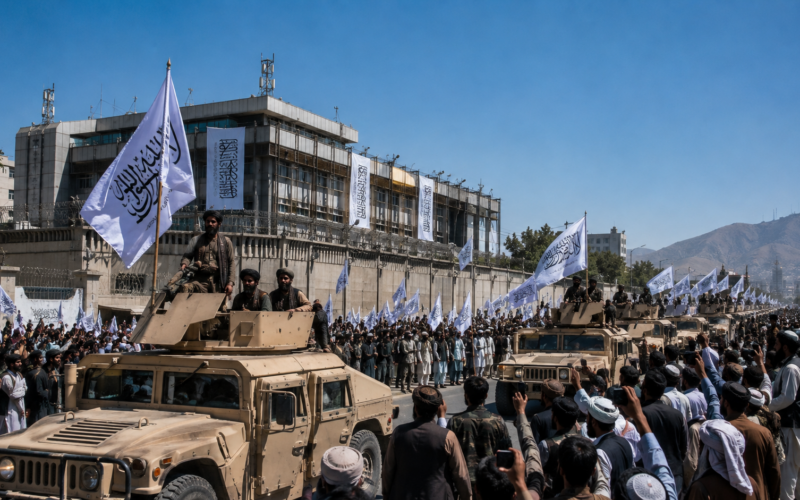
The Taliban marked five years in control of Afghanistan on August 15 with armoured vehicles, flags and celebrations outside the former United States embassy in Kabul, presenting the anniversary as proof that its government has survived international isolation and consolidated control after the chaotic Western withdrawal of 2021.
Interior Minister Sirajuddin Haqqani said in a video address that the Taliban’s return to power resulted from morale, courage and what he described as divine assistance. He also acknowledged that problems remain, an unusual concession during ceremonies intended to celebrate what the Taliban government calls its victory over foreign occupation.
The anniversary presents two sharply different versions of Afghanistan five years after Kabul fell. Taliban officials point to the end of the previous insurgency, reduced conventional warfare and expanding diplomatic and commercial contacts. The United Nations and humanitarian organisations, however, warn that restrictions on women and girls, mass refugee returns, drought, earthquake damage and shrinking international aid are creating another form of national crisis.
Education has become the clearest symbol of that divide. Reuters reported that UNESCO now estimates around 2.5 million Afghan girls and women are barred from secondary schools and universities. UN Women says the de facto authorities have issued more than 100 measures affecting women since 2021, while new survey data indicate that half of Afghan women interviewed leave their homes only once or twice a month.
Meanwhile, the United Nations estimates that around 21.9 million people, approximately 45% of Afghanistan’s population, will require humanitarian assistance during 2026. The pressure has intensified as large numbers of Afghans return or are deported from Pakistan and Iran while foreign humanitarian budgets become more constrained.
What happened in Kabul as the Taliban celebrated five years since retaking Afghanistan?
The Taliban used the August 15 anniversary to emphasise continuity, military victory and political survival. Armoured vehicles drove past the former US embassy complex in Kabul as Taliban supporters gathered with flags and banners celebrating the collapse of the previous Western-backed government. Ceremonies were also expected in several foreign capitals, including Islamabad, Beijing, Tehran, Ankara, Tashkent and Kuala Lumpur.
The location carried obvious symbolism. The US embassy was one of the principal institutions representing the two-decade Western intervention that ended as Taliban fighters entered Kabul on August 15, 2021. Five years later, the compound remains empty while the Taliban governs from the same capital without broad international diplomatic recognition.
Haqqani portrayed the anniversary as the culmination of a successful struggle against foreign military power but also referred to unresolved problems. The Taliban’s central message is that Afghanistan is now more secure from nationwide warfare and foreign occupation, even though Islamic State continues to mount attacks and several Taliban officials in northeastern Afghanistan have recently been targeted.
The contrast is important. Afghanistan no longer experiences the same nationwide Taliban insurgency against a Western-backed government, but reduced conventional fighting has not translated into political inclusion, international recognition or relief from the country’s economic and humanitarian pressures.

Why are 2.5 million Afghan girls and women still excluded from secondary schools and universities?
Restrictions on female education remain one of the biggest obstacles separating the Taliban government from most of the international community.
The Taliban initially suggested after taking Kabul that girls’ secondary schools would eventually reopen under an education system it considered compatible with Islamic requirements. Instead, restrictions expanded. Girls were prevented from attending secondary school, women were later excluded from universities, and further regulations reduced women’s ability to work, travel and participate in public life.
UNESCO previously estimated that 2.2 million adolescent girls were barred from secondary education. Reuters’ August 15 report, citing UNESCO, places the combined number excluded from secondary schools and universities at approximately 2.5 million. Afghanistan remains the only country where girls and women are systematically prohibited from secondary and higher education.
The longer the policy remains in place, the larger its cumulative effect becomes. Each academic year creates another group of girls who finish primary school but cannot legally progress through the normal secondary system. Girls who were approaching university age when the Taliban returned to power have now lost several years of formal education.
The Taliban says women’s rights are protected within its interpretation of Islamic sharia. International organisations and many Muslim-majority governments have argued that excluding girls from education is neither necessary nor sustainable, but five years of diplomatic pressure have failed to produce a reversal.
How far have restrictions on Afghan women expanded beyond the ban on education?
Education is only one part of a substantially wider system of restrictions.
UN Women says the de facto authorities have issued more than 100 measures affecting women and girls since August 2021. Restrictions touch employment, movement, public participation, dress, access to services and activities that women were previously permitted to perform.
The consequences are increasingly measurable. New UN Women data released around the fifth anniversary found that half of Afghan women interviewed leave their homes just once or twice each month because of the restrictive environment. Accessing healthcare can also become harder when travel requirements and shortages of female professionals interact with limitations on women’s mobility and education.
The education ban may eventually deepen the healthcare problem itself. Preventing young women from entering universities restricts the future supply of female doctors, nurses and other professionals in a society where gender segregation can make female healthcare workers particularly important for treating women.
UNAMA has continued documenting restrictions on freedom of movement, including requirements for women to be accompanied by a mahram, or male guardian, in certain circumstances. The United Nations argues that excluding women from economic and public life also reduces Afghanistan’s capacity to recover from poverty and humanitarian dependence.
Why does Afghanistan still face such a severe humanitarian crisis five years after the war changed dramatically?
Afghanistan’s humanitarian emergency cannot be attributed to one cause.
The country entered Taliban rule with decades of war damage, widespread poverty and heavy dependence on foreign assistance. The withdrawal of Western forces was followed by a sharp reduction in international development financing, while sanctions, banking constraints and uncertainty over the new government disrupted economic activity.
Some economic indicators later stabilised, but humanitarian needs remain enormous. OCHA projects that about 21.9 million Afghans, or roughly 45% of the population, will require humanitarian assistance in 2026.
Reuters reported that the International Rescue Committee considers humanitarian needs to have reached a record level, citing drought, destructive earthquakes and the return or deportation of Afghans from neighbouring countries. The organisation says the number requiring assistance has risen by around 3.5 million since 2021 even as international aid budgets have contracted.
That creates a difficult paradox. Afghanistan has experienced a substantial decline in the nationwide warfare that characterised the final years before the Taliban takeover, yet millions remain unable to meet basic needs. Security from conventional conflict does not automatically create employment, functioning healthcare, sufficient food or resilience to climate disasters.
UNAMA’s Georgette Gagnon used the anniversary to argue that sustainable peace requires more than the absence of fighting and depends on creating conditions in which the rights and abilities of all Afghans can be realised.
How are mass returns from Pakistan and Iran adding another layer to Afghanistan’s crisis?
Afghanistan is receiving large numbers of people returning from neighbouring countries at precisely the moment humanitarian agencies are struggling with limited funding.
UNHCR data showed more than one million Afghan returns from Iran and Pakistan during 2026 by early August, including roughly 654,100 from Pakistan and 426,700 from Iran in the available reporting period. More than 413,000 deportations had also been recorded in 2026 by August 1.
Many returnees arrive with limited money, housing or employment prospects. Families that spent years or even decades outside Afghanistan may have weak local support networks and can require immediate shelter, food, healthcare and transportation assistance.
Women returning from countries where they were able to work may encounter a particularly difficult adjustment. Reuters described the experience of one Afghan woman who had worked as a make-up artist in Iran but could no longer continue that occupation after being deported because the Taliban had prohibited women from doing such work.
Mass returns therefore do not simply increase Afghanistan’s population. They concentrate additional demand on housing, employment, food supplies and humanitarian services while international organisations are already trying to support millions of existing residents.
Has the Taliban broken out of its diplomatic isolation despite remaining largely unrecognised?
The Taliban has made diplomatic progress without securing widespread formal recognition.
Russia remains the only country to have formally recognised the Taliban government, according to Reuters. Most governments continue to engage with Kabul pragmatically while stopping short of accepting the Islamic Emirate as Afghanistan’s legitimate internationally recognised government.
That distinction allows neighbouring and regional governments to maintain embassies, negotiate trade, discuss security and work with Taliban officials without providing full diplomatic legitimacy. China, Iran, Pakistan, Uzbekistan, Turkey and other states have varying degrees of contact with Kabul because Afghanistan’s location makes complete isolation difficult.
The Taliban has also become increasingly useful to European governments seeking arrangements for returning Afghan nationals whose asylum applications have failed or who are otherwise subject to deportation. Reuters says Kabul is pursuing such arrangements while simultaneously expanding economic relationships across South Asia, Central Asia and the Middle East.
Formal recognition nevertheless remains a powerful bargaining instrument. Western governments and international institutions continue linking normalisation to issues including women’s rights, political inclusion and counterterrorism commitments. The Taliban has so far demonstrated that it is prepared to tolerate diplomatic isolation rather than make the policy concessions many countries demand.
Why has the Taliban’s relationship with Pakistan deteriorated despite Islamabad once being its most important regional partner?
Pakistan was widely regarded as the Taliban’s most important external relationship during much of the insurgency, but relations have deteriorated significantly since the group returned to power.
Islamabad accuses Afghanistan’s Taliban authorities of allowing militants from Tehrik-i-Taliban Pakistan and other groups to operate from Afghan territory and conduct attacks inside Pakistan. Kabul rejects accusations that it knowingly provides sanctuary for attacks against neighbouring states.
The dispute has repeatedly generated border tensions and military confrontation. UNAMA documented 372 civilians killed and 397 injured in Afghanistan from cross-border armed violence during the first three months of 2026, demonstrating how seriously relations between the neighbours deteriorated during that period.
Pakistan’s deportation and return policies for Afghan nationals also add strain. Hundreds of thousands of Afghans have returned from Pakistan during 2026, adding humanitarian pressure inside Afghanistan at the same time the two governments argue about cross-border militancy.
The tension demonstrates that Taliban control of Kabul has not produced the geopolitical alignment Islamabad might once have expected. Afghanistan now pursues its own relationships with China, Iran, Russia, Central Asian states and Gulf countries while disputes with Pakistan increasingly shape regional security.
Is Afghanistan more secure after five years of Taliban rule despite continuing Islamic State attacks?
The security picture is mixed.
The end of the Taliban’s own nationwide insurgency dramatically reduced one major source of violence after 2021. Large-scale clashes between Taliban forces, the former Afghan military and Western troops disappeared, and many roads and districts became easier to traverse than during the final years of the previous government.
Islamic State Khorasan Province, however, remains an active threat to both Taliban authorities and civilians. Reuters noted a series of recent assassinations involving officials in Afghanistan’s northeast, including the killing of the Taliban information director in Badakhshan in an attack later claimed by Islamic State. Local reporting also said the mayor of the provincial capital was killed in another attack shortly before the anniversary.
The Taliban has repeatedly conducted operations against Islamic State cells and portrays its ability to prevent the group from controlling substantial territory as a security success.
Yet the continued ability of militants to assassinate officials and conduct attacks complicates the Taliban’s claim that political control has solved Afghanistan’s security challenge. The threat has changed from a nationwide insurgency involving multiple armies into a more concentrated counterterrorism problem, but it has not disappeared.
What are the key takeaways as the Taliban marks five years in control of Afghanistan?
- The Taliban celebrated five years since returning to power on August 15, 2021, with armoured vehicles and supporters gathering outside the former US embassy in Kabul for what the government describes as a victory anniversary.
- Around 2.5 million Afghan girls and women are now barred from secondary schools and universities, according to UNESCO figures cited by Reuters, making female education one of the defining unresolved issues of Taliban rule.
- UN Women says Taliban authorities have issued more than 100 measures affecting women since returning to power, while half of women surveyed now report leaving their homes only once or twice per month.
- Approximately 21.9 million people, around 45% of Afghanistan’s population, are projected to require humanitarian assistance in 2026 as drought, poverty, disaster impacts and declining foreign aid continue to strain the country.
- More than one million Afghans had returned from Iran and Pakistan during 2026 by early August, with hundreds of thousands classified as deportees, adding substantial pressure to housing, employment and humanitarian services.
- Russia remains the only country to have formally recognised the Taliban government, although Kabul has expanded practical diplomatic and economic engagement with China, Iran, Pakistan, Central Asian states, Turkey and other countries.
- The Taliban points to lower nationwide warfare as one of its principal achievements, but Islamic State continues attacking Taliban officials and civilians, while cross-border tensions with Pakistan have become another serious security challenge.
- Five years after the Western withdrawal, Afghanistan has therefore achieved a degree of political and territorial consolidation without resolving the international isolation, women’s-rights restrictions and humanitarian dependence that continue to define its relationship with much of the world.
Why the Taliban’s fifth anniversary shows the difference between holding power and achieving normalisation
The Taliban’s ability to celebrate outside the former US embassy five years after entering Kabul demonstrates a political reality that seemed far less certain in August 2021. The government survived the immediate economic shock, prevented a rival armed movement from seizing significant territory and built enough relationships with neighbouring countries to avoid complete diplomatic isolation. No organised domestic force currently appears close to removing it from power.
What the anniversary does not demonstrate is international normalisation.
Russia’s recognition has broken one diplomatic barrier, and other governments increasingly conduct business with Kabul because geography, migration, security and trade make engagement unavoidable. Yet the Taliban has still not converted that engagement into widespread formal recognition. Five years after returning to power, that gap is unusually persistent for a government exercising effective control over almost an entire country.
Women’s education remains the clearest reason the gap has proved so difficult to close. The number affected is no longer measured only through individual restrictions or individual school years. Approximately 2.5 million girls and women are now excluded from secondary and university education, creating a cumulative human-capital loss that becomes harder to reverse with every passing year.
The humanitarian numbers create a second contradiction. Ending a major insurgency should ordinarily produce an economic peace dividend, yet roughly 45% of Afghans are projected to require humanitarian assistance during 2026. Drought, earthquakes, mass returns and reduced aid explain much of that outcome, but restrictions that prevent a large share of the adult population from participating fully in education and employment also limit the economy’s ability to rebuild.
That may become the central test of the Taliban’s next five years. Maintaining territorial control is no longer the same challenge it faced when Western forces departed in 2021. The harder questions concern whether Afghanistan can generate sufficient investment, employment and public services to reduce dependence on humanitarian relief and whether the government is prepared to alter policies that keep much of the female population outside education and significant parts of the economy.
August 15 therefore marks a genuine political achievement from the Taliban’s perspective but an unresolved national transformation from almost every other perspective. The movement has proved that it can remain in power. Whether it can turn that power into a broadly recognised, economically sustainable and socially inclusive Afghan state remains unanswered five years after the fall of Kabul.
Alternative headline options: Taliban celebrates five years in Afghanistan as 2.5 million girls remain barred from education; Five years after Kabul fell, Taliban survives but Afghanistan’s humanitarian crisis deepens; Taliban marks five-year victory anniversary as nearly half of Afghans need humanitarian assistance; What has changed in Afghanistan five years after the Taliban returned to power?; Taliban holds Kabul parade five years after US withdrawal as women face expanding restrictions; Five years of Taliban rule leave Afghanistan more secure from war but deeper in isolation; Russia recognises Taliban but most of world holds back as Afghanistan marks five years under Islamic Emirate; Taliban reaches five-year milestone with 2.5 million girls excluded and 21.9 million Afghans needing aid.
Discover more from Business-News-Today.com
Subscribe to get the latest posts sent to your email.