



Taiwan said it detected Chinese military aircraft and naval vessels operating near the island for a second consecutive day, adding another data point to the continuing pattern of military pressure around one of Asia’s most sensitive flashpoints.
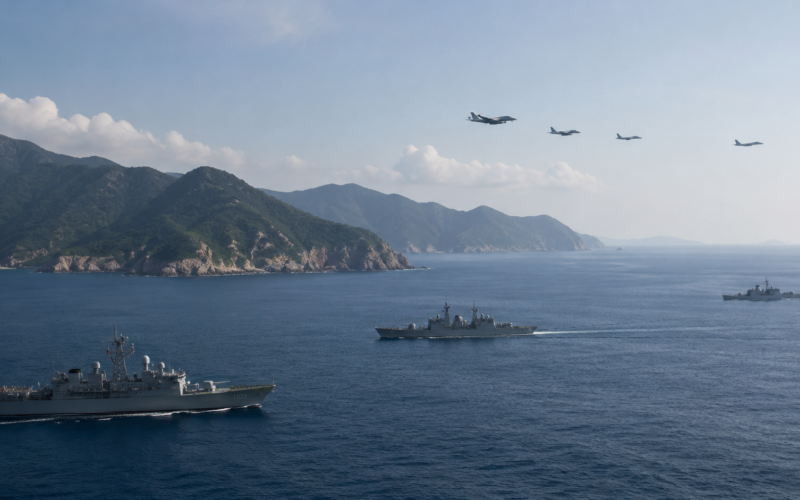
Taiwan’s Ministry of National Defence said four Chinese military aircraft sorties and six Chinese naval vessels were detected around Taiwan up to 6 a.m. local time on Sunday. The ministry said Taiwan’s armed forces monitored the situation and responded in line with established procedures. The latest activity followed similar Chinese military movement reported around the island a day earlier, reinforcing Taipei’s view that the People’s Liberation Army is maintaining persistent pressure across the Taiwan Strait.
The development comes as Taiwan continues to describe Chinese military operations near the island as a major source of regional instability. Taiwan’s government has repeatedly argued that Chinese air and naval activity around Taiwan affects not only Taiwan’s security but also maritime navigation, regional defence planning and the broader balance of power between China, the United States and American partners in the Indo-Pacific.
China claims Taiwan as part of its territory, while Taiwan’s elected government rejects Beijing’s sovereignty claim. The latest detections therefore carry significance beyond the number of aircraft or vessels involved. They reflect a sustained operational pattern in which China uses military presence, patrols, exercises and air defence zone incursions to keep Taiwan under pressure without necessarily crossing into open conflict.
Why is Taiwan reporting Chinese military aircraft and naval vessels near the island again?
Taiwan is reporting the latest Chinese military activity because the Ministry of National Defence tracks and publishes daily information on People’s Liberation Army aircraft, People’s Liberation Army Navy vessels and other Chinese official vessels operating near Taiwan. The ministry’s latest statement said four Chinese military aircraft sorties and six Chinese naval vessels were operating near Taiwan up to Sunday morning.
The immediate military activity was modest compared with some larger Chinese exercises seen in recent years, but the political importance lies in repetition. Taiwan has faced frequent Chinese military activity in surrounding air and maritime spaces. These detections have become part of the island’s regular security environment, with Taiwan’s armed forces monitoring movements, deploying appropriate assets and maintaining readiness.
For Taiwan, public reporting serves several purposes. It signals transparency to citizens, reassures partners that Taiwan is tracking Chinese activity, and documents the frequency of Chinese operations for the international community. In the information environment around the Taiwan Strait, daily defence ministry updates also help Taiwan frame the issue as a pattern of coercive pressure rather than isolated military movement.
For China, the presence of aircraft and naval vessels near Taiwan supports Beijing’s political message that Taiwan remains central to Chinese sovereignty claims. The People’s Republic of China has not renounced the possible use of force to bring Taiwan under its control, while Taiwan continues to maintain that its future should be decided by its people.
How does repeated Chinese military activity near Taiwan affect regional security planning?
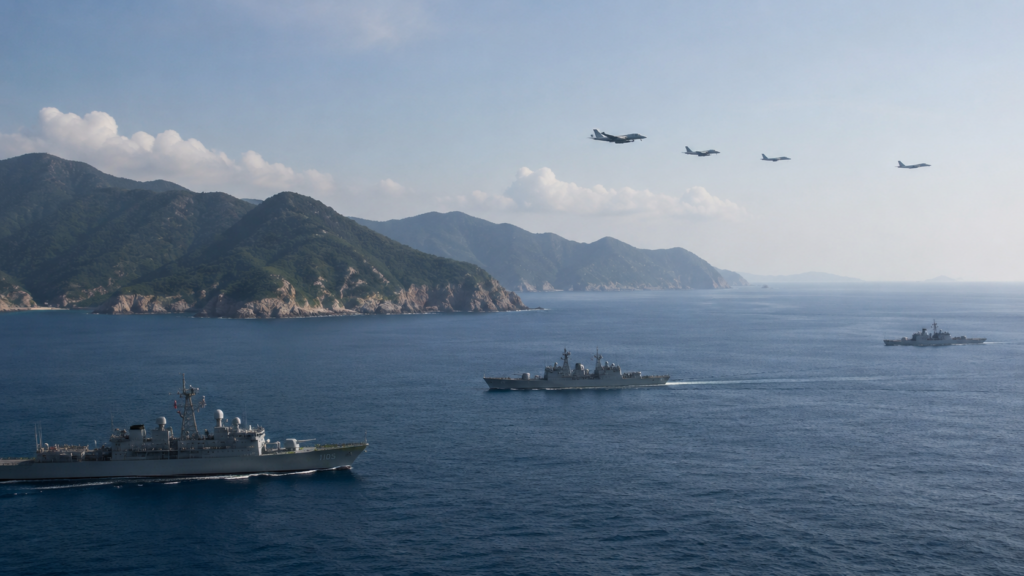
Repeated Chinese military activity near Taiwan affects regional security planning because it forces Taiwan, the United States, Japan and other Indo-Pacific actors to treat the Taiwan Strait as a live operational theatre rather than a frozen political dispute. Even when individual daily detections involve small numbers, the cumulative effect is to increase military readiness demands and reduce the margin for miscalculation.
Taiwan must maintain constant surveillance, air defence readiness and naval monitoring. That imposes pressure on personnel, equipment and defence budgets. It also requires Taiwan’s military to distinguish between routine pressure, exercises, probes and possible escalation signals. This is one reason Taiwan has placed repeated emphasis on Chinese military activity as a source of instability.
The United States and regional allies also watch these patterns closely because the Taiwan Strait is linked to wider Indo-Pacific security. The sea lanes around Taiwan connect major Asian economies, semiconductor supply chains, energy flows and allied defence postures. A crisis around Taiwan would not remain a local event. It would affect Japan, the Philippines, South Korea, Australia, the United States and global markets.
The regional consequence is a defence planning cycle in which every new Chinese patrol reinforces calls for readiness, arms procurement, military exercises and deeper security coordination. That cycle can strengthen deterrence, but it can also increase the density of military activity in contested spaces.
Why does the Taiwan Strait remain central to tensions between China and the United States?
The Taiwan Strait remains central to tensions between China and the United States because Taiwan sits at the intersection of sovereignty claims, military deterrence, democratic governance, technology supply chains and alliance politics. China sees Taiwan as an internal sovereignty issue. The United States maintains unofficial relations with Taiwan and remains legally committed under its domestic framework to help Taiwan maintain sufficient self-defence capabilities.
Recent reporting has also highlighted Taiwan’s sensitivity to United States arms sales and military support. Taiwan’s government said it had not received official notification of any pause in a planned United States arms sale, after comments in Washington raised questions about possible delays linked to American military stockpile needs.
That arms sale question matters because Taiwan’s ability to deter China depends partly on the pace and reliability of foreign military support. Beijing opposes United States arms sales to Taiwan, while Taipei argues that defensive capability is necessary to preserve peace. The dispute therefore becomes part of a wider China United States bargaining environment, where Taiwan is both a security issue and a diplomatic pressure point.
The broader geopolitical risk is that military movements near Taiwan are rarely interpreted in isolation. A patrol, a naval deployment or an aircraft crossing near Taiwan can be read through the lens of China United States rivalry, election politics in Taiwan, alliance activity in the Indo-Pacific and military planning by multiple governments.
What does Taiwan’s response reveal about its security strategy under sustained Chinese pressure?
Taiwan’s response reveals a strategy built around monitoring, public disclosure, deterrence and international signalling. Taiwan’s Ministry of National Defence typically states that Taiwan’s armed forces monitored Chinese activity and responded appropriately. That language is deliberately measured. It avoids escalation while confirming that Taiwan is not ignoring Chinese military movements.
The public disclosure model also helps Taiwan maintain international visibility. Taiwan cannot rely only on diplomatic recognition because many countries do not formally recognise Taiwan as a sovereign state. Regular defence ministry updates allow Taiwan to keep the security issue visible in global media, legislative debates and policy discussions.
Taiwan’s security strategy also depends on resilience. Persistent Chinese activity can test military readiness, civil preparedness and political confidence. By documenting Chinese operations, Taiwan seeks to show that it is managing the pressure without panic and that Chinese activity is part of a sustained challenge to regional stability.
At the same time, Taiwan faces domestic political constraints. Defence spending, procurement, military reform and civil defence measures can become contested within Taiwan’s own political system. The pressure from China therefore interacts with Taiwan’s internal democratic debate over how much to spend, how fast to reform and how to balance deterrence with public reassurance.
Why does the latest Taiwan China military activity matter even without immediate escalation?
The latest Taiwan China military activity matters even without immediate escalation because repeated low intensity pressure can gradually reshape the security environment. A small number of aircraft and ships on a single day may not produce a crisis, but persistent operations can normalise Chinese military presence near Taiwan and force Taiwan to operate in a near permanent alert posture.
This is the central strategic issue in the Taiwan Strait. The concern is not only whether China launches a major operation. The concern is also whether repeated military activity changes expectations, weakens Taiwan’s sense of security, strains Taiwan’s forces and makes regional actors more accustomed to Chinese presence in sensitive areas.
For the wider Indo-Pacific, the pattern matters because Taiwan sits near key maritime routes and within the first island chain, a strategic arc that matters to China, Japan, the United States and other regional players. Any shift in Taiwan’s security environment affects the wider balance of power across East Asia.
The latest detections are therefore important not because they are the largest reported military movement, but because they continue a pattern. Taiwan’s security challenge is cumulative. Each patrol, each vessel movement and each aircraft sortie adds to the longer contest over deterrence, political pressure and the future status of the Taiwan Strait.
What are the key takeaways from Taiwan’s latest Chinese military sightings near the island?
- Taiwan’s Ministry of National Defence said it detected four Chinese military aircraft sorties and six Chinese naval vessels near Taiwan up to Sunday morning.
The ministry said Taiwan’s armed forces monitored the situation and responded under established procedures. - The latest detections came for a second consecutive day, showing that Chinese military activity around Taiwan remains persistent.
Taiwan treats these daily movements as part of a broader pattern of pressure from the People’s Liberation Army. - China claims Taiwan as part of its territory, while Taiwan’s elected government rejects Beijing’s sovereignty claim.
This political dispute gives even routine military sightings wider strategic significance in the Taiwan Strait. - Taiwan has described Chinese military activity as a major source of regional instability.
Taiwan argues that Chinese operations affect regional navigation, military planning and broader Indo-Pacific security. - The United States remains an important factor in Taiwan’s security calculations through arms sales and defence support.
Taiwan has said it has not received official notice of any pause in a planned United States arms sale. - The latest activity matters because repeated military pressure can change the operating environment without immediate escalation.
The cumulative effect is greater defence readiness pressure on Taiwan and closer monitoring by regional governments.
Discover more from Business-News-Today.com
Subscribe to get the latest posts sent to your email.