





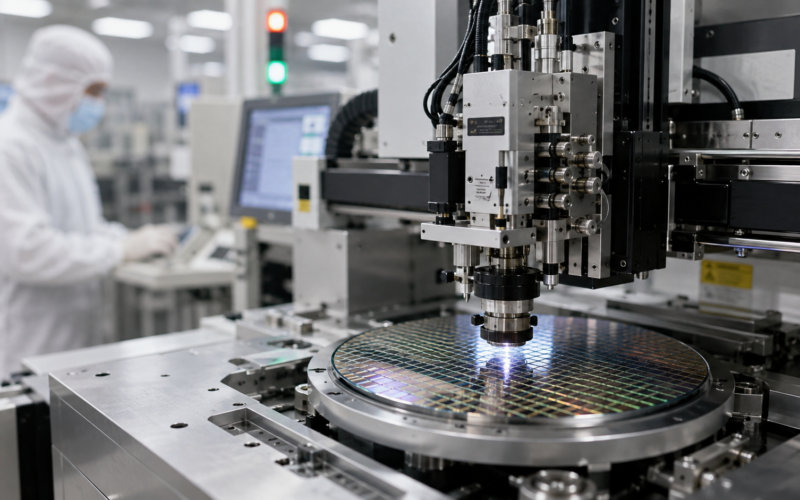
SUSS MicroTec SE (FWB: SMHN) entered the second half of 2026 with a €473.7 million order book, equivalent to 2.34 times first-half sales. A single approximately €115 million order from a Taiwanese outsourced semiconductor assembly and test customer equalled 28.0% of first-half intake. Its value was also equivalent to 24.3% of the June backlog, although SUSS MicroTec SE did not disclose how much of the order remained in that backlog at June 30. The customer’s delivery schedule and equipment acceptance therefore carry unusual weight in future revenue conversion.
The contradiction is sharp. First-half order intake increased 145.8% to €410.0 million, while sales fell 23.9% to €202.8 million and earnings before interest and taxes declined 67.9% to €14.2 million. Current revenue reflects lower order intake during 2025, particularly in the second half, while advanced-packaging demand is filling production schedules extending into 2027.
The Taiwanese order is not the whole growth story. Removing its approximate value leaves €295.0 million of intake, still 76.9% above the adjusted prior-year amount. The resulting book-to-bill ratio would remain about 1.45, compared with the reported 2.0. Demand has strengthened beyond one customer, although the order materially increases reported growth and concentration.
Management expects approximately €240 million of backlog to convert into second-half 2026 sales and approximately €220 million during 2027. Those schedules are subject to change and are not 2027 guidance. Nearly half of the backlog therefore sits beyond the current year.
The conversion question also matters to valuation. SUSS MicroTec SE closed at €83.20 on August 7, giving it a market capitalisation of approximately €1.59 billion, or about 3.5 times the midpoint of 2026 sales guidance. That valuation depends on the backlog becoming higher-margin revenue.
How much of SUSS MicroTec’s record order intake came from one Taiwanese customer?
The approximately €115 million coating-systems order came from a Taiwanese outsourced semiconductor assembly and test customer supplying a leading participant in the artificial-intelligence chip-module value chain. SUSS MicroTec SE did not identify either company. The order was unprecedented in the company’s history and was a major contributor to second-quarter intake of €260.7 million.
The order equalled 28.0% of first-half intake, 44.1% of second-quarter intake and 22.9% of SUSS MicroTec SE’s €503.2 million of 2025 sales. Its value was also equivalent to 24.3% of the June order book. The last ratio is a scale comparison rather than a disclosed backlog share because the company did not state how much of the order remained in backlog at June 30. None of the comparisons implies that the entire order will be recognised in one period.
This order-intake concentration can validate a supplier’s technology, but it also magnifies rescheduling, acceptance and working-capital risk. Order intake, backlog and recognised sales are related measures, not interchangeable ones.
The counterfactual is reassuring without eliminating the issue. Excluding the approximately €115 million order, intake would still have reached about €295 million, 1.77 times the adjusted prior-year amount and 1.45 times first-half sales. Demand therefore appears broader than one customer. The single order amplified an already improving cycle rather than creating it from nothing.

What does the €473.7 million backlog actually reveal about 2026 and 2027 conversion?
The June order book increased 45.5% from €325.6 million a year earlier and equalled 94.1% of all sales reported in 2025. That provides meaningful visibility, but the delivery split explains why first-half order strength could coexist with lower current sales.
Approximately €220 million, or 46.4% of the backlog, was scheduled to convert into 2027 sales. A further approximately €240 million, or 50.7%, was expected to convert during the second half of 2026. Together, those approximate allocations represent 97.1% of the June order book, leaving only a small residual affected by rounding or other delivery periods.
The 2027 amount should not be treated as a forecast. SUSS MicroTec SE expressly described it as the value of current orders based on scheduled delivery dates. Customer timing can change, and the company increased its assessed risk from supply bottlenecks and capacity constraints from low to medium. It also classified higher transportation costs as a medium overall risk because equipment manufactured in Germany is commonly shipped to customers by air.
Execution capacity is consequently part of the backlog’s value. SUSS MicroTec SE is rebuilding flexible capacity after the lower sales trough and preparing for higher delivery volumes. A backlog that extends into 2027 protects visibility, but it also means that the financial reward from current demand arrives only as equipment is completed, delivered and accepted.
Why did EBIT fall 67.9% even as semiconductor-equipment demand accelerated sharply?
The profit decline was mainly an operating-leverage problem. First-half gross profit fell 25.5% to €75.4 million as sales contracted, while combined selling, administrative and research expenses were almost unchanged at €59.2 million. Research and development expenditure increased 6.9% to €24.9 million, lifting the research ratio to 12.3% of sales from 8.7% a year earlier.
Product mix added pressure through fewer higher-margin temporary bonders and photomask cleaners. A €2.1 million charge tied to a product previously removed from the portfolio and an approximately €1.5 million negative foreign-exchange effect also contributed, but the larger issue was absorbing a stable cost base with €63.9 million less sales.
Photomask Solutions carried much of the year-on-year contraction. Segment sales fell 44.7% to €53.9 million, while segment EBIT declined from €29.0 million to €9.9 million and the margin narrowed from 29.8% to 18.4%. Advanced Backend Solutions sales fell a milder 12.0% to €148.9 million, but its first-half EBIT margin also declined from 11.1% to 5.6%.
Sequential evidence is more constructive. Sales increased 34.3% from €86.5 million in the first quarter to €116.2 million in the second, while EBIT margin improved from 4.3% to 9.0%. The 38.0% second-quarter gross margin shows that higher volume can restore fixed-cost coverage.
Can second-half sales and margins reach the midpoint of SUSS MicroTec’s guidance?
SUSS MicroTec SE retained 2026 guidance for sales of €425 million to €485 million, gross profit margin of 35% to 37% and EBIT margin of 8% to 10%. The first-half result sits below the full-year EBIT range, so the second half must provide both more revenue and better operating leverage.
At the sales midpoint of €455 million, SUSS MicroTec SE would need approximately €252.2 million of second-half sales. That is 24.4% more than first-half sales and 6.6% above the approximately €236.6 million generated in the second half of 2025. The company’s approximately €240 million expected conversion from the June order book would produce full-year sales of about €442.8 million before any additional in-year orders or scheduling changes. That result would fall within guidance but remain €12.2 million below the midpoint.
An illustrative midpoint earnings scenario is more demanding. A 9% full-year EBIT margin on €455 million of sales would imply approximately €41.0 million of annual EBIT. After the €14.2 million earned in the first half, the second half would need about €26.8 million, equivalent to a margin of approximately 10.6% on the required €252.2 million of sales. This is a mechanical scenario, not management guidance, and the endpoints of the company’s ranges need not move together.
The calculation defines the operational hurdle. Holding the second-quarter margin of 9.0% could support the lower part of the guidance range, but achieving the midpoint combination would require further benefit from volume, product mix or cost absorption. The planned conversion of the backlog supplies the revenue opportunity; profitability will determine its quality.
How much did customer advance payments contribute to positive first-half cash flow?
Cash generation improved even as profit fell. Operating cash flow reached €20.9 million, compared with a €16.3 million outflow a year earlier, while free cash flow moved from negative €27.5 million to positive €16.4 million. Cash reached €112.3 million, including €0.6 million not freely available, and net cash rose to €63.6 million.
Customer funding played a substantial role. Contract liabilities increased €33.8 million to €79.0 million, a 74.9% rise from December. The increase exceeded operating cash flow, although it cannot be subtracted mechanically because earnings and other working-capital movements also affected the total.
Inventories increased €10.7 million and contract assets €14.1 million during the first half. Purchase commitments rose 38.8% to €107.0 million. Customer advances reduce internal financing needs but create delivery obligations rather than profit.
Capital expenditure fell 58.9% to €4.6 million after prior-year spending on the Taiwan site. In July, SUSS MicroTec SE announced plans to invest approximately €45 million in a Karlsruhe application and development centre. The amount equals 70.8% of June net cash, but the company did not disclose a spending timetable and it should not be treated as an immediate one-period payment.
The €115 million syndicated facility had no cash drawings at June 30, while €6.2 million was used for guarantees. It strengthens flexibility but is not cash. Future cash quality depends on converting customer-funded production into delivered, profitable equipment.
Does SUSS MicroTec’s current valuation already price in a strong 2027 recovery?
SUSS MicroTec SE shares closed at €83.20 on August 7, up 5.18% in the session. They had gained 11.83% over five trading days and 112.57% since the start of 2026, although the standard trailing one-month return was negative 1.89%. The 52-week range was €24.00 to €118.40, leaving the price 29.7% below the high but 246.7% above the low.
At approximately €1.59 billion, market capitalisation equalled 3.16 times reported 2025 sales and 3.50 times the midpoint of 2026 guidance. These are market-value-to-sales comparisons, not enterprise-value or earnings multiples. They do not establish that the shares are expensive or cheap, but they demonstrate how much of the investment case depends on future conversion and margin recovery rather than the depressed first-half result.
The company’s entry into the MDAX on June 22 widened its public-market profile after strong share-price performance. Index inclusion can increase visibility and institutional relevance, but it does not change delivery economics. The valuation still has to be supported by the pace at which advanced-packaging orders become sales and the margin generated when they do.
The backlog is real, but conversion and order concentration now set the outcome
SUSS MicroTec SE has more than a one-order demand story. Excluding the approximately €115 million deal still leaves intake 76.9% above the adjusted prior-year comparison, while second-quarter sales and EBIT margin improved materially. Positive free cash flow and €63.6 million of net cash provide room for the next delivery cycle.
The same figures limit the conclusion. One order equalled 28.0% of intake, almost half of the backlog was scheduled beyond 2026, and the illustrative guidance midpoint requires a second-half EBIT margin above the 9.0% reached in the second quarter. Customer advances also brought funding and delivery obligations together.
The next results need a clean conversion bridge: how much of the approximately €240 million scheduled for the second half became sales, whether the €220 million assigned to 2027 remained on schedule and what margin the higher delivery volume produced. A sustained margin above the second-quarter level would show restored operating leverage; delays or weaker mix would shift value further into the future.
The record backlog therefore represents genuine commercial progress, but not a completed earnings recovery. SUSS MicroTec SE has already won a large part of the work. The harder task is now to convert that demand without allowing one customer, one delivery timetable or one product mix to dominate the financial result.
Discover more from Business-News-Today.com
Subscribe to get the latest posts sent to your email.

