



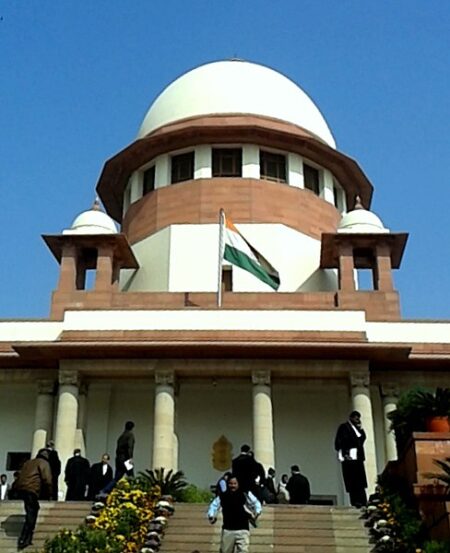
In a pivotal moment that could influence the constitutional future of Jammu and Kashmir, the Supreme Court of India has dismissed the contention that Article 370 ceased to exist following the enactment of the state’s constitution in 1957. A five judge Constitution Bench led by Chief Justice DY Chandrachud categorically stated during Tuesday’s hearing that such an argument was “unacceptable,” emphasizing the importance of examining the original language and intent behind the provision during the formation of the Indian Constitution.
The legal pushback comes in response to submissions by senior advocate Dinesh Dwivedi, who appeared for journalist and author Prem Shankar Jha. Dwivedi argued that the dissolution of the Jammu and Kashmir Constituent Assembly in 1957 signaled the expiration of Article 370, which had provided the erstwhile state with special status and autonomy.
However, the Supreme Court firmly refuted this position, declaring that such an interpretation would effectively “freeze” the Indian Constitution’s applicability to Jammu and Kashmir as of January 26, 1957, when the state’s constitution came into force. The hearing is part of the broader constitutional challenge to the Indian government’s 2019 decision to revoke Article 370.
Why the Supreme Court rejected the claim that Article 370 ended in 1957
The argument that Article 370 became inoperative after the Jammu and Kashmir Constituent Assembly ceased to exist has long circulated among legal scholars and political commentators. Dwivedi’s submission revived this position by asserting that the provision was inherently temporary, created as a transitional arrangement to accommodate Jammu and Kashmir’s accession to India following the tumultuous events of 1947.
According to Dwivedi, once the state adopted its own constitution in 1957, and its constituent assembly ceased to function, there was no further justification for continuing Article 370. He urged the court to read the provision as having effectively lapsed.
Chief Justice DY Chandrachud, however, pushed back on this line of reasoning. He noted that such a reading would not only disregard the explicit language of the provision but would also ignore the Constituent Assembly debates that shaped Article 370’s inclusion. He underlined that interpreting constitutional provisions requires a nuanced understanding of the historical and political context in which they were drafted.
Justice Sanjay Kishan Kaul added to the court’s objections by questioning the logic of treating Article 370 as “defunct,” given that it has continued to be part of the Indian Constitution for over seven decades and has been the subject of numerous judicial interpretations.
What makes Article 370 legally complex according to the bench
The Supreme Court’s bench, which also includes Justices Sanjiv Khanna, BR Gavai, and Surya Kant, argued that Article 370 cannot be invalidated by implication or convenience. They reminded the counsel that constitutional silence on a provision’s expiry does not equate to its expiration.
The judges stated that Article 370 was structured to provide a constitutional mechanism for integrating Jammu and Kashmir into the Indian Union while allowing for certain transitional arrangements. This framework included a provision allowing the President of India to issue orders applying provisions of the Indian Constitution to Jammu and Kashmir, with the concurrence of the state government and, in certain cases, its constituent assembly.
By claiming that the provision automatically expired in 1957, Dwivedi was, according to the court, asking the judiciary to read into the text something that was not stated. As Chief Justice Chandrachud put it, “You are asking us to read what is not there in Article 370.”
Justice Kaul also pointed out the contradiction between different arguments. On one hand, Dwivedi’s argument asserted the temporary nature of Article 370; on the other, many others opposing the abrogation claim that the same article had attained a permanent character post 1957 due to the absence of a constituent assembly to recommend its deletion. The court stressed that both interpretations could not coexist without legal conflict.
What this hearing means for the broader Article 370 abrogation case
This legal confrontation is part of a landmark constitutional case examining the Indian government’s decision on August 5, 2019, to revoke Article 370 and bifurcate the former state of Jammu and Kashmir into two union territories: Jammu and Kashmir, and Ladakh. The move was announced through a presidential order and ratified by Parliament but has remained mired in constitutional challenges ever since.
Petitioners opposing the abrogation have raised questions about the legality of invoking Article 370(3) in the absence of the Jammu and Kashmir Constituent Assembly. Others have argued that the state’s special status could not be nullified unilaterally by the Centre without violating the principles of federalism enshrined in the Constitution.
The court’s rejection of the 1957 expiration theory appears to align with the broader interpretation that Article 370 remained a live constitutional provision until it was formally revoked. However, whether the 2019 abrogation followed a valid constitutional route remains a separate and more contentious question that the bench is yet to resolve.
What constitutional experts said in 2023 about Article 370’s interpretation
In the broader legal community, the hearing reignited interest in the foundational questions surrounding Article 370. Constitutional scholars noted that the clause was never explicitly time bound. Though it was placed under Part XXI of the Constitution, titled “Temporary, Transitional and Special Provisions,” its language allowed for continuous presidential action until modified or repealed through due process.
Commentators also observed that while the dissolution of the state’s constituent assembly did limit one method of amendment (requiring its recommendation), it did not remove the provision from the Constitution or render it inactive by default.
Legal academics pointed out that successive presidential orders had continued to extend central laws to Jammu and Kashmir even after 1957, reinforcing the operational validity of Article 370. These orders, often issued with the concurrence of the state government, were seen as evidence that the Article remained functional in practice.
How Article 370 fits into the political and historical landscape of 2023
In 2023, the Article 370 debate is not merely a legal question but a politically charged and emotionally resonant issue. The 2019 revocation of the provision by the Bharatiya Janata Party led government was hailed by some as a bold step toward national integration and development of the region. Others condemned it as a unilateral assault on federalism and minority rights.
The constitutional challenge, now before the Supreme Court, is being closely watched not just by legal experts but also by regional leaders, human rights advocates, and international observers. The case is expected to shape how India defines the balance between national unity and state autonomy.
The Supreme Court’s remarks rejecting the 1957 expiration theory will likely influence other aspects of the hearings. It signals that the court is unlikely to entertain narrow textual interpretations that contradict the documented constitutional process and political practice over decades.
What to expect in the next phase of the hearing
The hearing, which remains ongoing, is set to resume on Wednesday with further arguments from the petitioners. The court’s firm stance on the continued applicability of Article 370 suggests it is leaning toward a comprehensive examination of how constitutional provisions can evolve, persist, or be repealed through structured legal mechanisms, rather than by interpretation alone.
Observers anticipate that upcoming sessions will tackle the legality of the presidential orders issued in 2019 and whether Parliament had the authority to approve the bifurcation of the state. The bench’s willingness to confront both historical and contemporary interpretations of Article 370 indicates that its final ruling may become a landmark judgment in Indian constitutional history.
What are the key takeaways from the Article 370 hearing and why does it matter for India’s constitutional future?
- The Supreme Court of India rejected the argument that Article 370 ended after the state constitution of Jammu and Kashmir came into force in 1957
- Chief Justice DY Chandrachud emphasized that the Indian Constitution does not support such an interpretation
- Justices noted that Article 370 remained operative for decades, as evidenced by repeated presidential orders extending constitutional provisions to Jammu and Kashmir
- The court’s stance has implications for the ongoing constitutional challenge to the abrogation of Article 370 in 2019
- The hearings are expected to continue, with further legal arguments on procedural and federalism related issues
Discover more from Business-News-Today.com
Subscribe to get the latest posts sent to your email.