

Sunrise Energy Metals Limited (ASX: SRL), the Melbourne-based critical-minerals developer advancing the Syerston Scandium Project in New South Wales, has executed a scheme implementation deed that would move its parent-company domicile from Australia to the United States and make Nasdaq its primary stock-exchange listing. Under the proposal, newly incorporated Delaware company Sunrise Energy Metals, Inc. would become the parent of the group, while CHESS Depositary Interests would continue trading on the Australian Securities Exchange.
Eligible Sunrise Energy Metals shareholders would receive one new holding-company security for each existing share, meaning the redomiciliation is intended to preserve proportional ownership rather than raise capital or dilute shareholders through the restructuring itself. Investors could hold an ASX-listed CDI by default or elect to receive a Nasdaq-listed common share.
Why is Sunrise Energy Metals moving its corporate home to the United States?
The immediate strategic connection is financing. Sunrise Energy Metals disclosed in August that the United States Department of War’s Office of Strategic Capital had issued a conditional commitment for up to US$400 million of long-term debt financing to support development of the wholly owned Syerston Scandium Project. The commitment remains non-binding and subject to due diligence, definitive documentation and other conditions, but the scale of the potential facility is substantial relative to the project’s estimated construction cost.
The company now argues that a US corporate domicile and Nasdaq listing would place Sunrise Energy Metals closer to the customers, financing sources and policy institutions driving Western scandium demand. Scandium can be used in aluminium-scandium alloys for aerospace and defence applications, solid-oxide fuel cells and certain advanced communications and semiconductor technologies.
This is therefore more than a stock-exchange branding exercise. Sunrise Energy Metals is attempting to align its legal structure, financing strategy and likely customer base around a US-centred critical-minerals industrial policy while keeping the underlying mine in Australia.
How large is the Syerston Scandium Project?
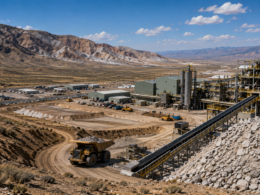
Syerston is located in New South Wales and has a granted mining lease and advanced environmental approvals. Sunrise Energy Metals’ 2026 feasibility work outlined an initial operation producing approximately 60 tonnes a year of high-purity scandium oxide over a 32-year operating life, with forecast development capital of around US$120 million. Life-of-mine C1 operating costs were estimated at approximately US$534 per kilogram of scandium oxide.
The underlying resource is considerably larger than the initial mining plan. Sunrise reports a global mineral resource containing roughly 23,554 tonnes of scandium at a 300 parts-per-million cut-off, including approximately 9,583 tonnes in measured and indicated categories. The initial project therefore represents only one possible production configuration rather than exhausting the mineral system.
That scalability matters because scandium is a relatively small market today. Building a mine too large before customers develop would create obvious demand risk, while starting at a smaller scale and expanding alongside contracted consumption could provide a more disciplined path.
Why could Nasdaq matter for Sunrise Energy Metals shareholders?
Nasdaq could expose Sunrise Energy Metals to a much deeper pool of US investors familiar with defence technology, strategic materials, advanced manufacturing and high-growth specialty-mineral companies. The company itself said the structure could broaden access to US capital markets while aligning Sunrise more closely with US government priorities around critical mineral security.
The structure also avoids forcing Australian investors to leave the ASX ecosystem. If the scheme succeeds, the holding company’s common shares would trade primarily on Nasdaq while CDIs representing those shares would trade on the Australian Securities Exchange.
For shareholders, that means the important question is not whether Sunrise Energy Metals is abandoning Australia. The Syerston asset remains in New South Wales, and the group’s underlying projects do not change because of the scheme. What changes is the jurisdiction of the parent company and the market in which its primary securities trade.
What approvals are needed before Sunrise Energy Metals can move?
The proposal requires multiple approvals and is therefore not yet complete. Sunrise shareholders must approve the scheme by the prescribed majorities, the Federal Court of Australia must approve it, and Foreign Investment Review Board clearance is required. The independent expert must also conclude that the scheme is in shareholders’ best interests.
Nasdaq must authorise the new holding-company shares for listing, while the Australian Securities Exchange must approve the holding company and its CDIs for secondary quotation. Sunrise Energy Metals also expects the Delaware holding company to submit registration documentation to the United States Securities and Exchange Commission.
Those conditions create execution risk, although the structure itself is relatively straightforward economically because shareholders are not exchanging their ownership for cash or taking a haircut in their proportional interest.
How have Sunrise Energy Metals shares reacted?
Sunrise Energy Metals shares closed at A$21.09 on October 2, down approximately 2.3% for the session after closing at A$21.58 on October 1. The stock had already experienced substantial volatility in late September, trading above A$23 on several occasions before the redomiciliation announcement.
The muted response suggests investors may already have been valuing Sunrise Energy Metals substantially around US strategic-financing expectations and the Syerston opportunity. Redomiciliation helps create the corporate framework for that strategy, but it does not itself convert the conditional US$400 million financing commitment into funded debt.
The next valuation step therefore depends on execution rather than domicile. Definitive financing, customer agreements, construction decisions and scandium demand will ultimately determine the economic value created.
What is the biggest opportunity and biggest risk for Sunrise Energy Metals?
The opportunity is that Sunrise Energy Metals could become an unusually important Western primary scandium supplier at precisely the moment governments are trying to reduce reliance on concentrated supply chains. Syerston is development-ready relative to many critical-mineral projects, while the potential US financing package is several times the project’s stated initial development cost.
The risk is that scandium demand still needs to expand dramatically for a large new supply source to realise its full strategic value. Unlike copper or gold, scandium does not have a deep, highly liquid commodity market where thousands of tonnes can simply be sold at a transparent benchmark price.
Sunrise Energy Metals therefore needs both sides of the market to develop together. Financing and mine construction can create supply, but aerospace, defence, energy and semiconductor applications must generate sufficient long-term demand.
Discover more from Business-News-Today.com
Subscribe to get the latest posts sent to your email.