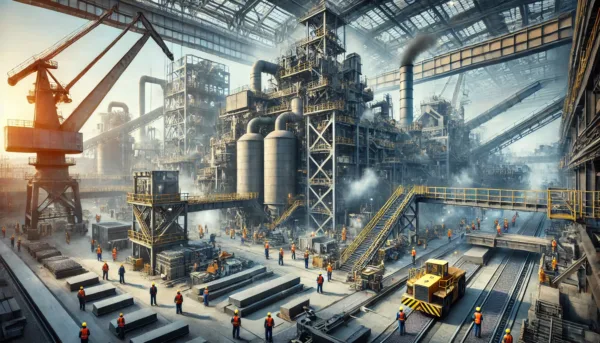
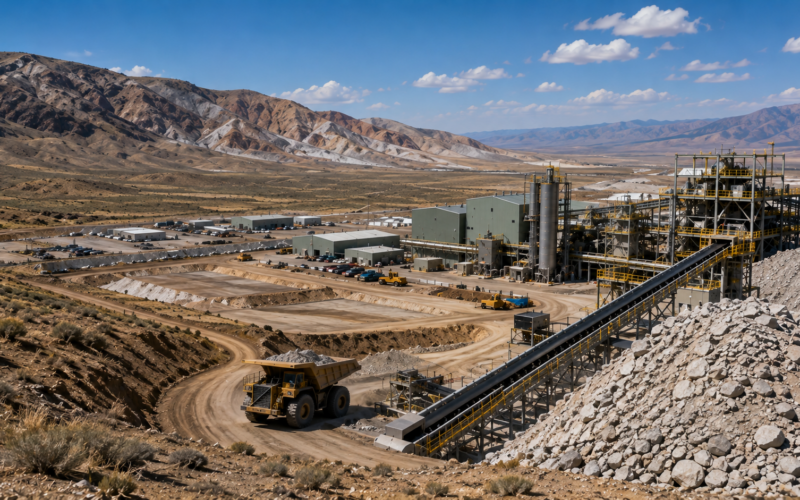
The Thacker Pass Lithium Project is strategically important because it is one of the most advanced attempts to build a large, integrated lithium mine and processing facility inside the United States. Located in Humboldt County in northern Nevada, the project is being developed to produce battery-grade lithium carbonate from a sedimentary clay resource in the McDermitt Caldera. Its first phase targets nominal production capacity of 40,000 tonnes per year of battery-grade lithium carbonate, with mechanical completion of the Phase 1 processing plant targeted for late 2027 and full ramp-up expected through 2028.
Thacker Pass matters in 2026 because the project has moved beyond permitting, litigation and financing into heavy construction. Lithium Americas has reported that detailed engineering for Phase 1 has surpassed 95%, procurement is more than 70% complete, more than 1,300 workers were on site by mid-May 2026, and peak construction employment is expected to exceed 2,000 workers in the second half of the year.
The project also matters because it sits at the centre of the United States critical minerals strategy. Lithium is essential for electric vehicle batteries, grid storage and broader electrification, but the United States remains heavily dependent on foreign mining and processing supply chains. Thacker Pass is designed to mine ore and process it into battery-grade lithium carbonate at the same site, creating a domestic source of refined lithium rather than only a raw mineral extraction project.
That integrated model is why the Thacker Pass Lithium Project is more than a mining story. It is a mine, chemical processing complex, workforce project, logistics project, water-management project, power-infrastructure project and national industrial policy test wrapped into one development. If it delivers, it could become one of the most important domestic lithium supply sources in North America. If it struggles, it will show how difficult it remains to localise battery-material supply chains in the United States.
Where is the Thacker Pass Lithium Project located and what resource is being developed?
The Thacker Pass Lithium Project is located in Humboldt County, northern Nevada, near the Oregon border and west of the Quinn River Valley. The project sits within the McDermitt Caldera, a volcanic geological system that hosts lithium-bearing claystone near the surface. This gives Thacker Pass a different development profile from hard-rock lithium mines in Australia or brine operations in South America.
Lithium Americas describes Thacker Pass as a sedimentary clay resource and one of the world’s largest known lithium resources. The company’s updated technical reports released in January 2025 included a proven and probable reserve estimate of 14.3 million tonnes of lithium carbonate equivalent at an average grade of 2,540 parts per million lithium. The same update included a measured and indicated resource estimate of 44.5 million tonnes of lithium carbonate equivalent at an average grade of 2,230 parts per million lithium.
The deposit’s scale gives the project long-term expansion potential. Phase 1 is targeting 40,000 tonnes per year of battery-grade lithium carbonate. Future phases, if approved and funded, could add additional 40,000 tonnes-per-year increments, with a long-term plan that contemplates total nominal lithium carbonate capacity of 160,000 tonnes per year across multiple production phases.
This phased structure is important because the current project under construction is not the full long-term development concept. The present build is Phase 1. Later phases would require additional approvals, capital decisions, construction work, processing capacity, market justification and partner support.

Who owns and operates the Thacker Pass Lithium Project?
Thacker Pass is owned by Lithium Nevada LLC, which is owned by Lithium Nevada Ventures LLC, a joint venture between Lithium Americas Corp. and General Motors Holdings LLC. Lithium Americas owns 62% of the project and manages Thacker Pass, while General Motors owns 38%.
The General Motors ownership position was created through a joint venture transaction that closed in December 2024. General Motors acquired its 38% asset-level stake for $625 million in committed cash and letters of credit. This included direct cash funding to support Phase 1 construction and a letter of credit facility linked to reserve account requirements under the United States Department of Energy loan.
The ownership structure is highly strategic. General Motors is not only a financial investor. It is a downstream automotive manufacturer seeking secure lithium supply for electric vehicle batteries. The project therefore connects upstream mining and lithium processing with automotive supply-chain localisation.
The United States Department of Energy also has a financing and warrant-linked role. Lithium Americas’ subsidiary executed a Department of Energy loan agreement in October 2024 for a construction facility with principal of $1.97 billion plus capitalised interest. The expected total loan amount was later reduced to about $2.23 billion after an amendment, while the principal remained unchanged. In January 2026, Lithium Americas and the project joint venture issued warrants to the Department of Energy that could provide economic exposure to both Lithium Americas and the joint venture if exercised or exchanged.
This structure makes Thacker Pass a rare example of a critical-minerals project involving a mining developer, a major automaker and a federal financing programme. The result is a project that reflects both commercial demand and national policy priorities.
What is the planned capacity of the Thacker Pass Lithium Project?
The first phase of the Thacker Pass Lithium Project is designed for nominal production capacity of 40,000 tonnes per year of battery-grade lithium carbonate. The current construction programme is focused on that Phase 1 processing plant and associated mine, infrastructure and utility systems.
The updated technical plan contemplates future expansion phases. Phases 2, 3 and 4 would each add another nominal 40,000 tonnes per year of lithium carbonate capacity if approved. The full long-term production plan therefore contemplates nominal lithium carbonate capacity of 160,000 tonnes per year after the first four production phases.
Phase 5 would not add another lithium carbonate production circuit. It is expected to add a 3,000 tonnes-per-day sulfuric acid plant and brine-related capacity to help feed the Phase 1 through Phase 4 lithium processing plants. This makes Phase 5 a supporting infrastructure and reagent-supply expansion rather than a fifth standalone lithium carbonate train.
This phased capacity profile should be described carefully. The project under construction in 2026 is Phase 1, not the full 160,000 tonnes-per-year plan. The larger capacity represents future expansion potential that depends on technical performance, lithium market conditions, permitting, capital availability, customer demand and partner approvals.
The production route is also important. Thacker Pass is designed to produce battery-grade lithium carbonate from claystone ore. That means the project includes mining, beneficiation, leaching, impurity removal, crystallisation and refining steps. It is not simply a mine that ships concentrate elsewhere for processing.
For the United States supply chain, the distinction is critical. A domestic lithium mine would still leave a processing gap if the raw material had to be sent overseas. Thacker Pass is designed to close more of that gap by producing a refined lithium chemical suitable for battery supply chains.
How will Thacker Pass be mined, processed and connected to battery supply chains?
The Thacker Pass development combines open-pit mining with on-site chemical processing. Ore mined from the deposit will be processed to extract lithium and produce battery-grade lithium carbonate. The project’s integrated flowsheet is supported by Lithium Americas’ Lithium Technical Development Center in Reno, Nevada, where the company has produced battery-quality lithium carbonate samples from Thacker Pass ore.
The processing complex includes multiple facilities, including lithium carbonate crystallisation, filtration, magnesium sulfate handling, sulfuric acid systems and related utilities. The sulfuric acid plant is important because acid is required for the leaching process, while heat recovery from sulfuric acid production can also support power generation for the processing plant.
The project is designed to recycle significant process water and reduce the need for external power through energy generated from sulfuric acid plant heat recovery. Bechtel has said the project is expected to recycle more than 85% of the groundwater used in the processing plant and generate more than 40% of its own electricity. Those figures help explain why the project is framed as a mining and chemical facility rather than a simple extraction operation.
Logistics are another major part of the development. Thacker Pass is remote, and the project requires reliable movement of reagents, equipment, construction materials and finished lithium carbonate. A transload terminal west of Winnemucca is being developed to support operations and serve as a logistics hub for reagents needed by the project.
The lithium carbonate output is expected to support electric vehicle battery supply chains. General Motors’ ownership and offtake rights give the project a direct link to the automotive sector, although final customer allocations will depend on production ramp-up, contract requirements and future third-party commitments.
Which companies won major contracts for the Thacker Pass Lithium Project?
Bechtel is the engineering, procurement and construction management contractor for Thacker Pass Phase 1. The company was awarded the EPCM contract in the fourth quarter of 2022 and is helping Lithium Americas manage design, procurement, construction execution and contractor coordination.
Bechtel’s role is central because Phase 1 is not a standard mine build. It includes a large processing plant, sulfuric acid systems, utilities, roads, plant buildings, material handling systems, construction management and contractor oversight. Bechtel has said it is managing construction of a 642-acre plant complex with 600,000 square feet of processing plant buildings, administrative buildings, roads, utilities and associated infrastructure.
Aquatech International LLC was awarded the contract for the magnesium sulfate and lithium carbonate chemical plants. This scope is important because product quality is a core risk in lithium projects. Battery-grade lithium carbonate requires tight chemical specifications, and the performance of purification, crystallisation and related chemical systems will affect project ramp-up.
EXP Global Inc. was awarded work covering engineering, procurement, construction support, commissioning and start-up services for the sulfuric acid plant. MECS Inc. was awarded the technology licence, engineering and equipment for its heat recovery system, which is intended to harness waste heat from sulfuric acid production and convert it into steam for power generation.
Lithium Americas and Bechtel also entered into a National Construction Agreement, or Project Labor Agreement, with North America’s Building Trades Unions for Phase 1 construction. The agreement is intended to support skilled labour availability, reduce execution risk and create union construction jobs during the build.
The workforce and accommodation model is also contract-sensitive. Target Hospitality is contracted to operate the Workforce Hub in Winnemucca, a temporary full-service housing facility for construction craft professionals. This is relevant because workforce availability and housing capacity are practical constraints for large projects in rural regions.
How did the Thacker Pass Lithium Project move from permitting to construction?
The Thacker Pass project moved through a long permitting and legal process before major construction accelerated. The Bureau of Land Management issued the federal Record of Decision in January 2021 after completing a National Environmental Policy Act review and environmental impact statement process.
Lithium Americas commenced construction in March 2023 after receiving a notice to proceed from the Bureau of Land Management. Early work included site preparation, geotechnical drilling, water pipeline development and associated infrastructure. Major construction activities then accelerated after financing, joint venture and final investment decision milestones were completed.
The project also faced legal challenges from environmental groups and tribal plaintiffs. Federal court litigation challenged aspects of the National Environmental Policy Act review and cultural consultation process. Courts declined to vacate the Record of Decision, and later litigation brought by tribal plaintiffs was dismissed. Lithium Americas has stated that there are no current adversarial matters involving the company or its regulatory authorisations.
The modern financing structure came together across 2024 and 2025. The Department of Energy loan closed in October 2024, the General Motors joint venture closed in December 2024, Orion Resource Partners completed a strategic investment in April 2025, and Lithium Americas and General Motors made the Phase 1 final investment decision on April 1, 2025.
Those milestones turned Thacker Pass from a permitted project into a funded construction programme. By 2026, the dominant questions had shifted from whether construction could begin to whether the project can execute the Phase 1 build, manage cost exposure and reach mechanical completion on schedule.
What are the latest Thacker Pass construction updates in 2026?
The latest 2026 updates show Thacker Pass moving through heavy construction. As of March 31, 2026, Lithium Americas reported that 2.43 million workhours had been completed without a serious injury or lost-time incident. The company had capitalised $1.3 billion of construction capital costs and other project-related costs, including $1.1 billion that is part of the $2.93 billion technical-report capital estimate.
Detailed engineering had surpassed 95% by the end of the first quarter, while procurement was over 70% complete. Lithium Americas said long-lead equipment had been arriving at Thacker Pass or the Winnemucca fabrication yard, including the main transformer, auxiliary boiler, air-cooled heat exchangers, fin fan cooler, duplex stack, bicarbonate reactors and other major plant materials.
Construction activity has included structural steel at the Filter Building, installation of bicarbonate reactors for the lithium carbonate crystallisation facility, ring walls for counter-current decantation units and initial permanent electrical cable work. The first cable pulls on module pipe racks began in March 2026.
The workforce is also scaling. Lithium Americas reported around 1,065 personnel on site at the end of March 2026 and more than 1,300 workers by mid-May. The company expects the workforce to increase to more than 2,000 at peak construction in the second half of 2026.
Several 2026 milestones are relevant to the schedule. Upgrades to six regional substations and switching stations were completed in March 2026, ahead of schedule, to improve grid power reliability. Construction of the transload terminal west of Winnemucca began in March 2026, with completion targeted in 2027 to align with start-up needs. Lithium Americas continues to target mechanical completion of the Phase 1 processing plant in late 2027.
What is the capital cost and financing structure of Thacker Pass Phase 1?
The current technical-report capital estimate for Thacker Pass Phase 1 is $2.93 billion. As of the end of the first quarter of 2026, Lithium Americas had capitalised $1.3 billion of construction capital and other project-related costs, with $1.1 billion included in the technical-report capex estimate.
The company is targeting 2026 capital expenditure of $1.3 billion to $1.6 billion for Phase 1. That guidance includes construction costs, other capitalised development costs and capitalised interest on the Department of Energy loan.
The Department of Energy loan is one of the project’s most important financing components. The loan was executed in October 2024 under the Advanced Technology Vehicles Manufacturing Loan Program. It provides principal of $1.97 billion plus capitalised interest, with the expected total loan amount later adjusted to approximately $2.23 billion. Lithium Americas received the first $435 million advance in October 2025 and a second $432 million advance in February 2026.
General Motors’ $625 million commitment and Orion Resource Partners’ $250 million strategic investment also form part of the funding structure. Together with the Department of Energy loan and Lithium Americas’ own contributions, these financing elements supported the April 2025 final investment decision and the company’s statement that Phase 1 was fully funded for construction.
Cost control remains an important risk. Lithium Americas has said the $2.93 billion capex estimate did not include tariff exposure and has estimated potential tariff exposure for Phase 1 construction costs at approximately $80 million to $120 million, most of which is expected in 2026. The company has also referenced potential inflation, fuel price and supply-chain factors in its definitive capital estimate work.
What regulatory, environmental and community issues affect Thacker Pass?
Thacker Pass is governed by federal, state and local permitting frameworks covering mining, reclamation, water, air quality, waste management, worker safety and environmental protection. The Bureau of Land Management Record of Decision issued in 2021 remains the key federal approval underpinning the project.
The Nevada Division of Environmental Protection has also issued key state-level permits, including water pollution control, reclamation and air quality operating permits. Lithium Americas has received modifications to some permits as the project design has evolved. Additional modifications may be pursued as the company advances detailed engineering and construction.
Water rights have been a significant local issue. The Nevada State Engineer approved the transfer of certain water rights for Phase 1 in 2023. A local ranching company appealed that decision, but Lithium Americas later finalised a settlement in 2025, after which related judicial appeals were dismissed and the State Engineer confirmed the water rights remained in full force and effect.
Reclamation is another central issue. The project submitted a third-party reclamation bond of $73 million to the Bureau of Land Management in February 2025 for full construction of Phase 1, and final approval was received in March 2025. The project’s reclamation approach includes backfilling and revegetation over time rather than leaving an open pit at the end of operations.
Community and tribal issues remain part of the broader project context. Thacker Pass has faced opposition linked to environmental concerns, water use, cultural heritage and the area’s significance to Indigenous communities. Lithium Americas has entered into community benefits arrangements with the Fort McDermitt Paiute and Shoshone Tribe, but the project remains closely watched because of its location, scale and symbolic role in the energy transition.
How does Thacker Pass affect U.S. critical minerals strategy?
Thacker Pass directly affects United States critical minerals strategy because it aims to produce refined lithium carbonate domestically at commercial scale. The United States has battery manufacturing ambitions, electric vehicle targets and defence-related supply-chain concerns, but domestic lithium mining and refining capacity remains limited.
The project therefore addresses two linked vulnerabilities. The first is raw material supply. The second is lithium chemical processing. A project that only mines ore but sends it abroad for refining would not fully solve the supply-chain problem. Thacker Pass is designed to mine and process lithium at the same site, making it more strategically valuable.
The Department of Energy’s loan support reflects this national policy importance. The financing was provided under a programme intended to support advanced technology vehicle manufacturing and domestic supply chains. The project’s connection with General Motors further reinforces its role in North American electric vehicle supply chains.
Thacker Pass also supports Nevada’s emerging battery and critical-minerals ecosystem. Nevada already hosts battery manufacturing, recycling and mining-related assets. Thacker Pass could help strengthen that ecosystem by adding a major upstream and chemical processing anchor.
At the same time, the project demonstrates that supply-chain localisation is difficult. Permitting, litigation, workforce, water, housing, construction costs, logistics and market volatility all affect execution. Building a domestic critical-minerals supply chain is not simply a matter of identifying a resource. It requires a full industrial development model.
What could limit the Thacker Pass Lithium Project’s output or expansion?
The main near-term limitation is execution risk. Lithium Americas must complete construction of a first-of-kind clay-based lithium processing facility at commercial scale. Even if mine development proceeds, the processing plant must meet quality, recovery and reliability targets before the project can deliver battery-grade lithium carbonate consistently.
Cost risk is another important factor. Tariff exposure, inflation, labour productivity, fuel costs, equipment delivery and supply-chain disruptions can affect the final capital estimate. Lithium Americas has already begun a definitive capital estimate process in 2026 to incorporate current data and better assess remaining project quantities, labour needs and productivity assumptions.
Market risk also matters. Lithium prices have been volatile, and project economics depend on long-term demand from electric vehicles, stationary storage and battery supply chains. A lower-price environment could affect the timing of future expansions even if Phase 1 remains strategically important.
Water and environmental compliance remain ongoing requirements. The company must maintain permits, manage reclamation obligations, protect water resources, meet air quality conditions and comply with federal and state mining regulations.
Expansion beyond Phase 1 also requires future approvals and investment decisions. The long-term 160,000 tonnes-per-year plan is not automatic. Later phases would depend on the success of Phase 1, lithium market conditions, regulatory processes, customer commitments, infrastructure readiness and partner support.
What is the future outlook for the Thacker Pass Lithium Project?
The future outlook for the Thacker Pass Lithium Project is constructive but execution-sensitive. The project has secured major permits, financing, strategic partners and contractor support. Construction is advancing, engineering is substantially complete, procurement has passed 70%, and mechanical completion of Phase 1 remains targeted for late 2027.
The next major tests are construction productivity, cost control, equipment installation, early commissioning and the transition from construction to operations. Lithium Americas has begun building its operations and business readiness team to prepare for pre-commissioning, process commissioning, ramp-up and production.
Full ramp-up through 2028 will be just as important as mechanical completion. For a lithium chemical project, the first major milestone is building the plant, but the commercial milestone is producing battery-grade lithium carbonate at scale and within expected cost and quality parameters.
Thacker Pass also has long-term expansion value. The reserve base supports a multi-phase development concept with total nominal production capacity of 160,000 tonnes per year if future phases are approved. That would make the project significantly larger than the current Phase 1 build.
The project’s long-term relevance lies in its role as a domestic lithium supply-chain anchor. It links a large Nevada resource with on-site processing, a major automotive customer, federal financing, union labour and a broader national strategy to reduce dependence on overseas critical-minerals supply.
If Thacker Pass reaches mechanical completion in late 2027 and ramps up successfully through 2028, it could become one of the defining critical-minerals projects in the United States. If delays, cost increases or processing challenges emerge, it will still remain strategically important, but it will also show how hard it is to turn energy-transition policy into operating industrial capacity.
Discover more from Business-News-Today.com
Subscribe to get the latest posts sent to your email.