


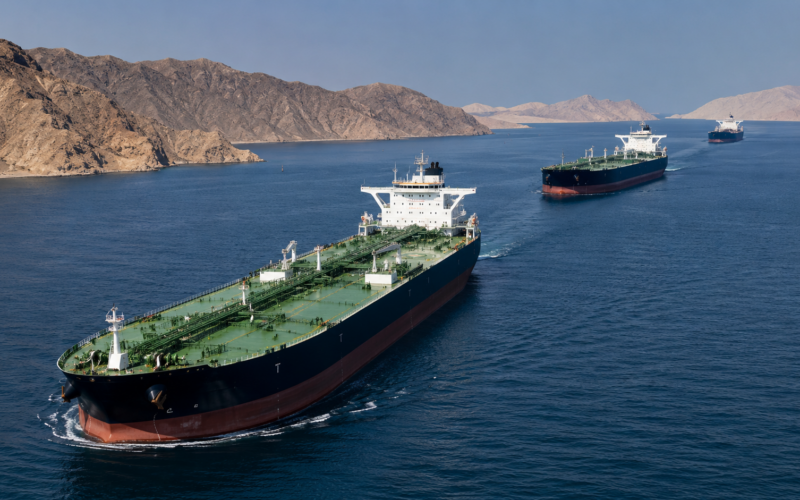
Two supertankers exited the Strait of Hormuz on Wednesday while a third tanker was making its way out, carrying a combined 6 million barrels of Middle East crude oil after waiting inside the Gulf for more than two months. The movement marks one of the clearest signs yet that some stranded crude cargoes are beginning to leave the Gulf despite continuing security risks around the world’s most important oil transit chokepoint.
Shipping data from LSEG and Kpler showed that the cargoes included Iraqi, Qatari and Kuwaiti crude bound for China and South Korea. The tankers are part of a small but closely watched group of very large crude carriers moving through the Strait of Hormuz this month using a transit route that Iran has ordered ships to follow.
The development matters because the Strait of Hormuz normally carries around one fifth of global oil and energy flows. Any disruption to the waterway can quickly affect crude prices, refinery planning, tanker insurance, strategic reserves and inflation expectations across Asia, Europe and North America. The latest tanker exits do not mean the Strait of Hormuz has returned to normal, but they do show that some Gulf crude exports are moving again under tightly constrained conditions.
Why are crude oil tankers exiting the Strait of Hormuz after more than two months inside the Gulf?
The tankers had been waiting inside the Gulf since early March and late February, when conflict conditions sharply reduced maritime movement through the Strait of Hormuz. The latest vessel movements show that some cargo owners, refiners and shipping operators are now attempting to clear crude oil trapped inside the Gulf, even though the transit environment remains far from routine.
The South Korean flagged very large crude carrier Universal Winner was carrying 2 million barrels of Kuwaiti crude loaded on March 4. The vessel was exiting the Strait of Hormuz after the departure of two China linked tankers on Wednesday. Kpler data showed the Universal Winner was heading to Ulsan, where SK Energy operates South Korea’s largest refinery, with discharge expected on June 9.
The China flagged Yuan Gui Yang loaded 2 million barrels of Iraqi Basrah crude on February 27, one day before the United States and Israel war on Iran began. The vessel was chartered by Unipec, the trading arm of Sinopec, and is expected to reach Shuidong Port near Maoming in southern Guangdong province on June 4.
The Hong Kong flagged Ocean Lily loaded 1 million barrels of Qatar’s al Shaheen crude and 1 million barrels of Iraqi Basrah crude between late February and early March. The vessel is owned by Sinochem and is expected to reach Quanzhou Port in eastern Fujian province on June 5.
Together, the three tankers represent 6 million barrels of crude oil moving out of the Gulf at a moment when global energy markets are watching every Hormuz transit for signs of either de escalation or renewed disruption.

How does the Strait of Hormuz tanker movement affect Asian refiners and crude supply chains?
The immediate commercial importance lies in Asia. China and South Korea are among the largest buyers of Middle East crude oil, and the cargoes now leaving the Gulf are headed toward major refining hubs in Guangdong, Fujian and Ulsan. These destinations matter because refinery feedstock timing is critical for fuel production, petrochemical supply and regional inventory planning.
For Chinese refiners, the Yuan Gui Yang and Ocean Lily cargoes add visibility to June crude receipts after weeks of uncertainty over whether Middle East barrels could move through the Strait of Hormuz. Sinopec and Sinochem exposure to the cargoes also makes the development relevant to China’s broader crude procurement system, which depends heavily on Gulf producers for stable supply.
For South Korea, the Universal Winner cargo provides a concrete example of how delayed Kuwaiti crude can still reach Northeast Asian refining systems despite the security strain around Hormuz. Ulsan is one of Asia’s most important refining and petrochemical centers, so the movement of Kuwaiti crude toward South Korea will be watched by fuel traders, refiners and policymakers.
The broader signal is that Asian buyers are not abandoning Gulf crude. Instead, the latest vessel movements suggest that buyers and ship operators are adapting to a higher risk operating model, using designated routes, selective vessel movements and careful timing to keep supply chains functioning.
Why does Iran’s ordered transit route matter for Strait of Hormuz shipping risk?
The tankers are among a limited number of supertankers exiting the Gulf this month through a transit route ordered by Iran. That detail is central to the story because it shows that movement through the Strait of Hormuz is not simply a matter of normal commercial navigation. It is now shaped by conflict risk, route control, security monitoring and political calculations.
The Strait of Hormuz is a narrow maritime corridor between Iran and Oman. Under normal conditions, it is a routine but highly strategic passage for crude oil, liquefied natural gas and refined product flows from the Gulf. Under conflict conditions, however, the Strait of Hormuz becomes a geopolitical pressure point where vessel movement can signal leverage, restraint or escalation.
The latest exits show that Iran’s route instructions are affecting how oil moves through the waterway. For shippers, this creates difficult operational choices. Following the route may allow some passage, but it does not eliminate risk. Ignoring the route could increase exposure to inspection, delay or security incidents.
This is why the latest 6 million barrel movement should not be read as a full reopening. It is better understood as a controlled and limited restart of some outbound crude flows. The distinction matters for energy markets because a handful of successful exits can ease immediate supply anxiety, while still leaving the wider shipping system exposed to disruption.
What does the 6 million barrel movement reveal about oil prices and market sentiment?
The tanker exits give oil markets a visible sign that crude stranded inside the Gulf is not completely immobilised. That can reduce some of the fear premium built into prices when traders believe supply may be trapped behind a strategic chokepoint.
However, the market signal remains mixed. On one side, 6 million barrels moving out of the Gulf is meaningful because each very large crude carrier can carry around 2 million barrels, and the cargoes are heading toward real refinery destinations. On the other side, normal Strait of Hormuz traffic is much larger and more fluid than the current pattern of limited, closely watched tanker exits.
Oil traders will therefore treat the movement as a positive supply signal but not as proof of restored normality. The important question is whether more tankers can follow over several days and weeks without incident. A single day of successful exits may cool immediate anxiety, but repeated passages would be needed to rebuild confidence in Gulf export reliability.
The movement also affects tanker insurance, freight rates and refinery procurement strategies. If shipowners continue to view Hormuz as high risk, freight and insurance costs may remain elevated even when crude cargoes physically move. That cost pressure can still flow through to refiners and, eventually, fuel markets.
How does the latest Strait of Hormuz movement fit into wider Gulf energy security concerns?
The latest tanker exits sit within a much larger Gulf energy security problem. The Strait of Hormuz is not just another sea lane. It is the outlet for major crude oil and gas exports from Saudi Arabia, Iraq, Kuwait, Qatar, the United Arab Emirates and Iran. When movement through the Strait of Hormuz slows, the impact spreads far beyond the Gulf.
For Gulf producers, the immediate priority is to keep export flows moving without exposing vessels, crews and infrastructure to unacceptable risk. For Asian buyers, the priority is to secure crude arrivals without overpaying for emergency replacement cargoes. For Western policymakers, the priority is to prevent energy market instability from feeding inflation and undermining economic conditions.
This is why the latest tanker movement carries strategic weight beyond its headline volume. Six million barrels is not enough to solve the Hormuz disruption. But it is enough to show that commercial actors are testing whether carefully managed transits can reopen a narrow path for energy flows.
The development also highlights why Gulf states have invested in alternative export routes, especially pipelines that bypass Hormuz. The United Arab Emirates has long used Fujairah on the Gulf of Oman as a strategic outlet outside the Strait of Hormuz. The renewed focus on bypass capacity reflects a basic reality: Gulf energy security cannot depend entirely on a single maritime chokepoint during a regional conflict.
Can the Strait of Hormuz return to normal if only a handful of supertankers are moving?
A normal Strait of Hormuz environment would involve steady two way movement of crude tankers, product tankers, liquefied natural gas carriers and commercial vessels, with predictable insurance, routing and port schedules. The current situation is far from that.
The latest movements show that selected tankers can exit, not that the whole system has stabilised. Cargoes waited for more than two months before moving. Some vessels have used restricted routing. Earlier tanker movements through Hormuz involved vessels switching off trackers to reduce exposure. Those conditions point to a fragile shipping environment rather than a restored trade corridor.
For refiners, the practical issue is not whether one cargo arrives. It is whether a schedule of cargoes can arrive reliably enough to support refinery runs, product exports and inventory targets. For governments, the issue is whether energy supply can be protected without widening the conflict. For insurers and shipowners, the issue is whether transiting Hormuz is commercially viable under current threat levels.
The answer, for now, is that the Strait of Hormuz appears partially usable but not fully normal. That makes every additional tanker exit important, because each movement adds evidence about whether the risk environment is improving or merely being managed temporarily.
What should governments, refiners and energy markets watch after the latest Hormuz tanker exits?
The next indicators will be vessel frequency, cargo diversity, destination patterns and whether ships move with tracking systems visible or hidden. If more tankers carrying Iraqi, Kuwaiti, Qatari, Emirati or Saudi crude exit consistently, markets may begin to price in a more durable reopening. If movements remain sporadic, the supply risk will remain embedded in crude pricing and freight markets.
Another key signal will be whether inbound empty tankers enter the Strait of Hormuz to load new cargoes. Outbound vessels clear stranded oil, but inbound ballast tankers are needed to restart the broader export cycle. The Cypriot flagged Grand Lady, an empty very large crude carrier, was reported to have entered the Strait of Hormuz with its transponder off and anchored off Dubai. Such movements are important because they show whether owners are willing to send ships back into the Gulf, not merely bring loaded vessels out.
The destination of cargoes also matters. China and South Korea are central indicators because they are major Asian refiners with deep exposure to Middle East crude. If China bound and South Korea bound cargoes continue to move, Asian crude buyers may gain more confidence in June and July supply planning.
For policymakers, the most important issue remains escalation risk. The movement of 6 million barrels through the Strait of Hormuz is a practical supply event, but it is also a geopolitical signal. It shows that crude can still move through the Gulf under constrained conditions. It does not remove the underlying security problem that made the cargoes wait for more than two months in the first place.
What are the key takeaways from the Strait of Hormuz crude tanker exits with 6 million barrels?
- Two supertankers exited the Strait of Hormuz on Wednesday, while a third tanker was making its way out with a combined 6 million barrels of Middle East crude oil.
- The cargoes had waited inside the Gulf for more than two months before moving through the strategic waterway.
- The tankers include China bound cargoes linked to Iraqi Basrah crude, Qatari al Shaheen crude and a South Korea bound Kuwaiti crude cargo.
- The destinations include Shuidong Port near Maoming in Guangdong province, Quanzhou Port in Fujian province and Ulsan in South Korea.
- The tanker exits show that some crude flows are restarting through the Strait of Hormuz, but the waterway has not returned to normal commercial conditions.
- The key market test is whether more loaded and empty tankers can move through the Strait of Hormuz consistently without renewed disruption.
Discover more from Business-News-Today.com
Subscribe to get the latest posts sent to your email.