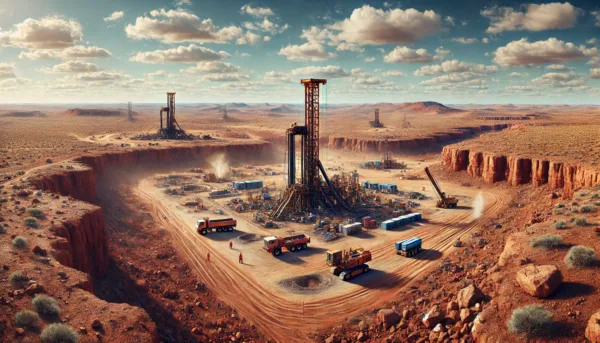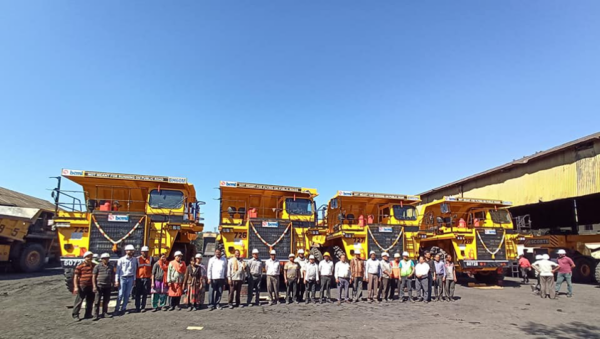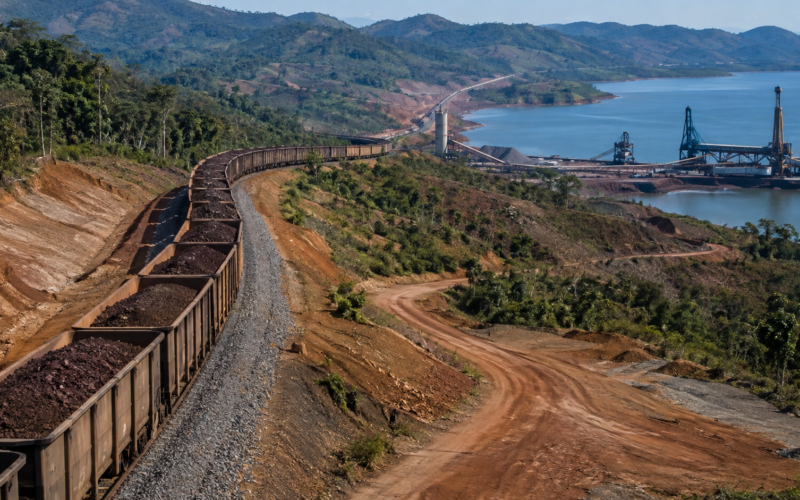
The Simandou Iron Ore Project is located in the Simandou mountain range in southeast Guinea, one of the world’s most important high-grade iron ore districts. The project is split into four blocks, with Blocks 3 and 4 developed by Rio Tinto SimFer and Blocks 1 and 2 developed by Winning Consortium Simandou, while the Government of Guinea holds strategic interests across the mining and infrastructure structure.
Simandou is not just a mine. It is an integrated national infrastructure system built around two mining concessions, more than 600 kilometres of new trans-Guinean railway, port facilities near the coast in Forécariah prefecture and a shared export chain designed to move ore from the country’s far southeast to international steel markets.
The project moved into operations in November 2025, with ore being railed from the SimFer mine through its rail spur and initially shipped through the WCS port while the SimFer port is completed. In the first quarter of 2026, SimFer shipped 0.6 million tonnes of iron ore, realised first sales in China in April and continued progressing toward its planned 60 million tonnes-per-year capacity, expected to be reached in the second half of 2028.
Simandou matters because it gives Guinea a chance to convert mineral wealth into railway, port, jobs, fiscal revenue and industrial leverage. It also matters for global steel supply because its premium-grade iron ore can help steelmakers reduce emissions intensity by using higher-grade feedstock. The harder test in 2026 is whether the project can move from first shipments to safe, reliable, large-scale operations across mines, rail, port systems, contractors and communities.
Where is the Simandou Iron Ore Project located and what infrastructure is being built?
The Simandou Iron Ore Project is located in southeast Guinea, in the Simandou mountain range. The deposit area lies far inland, which is why the project has always been as much an infrastructure challenge as a mining challenge.
The project is divided into four mining blocks. Blocks 3 and 4 are held through Rio Tinto SimFer, a joint venture involving Rio Tinto, the Chinalco-led CIOH consortium and the Government of Guinea. Blocks 1 and 2 are held by Winning Consortium Simandou, with China Baowu now playing a central role in the northern blocks.
The infrastructure package is designed to solve Simandou’s biggest historical constraint: distance from the coast. The project includes more than 600 kilometres of multi-use trans-Guinean railway and port infrastructure that allows iron ore mined in the southeast to be exported from Guinea’s Atlantic coast.
The rail system includes the common trans-Guinean main line and mine-specific connections such as the SimFer rail spur. SimFer said in June 2026 that its 70-kilometre rail spur had achieved full rail commissioning in the first quarter of 2026 and was already moving ore from the SimFer mine to the main rail line.
The port system is also central to the project. While SimFer’s own port continues toward commissioning, SimFer ore is initially being shipped through the WCS port. This staged logistics approach allows early shipments and sales to begin before every element of the dedicated SimFer port system is fully complete.

Who owns and operates the Simandou Iron Ore Project?
The Simandou ownership structure is complex because the project brings together separate mining concessions and shared national infrastructure. On the southern half of the deposit, Rio Tinto holds rights to Blocks 3 and 4 through Rio Tinto SimFer, in partnership with the Chinalco-led CIOH consortium and the Government of Guinea.
SimFer Jersey Limited is owned 53% by Rio Tinto and 47% by Chalco Iron Ore Holdings, known as CIOH. CIOH is led by Chinalco and includes Chinese state-owned partners including Baowu, China Railway Construction Corporation and China Harbour Engineering Company. The SimFer mine itself is structured with SimFer holding 85% and the Government of Guinea holding 15%.
The northern part of the deposit, Blocks 1 and 2, is developed by Winning Consortium Simandou. China Baowu has become increasingly important in that structure, with Baowu Resources taking control of the operator of Blocks 1 and 2 in 2026 after increasing its stake in the consortium.
The shared infrastructure is managed through La Compagnie du TransGuinéen, known as CTG. Rio Tinto says CTG is owned 42.5% by Rio Tinto SimFer, 42.5% by WCS and 15% by the Government of Guinea. Once commissioned, the co-developed infrastructure and rolling stock are expected to be transferred to and operated by CTG.
This structure is important because Simandou is not a simple single-company mine. It is a partnership between the Guinean state, a Rio Tinto-led southern mine structure, a WCS and Baowu-led northern mine structure, Chinese industrial and infrastructure players, and a jointly owned infrastructure company.
What is the planned capacity of the Simandou Iron Ore Project?
The full Simandou export system is designed to support up to 120 million tonnes per year of iron ore exports from SimFer and WCS combined. This makes it one of the largest new iron ore supply sources to enter the seaborne market in decades.
SimFer’s Blocks 3 and 4 are planned for approximately 60 million dry tonnes per year of iron ore production over the life-of-mine schedule. Rio Tinto’s attributable share of that production is about 27 million dry tonnes per year. SimFer said in June 2026 that the project was progressing toward planned annual capacity of 60 million tonnes, expected to be reached in the second half of 2028.
WCS is also developing its own mine capacity from Blocks 1 and 2, with the shared rail and port system designed to move ore from both the northern and southern concessions. The capacity structure means Simandou is effectively two mining systems tied into one national export corridor.
The reserve quality is one of the main reasons Simandou has drawn global attention for decades. Rio Tinto has reported Simandou ore reserves of around 1.5 billion tonnes across Blocks 3 and 4, including high iron grades of about 65% to 66% Fe. That grade profile makes the ore valuable for steelmakers seeking higher-quality feedstock.
The project’s capacity should be understood as a ramp-up target rather than an immediate operating level. SimFer shipped 0.6 million tonnes in the first quarter of 2026, and Rio Tinto has kept 2026 Simandou sales guidance at 5 million to 10 million tonnes on a 100% basis. The move toward full capacity will depend on mine output, railway reliability, port commissioning, shipping logistics, contractor performance and safety systems.
How does the Simandou mine, rail and port system work?
The Simandou system begins with high-grade iron ore mined in the Simandou mountain range. Ore is crushed and stockpiled at the mine before being moved by rail toward the coast. Rio Tinto has said Simandou production is counted as crushed ore at the SimFer mine gate before train loading, with final tertiary crushing taking place in China.
The SimFer rail spur connects the southern mine to the main trans-Guinean rail line. This 70-kilometre spur is critical because it links the mine to the common national corridor that carries ore across Guinea. SimFer said the spur was fully operational and fully commissioned in the first quarter of 2026.
The main rail line then moves ore across the country to coastal export facilities. This is the defining infrastructure challenge of Simandou. Without the railway, the deposit cannot become a global iron ore supply source at meaningful scale.
At the coast, ore is moved through port and transshipment infrastructure. Rio Tinto has said ore from SimFer is initially being shipped through the WCS port while construction of the SimFer port is finalised. SimFer reported that its port was 78% complete at the end of March 2026, with commissioning expected in the first quarter of 2027.
This staged system means the project can begin shipping before every piece of the final logistics chain is complete. It also means 2026 is a transition year, with early sales underway but full logistics optimisation still ahead.
Which companies and partners are delivering the Simandou project?
Simandou’s delivery model is built around project partners rather than a single turnkey contractor. On the SimFer side, Rio Tinto is the majority shareholder and managing partner of the southern blocks through Rio Tinto SimFer. The Chinalco-led CIOH consortium brings Chinese state-owned industrial and infrastructure partners into the structure.
CIOH includes Chinalco, Baowu, China Railway Construction Corporation and China Harbour Engineering Company. That partner mix reflects the project’s dual nature: Simandou requires mining, rail, port, heavy construction, shipping and steel-industry demand alignment.
Winning Consortium Simandou is the developer of Blocks 1 and 2 and a co-developer of the shared infrastructure. China Baowu’s role has grown through its control of the northern block operator, making the world’s largest steelmaker a central participant in the project’s commercial and operating structure.
The Government of Guinea is also a core project partner, not just a regulator. It holds equity interests in the mining and infrastructure structures and sees Simandou as a national transformation project. The state’s role is central because the railway and port corridor has implications beyond mining exports.
La Compagnie du TransGuinéen is the vehicle for the shared infrastructure system. CTG’s planned role is important because Simandou’s long-term value depends on the railway and port functioning as a national industrial corridor, not only as a private mine evacuation route.
Public disclosures do not give a simple single list of EPC winners for every package in the way some offshore or power projects do. The safest reading is that Simandou is being delivered through a partner-led construction and operating framework involving Rio Tinto SimFer, WCS, CTG, the Government of Guinea and Chinese industrial and infrastructure shareholders.
How did Simandou move from decades of delay to operations?
Simandou has been one of the mining industry’s most delayed mega projects. Rio Tinto first became involved in the deposit in the 1990s, but the project was slowed for years by ownership disputes, political instability, infrastructure cost, commercial negotiations and the sheer difficulty of building a long rail and port corridor through Guinea.
The project’s main challenge was always logistics. The orebody is high grade, but it is located far from the coast. A world-class ore deposit cannot become a world-class export business without rail and port infrastructure capable of moving tens of millions of tonnes every year.
Momentum increased after Guinea pushed for coordinated development and national participation. The creation of CTG in 2022 provided a framework for shared infrastructure, while Rio Tinto, SimFer, WCS and the Government of Guinea worked to align rail, port and mining development.
Rio Tinto’s Simandou investment moved through approvals in 2024, after conditions were satisfied for the company’s participation in the co-developed infrastructure and mine. The SimFer funding requirement was previously estimated at about $11.6 billion, with Rio Tinto’s share around $6.2 billion.
The start of operations in November 2025 was therefore a major historical milestone. It marked the point at which Simandou began moving from long-delayed ambition to physical ore movement, port activity and customer sales.
What are the latest Simandou Project updates in 2026?
The latest 2026 updates show Simandou shifting from start-up to ramp-up. SimFer reported in June 2026 that ore was being railed from the SimFer mine to the main rail line through the SimFer rail spur and shipped through the WCS port to international customers.
The SimFer mine was approximately 74% complete at the end of March 2026, with bulk earthworks and permanent process facilities progressing in line with plan. Ore continued to be crushed and stockpiled as ramp-up activity advanced.
The SimFer rail spur reached full commissioning in the first quarter of 2026. That is a major milestone because the spur links the mine to the trans-Guinean main rail line and allows ore to move from the inland mine area into the wider logistics system.
The SimFer port was 78% complete at the end of March 2026, with commissioning expected in the first quarter of 2027. The arrival of three shiploaders at the Morebaya port was another important milestone in preparing the export system for higher volumes.
SimFer also reported shipment of 0.6 million tonnes of iron ore in the first quarter of 2026, with first sales realised in China in April. Rio Tinto’s first-quarter 2026 production report separately confirmed the first full SimFer shipment of high-grade Simandou product was successfully delivered to China, with first sales realised in April.
Rio Tinto’s July 2026 production update said SimFer mine construction and port infrastructure were both more than three quarters complete, while 2026 Simandou sales guidance remained unchanged at 5 million to 10 million tonnes on a 100% basis. The company also continued to flag a two to three month lag between mine-gate production and sales because ore must be railed, shipped to China and crushed there.
What role does Simandou play in global iron ore and steel markets?
Simandou matters to the global iron ore market because it adds a large new high-grade supply source outside Australia and Brazil, the two dominant seaborne iron ore export regions. Once fully ramped, the wider Simandou system could export up to 120 million tonnes per year from the SimFer and WCS concessions combined.
For China, Simandou is strategically important because Chinese steelmakers are the world’s largest iron ore consumers and have long sought greater supply diversity. The involvement of Chinalco, Baowu and WCS gives Chinese industrial players deep exposure to the project’s ownership, financing, infrastructure and offtake logic.
For Rio Tinto, Simandou complements its Pilbara iron ore base and Iron Ore Company of Canada portfolio. It gives the company exposure to a premium-grade African orebody, though at a very different risk profile from its long-established Australian operations.
The high-grade nature of Simandou ore is also relevant to steel decarbonisation. Higher-grade iron ore can improve blast furnace efficiency and is often better suited for lower-emission steelmaking pathways compared with lower-grade ore that requires more processing or generates higher emissions per tonne of steel output.
That does not make Simandou a zero-carbon project. Mining, rail, shipping and steelmaking all carry emissions. But the ore quality gives Simandou strategic value in a market where steelmakers are under pressure to reduce carbon intensity while maintaining production.
How could Simandou reshape Guinea’s economy?
Simandou could reshape Guinea’s economy because it is not limited to mine output. The project includes a national railway corridor, coastal port infrastructure, workforce development, supplier networks, local procurement, community programmes and government revenue.
The trans-Guinean railway is the most important economic lever beyond mining. If managed effectively, multi-use rail infrastructure can support broader economic activity, connect inland regions more efficiently and provide a platform for future industrial development.
The port infrastructure also has national significance. Guinea’s ability to move bulk commodities through modern export facilities can increase its role in global minerals supply chains. Over time, this could support additional investment in mining, logistics and processing.
The Government of Guinea’s equity participation gives the state a direct stake in long-term project value. The country’s challenge will be converting that stake into durable public benefit through transparent revenue management, infrastructure access, local capability and social development.
Simandou also carries high expectations. Large mining projects can create jobs, royalties and infrastructure, but they can also create displacement, social tension and uneven benefits if governance is weak. The project’s national impact will depend on how revenues, jobs, land use, safety and community commitments are managed over decades.
What regulatory, environmental and community issues shape Simandou?
Simandou operates in a sensitive environmental and social setting. The project spans mining areas, rail corridors, communities, agricultural land, forests and coastal ecosystems. Its footprint is much larger than the mine itself because the export corridor stretches across a major part of Guinea.
Rio Tinto has said Simandou is being developed in line with internationally recognised environmental, social and governance standards, with commitments to transparent reporting, stakeholder engagement and mitigation of mining impacts. Those commitments will be tested as construction transitions into sustained operations.
Community engagement is a long-term issue. The rail corridor, mine development and port infrastructure affect communities through land access, resettlement, traffic, dust, noise, safety, employment expectations and public-service demands. SimFer’s 2026 update referenced community forums across the mine, rail spur and port, as well as road safety campaigns across eight prefectures.
Safety is another critical issue. Simandou has faced serious safety scrutiny after fatal incidents during the project’s construction period. Rio Tinto’s 2026 materials refer to the establishment of a Simandou Safety Advisory Panel to provide independent external advice on safety performance across the SimFer project.
Labour relations have also emerged as a current operational issue. In May 2026, Reuters reported that mining at the Baowu-led Blocks 1 and 2 site was halted by a pay-related worker dispute before operations resumed after the strike ended. That episode shows how labour compliance, workforce management and local expectations can affect ramp-up.
What could limit Simandou’s ramp-up or long-term performance?
The first major limitation is execution risk. Simandou is already operating, but ramping from first shipments to tens of millions of tonnes per year requires consistent performance from the mine, rail, port, stockyard, shiploading and transshipment chain.
Rail reliability will be central. The mine is far inland, and every tonne exported depends on the rail corridor. Disruption from mechanical issues, weather, maintenance, contractor coordination, community incidents or labour disputes could affect volumes.
Port commissioning is another near-term bottleneck. SimFer’s port was still under construction in early 2026, with commissioning expected in the first quarter of 2027. Until that system is fully commissioned, export logistics remain partly dependent on interim arrangements through WCS infrastructure.
Safety and labour performance will remain central to the project’s credibility. Simandou is one of the world’s most visible mining projects, and its scale means incidents can have commercial, regulatory and reputational consequences.
Market risk also matters. Simandou’s high-grade ore should command strategic interest, but iron ore prices remain cyclical. A large new supply source entering the market could affect pricing, especially if Chinese steel demand softens or global steel production weakens.
What is the future outlook for the Simandou Iron Ore Project?
The future outlook for the Simandou Iron Ore Project is positive but execution-sensitive. The project has finally entered operations after decades of delay, first shipments have left Guinea, first sales have been realised in China and SimFer is progressing toward 60 million tonnes per year of planned annual capacity by the second half of 2028.
The next major milestones are port commissioning, rail reliability, mine completion, higher shipment volumes and safe ramp-up across both the SimFer and WCS systems. These are practical operating milestones, not just ceremonial project markers.
If the ramp-up succeeds, Simandou could become one of the most important new iron ore supply hubs in the world. It would diversify seaborne high-grade iron ore supply, strengthen China-linked steel supply chains, expand Rio Tinto’s iron ore portfolio and give Guinea a transformational infrastructure asset.
For Guinea, the bigger question is whether Simandou becomes a national development platform or mainly an export corridor. The railway, port, jobs and revenues could reshape the country’s economic base, but only if governance, local participation and infrastructure access are managed well.
For the iron ore market, Simandou is already past the point of being only a future threat or promise. Ore has moved, shipments have begun and sales have been realised. The 2026 question is whether Guinea’s mega mine can turn early operations into a reliable 120Mtpa export system without losing control of safety, communities, costs and national expectations.
Discover more from Business-News-Today.com
Subscribe to get the latest posts sent to your email.