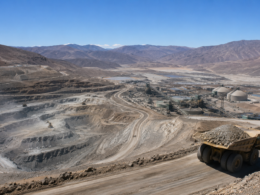

Lindian Resources Limited (ASX:LIN) has moved beyond mine construction and into active mining after completing the first production blast at its Kangankunde Rare Earths Project in Malawi. The blast covered 206 holes and fragmented approximately 13,100 tonnes of material, strengthening the company’s timetable for front-end commissioning in October and first concentrate production during the fourth quarter of 2026. LIN shares traded around A$0.98 in late-morning trading on July 3, up more than 5 per cent for the session and valuing the pre-revenue company at approximately A$1.8 billion. The next four months must now prove that Kangankunde can move from a highly valued construction story into a dependable rare earths operation.
The share price is approximately 6.5 per cent above its June 26 close and more than 17 per cent above the June 3 close. It is also sitting within a few percentage points of its A$1.02 52-week high, compared with a yearly low near A$0.09. That performance shows how much confidence the market has already placed in first production, downstream processing and Lindian’s ability to participate in the increasingly strategic non-Chinese rare earths supply chain.
Why does the first Kangankunde production blast matter more than another construction update?
The first blast marks the formal beginning of active mining at Kangankunde. It confirms that the production drill, explosives approvals, magazine infrastructure, mine access and operating personnel were ready to work together under real mining conditions. That is a more consequential milestone than another equipment-delivery photograph because it begins the physical process of extracting material intended to support commissioning and production.
Lindian already had approximately 27,000 tonnes of ore on the run-of-mine pad before the maiden production blast. This early inventory gives the processing team material that can be used during plant commissioning, allowing mechanical, electrical and recovery issues to be identified without waiting for the mine to establish full production rhythm. It can also reduce the risk that a temporary mining interruption leaves the new processing plant without feed during its most sensitive ramp-up period.
The blast does not mean commercial production has begun. The material still needs to be mined selectively, hauled, stockpiled and processed through a plant that remains under construction. Investors must therefore distinguish between mining commencement and the later achievement of saleable concentrate at the expected grade, recovery and operating cost.
The immediate significance is that one more major dependency has been removed. Kangankunde is no longer waiting for mining access or its first drill-and-blast cycle. The remaining challenge is coordinating mining, construction, power, water, tailings infrastructure and plant commissioning closely enough to preserve the fourth-quarter production target.
What makes Kangankunde different from the many rare earth projects that never reach production?
Kangankunde contains a Mineral Resource of 261 million tonnes grading 2.14 per cent total rare earth oxides. This includes 61 million tonnes in the indicated category at 2.43 per cent total rare earth oxides and an inferred resource of 200 million tonnes at 2.05 per cent. The project also has a probable Ore Reserve of 23.7 million tonnes grading 2.9 per cent total rare earth oxides.
Approximately 20 per cent of the project’s total rare earth content consists of neodymium and praseodymium, the elements used in high-strength permanent magnets for electric motors, wind turbines, robotics and defence systems. Kangankunde also contains relatively low uranium and thorium levels, reducing some of the handling, transport and downstream-processing complications associated with radioactive impurities in monazite deposits.
The project’s proposed processing route is comparatively simple. Stage 1 is designed to produce a high-grade monazite concentrate through physical beneficiation rather than constructing a large, chemically complex separation facility at the mine. This contributes to an estimated Stage 1 development cost of approximately US$40 million, unusually modest for a rare earths project approaching production.
Its location also offers useful infrastructure advantages. Kangankunde has access to established roads and an export route through Mozambique, while a 27-kilometre power corridor and 269 power poles have been installed towards the Balaka substation. All 17 planned water boreholes have been drilled, and work on the site’s water-distribution system is progressing.
These strengths reduce development complexity but do not eliminate it. A high-grade, low-radioactivity deposit can still underperform if the processing plant fails to achieve expected recoveries, logistics costs exceed assumptions or product specifications differ from customer requirements. Kangankunde’s differentiation now needs to be proven through operating data rather than geological comparisons.
Can Stage 1 production economics support Lindian Resources’ A$1.8 billion market value?
The Kangankunde feasibility study estimated average production of approximately 15,323 tonnes of concentrate annually, containing around 8,259 tonnes of total rare earth oxides and 1,613 tonnes of neodymium-praseodymium. The study estimated a post-tax net present value of US$555 million, a post-tax internal rate of return of 80 per cent and operating expenditure of approximately US$2.92 per kilogram of rare earth oxide.
Those figures helped establish Kangankunde as a potentially low-cost project, but Lindian’s present equity value is substantially higher than the feasibility study’s stated Stage 1 net present value after currency conversion. The gap suggests that the market is not valuing Lindian solely on the initial mining operation.
The valuation appears to include expectations for successful Stage 1 execution, the much larger Stage 2 expansion, higher-value downstream production in Kazakhstan and the strategic value of supplying rare earth materials outside China. It may also include a premium for the project’s long life and the possibility that governments or industrial customers will support alternative supply chains through financing, floor prices or long-term procurement.
This does not necessarily make the valuation excessive. Feasibility-study valuations use specific commodity prices, discount rates and operating assumptions that may not capture strategic scarcity or later expansions. However, it does mean that simply reaching first production may not be enough to generate another major rerating.
At around A$1.8 billion, the market expects a relatively smooth commissioning process and a credible pathway towards considerably greater scale. A delayed ramp-up, weaker recovery or cost overrun could therefore affect the shares more severely than it would affect a developer still valued mainly on its initial mine economics.
What must happen between the first blast and Q4 2026 concentrate production?
Mining must first establish a reliable supply of correctly classified ore. Drill-and-blast activity must be followed by grade control, selective loading, haulage and stockpile management. The existing run-of-mine inventory provides a useful buffer, but plant commissioning will eventually require a continuing flow of feed with sufficiently predictable grade and mineralogy.
The Tailings Storage Facility represents another critical path item. Construction was approximately 50 per cent complete in June, with completion targeted for September. Delays to tailings infrastructure could restrict wet commissioning even if the main processing plant is mechanically ready.
Electrical and water infrastructure must also be completed and tested. Front-end commissioning remains targeted for October, followed by practical completion around the middle of November. Lindian is still targeting first production within the fourth quarter, leaving limited room between final construction, commissioning and the end of the calendar year.
The first concentrate batch will not by itself establish steady-state economics. Investors will need production volumes, concentrate grade, recovery, plant availability, operating costs and evidence that material can be transported and sold under commercially workable arrangements.
The July 30 quarterly report should provide the next formal assessment of cash expenditure, construction progress and operational readiness. Further announcements around plant energisation, Tailings Storage Facility completion, first feed and first concentrate will progressively reveal whether the schedule remains intact.
How do Iluka Resources and Lindian’s Singapore sales hub reduce commercial risk?
Lindian has a binding 15-year supply agreement with Iluka Resources Limited covering 6,000 tonnes of rare earth concentrate annually from Kangankunde. The total 90,000-tonne commitment is expected to represent approximately 10 per cent of the feed capacity of Iluka Resources’ Eneabba rare earths refinery in Western Australia.
The partnership also includes a US$20 million construction term-loan facility. Iluka Resources provides Lindian with an established downstream counterparty, while Kangankunde gives the Eneabba refinery an external source of neodymium-praseodymium-rich concentrate. This alignment reduces the risk that Lindian completes the mine without an identified customer for a meaningful portion of Stage 1 production.
Lindian has separately terminated its earlier five-year sales arrangement with Gerald Metals. The termination required the issue of 20 million Lindian shares, subject to 90 days of voluntary escrow, but restored control over product allocation and marketing outside the Iluka Resources commitment.
The company subsequently established a Singapore office to manage international sales, marketing and logistics. Bringing these functions in-house gives Lindian greater flexibility to negotiate directly with refiners, automotive companies, original equipment manufacturers and strategic industrial customers.
Direct marketing can improve pricing and customer intelligence, but it also transfers responsibility from an established commodities trader to Lindian. The company must build logistics, credit assessment, contract management and customer-support capability while commissioning its first mine. Recovering greater commercial control is valuable only when the internal sales organisation can execute reliably.
Could the SARECO plant turn Lindian from a concentrate producer into a higher-margin processor?
Lindian’s proposed downstream strategy centres on the SARECO hydrometallurgical facility in Stepnogorsk, Kazakhstan. The planned joint venture structure gives Lindian 51 per cent and RA Group 49 per cent, with the parties acquiring the plant for US$15 million. Approximately 12,500 tonnes of Kangankunde concentrate could be processed annually into higher-value mixed rare earth carbonate, with first production targeted for the fourth quarter of 2026.
The facility already has infrastructure, permits, industrial services and an operating history. This gives Lindian a potentially faster and less capital-intensive route into downstream processing than building a new chemical plant. Independent test work has indicated a recovery profile of approximately 92 per cent for total rare earth oxides and around 97 per cent for neodymium-praseodymium.
Selling mixed rare earth carbonate rather than concentrate could improve payability and capture a larger part of the value chain. It could also make Lindian more strategically relevant to customers seeking material processed outside China.
The downstream plan introduces a new set of risks. The plant requires due diligence, recommissioning, engineering verification and operating preparation. Lindian must also transport concentrate from landlocked Malawi to Kazakhstan, creating a longer and more complicated logistics chain than supplying customers through southern African ports.
Running a mine and recommissioning an overseas chemical-processing facility during the same quarter is ambitious. Any delay at SARECO would not necessarily prevent Kangankunde from selling concentrate, particularly because the Iluka Resources agreement provides an alternative route. It could, however, weaken the vertically integrated valuation narrative already reflected in LIN shares.
How does the worsening rare earth supply conflict strengthen the Lindian investment case?
The geopolitical backdrop remains supportive for rare earth projects outside China. China has continued using export licensing and controls over critical minerals and dual-use products, while governments in the United States, Europe, Japan and Australia are accelerating efforts to diversify supply and processing. Recent restrictions have intensified uncertainty for defence, automotive, electronics and magnet manufacturers that depend on Chinese materials.
The G7 has committed to reducing dependence on any single critical-mineral supplier, with stockpiling and supply-chain diversification becoming increasingly prominent policy tools. Companies affected by supply restrictions are also searching for alternative suppliers, even though replacing China’s mining, refining and magnet-manufacturing capacity will take years.
Kangankunde fits this strategic requirement because it offers a near-term source of neodymium-praseodymium-rich concentrate with low radioactive impurities. The Iluka Resources partnership creates a possible supply chain linking a mine in Malawi with refining capacity in Western Australia, while SARECO offers a second non-Chinese processing route through Kazakhstan.
Geopolitical scarcity does not guarantee attractive commodity pricing. China can influence rare earth markets through production, inventories and export policies, while new Western supply may eventually place pressure on prices. Lindian’s strongest defence is therefore its expected low operating cost rather than an assumption that rare earth prices will remain permanently elevated.
The macro environment increases the strategic value of successful production. It cannot compensate for a missed construction schedule, weak recovery or unreliable product quality.
Why are investors watching LIN so closely when so much success is already priced in?
Lindian offers a rare combination on the Australian Securities Exchange. It owns a large rare earth resource, has completed a feasibility study, secured funding and offtake, begun mining, started building an international sales operation and is pursuing downstream processing. Few rare earth developers have reached all these milestones while retaining significant expansion potential.
This explains why the stock has risen from around A$0.09 at its 52-week low to approximately A$0.98. The market increasingly treats Lindian as an approaching producer rather than an exploration company. That transition has attracted investors who want exposure to rare earth supply-chain diversification before the first operating revenue appears.
The tension is that the valuation leaves little room for ordinary project slippage. A developer valued near A$1.8 billion must do more than complete construction. It must demonstrate that production can scale, customers will accept the product and the downstream strategy can improve margins without consuming excessive capital.
Share-count growth also deserves attention. Lindian issued 20 million shares to terminate the Gerald Metals arrangement, while securities have been issued through option conversions and management-related approvals. Further expansion or downstream investment may require additional capital even though Stage 1 is described as fully funded.
Investors should also distinguish the Stage 2 opportunity from the current operating plan. Stage 2 targets a four-million-tonne-per-year processing pathway and approximately 120,000 tonnes of annual concentrate capacity. Its feasibility study is targeted for December 2026, but expansion remains subject to study outcomes, financing and a future final investment decision.
The next sustainable rerating will probably require operating evidence. First concentrate, achieved recoveries, repeat shipments and a credible Stage 2 study would support the market’s optimism. Schedule slippage or disappointing plant performance would test whether the current valuation has moved too far ahead of project reality.
What are the key Lindian Resources takeaways for investors watching ASX:LIN?
- Lindian Resources has completed the first Kangankunde production blast, marking the start of active mining ahead of targeted first production in the fourth quarter of 2026.
- Approximately 27,000 tonnes of ore had already been stockpiled before the blast, providing commissioning feed and reducing part of the early ramp-up risk.
- LIN shares traded near A$0.98 on July 3, valuing the company at roughly A$1.8 billion and placing the stock close to its 52-week high.
- Stage 1 is fully funded and targets high-grade monazite concentrate, but the current valuation appears to include substantial value for Stage 2 and downstream processing.
- Iluka Resources has committed to buying 6,000 tonnes of concentrate annually for 15 years, providing a cornerstone customer for Kangankunde.
- The Singapore sales hub and termination of the Gerald Metals agreement give Lindian greater control over remaining output, pricing and customer relationships.
- SARECO could increase Lindian’s margins by converting concentrate into mixed rare earth carbonate, although recommissioning and international logistics add execution risk.
- October commissioning, November practical completion and first concentrate production are the milestones that must now validate the market’s expectations.
Discover more from Business-News-Today.com
Subscribe to get the latest posts sent to your email.