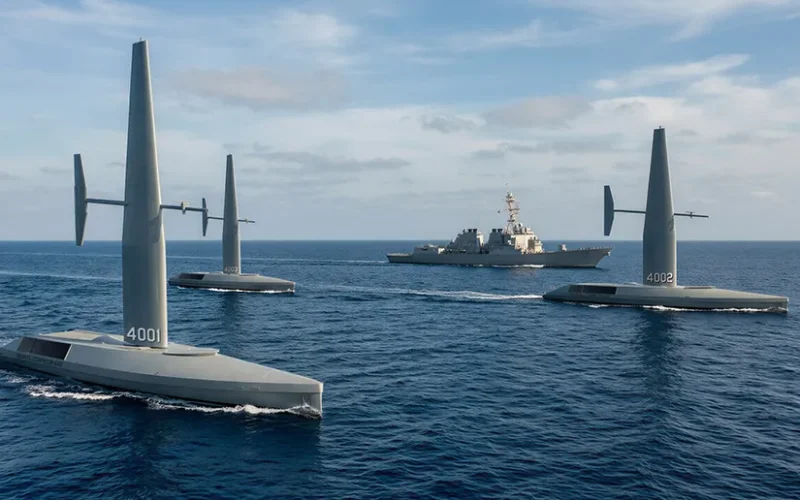
Saildrone, the California-based autonomous maritime company with more than a decade of operational experience deploying unmanned surface vehicles in open-ocean conditions, has unveiled Spectre, its largest and most capable platform to date. The announcement, made at the Navy League’s Sea-Air-Space 2026 exhibition in National Harbor, Maryland, was accompanied by the confirmation that Fincantieri Marine Group, the US subsidiary of Italian shipbuilder Fincantieri, will construct the vessel at its Wisconsin shipyard system. The programme brings together Lockheed Martin as payload integrator under a $50 million strategic partnership signed in October 2025, with Thales providing variable-depth sonar integration. At approximately $40 million per vessel, Spectre enters a naval unmanned surface vehicle market that is moving rapidly from concept to procurement, and the platform is being positioned as Saildrone’s entry into the US Navy’s Medium Uncrewed Surface Vessel programme.
What does Spectre’s dual-variant architecture mean for US Navy anti-submarine warfare coverage?
Spectre’s engineering brief reflects a deliberate attempt to serve two distinct operational demands within a single hull programme rather than compromising on either. The Silent Endurance variant retains Saildrone‘s signature 43-metre composite wing, built by American Magic Services at its Pensacola facility, which enables near-silent electric propulsion at speeds up to 12 knots and extends range to more than 8,000 nautical miles. That endurance profile is directly relevant to anti-submarine warfare, where dwell time over a patrol corridor matters as much as sensor capability. The Stealth Strike variant strips the wing entirely, reducing both visual and radar cross-section to produce a platform suited to kinetic strike missions where signature discipline and sprint speed take precedence over endurance.
The twin-shaftline propulsion arrangement underpins both variants. Twin electric motors handle quiet-mode operations, while two Caterpillar diesel engines delivering a combined 5,000 horsepower push the platform to 27 knots under full load. Controllable-pitch propellers allow Spectre to modulate its acoustic signature actively, which is not a trivial capability in ASW operations where the towing vessel’s own noise floor can degrade the performance of streamed sonar arrays. At a cruising speed of 25 knots with a 25-tonne payload, Saildrone projects a range of 3,280 nautical miles in flat water and 2,790 nautical miles in Sea State 4 head-sea conditions. These figures were verified through months of hydrodynamic testing on a 1:7 scale model at Force Technologies’ tow tank in Copenhagen.
The structural decision to engineer the hull to accept or reject the wing from the outset, rather than treating one configuration as a modification of the other, reflects a level of design maturity that distinguishes Spectre from USV concepts developed in closer proximity to request-for-proposal cycles. Richard Jenkins, Saildrone’s founder and chief executive, confirmed the platform is fully self-funded and stated it is 100 per cent compliant with US Navy Medium Uncrewed Surface Vessel threshold and desired requirements without modification. That is a significant commercial positioning claim, and one the Navy will be expected to stress-test rigorously.
How does the $50 million Lockheed Martin partnership shape Spectre’s payload and strike integration?
The payload architecture is where Spectre’s strategic ambition becomes most legible. The concealed deck can accommodate up to two 40-foot containers or five 20-foot containers, giving mission planners flexibility to configure the vessel for ASW, electronic warfare, or kinetic strike without redesigning the hull. The integration of the Lockheed Martin Mk70 Payload Delivery System, which adapts four Mk-41 shipborne vertical launch cells into a standard shipping container footprint, converts Spectre into a distributed strike node. Two Mk70 launchers can be carried simultaneously, meaning a single unmanned platform operating ahead of a surface action group could hold a meaningful offensive load at modest cost relative to a crewed surface combatant.
The Mk70 is scheduled for a live-fire demonstration at the US Navy’s Rim of the Pacific exercise this summer, integrated onto a Saildrone Surveyor. That test is designed to de-risk the propulsion and autonomy interfaces before the same integration architecture transfers to Spectre. It is a sensible sequencing decision, though it also makes Spectre’s kinetic strike claim conditional on a demonstration that has not yet occurred. The Lockheed Martin partnership provides not just hardware compatibility but also mission autonomy integration, with Lockheed Martin functioning as the system integrator for payload autonomy rather than simply a hardware supplier.
Thales’s Combined Active Passive Towed Array Sonar-4 variable-depth sonar system adds a genuine below-surface sensing capability. Variable-depth sonar is significant in ASW because it can be deployed beneath thermal layers that defeat hull-mounted sonar, allowing detection at ranges that surface sensors cannot achieve. The transom-deployment configuration built into Spectre’s design enables streaming of both thin-line towed arrays and variable-depth systems, with the controlled acoustic signature of the vessel itself preserving the integrity of the sensor data. SH Defence’s mine-laying module has also been identified as a compatible payload, extending Spectre’s mission envelope further into area-denial operations.
What does Fincantieri’s Wisconsin production commitment signal about the industrial strategy behind autonomous naval platforms?
Fincantieri Marine Group’s involvement answers a production question that has historically weakened USV programme credibility. Many autonomous maritime platform announcements have described compelling operational concepts while leaving the manufacturing pathway vague. Spectre has a named shipbuilder, a specific facility, a stated production rate of five vessels per year, and a confirmed sea trials date in early 2027 for the first hull. Long-lead materials, primarily the twin-shaft diesel-electric propulsion components, were ordered in October 2025. The programme is, by Saildrone’s account, already in motion rather than awaiting a contract award to begin.
Fincantieri’s positioning of this programme as part of a broader transformation from traditional shipbuilder to system-level industrial integrator deserves examination. The Italian group has navigated a challenging period in naval shipbuilding, with US Navy frigate construction delays and cost pressures at Marinette Marine drawing attention from both the Pentagon and congressional oversight. Taking on an aluminium USV programme at volume, rather than a steel combatant at low rate, represents a different industrial risk profile. Aluminium construction is faster and less labour-intensive at this displacement class, and the annualised production rhythm of five hulls is more compatible with continuous workforce deployment than large combatant block construction.

The European dimension of the programme is also relevant. Jenkins confirmed that Saildrone is evaluating Spectre construction in Europe, citing the immediacy of the Russian submarine threat to undersea infrastructure across the North Sea and Baltic. That geographic interest aligns with current NATO investment in autonomous maritime patrol capability and suggests Saildrone views Spectre as a platform with allied-navy demand beyond the US Navy’s MUSV competition.
What are the operational risks and competitive pressures facing Spectre before the US Navy makes procurement decisions?
Several execution risks sit beneath the programme’s confident public presentation. Spectre is a self-funded development, which insulates Saildrone from the contractual dependencies that constrain government-funded programmes but also means the company is absorbing development and production cost without a committed buyer. At $40 million per hull, Spectre is positioned below the cost threshold of crewed surface combatants but above the expendable drone tier. Whether the US Navy views that price point as cost-effective persistent presence or expensive autonomy depends heavily on how the service weights reliability and payload utility against attrition risk in contested environments.
The American Bureau of Shipping’s Approval in Principle confirms Spectre complies with High Speed Naval Craft classification standards, and Saildrone is the only USV operator to have achieved full ABS class certification for its existing platforms. That regulatory track record provides some assurance that the classification process for Spectre will not stall on technical grounds. The autonomy software, drawing on more than ten years of open-ocean operational data across Saildrone’s Voyager and Surveyor fleet, is arguably the least-discussed but most operationally significant component of the platform. Command-and-control reliability at extended range, COLREGS compliance in mixed maritime traffic, and graceful degradation under electronic interference are questions that tank tests cannot answer but operational deployment will.
The competitive landscape for the MUSV programme includes Textron’s Devil Ray and other contenders that have accumulated Navy evaluation time. Spectre enters the competition with a differentiated ASW payload suite and a formal industrial production commitment, but without a competitive evaluation record in Navy hands. The live-fire RIMPAC demonstration this summer is the next meaningful milestone and will receive significant scrutiny from programme office staff and potential allies watching the MUSV competition.
Key takeaways: what Saildrone Spectre means for autonomous naval warfare, the MUSV competition, and allied maritime strategy
- Saildrone’s Spectre is the largest and most capable unmanned surface vehicle yet unveiled by a Western autonomous maritime company, at 52 metres and 250 tonnes with a 30-knot top speed.
- The dual-variant architecture, Silent Endurance for ASW and Stealth Strike for kinetic operations, addresses two distinct mission sets within a single hull programme rather than forcing a capability compromise.
- Integration of the Lockheed Martin Mk70 VLS launcher enables Spectre to carry a meaningful offensive missile load, converting an ISR platform into a distributed strike node at roughly one-tenth the operating cost of a crewed surface combatant.
- Thales CAPTAS-4 variable-depth sonar capability addresses a genuine coverage gap in below-surface detection, particularly in thermally stratified waters where hull-mounted arrays are limited.
- Fincantieri Marine Group’s Wisconsin production commitment, at up to five vessels per year with sea trials scheduled for early 2027, gives the programme industrial credibility that many USV concepts have lacked.
- At approximately $40 million per vessel, Spectre occupies a price tier that the US Navy will need to evaluate against expendable drone alternatives and the lifecycle costs of crewed platforms performing equivalent missions.
- The $50 million Lockheed Martin strategic investment, signed in October 2025, signals that major prime contractors view autonomous surface platforms as a near-term revenue category rather than a long-term research bet.
- Saildrone’s European production ambitions suggest the company is positioning Spectre for NATO allied-navy procurement, where Russian submarine activity near undersea infrastructure has created urgent demand.
- The RIMPAC live-fire demonstration this summer, integrating a Mk70 launcher on a Saildrone Surveyor, is the critical near-term proof point for the kinetic strike capability central to the Stealth Strike variant’s value proposition.
- The programme is entirely self-funded, which reduces procurement dependency risk but concentrates financial exposure on Saildrone until a navy customer commits to a production contract.
Discover more from Business-News-Today.com
Subscribe to get the latest posts sent to your email.